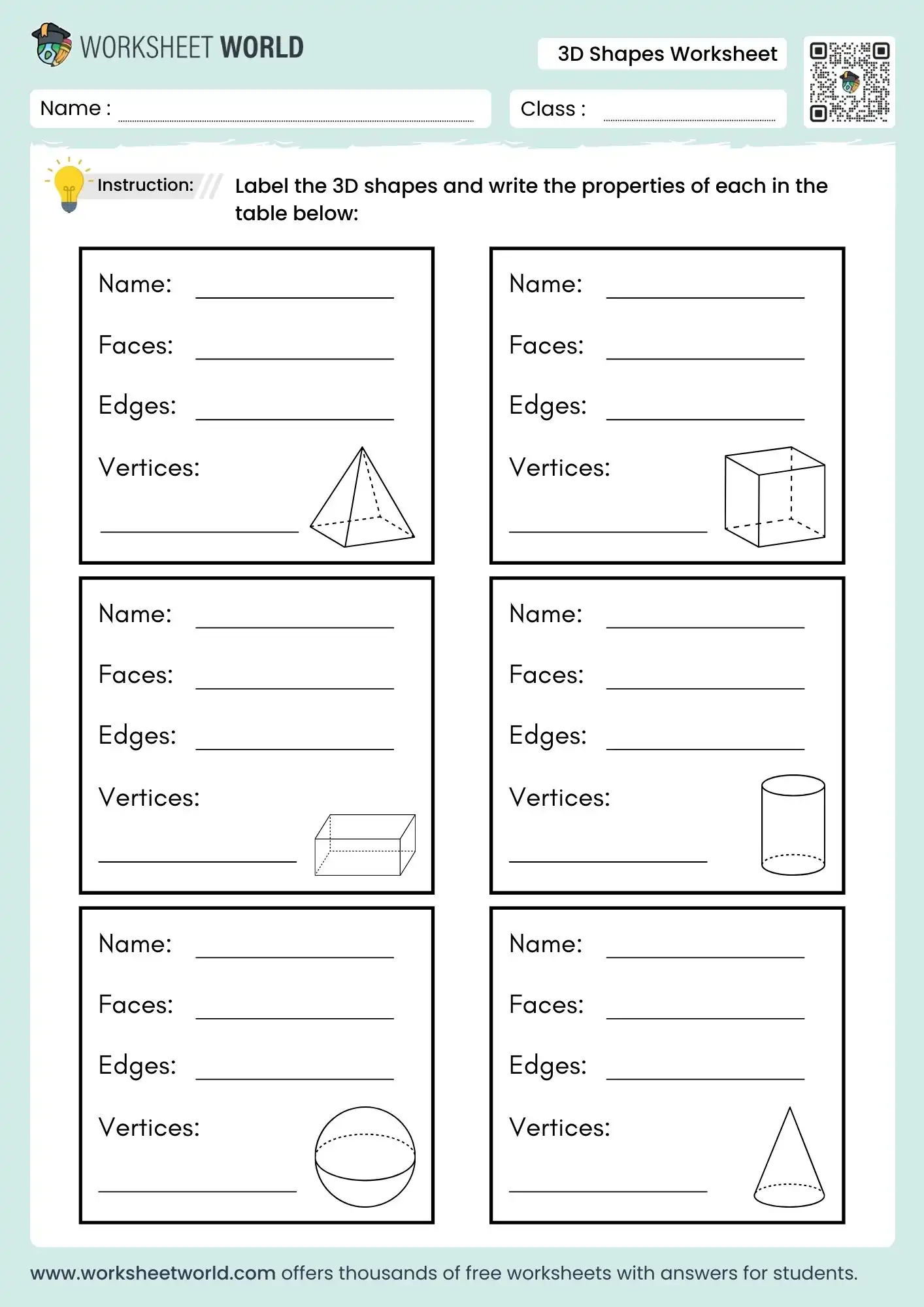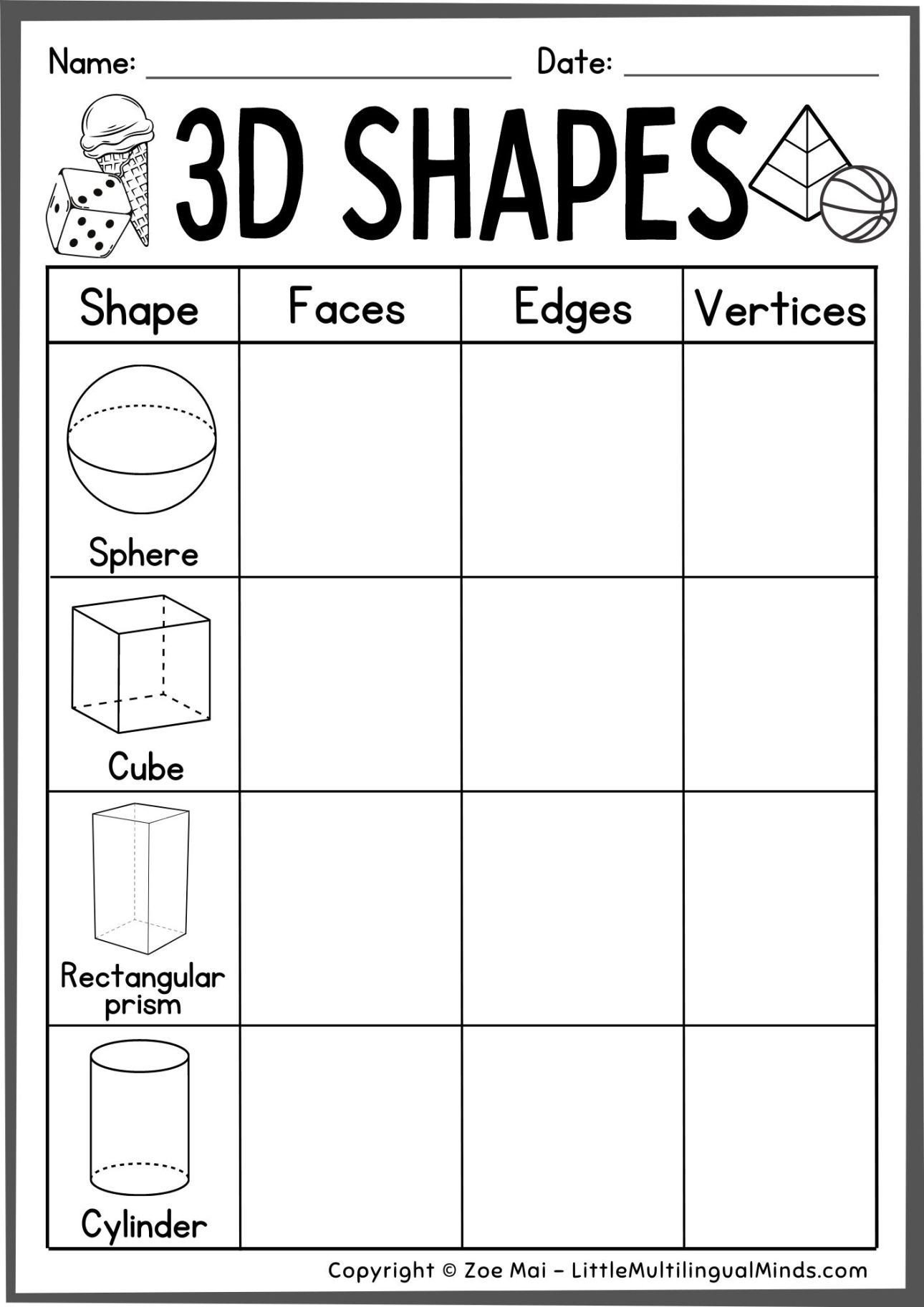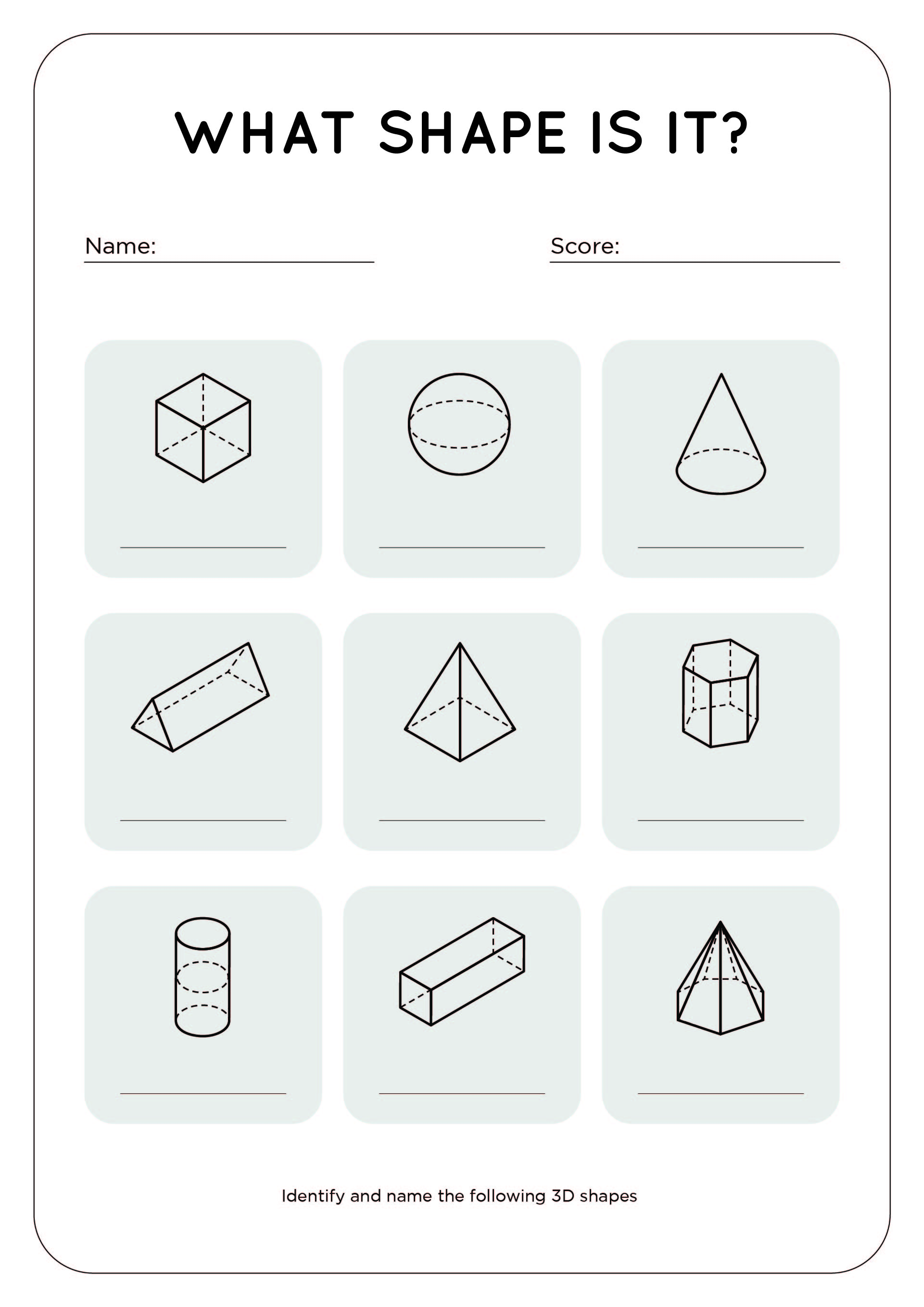
3 D Shapes Worksheets serve as a dynamic bridge between abstract geometry concepts and tangible learning experiences for young minds. By engaging students in activities that involve manipulating, identifying, and constructing three‑dimensional forms, these worksheets foster critical thinking, spatial awareness, and a foundational understanding of STEM principles—all while keeping the learning process interactive and enjoyable.
Why 3 D Shapes Worksheets Are Essential for Early Learning

Develop Spatial Awareness
Spatial awareness is the ability to perceive relationships between objects in space. When children work with 3‑D shape worksheets, they practice visualizing how a cube, pyramid, or cylinder fits together with other shapes. This skill translates to real‑world tasks such as reading maps, understanding architectural plans, and even navigating daily environments. By consistently manipulating three‑dimensional figures, learners internalize concepts of depth, perspective, and volume, which are crucial for advanced mathematical reasoning.
Build Critical Thinking
Critical thinking in geometry is not just about memorizing shape names; it involves analyzing properties, comparing attributes, and solving problems based on logical reasoning. Worksheets that challenge students to identify common faces, count edges, or determine surface areas encourage analytical thinking. For example, a worksheet may ask, “Which of these shapes has the most faces?” Students must evaluate each figure, eliminate possibilities, and justify their choice, honing their deductive skills.
Prepare for STEM
Early exposure to 3‑D shapes lays the groundwork for science, technology, engineering, and mathematics. Understanding volume and surface area is essential for physics and engineering projects. Moreover, recognizing patterns and symmetry in shapes aids computer graphics and robotics. Integrating 3‑D shape worksheets into curricula ensures that students possess the conceptual tools needed for future STEM success.
Key Features to Look For in Quality 3 D Shapes Worksheets
Variety of Shapes
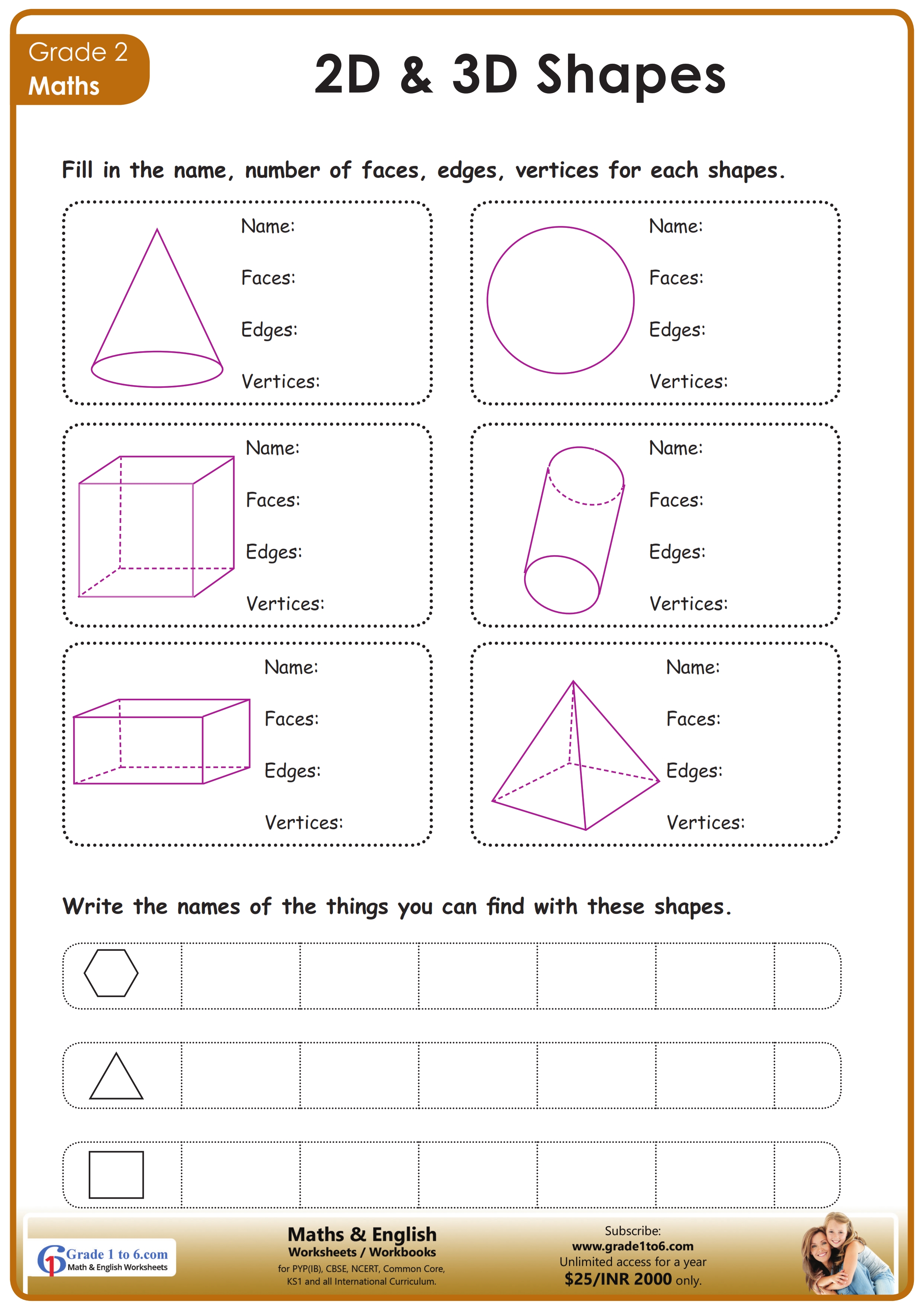
A comprehensive worksheet set includes basic solids—cubes, spheres, cylinders, pyramids—and less common forms such as cones and prisms. Diversity keeps learners engaged and exposes them to a broad spectrum of geometrical concepts. The presence of irregular shapes can further challenge advanced students, encouraging exploration beyond textbook definitions.
Clear Visuals
Visual clarity is paramount. High‑resolution images with contrasting colors help students distinguish edges, faces, and dimensions. Diagrams should be labeled subtly, using minimal text to avoid clutter. When illustrations are crisp, learners can focus on the shape itself rather than deciphering confusing graphics.
Interactive Elements
Worksheets that incorporate cut‑and‑paste, color‑by‑shape, or matching activities transform passive reading into active participation. Interactive sections foster engagement, reduce boredom, and reinforce memory retention. For instance, a worksheet might feature a blank template where students glue cut‑outs of shapes to form a 3‑D model.
Progressive Difficulty
Effective worksheets progress from simple identification tasks to complex problem‑solving. Beginning with “Name the shape” questions, the difficulty escalates to “Calculate the surface area of this shape” or “Design a 3‑D model with specified constraints.” Such progression ensures that each learner remains challenged without feeling overwhelmed.
How to Use 3 D Shapes Worksheets in the Classroom

Lesson Planning Tips
Integrate worksheets into a structured lesson that starts with a brief review of key properties, follows with guided worksheet activity, and concludes with a discussion or reflection. For example, begin with a short video demonstrating how a cube can be unfolded into a net. Then, provide a worksheet asking students to match the net to the cube, reinforcing the connection between 2‑D nets and 3‑D forms.
Group Activities
Collaborative projects enhance learning outcomes. Assign students to groups and provide each team with identical worksheet sets. Encourage them to discuss strategies, compare solutions, and present findings. Group work promotes communication, teamwork, and the ability to articulate geometric reasoning.
Assessment and Feedback
Use worksheets as low‑stakes assessments to gauge understanding. Collect completed sheets, review for accuracy, and offer individualized feedback. Highlight common misconceptions—such as confusing a sphere with a cylinder—and provide targeted explanations. Immediate corrective feedback solidifies learning and reduces the propagation of errors.
Creative Ways to Extend 3 D Shape Learning Beyond the Worksheet

Hands‑On Modeling with Everyday Materials
Students can use clay, playdough, or recycled cardboard to construct physical replicas of shapes from worksheets. This tactile approach reinforces spatial concepts and allows learners to experiment with modifications. For example, after identifying a pyramid on a worksheet, students might build a pyramid using straws and paper, then calculate its volume using simple arithmetic.
Digital Tools and Apps
Interactive software enables dynamic manipulation of 3‑D shapes—rotating, scaling, and slicing them in real time. Programs like GeoGebra or TinkerCAD provide free resources where students can recreate worksheet challenges digitally. The visual feedback from rotating models deepens comprehension and offers an engaging alternative to static images.
Art and Design Projects
Merge geometry with creativity by challenging students to design a 3‑D sculpture based on a shape theme from a worksheet. Whether drawing a tessellated pattern of cubes or crafting a collage of spheres, the project encourages application of shape properties in artistic contexts. This cross‑disciplinary approach nurtures both analytical and creative thinking.
Sample 3 D Shape Worksheet Ideas

Shape Sorting Game
Provide students with a set of cut‑outs representing different 3‑D shapes. Ask them to sort the shapes by volume, surface area, or number of faces. This activity promotes comparative reasoning and encourages the use of measurement tools such as rulers or protractors.
Color and Shape Matching
Create worksheets where each shape is assigned a color, and students must match each shape to a corresponding color key. This simple matching task can be extended by adding a rule—for instance, “Color all shapes with an odd number of faces green.” Such additions introduce rule‑based problem solving.
Build a 3D Model Challenge
Challenge students to design a simple 3‑D model—like a miniature house—using only the shapes listed in the worksheet. Provide guidelines for dimensions and encourage them to write a brief explanation of how each shape contributes to the overall structure. This activity integrates design, mathematics, and written communication.
Common Mistakes and How to Avoid Them

Overloading Information
Too many concepts on a single worksheet can overwhelm learners. Keep instructions concise and focus on one skill at a time. If a worksheet covers both identification and calculation, separate the activities into distinct pages or sections.
Ignoring Student Interest
Students are more likely to engage with shapes that connect to their interests—sports, animals, or everyday objects. Incorporate familiar examples in worksheets, such as “Identify the shape of a basketball” or “What shape is a pizza box?” Personal relevance boosts motivation.
Skipping Review
Without a review session, misconceptions can persist. After worksheet completion, revisit common errors as a class. Use quick quizzes or peer‑review exercises to reinforce correct concepts.
Conclusion

Incorporating 3 D Shapes Worksheets into early education offers a multifaceted approach to learning geometry. By emphasizing spatial reasoning, critical thinking, and STEM readiness, these worksheets lay a solid foundation for future academic pursuits. Selecting worksheets with diverse shapes, clear visuals, interactive elements, and progressive difficulty ensures a well‑structured learning experience. When teachers combine worksheets with hands‑on modeling, digital tools, and art projects, students gain a holistic understanding of three‑dimensional geometry. By anticipating common pitfalls and fostering a supportive classroom environment, educators can unlock the full potential of these engaging resources, preparing learners for a world that increasingly relies on spatial intelligence and creative problem‑solving.