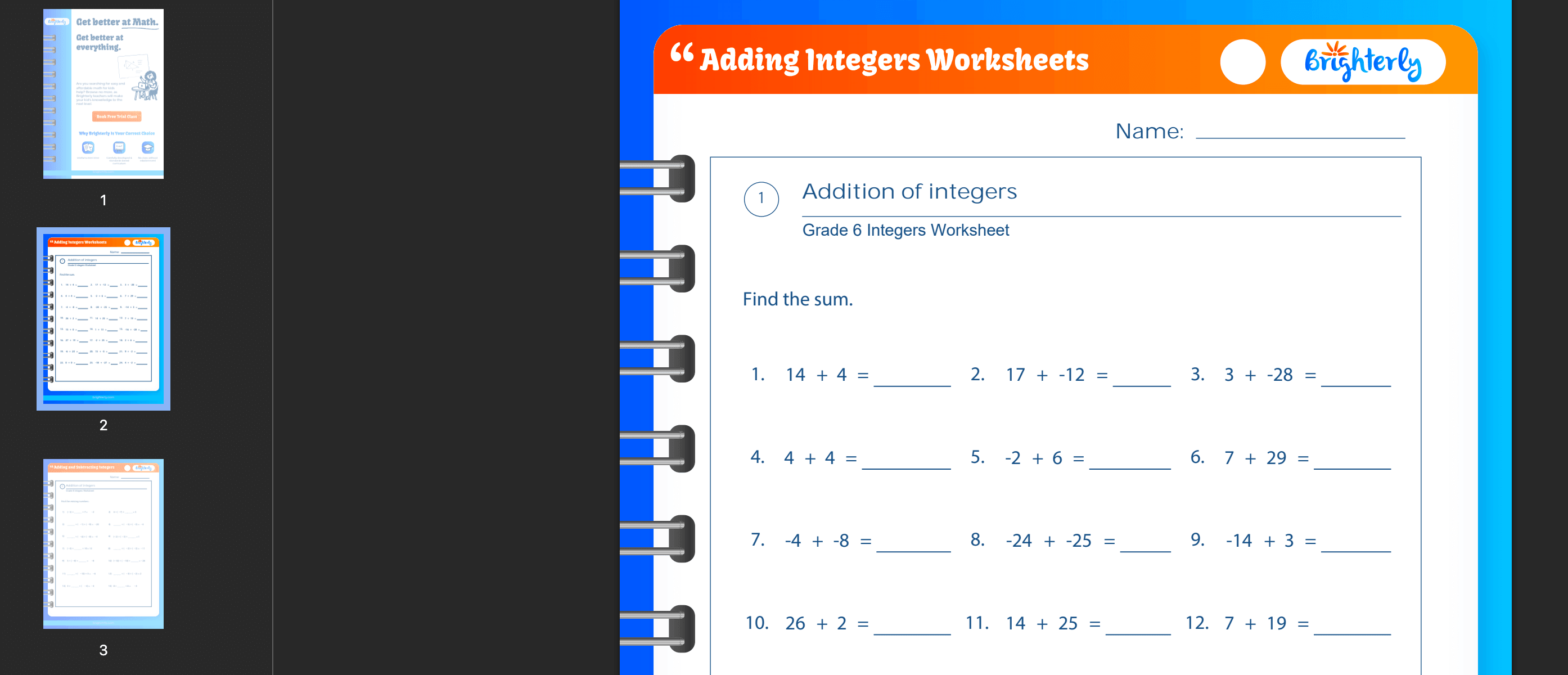
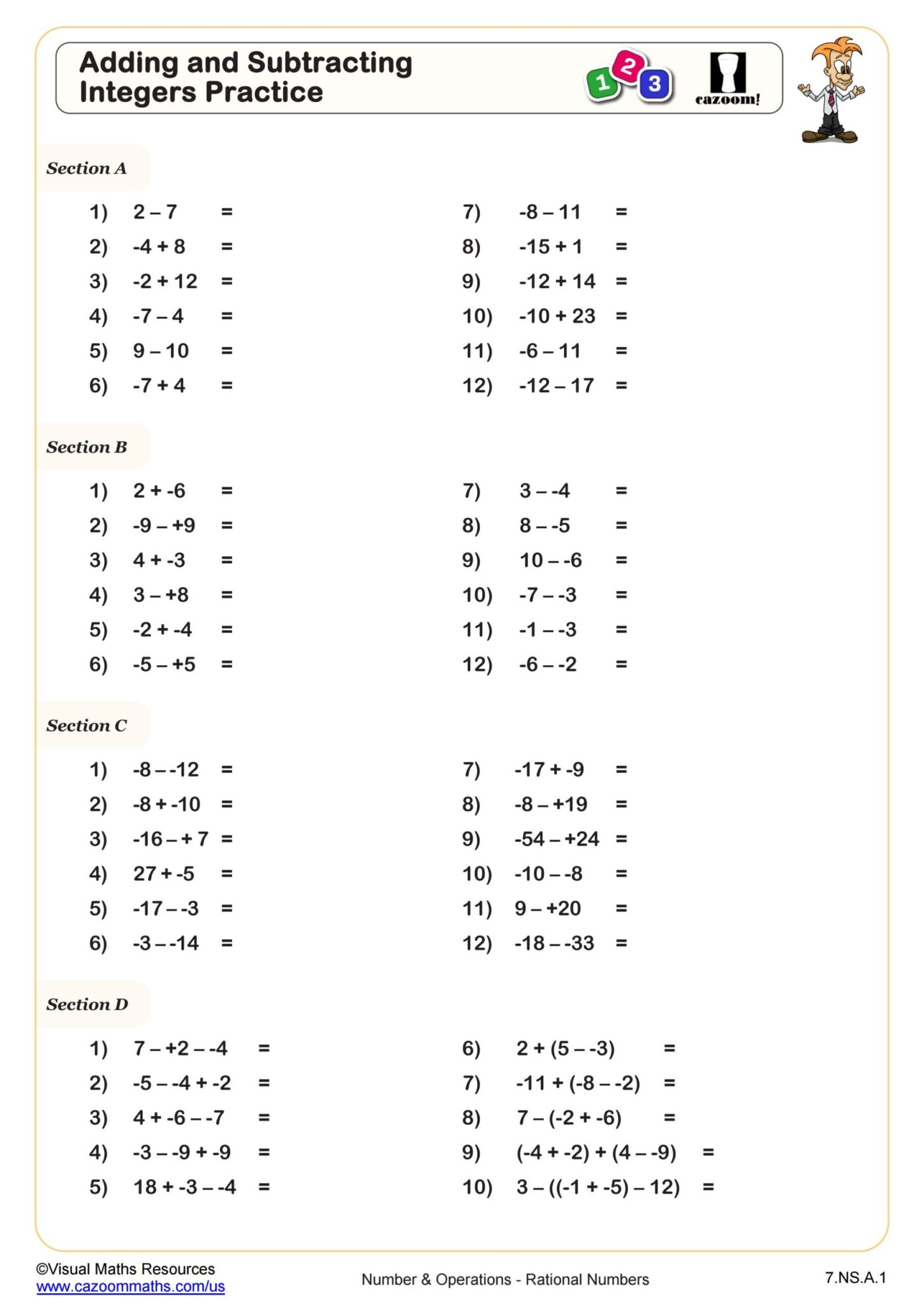
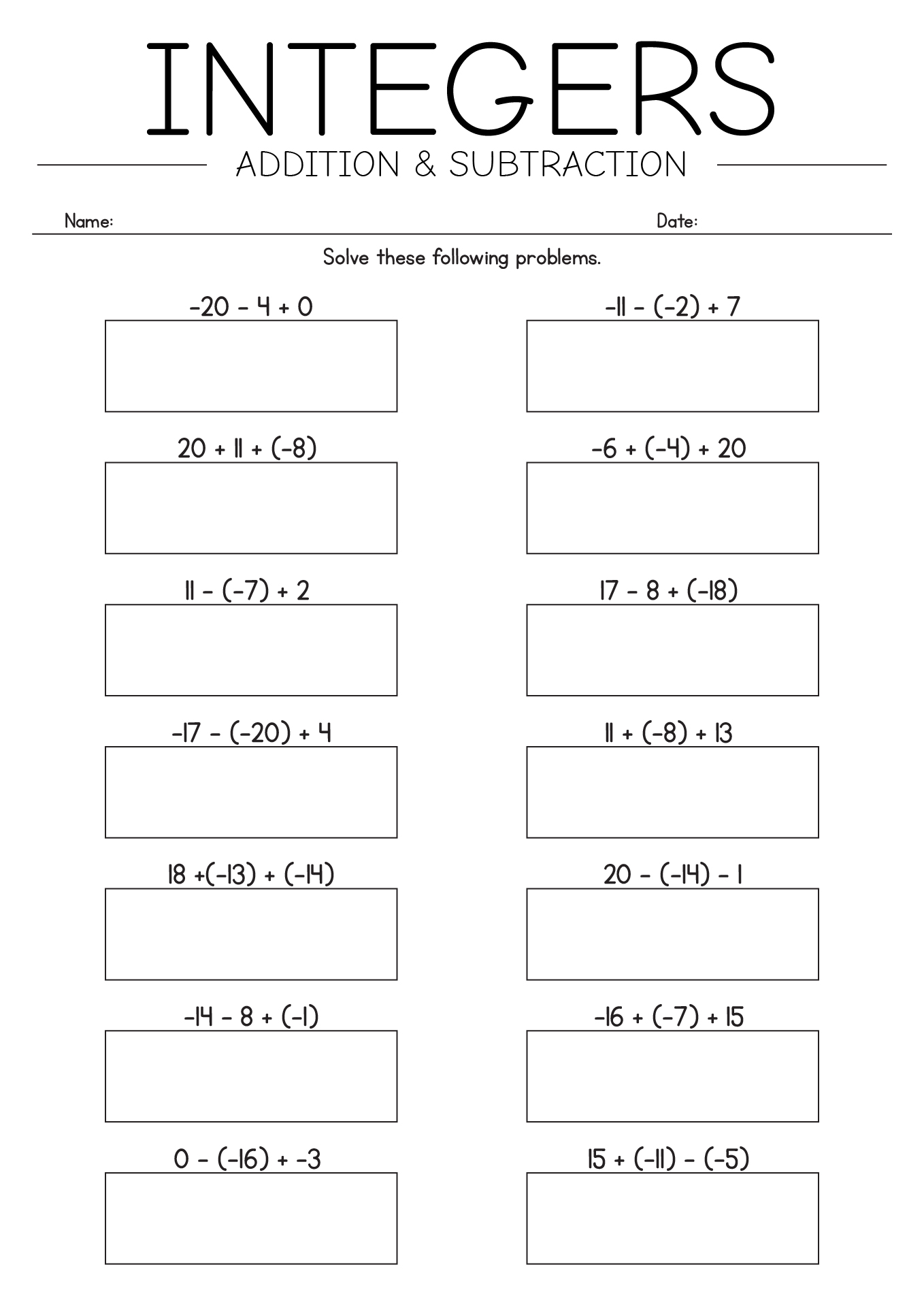
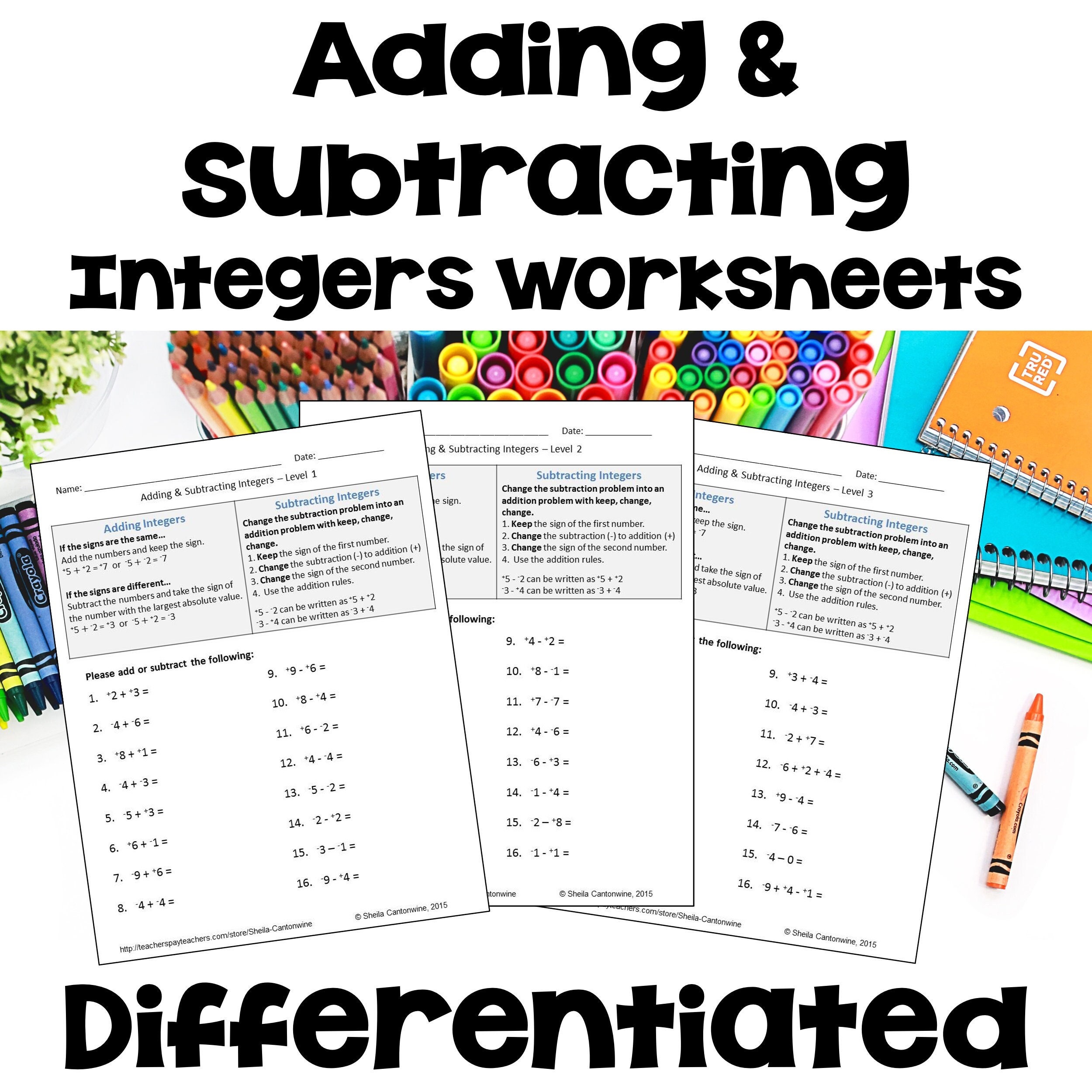
Adding And Subtracting Integers Worksheets are the cornerstone of building strong numerical confidence in students who thrive in disciplined, detail-oriented learning environments. By offering clear visual patterns and progressive challenges, these worksheets guide learners from basic sign rules to complex problem-solving in a way that mirrors the structured thinking celebrated across many Asian classrooms.
The Importance of Integer Mastery in Asian Learning Culture
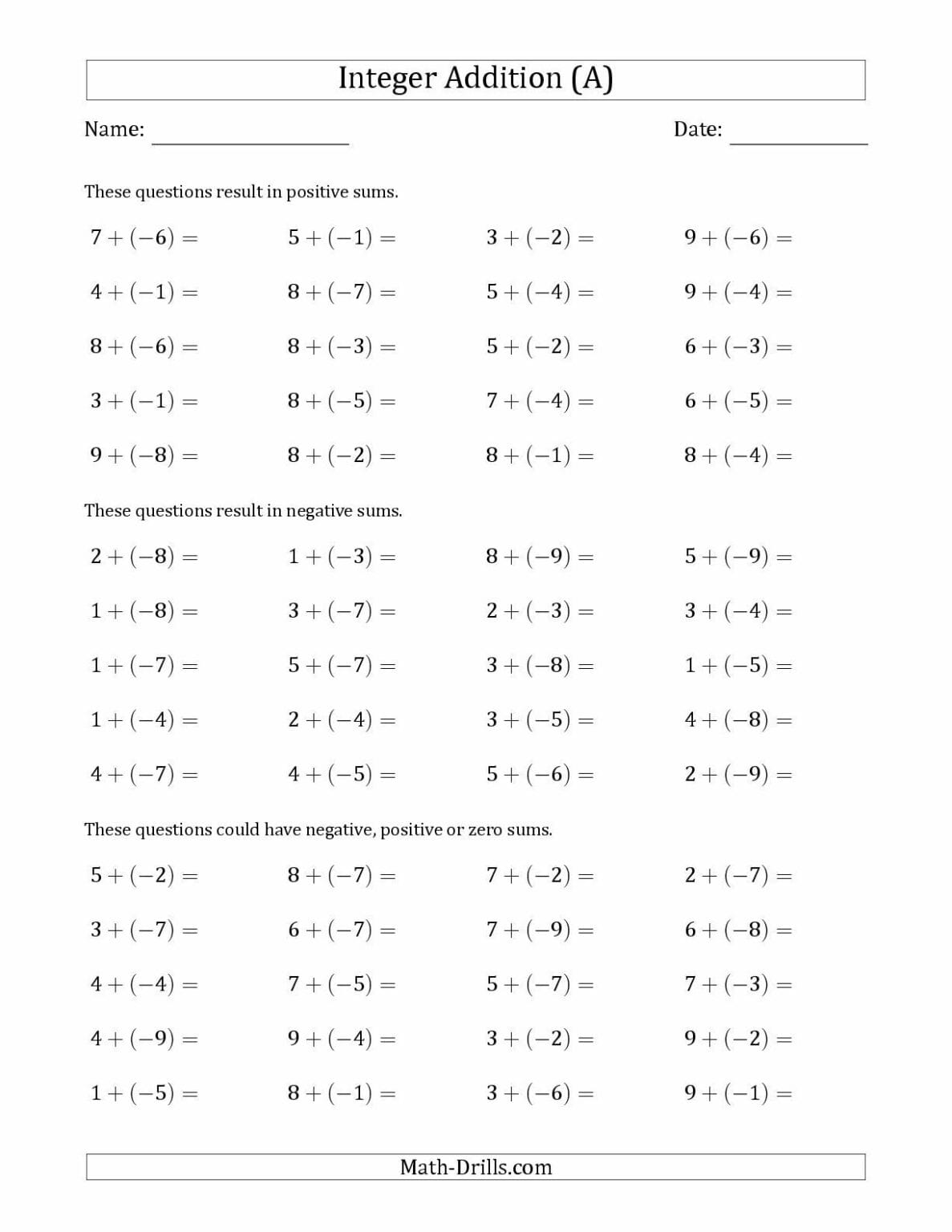
In many Asian educational traditions, precision and logical consistency are highly prized. Mastery of integers—understanding positive and negative numbers—serves as the foundation for advanced topics such as algebra, calculus, and statistics. When students can comfortably navigate the addition and subtraction of integers, they gain a mental toolkit that supports critical thinking and problem-solving in mathematics, science, and even programming.
Moreover, the practice of “learning through repetition” aligns perfectly with integer worksheets. Repeated exposure to similar patterns helps students internalize rules, reducing errors in more complex equations and preparing them for standardized tests where integer calculations often appear.
How Adding And Subtracting Integers Worksheets Support Classroom Success

These worksheets offer several pedagogical benefits:
- Immediate Feedback: Correct or incorrect answers can be tallied quickly, allowing teachers to identify misconceptions in real time.
- Layered Difficulty: Worksheets can range from simple number line problems to multi-step word problems, ensuring that every student can find an appropriate challenge.
- Consistency: Structured questions reinforce the rule that “a plus a negative equals a minus,” which can be difficult to grasp through abstract explanation alone.
- Skill Transfer: Practice with integers builds a mental model that applies to fractions, decimals, and algebraic expressions.
Common Challenges Students Face with Integers

Despite their ubiquity in curricula, integers can be a stumbling block for many students. Common difficulties include:
- Confusing Sign Operations: Students often mistake “negative plus negative” for “negative minus negative.”
- Visualizing Number Lines: Without a clear mental map, learners may struggle to see why adding a negative number is equivalent to subtraction.
- Translating Words to Numbers: Word problems that involve temperature, altitude, or financial loss require students to interpret context before performing calculations.
- Overgeneralization: Applying addition rules to subtraction scenarios can lead to systematic errors.
Choosing the Right Worksheet Resources

When selecting worksheets, consider the following criteria:
Alignment with Learning Objectives
Ensure the content matches the specific skills you want to reinforce—whether it’s simple addition, mixed operations, or real-life application problems.
Progressive Difficulty Levels
A set that starts with basic sign recognition and advances to multi-digit operations will keep learners engaged and gradually build confidence.
Visual Clarity and Cultural Relevance
Worksheets that use familiar contexts—such as weather changes, stock market movements, or sports scores—can make abstract concepts more relatable for students accustomed to narrative learning.
Format Flexibility
Print-friendly and digital versions allow teachers to adapt to various classroom settings, from traditional pencil-and-paper labs to blended learning environments.
Step-by-Step Guide to Using Worksheets Effectively

Pre-Assessment
Begin with a quick diagnostic test that includes both straightforward and trick questions. This establishes a baseline, revealing which signs and rules students understand well and which require further attention.
Guided Practice
In small groups, walk through a few worksheet problems together. Emphasize the number line method, showing how moving left or right corresponds to negative or positive operations. Encourage students to verbalize each step, fostering verbal reasoning alongside numerical accuracy.
Independent Work
Distribute worksheets that gradually increase in complexity. Monitor progress through formative assessment, providing immediate feedback and corrective prompts when errors surface.
Review and Feedback
After completion, review common mistakes as a class. Use a “problem of the day” approach where a representative student solves a challenging question aloud, while classmates offer alternative strategies.
Creative Worksheet Ideas for Real-World Contexts
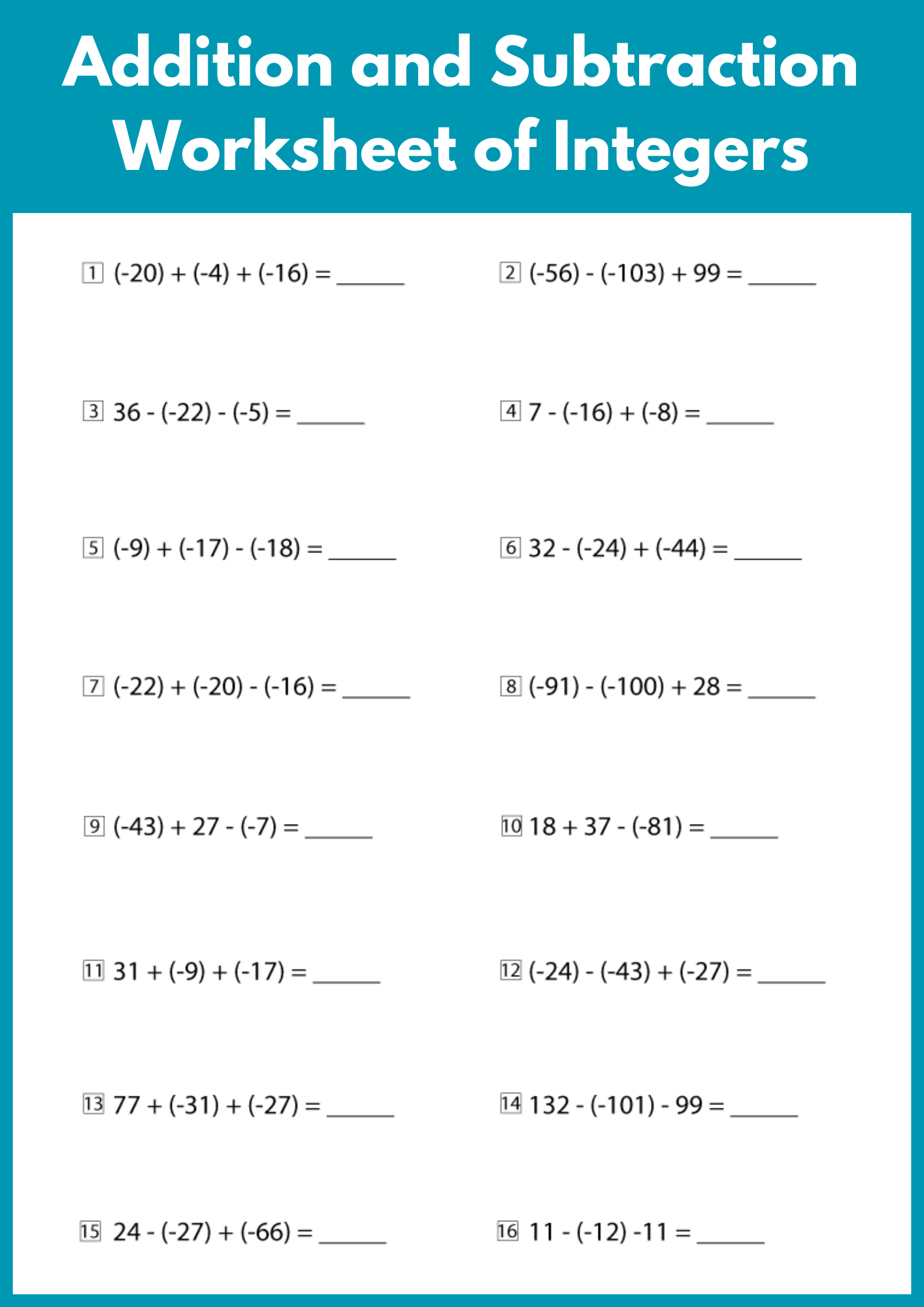
Real-world scenarios can transform abstract number manipulation into tangible learning moments:
- Weather Forecasting: Calculate temperature changes over several days using positive and negative values.
- Finance and Budgeting: Work through simple profit and loss statements where gains are positive and losses are negative.
- Altitude Tracking: Determine net elevation gain or loss when hiking across varying terrain.
- Sports Analytics: Analyze a player’s goal differences over a season, noting both positive contributions and deficits.
- Inventory Management: Compute changes in stock levels where restocks are positive and sales or losses are negative.
Technology Integration: Digital Worksheets and Apps

Digital worksheets provide interactive features such as drag-and-drop operations, instant grading, and adaptive difficulty. Popular platforms offer:
- Dynamic Number Lines: Students can slide a marker to visualize addition and subtraction in real time.
- Gamified Challenges: Points and badges reward accuracy, encouraging friendly competition.
- Customizable Problem Sets: Teachers can generate random integers or focus on specific number ranges to target individual learning gaps.
- Data Analytics: Instant dashboards reveal student performance trends, allowing for personalized interventions.
When integrating technology, maintain a balance. Pair digital practice with traditional worksheets to reinforce manual calculation skills and avoid overreliance on visual cues.
Tips for Parents and Teachers to Reinforce Learning
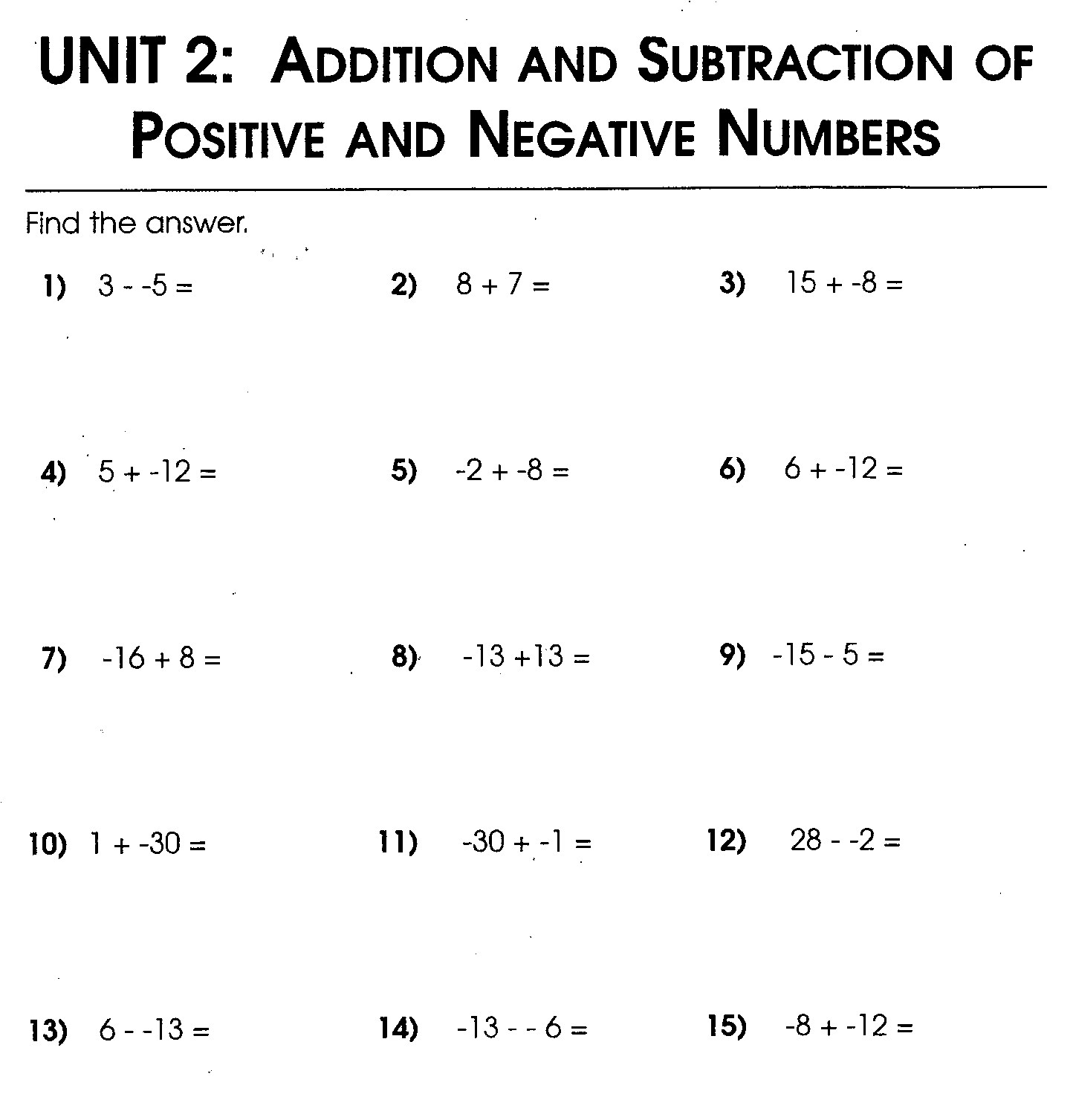
1. Encourage Daily Mini-Practices: Short, focused sessions of 5–10 minutes on integer problems can keep concepts fresh.
2. Use Everyday Situations: Ask children to calculate temperature differences between morning and evening or the net balance of a simple household budget.
3. Model Problem Solving: Walk through a worksheet problem aloud, explaining each rule and choice.
4. Celebrate Mistakes as Learning Opportunities: Discuss common errors and how to correct them, reinforcing a growth mindset.
5. Integrate Cross-Curricular Links: Connect integer operations to science experiments (e.g., measuring temperature changes) or history lessons (e.g., analyzing population changes).
Frequently Asked Questions

What is the best age for students to start learning integers?
Students as young as 5 or 6 can begin exploring basic sign concepts, especially if they are familiar with number lines and simple addition.
How can I prevent my child from memorizing patterns instead of understanding rules?
Incorporate varied contexts and require explanations for each answer. Encourage them to articulate why a negative number was added or subtracted rather than merely delivering the result.
Can integer worksheets be used for advanced math courses?
Yes, once foundational skills are solid, worksheets can evolve into problems involving algebraic expressions, linear equations, and even calculus concepts where integer coefficients are common.
What if my child struggles with visualizing number lines?
Use physical number line stickers or interactive digital tools that allow moving a marker. Repeated physical interaction can strengthen the mental image.
By integrating thoughtfully designed Adding And Subtracting Integers Worksheets into both classroom and home learning environments, educators and parents can cultivate a deep, intuitive grasp of number signs. This foundation not only boosts performance in mathematics but also instills analytical habits that span across disciplines—an essential skill set for success in today’s global and technology-driven world.