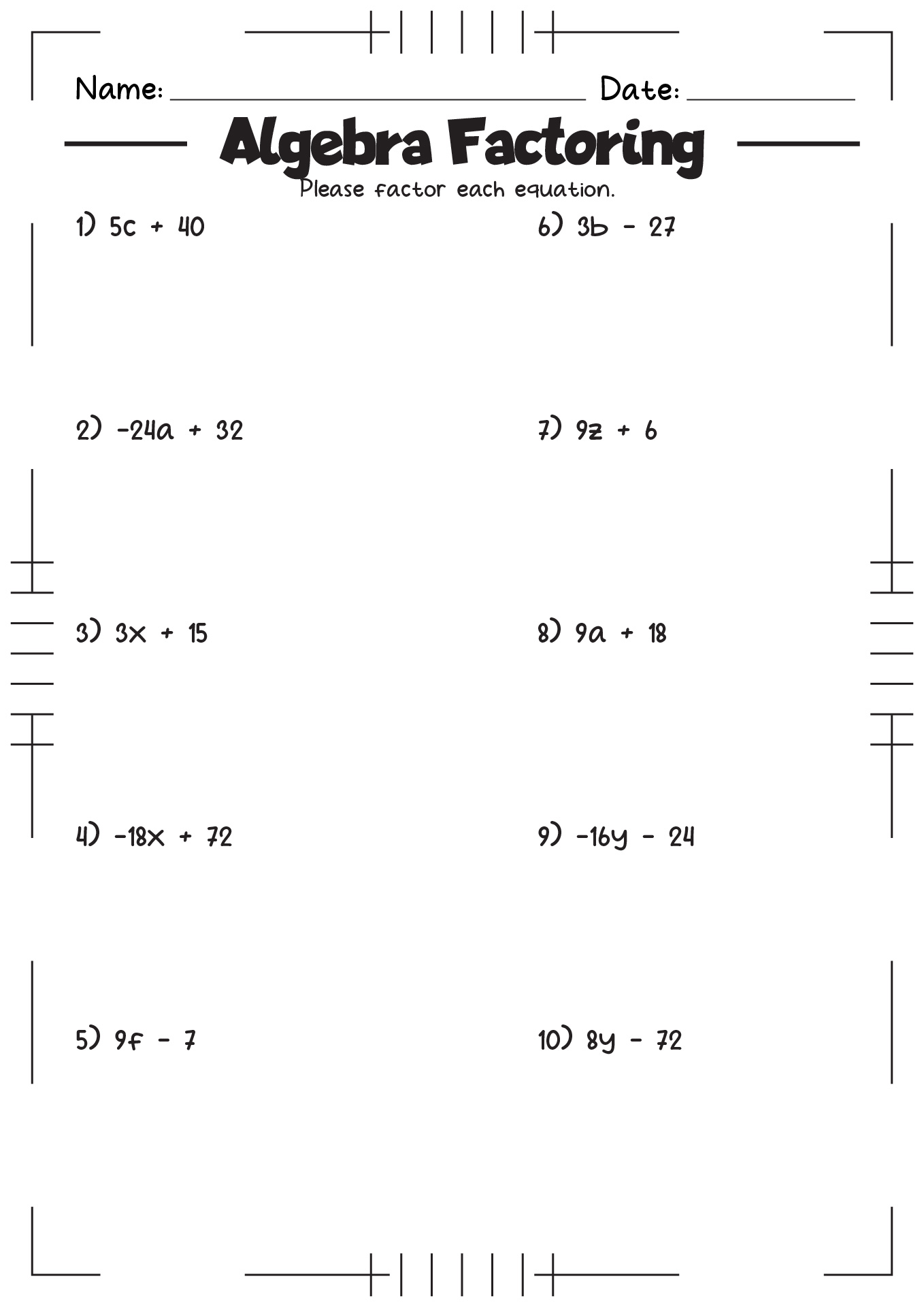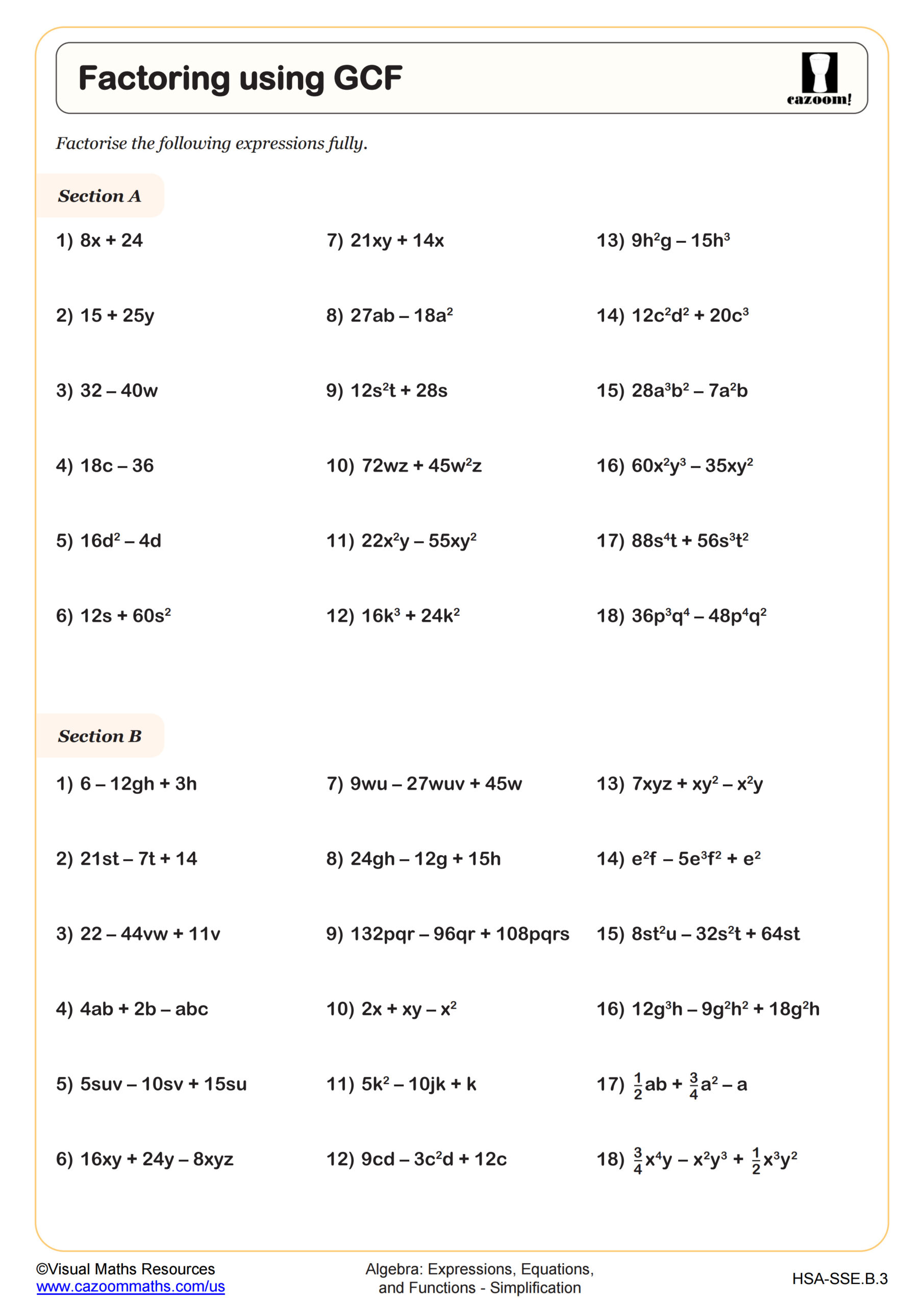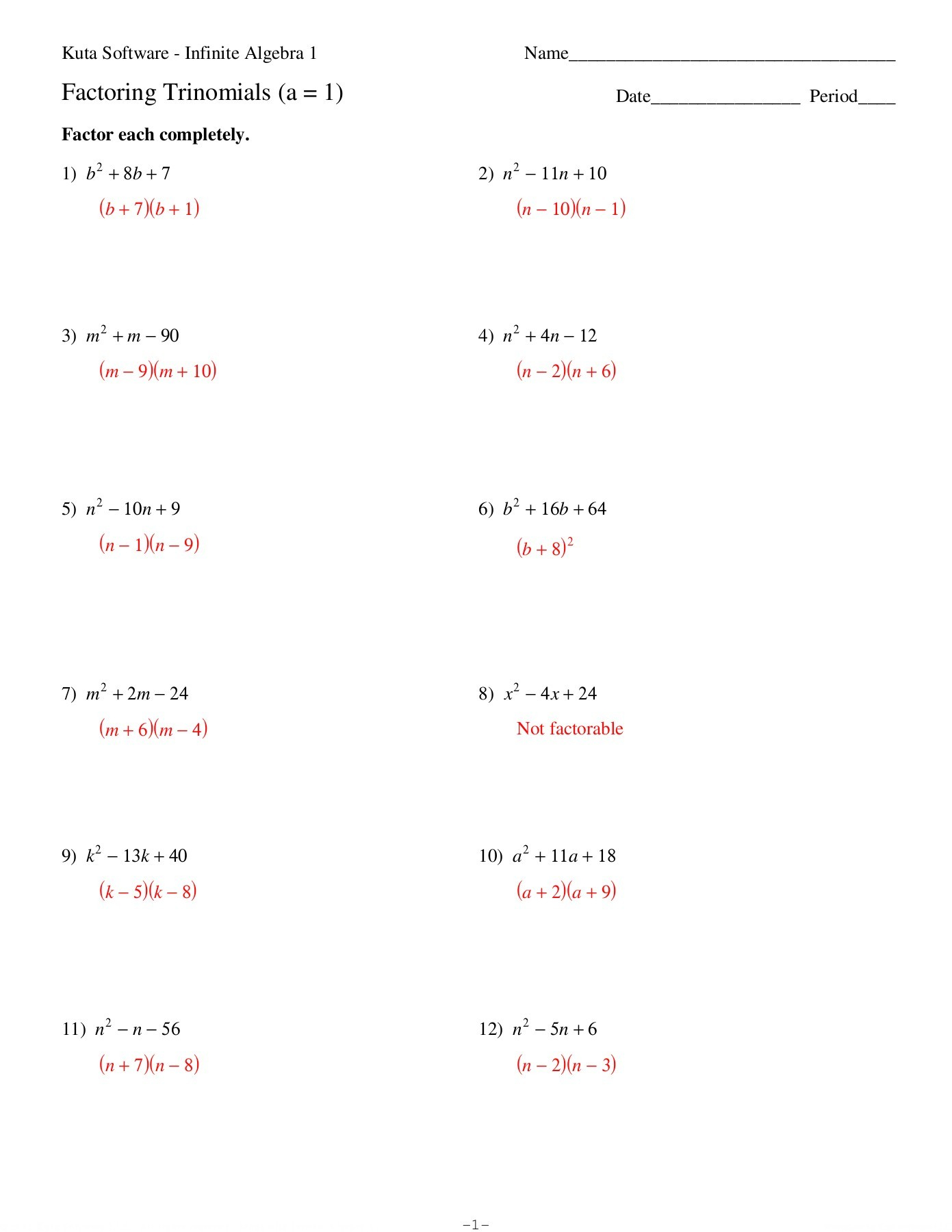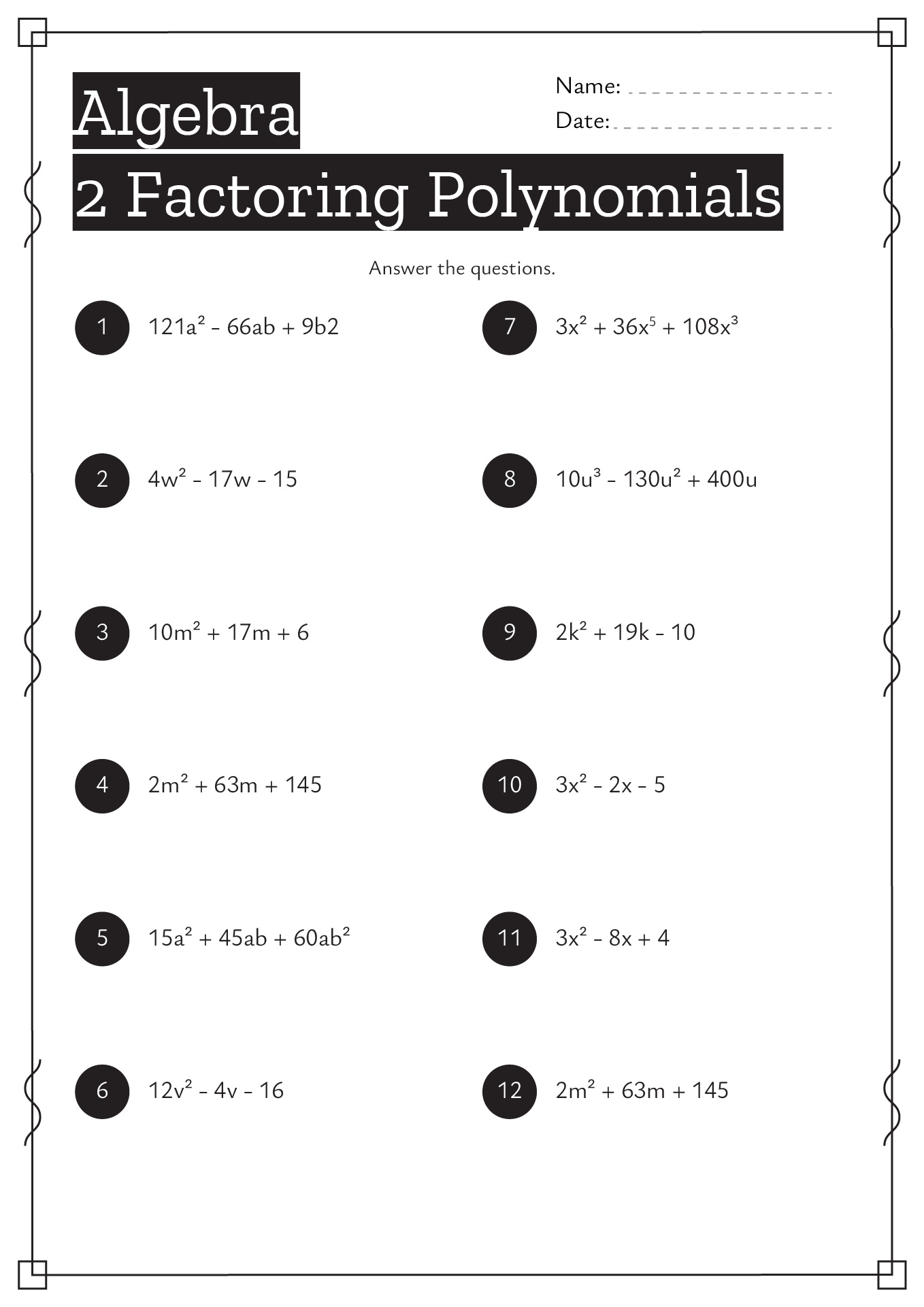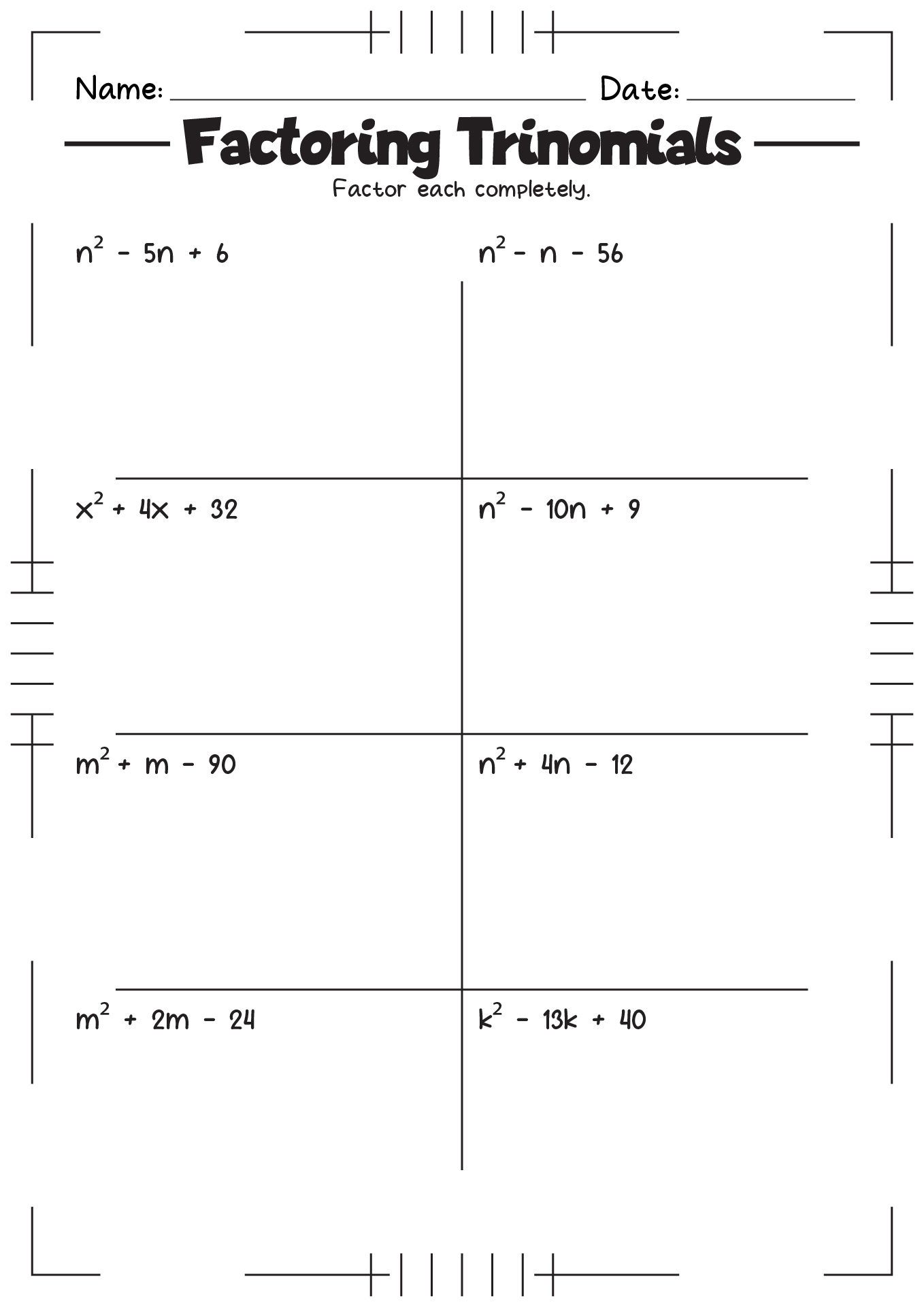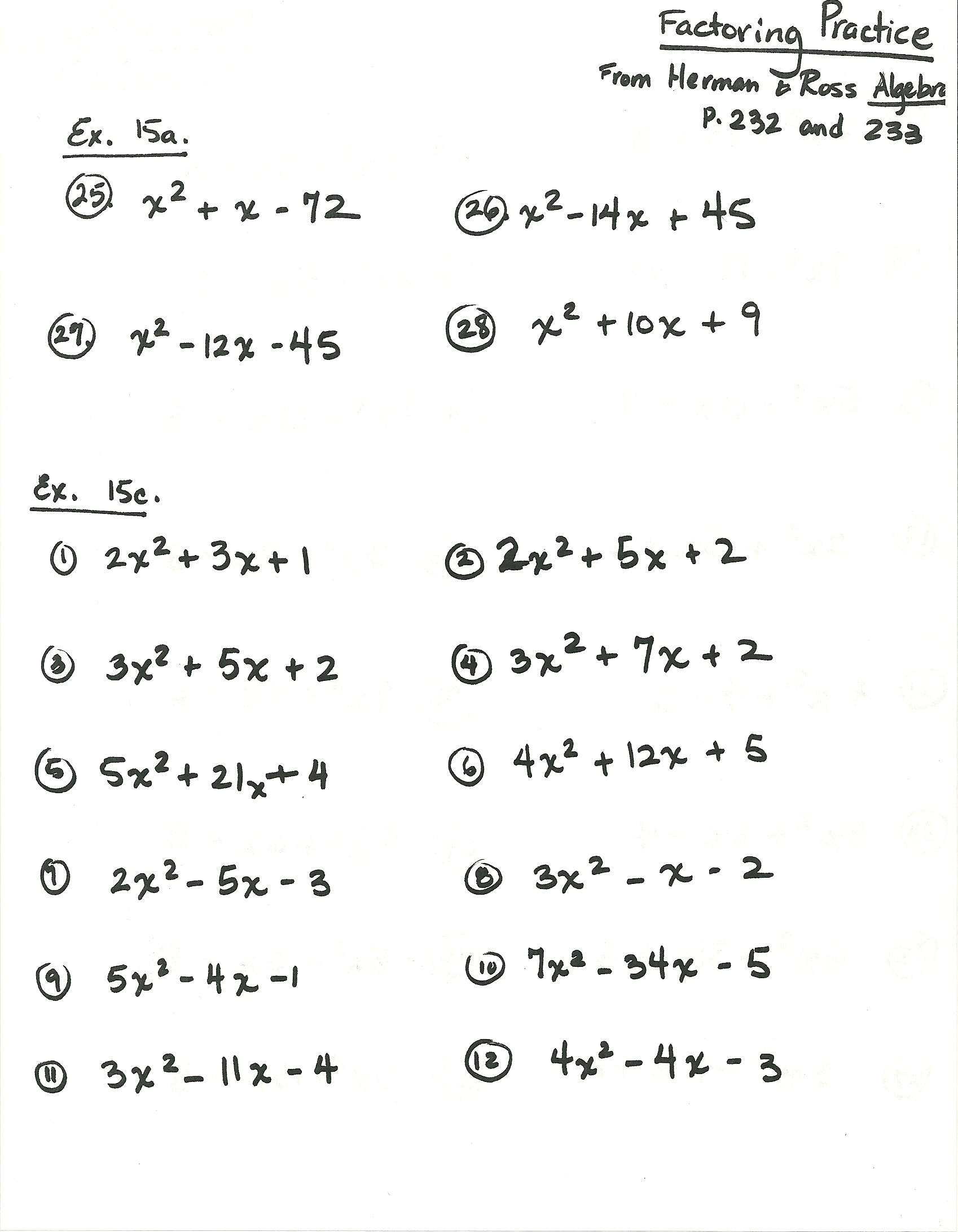
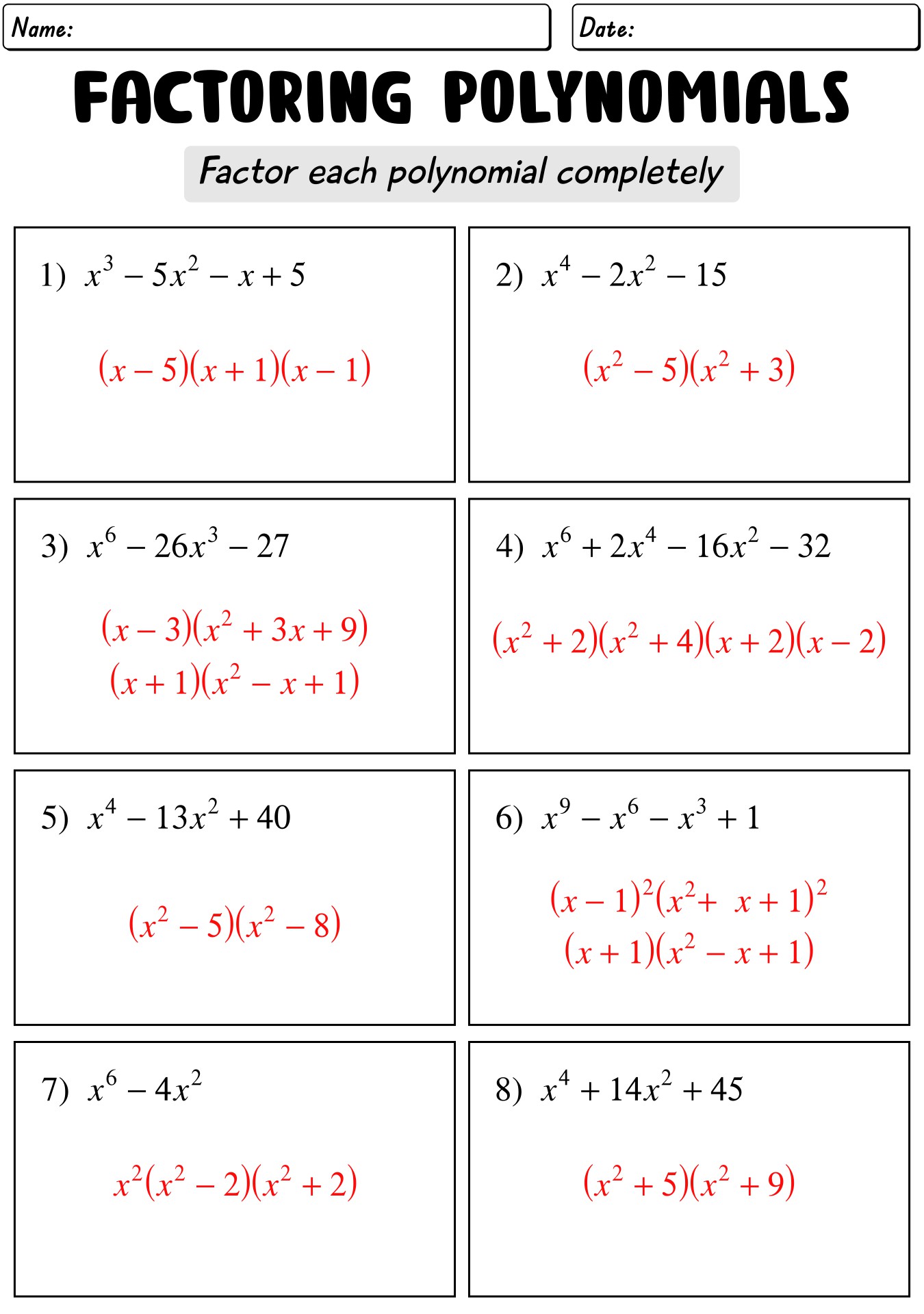
Algebra 2 Factoring Worksheet resources are the secret sauce that turns abstract polynomial puzzles into clear, conquerable challenges, and they’re exactly what students need to build confidence and master one of the most essential skills in high school math.
Why Factoring Is a Cornerstone of Algebra 2
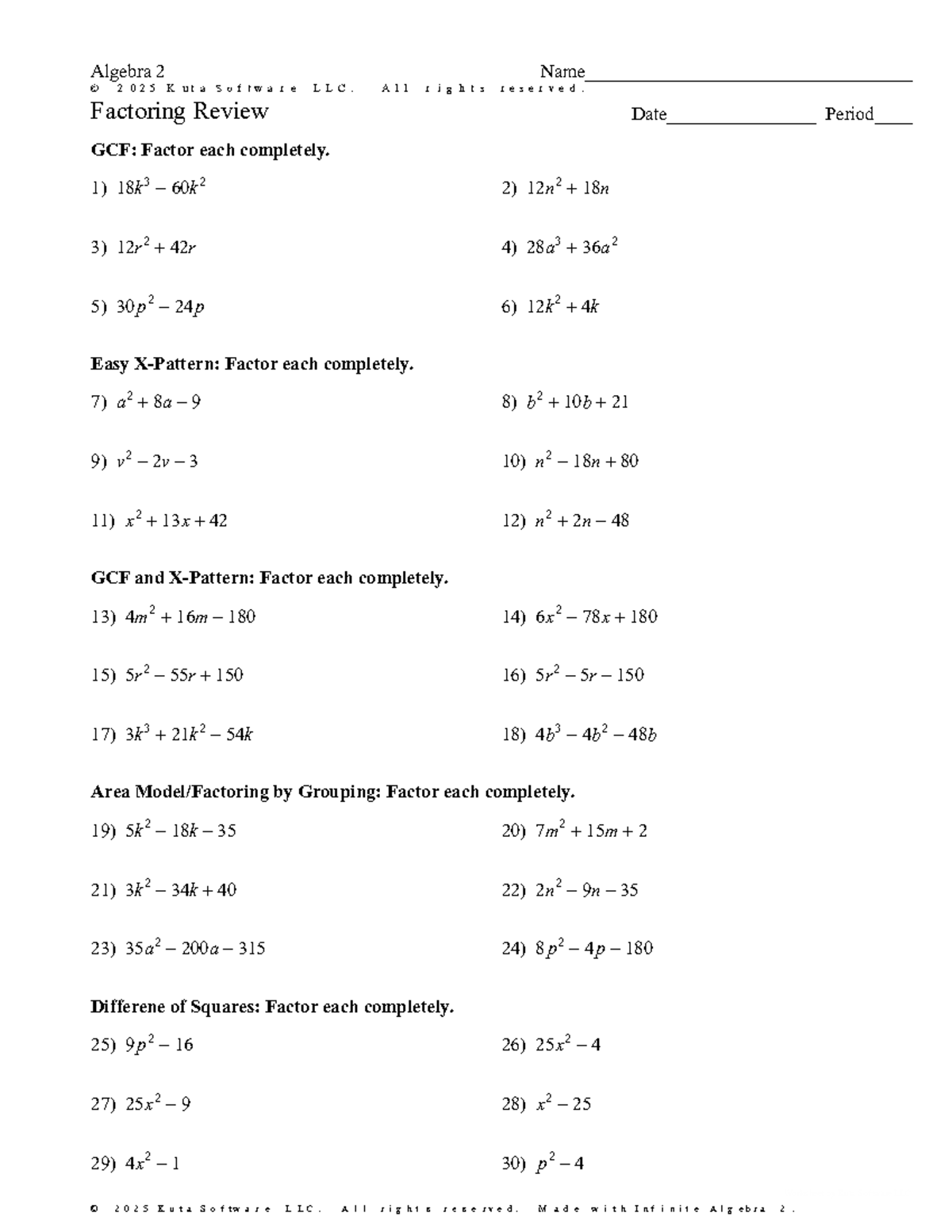
Factoring is more than just a procedural step; it’s a mathematical language that reveals hidden structure inside expressions. When students can rewrite a polynomial as a product of simpler factors, they unlock the ability to solve equations, simplify rational expressions, and analyze functions with ease. In Algebra 2, the depth of factoring expands dramatically, moving from basic greatest common factor (GCF) extraction to sophisticated techniques like grouping, sum and difference of cubes, and even factoring by substitution. Mastery of these methods lays the groundwork for calculus, linear algebra, and real‑world problem solving.
Core Factoring Techniques Covered in a Quality Worksheet
Greatest Common Factor (GCF)
The GCF is the first checkpoint on any factoring journey. A well‑designed worksheet starts with mixed‑type problems that require students to identify the largest common factor across terms, pull it out, and then continue factoring the remaining polynomial if possible. For example, factoring 6x³ – 9x² + 12x teaches students to recognize 3x as the GCF, resulting in 3x(2x² – 3x + 4). The worksheet should then ask whether the quadratic inside can be factored further, reinforcing the decision‑making process.
Difference of Squares
Expressions such as a² – b² factor into (a + b)(a – b). A comprehensive worksheet presents a variety of numeric and variable examples, like 25y² – 36 → (5y + 6)(5y – 6), encouraging students to spot the perfect squares and apply the pattern without hesitation.
Perfect Square Trinomials
Recognizing when a trinomial fits the form a² ± 2ab + b² is crucial for quick factoring. Worksheets often include both the “plus” and “minus” versions, such as 9x² + 24x + 16 → (3x + 4)² and 16m² – 24m + 9 → (4m – 3)². These problems reinforce the connection between squaring binomials and factoring back to them.
Factoring Trinomials (Ax² + Bx + C)
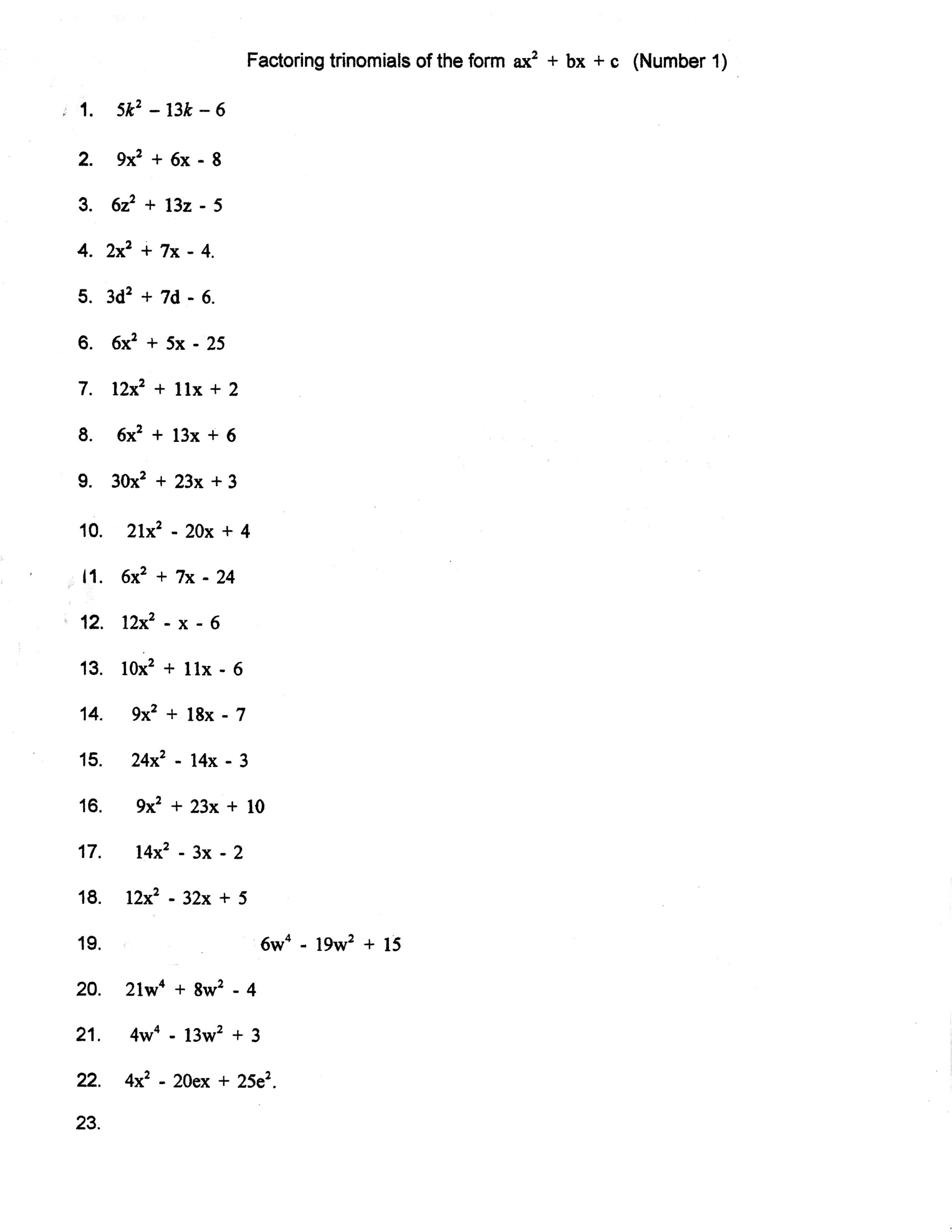
When the leading coefficient A is not 1, the worksheet should guide students through the “ac method” or “splitting the middle term.” For instance, factor 6x² + 11x + 3. Multiplying A and C yields 18; finding two numbers that multiply to 18 and add to 11 (2 and 9) leads to 6x² + 2x + 9x + 3, then grouping to obtain (2x + 1)(3x + 3) → (2x + 1)3(x + 1). Including multiple variations ensures students internalize the systematic approach.
Sum and Difference of Cubes
Cubic expressions factor via the identities:
- a³ + b³ = (a + b)(a² – ab + b²)
- a³ – b³ = (a – b)(a² + ab + b²)
Worksheets should pose challenges like 8x³ – 27 → (2x – 3)(4x² + 6x + 9), prompting learners to recognize perfect cube roots and apply the pattern.
Factoring by Grouping
When a polynomial has four terms, grouping can reveal a common binomial factor. A worksheet example: x³ + 3x² + 2x + 6. Group as (x³ + 3x²) + (2x + 6) → x²(x + 3) + 2(x + 3) → (x² + 2)(x + 3). Including both straightforward and trickier cases helps students become comfortable with rearranging terms to expose hidden factors.
Factoring Quadratics with Non‑Integer Roots
Some worksheets push learners to factor expressions that result in irrational or complex roots, such as x² – 2 → (x – √2)(x + √2). While not always required for standard Algebra 2 curricula, exposing students to these cases deepens conceptual understanding and prepares them for higher‑level math.
How to Use an Algebra 2 Factoring Worksheet Effectively
Set Clear Objectives Before Each Session
Start by stating what skill the worksheet targets—whether it’s GCF extraction, mastering the ac method, or practicing cubic identities. This focus helps students see the purpose behind each problem and prevents them from mindlessly completing questions.
Incorporate a Warm‑Up and a Cool‑Down
Begin with a brief 5‑minute mental drill of simple factorable expressions to activate prior knowledge. After the main worksheet, allocate time for reflection: ask students to write a one‑sentence summary of the strategy they used most often and why it worked for them.
Encourage Step‑by‑Step Notation
Students should write each transformation on a separate line, labeling steps like “Identify GCF,” “Rewrite,” “Apply Difference of Squares,” etc. This habit makes it easier to spot errors and provides a clear audit trail for teachers during grading.
Utilize Peer Review
Pair students and have them exchange completed worksheets. Each reviewer checks for correct factorization, proper notation, and logical flow. Peer feedback reinforces learning and builds a collaborative classroom culture.
Integrate Technology Wisely
While paper worksheets are valuable, pairing them with interactive tools (e.g., algebraic factoring apps) offers instant feedback. Encourage students to verify their answers with a calculator or algebra system after they’ve worked through the problem manually.
Real‑World Applications That Make Factoring Relevant

Factoring isn’t confined to textbook drills; it appears in physics, economics, and engineering. Below are three relatable scenarios you can embed in a worksheet to show practical value.
Projectile Motion
When calculating the height of a projectile, the equation often simplifies to a quadratic in time: h(t) = ‑4.9t² + 30t + 5. Factoring the quadratic can reveal the exact times when the projectile reaches a specific height, helping students connect algebra to real‑world motion.
Optimization in Business
A company might model profit as P(x) = ‑2x² + 40x – 150, where x is the number of units sold. Factoring the profit function assists in finding break‑even points and maximum profit intervals, demonstrating how algebra directly influences decision‑making.
Electrical Engineering
The characteristic equation of an RLC circuit can be a cubic expression such as L s³ + R s² + 1/C = 0. Factoring helps engineers determine resonance frequencies and stability conditions, illustrating the bridge between abstract factoring and tangible technology.
Common Pitfalls and How to Overcome Them
Skipping the GCF Check
Students often jump straight to advanced techniques and miss the simplest factor. Reinforce the habit of scanning for a GCF first by placing a “GCF reminder” box at the top of each worksheet page.
Misidentifying Perfect Squares or Cubes
Confusing 9 for a perfect square of 3 is easy, but mistaking 27 for a perfect square leads to errors. Include a quick reference chart of common perfect squares (1‑144) and cubes (1‑125) on the worksheet margin.
Sign Errors in Difference of Squares
When factoring a² – b², the signs of the binomials are crucial. Encourage students to write the final answer as (a + b)(a – b) and double‑check by expanding to confirm they return to the original expression.
Over‑Factoring or Under‑Factoring
Sometimes a quadratic can be factored further after extracting a GCF, while other times the remaining quadratic is prime. Provide a “factor‑check” question after each problem: “Can the result be factored again? Yes/No.” This prompts critical evaluation.
Tips for Teachers Designing Their Own Factoring Worksheets

- Balance difficulty: Mix easy, medium, and challenging problems to cater to diverse skill levels.
- Include real‑life word problems: Translate a scenario into a polynomial that must be factored to find the answer.
- Provide answer keys with step‑by‑step solutions: This aids both independent study and quick grading.
- Use clear, legible fonts and ample spacing: Students need room to write intermediate steps without crowding.
- Incorporate visual cues: Highlight the part of the expression where the GCF appears or use colored brackets for grouping tasks.
Frequently Asked Questions About Factoring Worksheets

How often should students practice factoring?
Consistency is key. A short, focused factoring drill three times a week—each session lasting 10‑15 minutes—helps cement the patterns without overwhelming learners.
Can factoring worksheets replace textbook exercises?
Worksheets should complement, not replace, textbook theory. Use them as application tools after the concept has been introduced and explained in class.
What’s the best way to assess student progress?
Combine worksheet scores with oral explanations. Ask students to pick a problem they solved and verbally walk through each step; this reveals depth of understanding beyond mere correctness.
Are there digital alternatives that are as effective?
Digital platforms offer instant feedback and adaptive difficulty, but the tactile experience of writing out each step on paper reinforces procedural memory. A hybrid approach—paper worksheets for practice, digital tools for quick checks—often yields the best results.
Conclusion

Integrating a well‑crafted Algebra 2 Factoring Worksheet into regular instruction transforms factoring from a rote task into an engaging, purposeful activity that builds analytical confidence. By covering the full spectrum of factoring techniques, providing clear step‑by‑step expectations, and connecting the skill to real‑world scenarios, teachers empower students to see the elegance of algebraic structure and its relevance beyond the classroom. Consistent practice, thoughtful feedback, and reflective discussion ensure that learners not only master the mechanics but also develop a deeper appreciation for the power of factoring—a skill that will serve them throughout their academic journey and into their future careers.