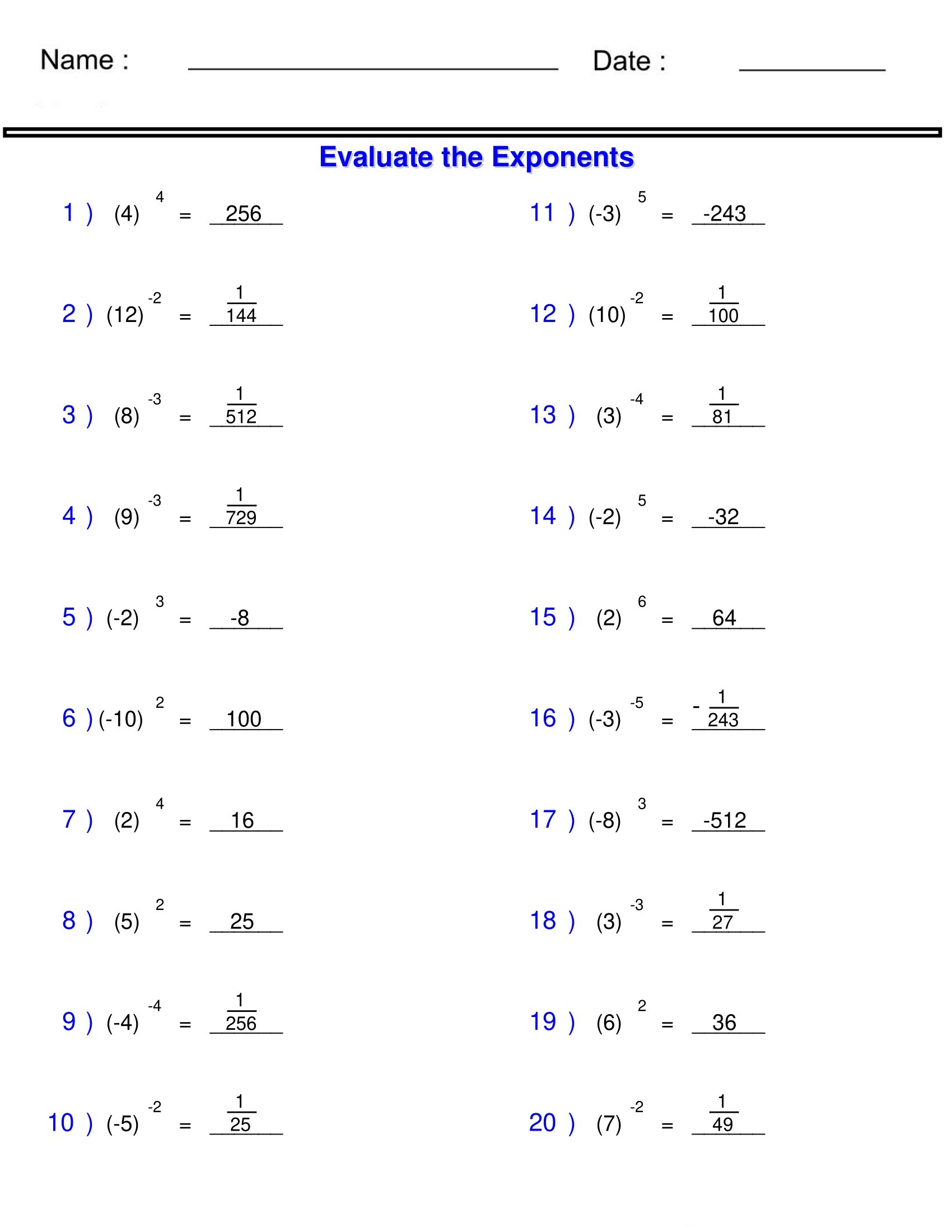
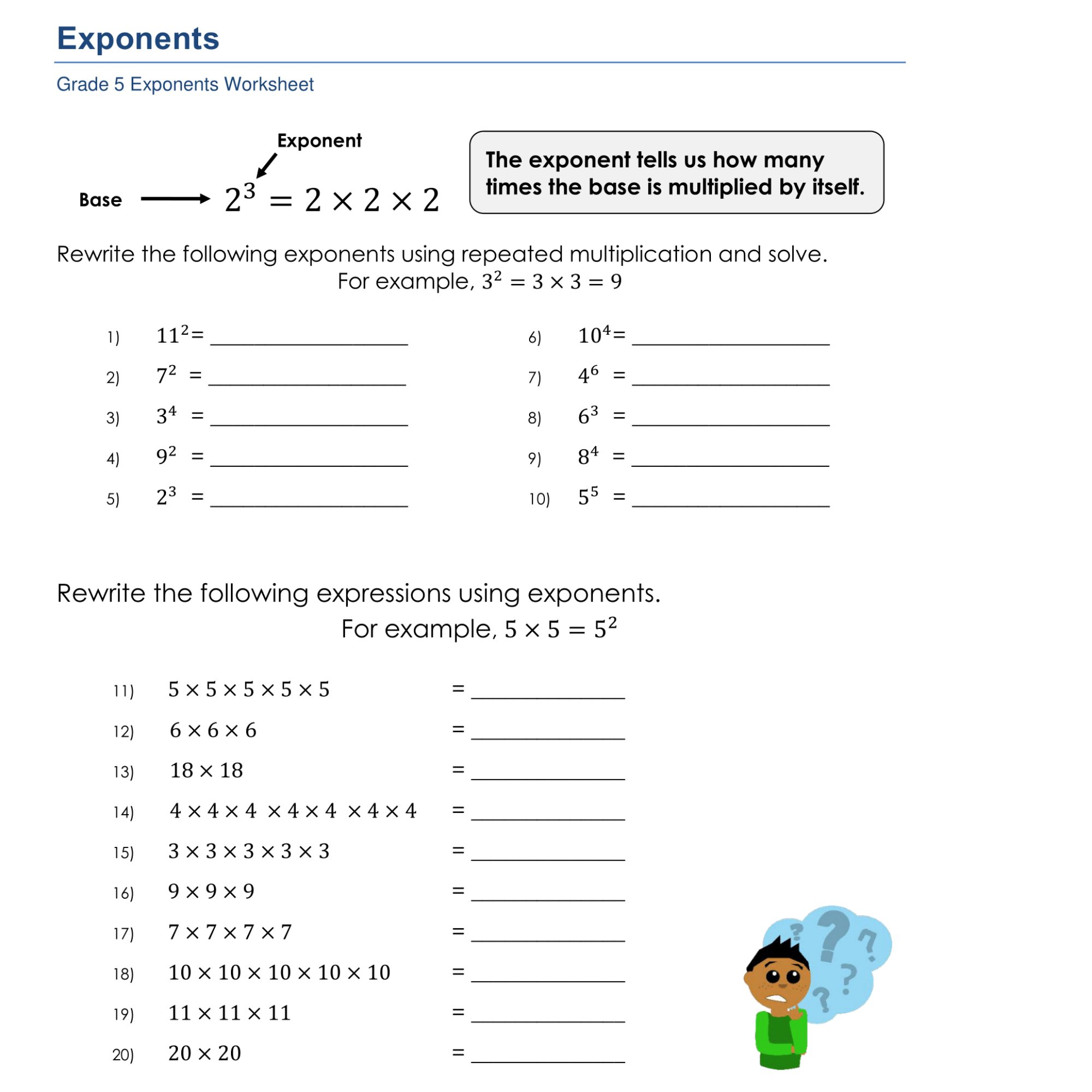
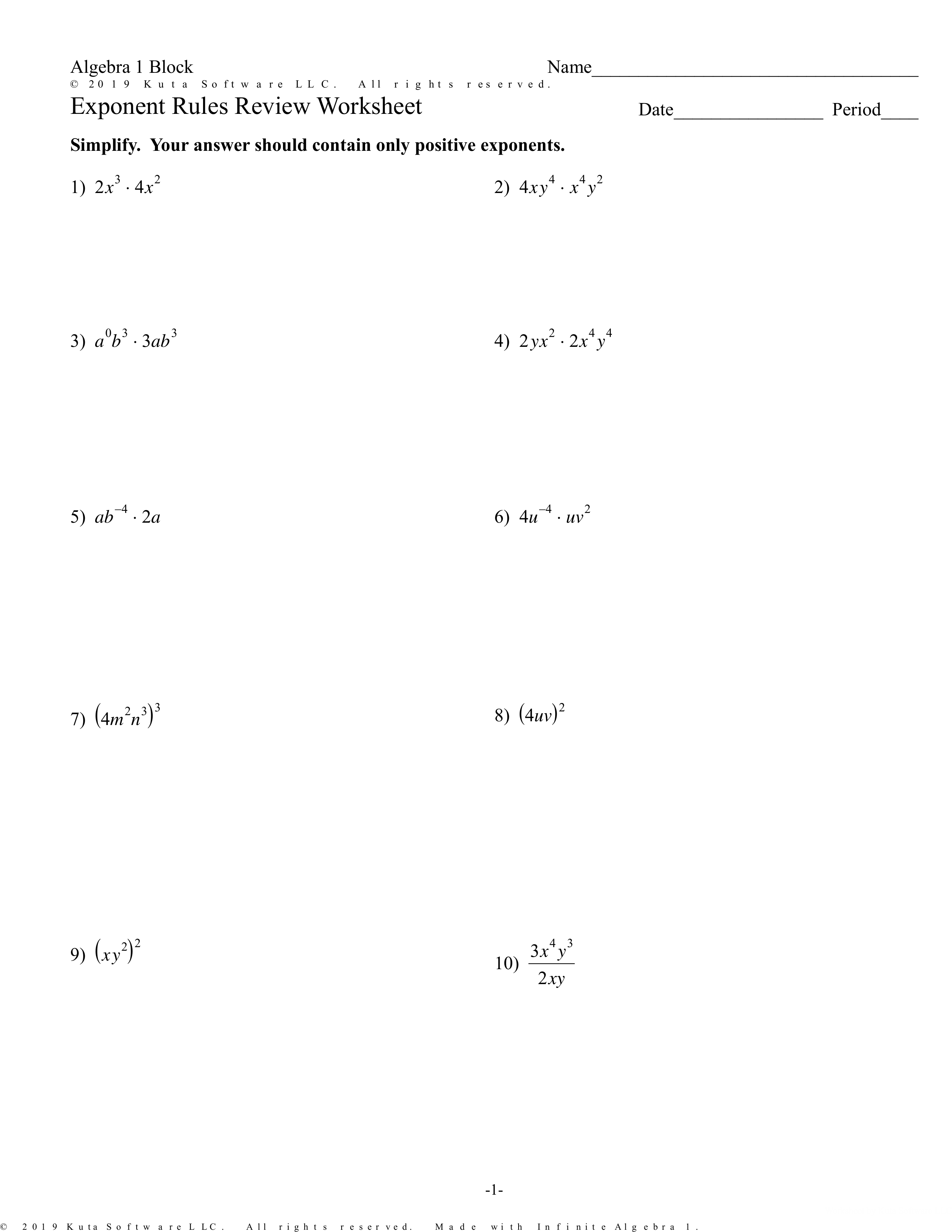
Algebra Positive Exponents Worksheet Pdf serves as a powerful resource for students transitioning from basic exponent rules to more complex algebraic manipulations. By combining clear explanations with a variety of practice problems, this worksheet not only reinforces theory but also equips learners with the confidence to tackle real-world situations that require exponential reasoning.
Understanding Positive Exponents in Algebra

Before diving into worksheets, it’s essential to grasp what a positive exponent truly represents. In algebraic expressions, a positive exponent denotes repeated multiplication of a base by itself. For instance, in the term 34, the base 3 is multiplied four times: 3 × 3 × 3 × 3. This simple rule underpins many advanced topics such as polynomial expansion, rational expressions, and even calculus.
The Core Rules of Positive Exponents
- Product Rule: am × an = am+n. When two exponents share the same base, add them.
- Quotient Rule: am ÷ an = am-n. Subtract the exponents when dividing.
- Power of a Power: (am)n = amn. Multiply the exponents.
- Power of a Product: (ab)n = an × bn. Apply the exponent to each factor.
- Zero Exponent: a0 = 1, provided a ≠ 0. Any non-zero number raised to zero equals one.
These rules form the backbone of any exercise set that involves simplifying expressions or solving equations with exponents.
How the Worksheet Enhances Learning

The Algebra Positive Exponents Worksheet Pdf is more than a collection of blank spaces. It is a structured learning tool designed to guide students from foundational concepts to advanced application.
Progressive Difficulty Levels
- Beginner Section: Simple evaluation problems such as 53 or 24 to reinforce basic calculations.
- Intermediate Section: Simplifying expressions using the product and quotient rules, e.g., 72 × 73 = 75.
- Advanced Section: Combining multiple rules in a single problem, like simplifying (23 × 54) / 52.
Real-World Contextual Problems
Understanding positive exponents extends beyond textbook examples. This worksheet includes scenarios such as:
- Calculating compound interest: A principal grows by a factor of (1 + r)n each period.
- Population growth models: Doubling time expressed as 2t where t is time in years.
- Decibel levels in acoustics: Using 10 log10(power) to represent exponential sound intensity.
By embedding these contexts, students see the practical relevance of algebraic exponent rules.
Step‑by‑Step Guide to Using the Worksheet

To maximize the value of this resource, teachers and parents can follow a structured approach:
1. Pre‑Assessment
Before handing out the worksheet, quickly quiz students on basic exponent facts (e.g., 32, 40). This sets a baseline and identifies gaps.
2. Guided Practice
Walk through a handful of problems together. Highlight the use of rules and ask students to verbalize the steps they take when simplifying a term.
3. Independent Completion
Students complete the worksheet on their own. Encourage them to show every step; hidden work fosters deeper understanding.
4. Review and Feedback
Collect the worksheets, grade them, and provide targeted feedback. Focus on common mistakes such as incorrect application of the power of a product rule or misreading exponent signs.
5. Extension Activities
For students who finish early, offer more challenging problems such as:
- Proving identities like (x2 + 3x + 2) 2 = x4 + 6x3 + 13x2 + 12x + 4.
- Using exponents to solve equations: 2x = 32 → x = 5.
Integrating Technology with the Worksheet
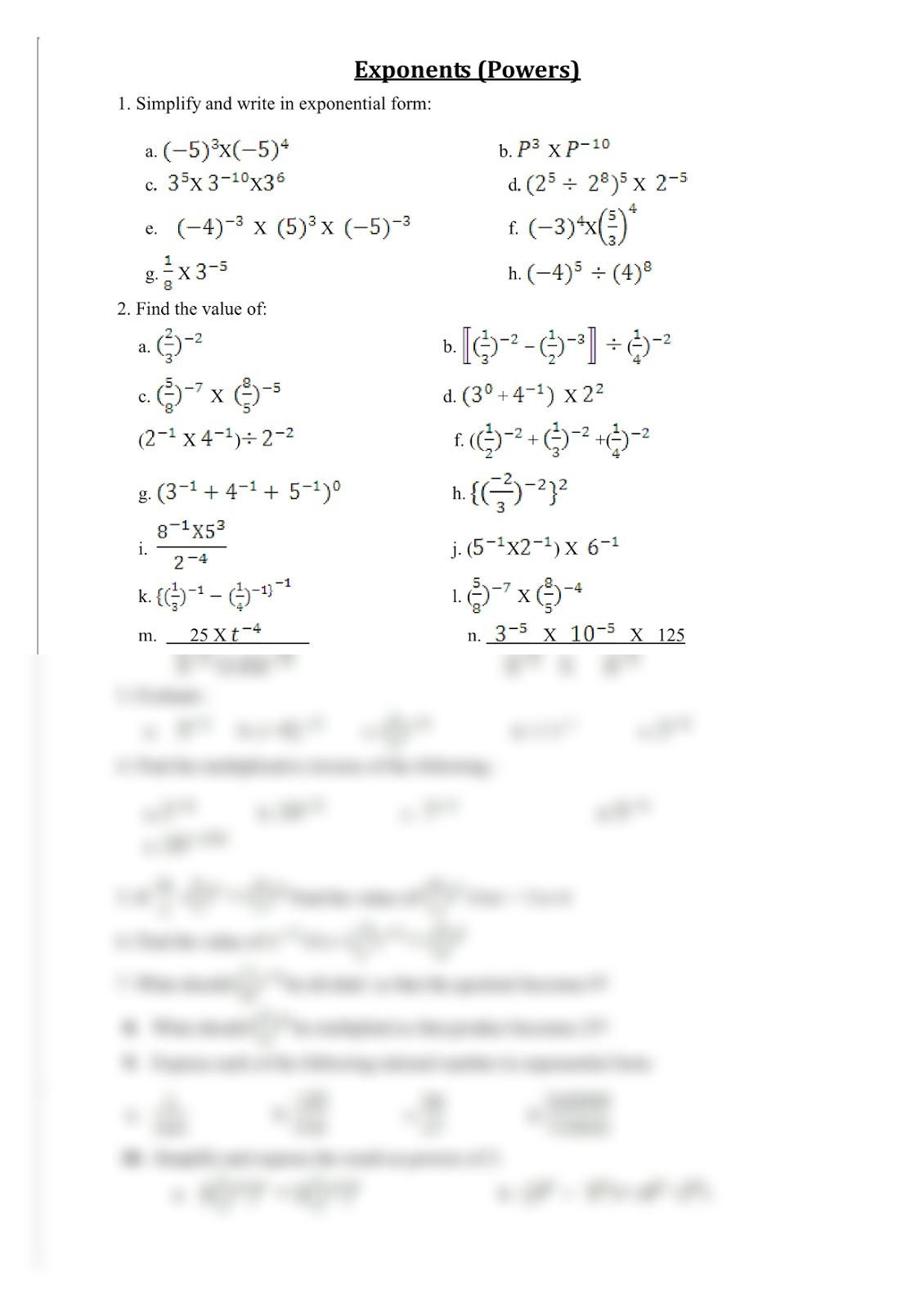
While paper is effective, blending digital tools amplifies learning. Here are some tech-friendly strategies:
Interactive PDF Features
Convert the worksheet into a fillable PDF where students can type answers directly. This eliminates handwriting errors and speeds up grading.
Online Algebra Platforms
Link the worksheet to platforms that track student progress. Many educational software packages automatically check exponent simplifications and offer instant feedback.
Gamified Problem Sets
Create a quiz with timed exponent challenges. This simulates real test conditions and makes learning fun.
Common Challenges and How to Overcome Them
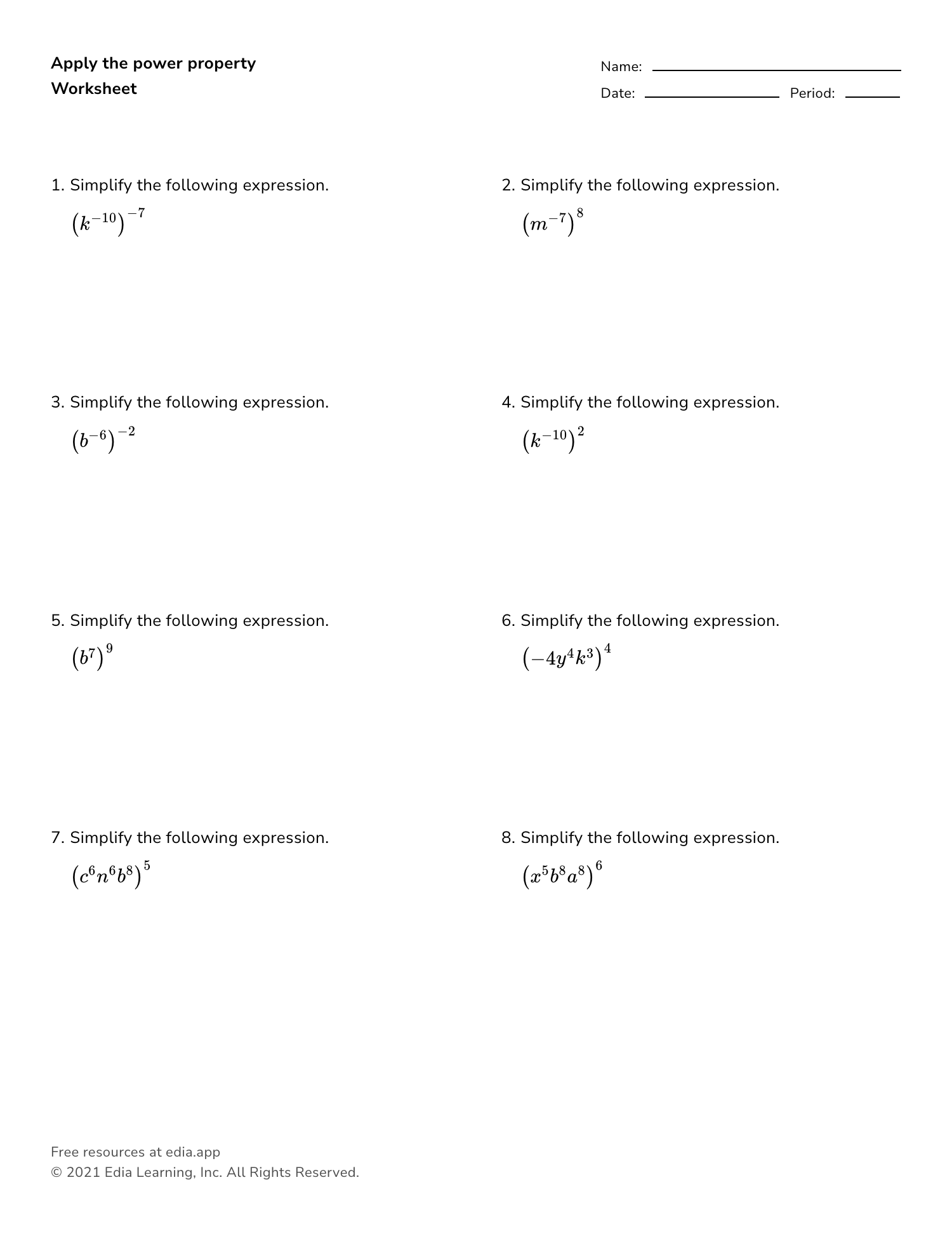
Students often stumble on certain aspects of exponent work. Below are typical pitfalls and remedial tips.
Misapplying Rules with Negative Numbers
While the worksheet focuses on positive exponents, students may inadvertently bring in negative bases. Clarify that rules stay the same: (-2)3 = -8 because the base is negative but the exponent is positive.
Forgetting the Zero Exponent Rule
Remind learners that any non-zero number raised to the power of zero equals one. Practice with a quick drill: 60 = 1, 00 is undefined.
Overlooking the Parentheses Rule
When students encounter (ab)n, they sometimes forget to distribute the exponent to each factor. Use visual aids: draw a diagram showing the product inside a box that is raised to the nth power.
Tips for Parents and Tutors

Parents can support their children’s learning even without a background in algebra. Here are actionable strategies:
Reinforce Through Everyday Examples
Explain how a pizza with 8 slices, each doubled in size over time, uses exponent rules: 8 × 2t. This makes abstract concepts tangible.
Encourage Consistent Practice
Set aside 15–20 minutes daily for exponent problems. Consistency builds muscle memory, especially for multiplication and division of like bases.
Use Flashcards
Create cards with base–exponent combinations on one side and the expanded form on the other. This quick review method sharpens recall.
Why Positive Exponents Matter Beyond Algebra
The principles taught in the worksheet extend into various fields:
- Computer Science: Complexity analysis often relies on exponential growth functions.
- Physics: Power laws, such as the inverse-square law, involve exponents to model natural phenomena.
- Finance: Calculating compound interest uses (1 + r)n to predict future balances.
By mastering positive exponents early, students lay a foundation for these advanced topics.
Design and Layout of the Worksheet

The Algebra Positive Exponents Worksheet Pdf is thoughtfully organized to enhance readability:
Clear Section Headings
Each problem set starts with a heading that indicates the rule being practiced, such as “Product Rule” or “Zero Exponent.” This visual cue helps students target specific concepts.
Spacious Answer Fields
Large boxes allow for step-by-step calculations, preventing cramped work that can obscure errors.
Progressive Problem Complexity
Problems are arranged from straightforward to challenging, encouraging a sense of accomplishment as students advance.
Conclusion: Empowering Students with Exponent Confidence

Mastering positive exponents is a pivotal milestone in algebra. The Algebra Positive Exponents Worksheet Pdf delivers a comprehensive, engaging, and practical platform for learners to master these rules. By integrating structured practice, real-world applications, and technological enhancements, educators and parents can ensure students not only solve problems accurately but also appreciate the broader significance of exponents in everyday life and future academic pursuits. With consistent use of this resource, students will develop a solid algebra foundation that will serve them well in high‑school courses, college mathematics, and beyond.