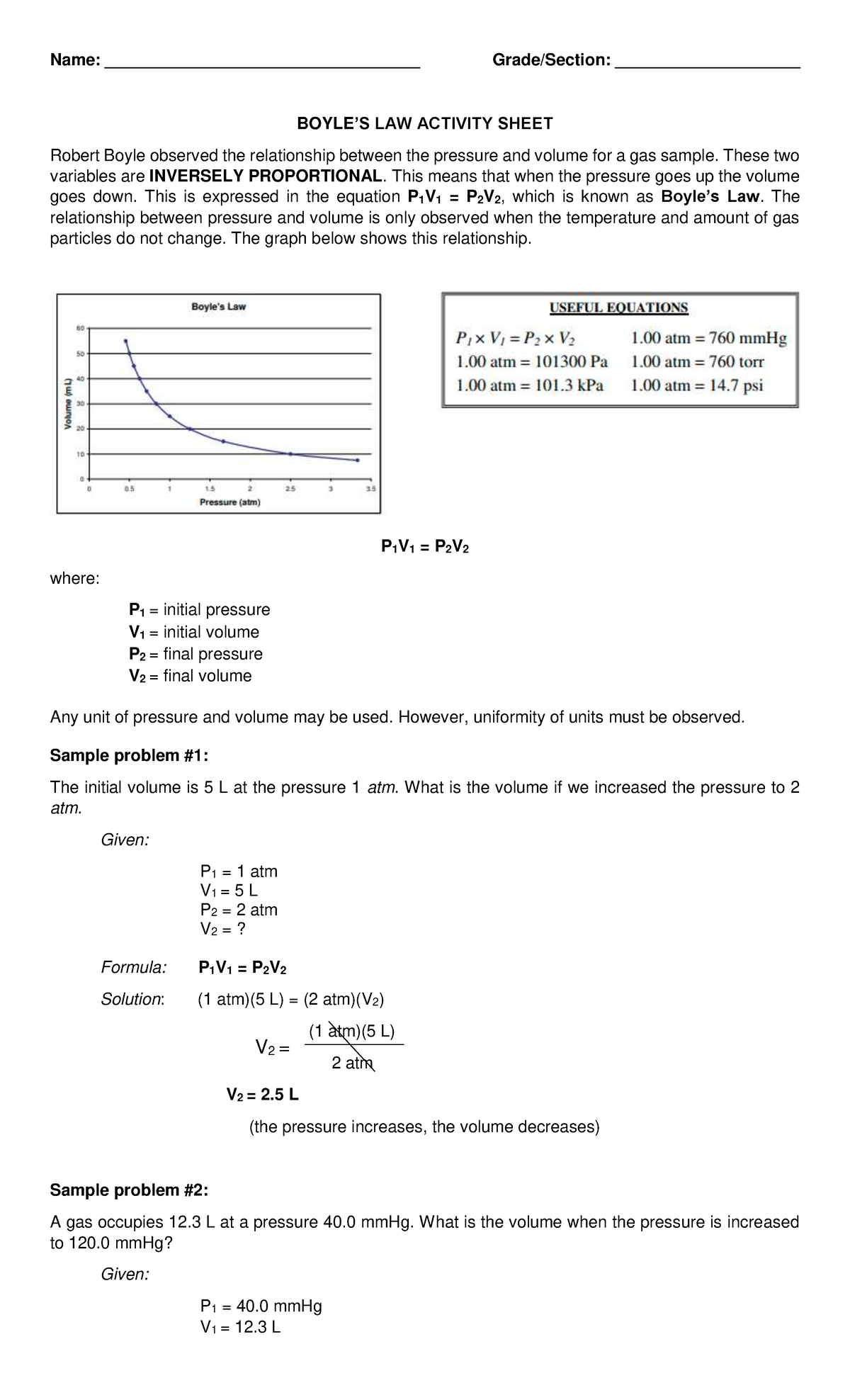
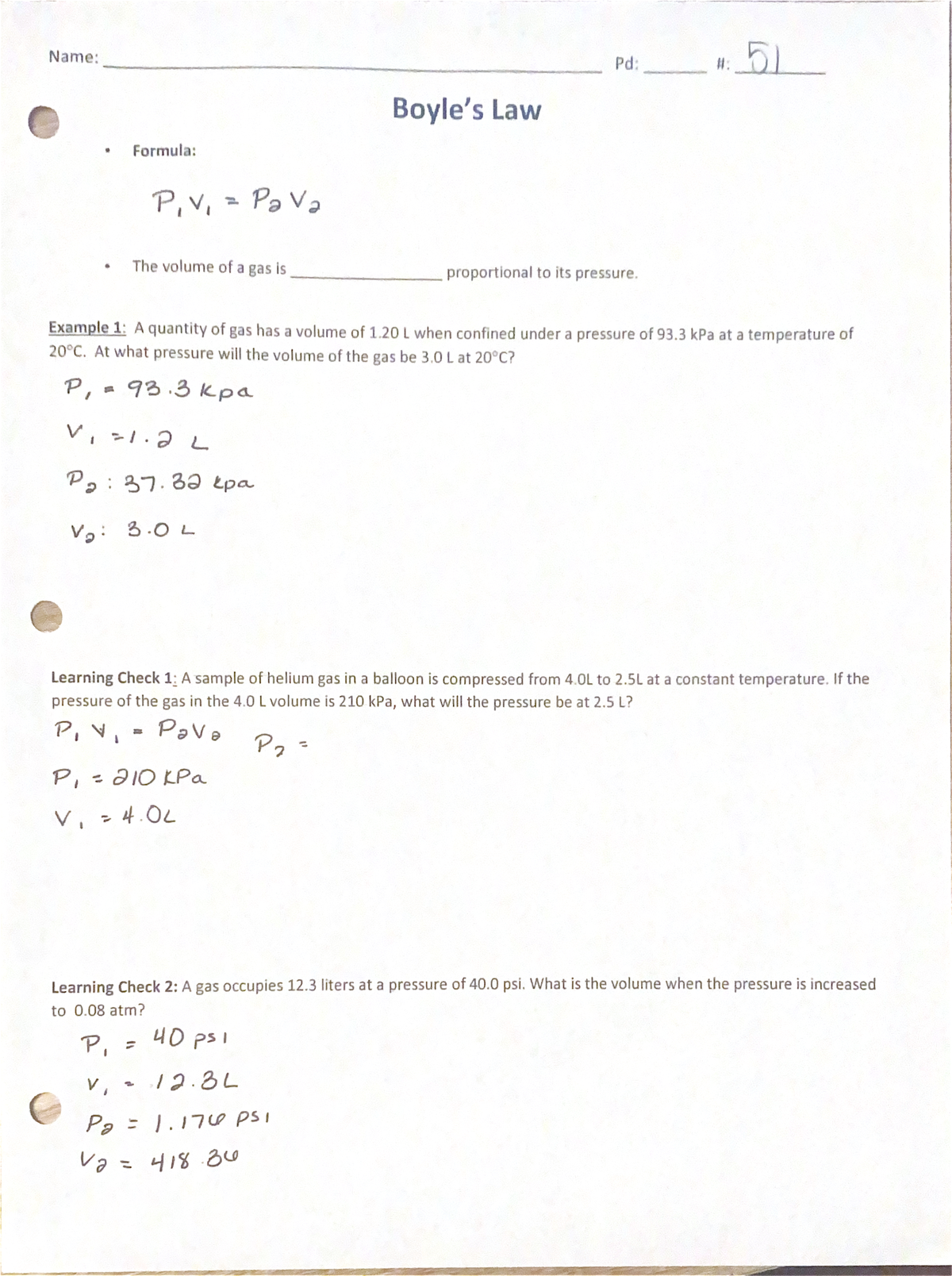
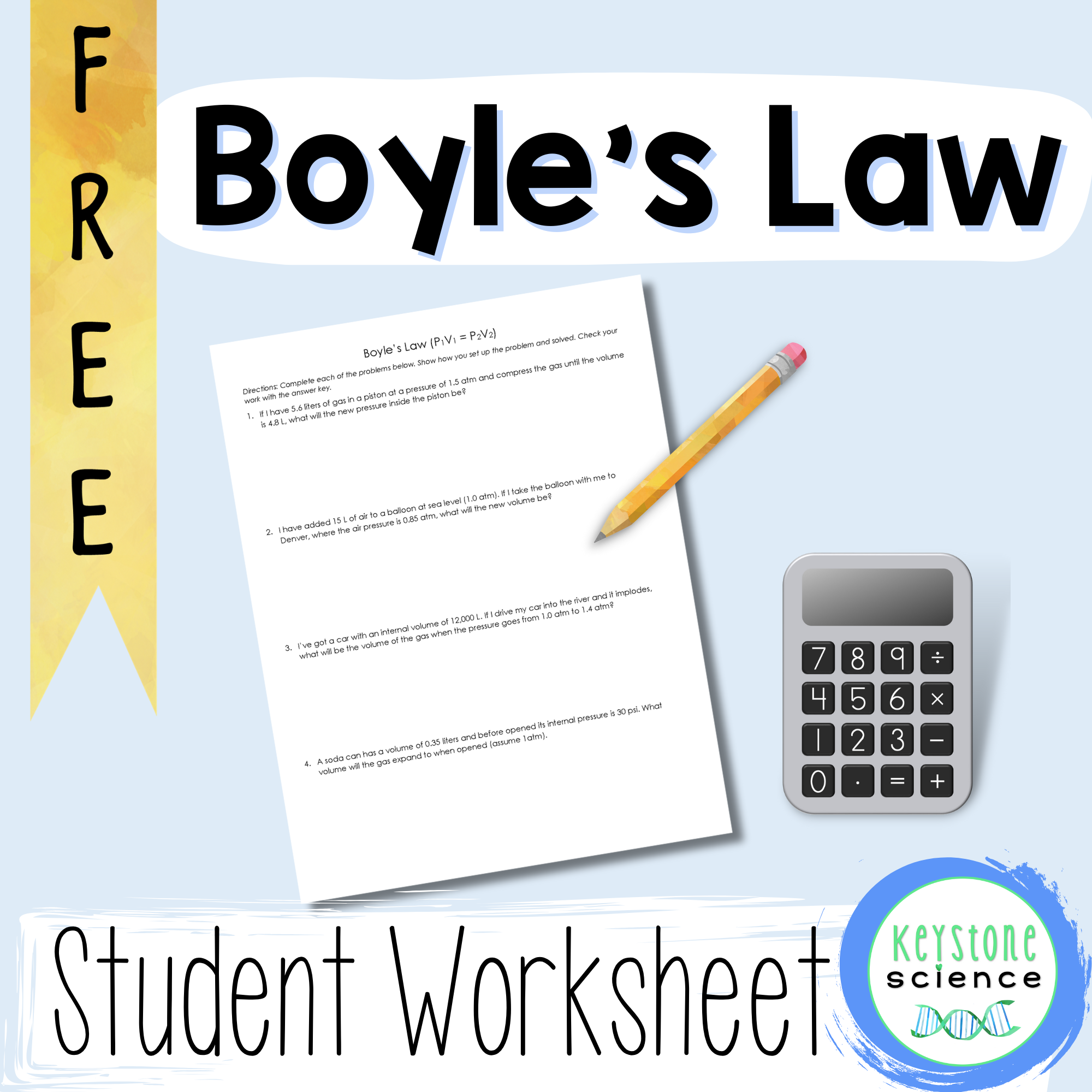
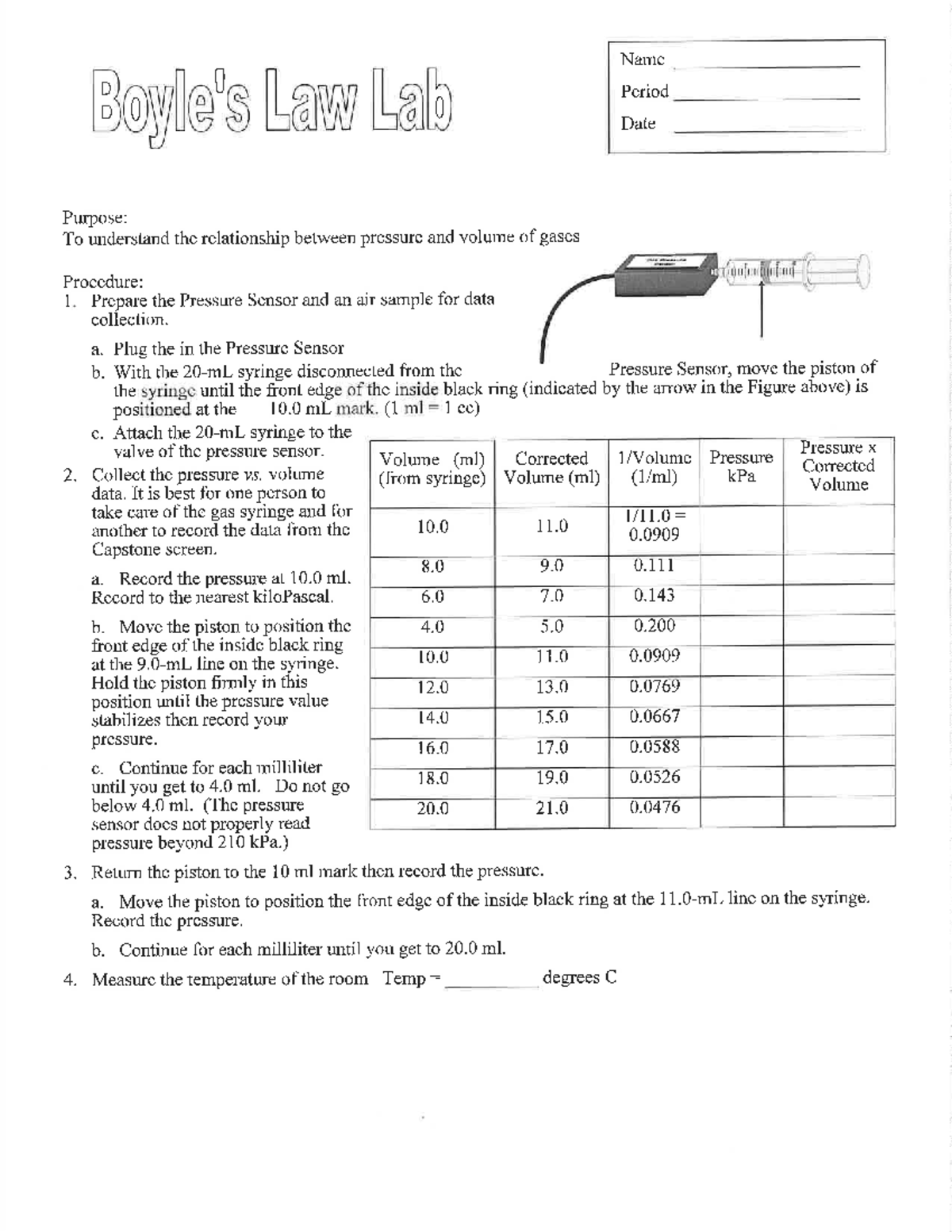
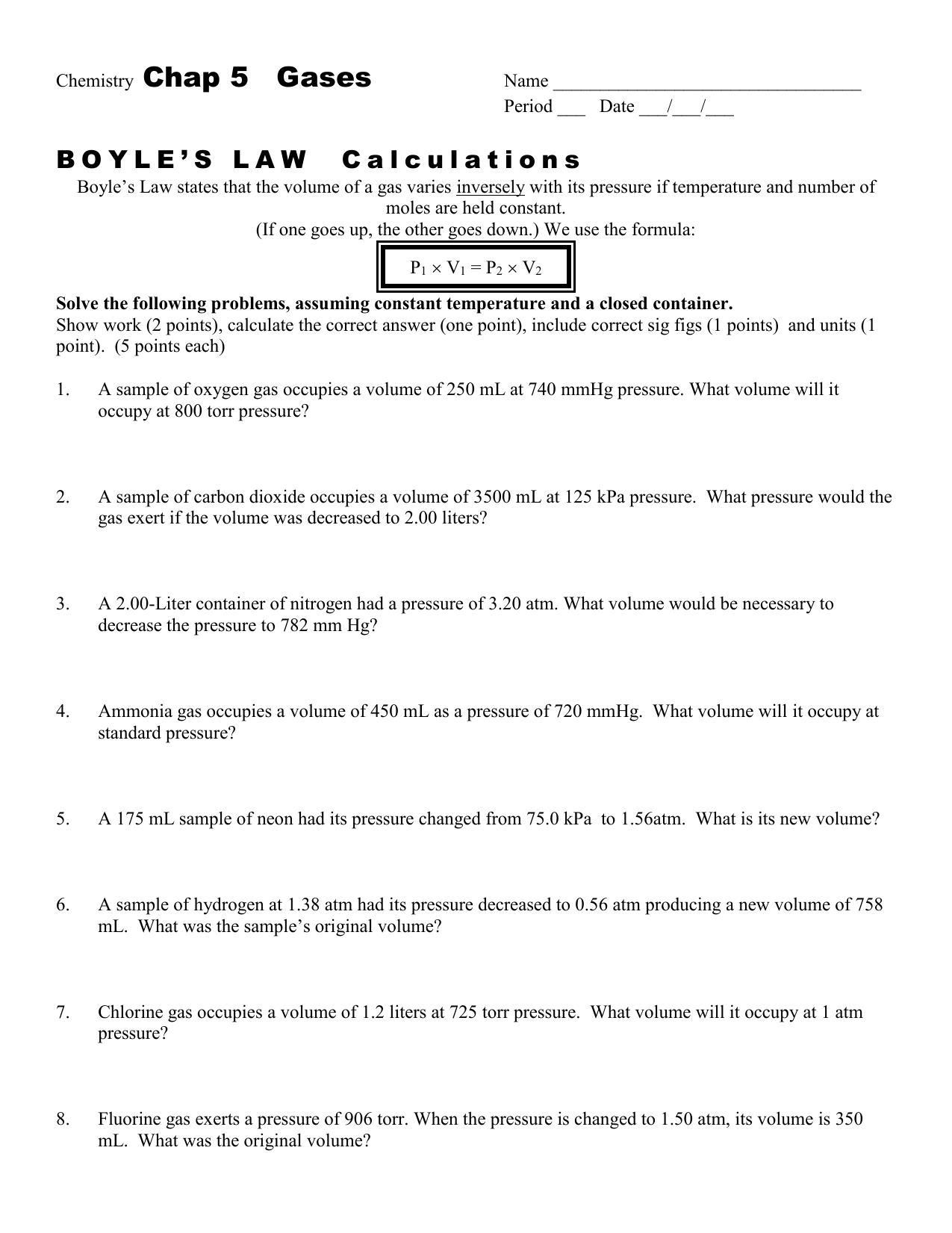
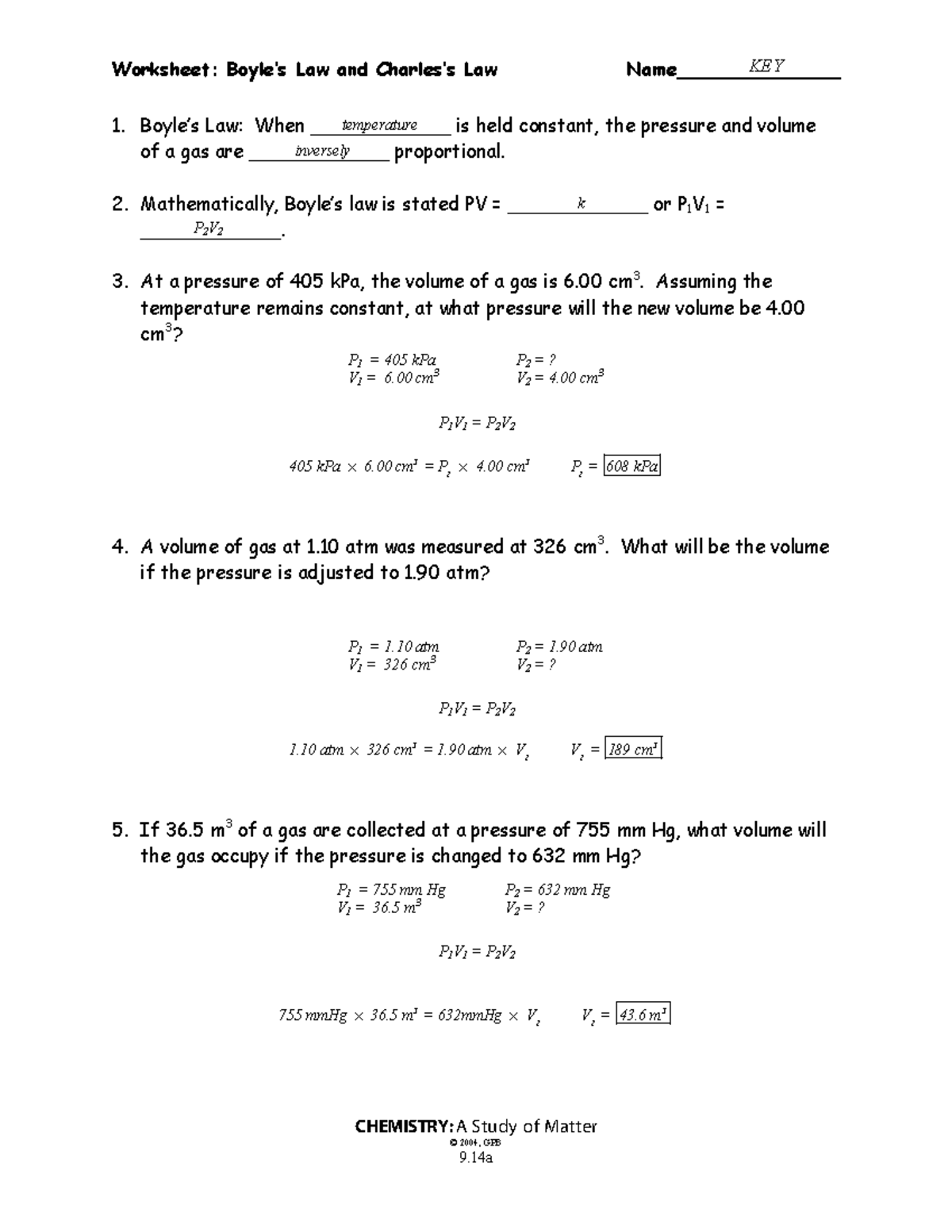
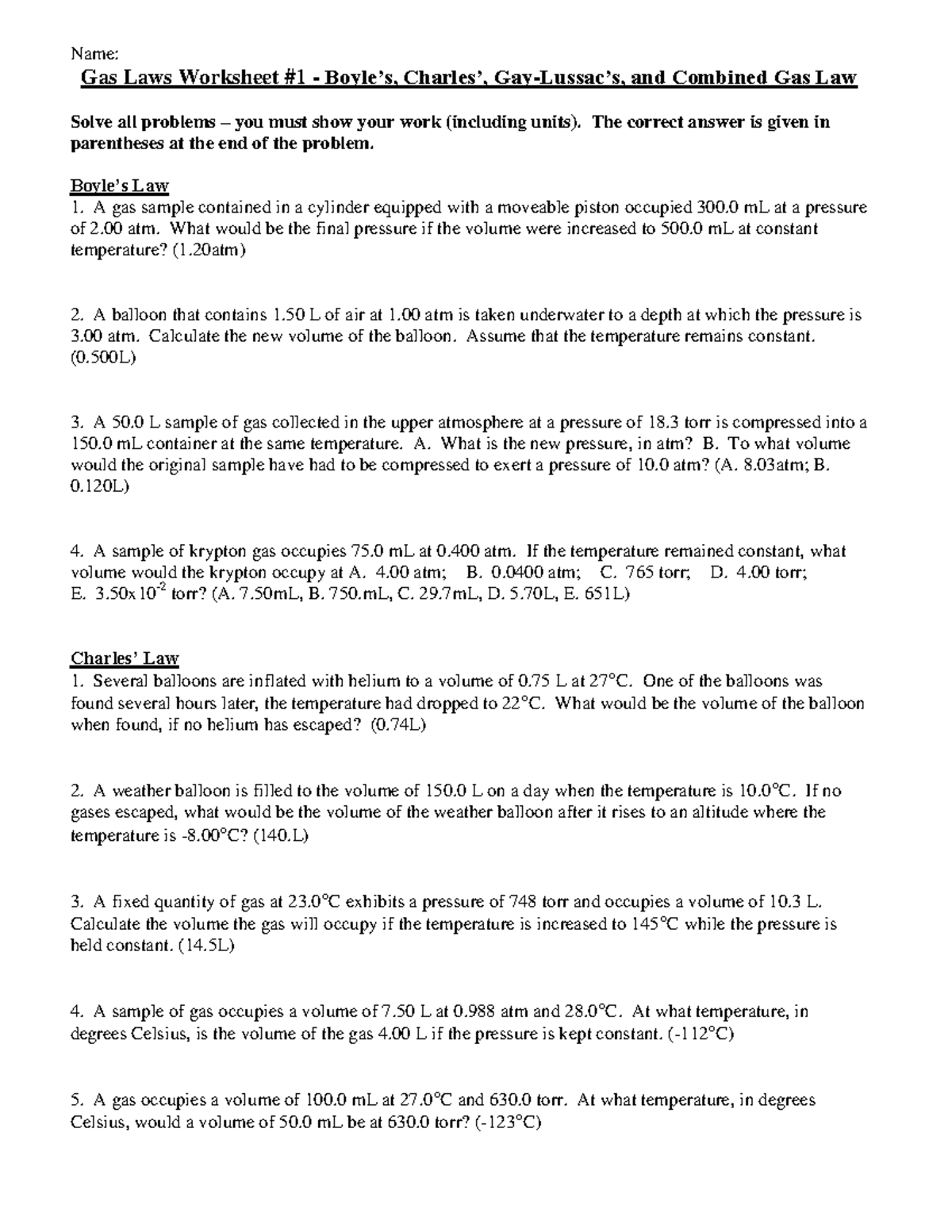
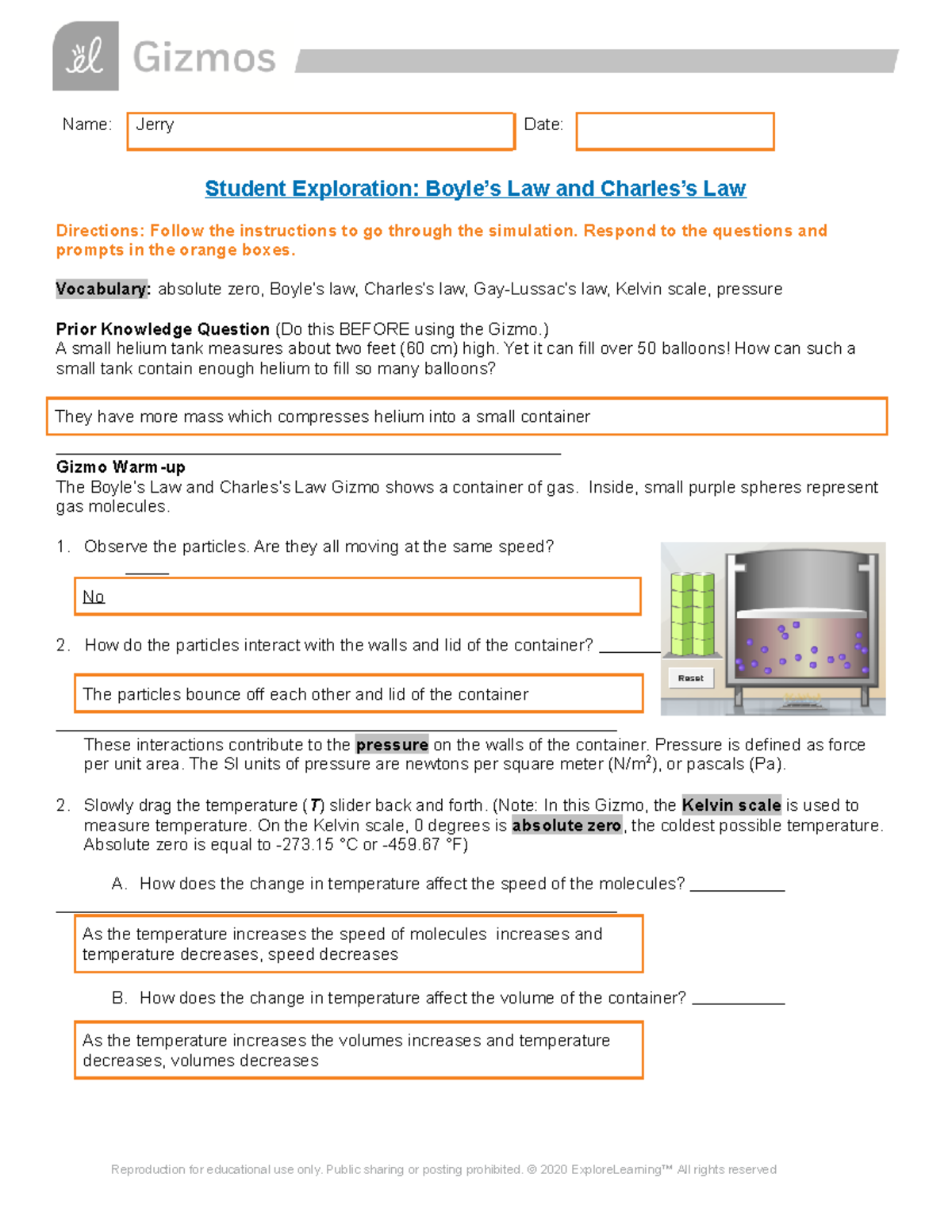
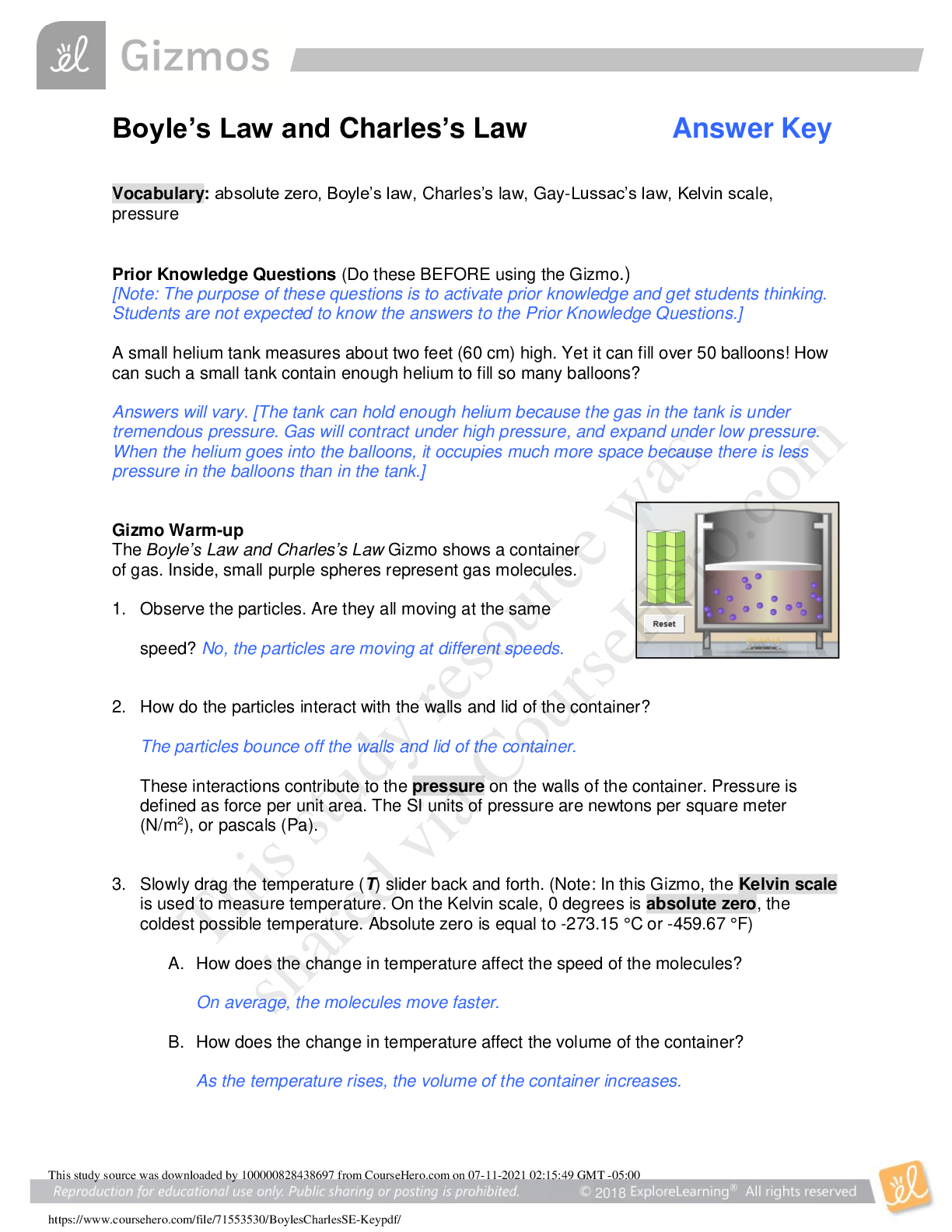
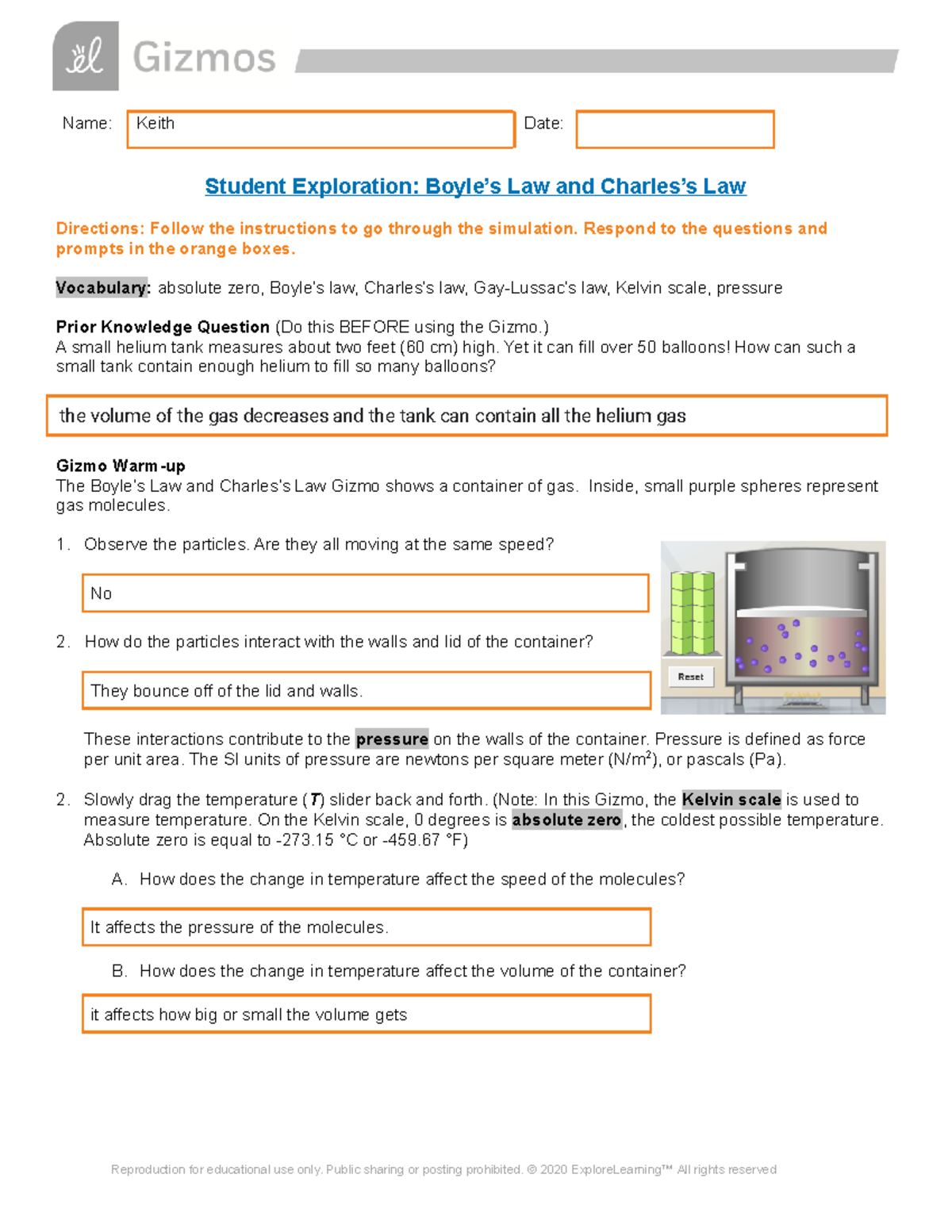
Boyle’s Law Worksheet Answers serve as a crucial bridge between theory and practice for students navigating the intricacies of pressure, volume, and temperature relationships in gases. By working through these solutions, learners not only solidify their grasp on the inverse proportionality described by Boyle’s Law but also gain a deeper appreciation for how this principle manifests in everyday contexts, from breathing to engineering systems.
Understanding the Core Concept Behind Boyle’s Law

Defining Boyle’s Law in Plain Terms
Boyle’s Law states that for a fixed amount of an ideal gas kept at a constant temperature, the pressure is inversely proportional to its volume. Mathematically, this is expressed as P × V = constant or P = k/V, where P represents pressure, V denotes volume, and k is a constant for a particular sample of gas. This relationship implies that if the volume of a gas container is halved, the pressure inside doubles, provided temperature remains steady.
Why This Law Matters in Real-World Settings
Imagine a scuba diver descending into deep water. The surrounding pressure rises dramatically, forcing more air molecules into the diver’s lungs. The diver’s breathing apparatus must manage this increase to prevent lung damage. Likewise, a bicycle pump leverages the same pressure–volume trade‑off to inflate tires efficiently: squeezing the pump’s chamber reduces its volume, forcing air out into the tire. These everyday applications illustrate how Boyle’s Law is not merely an academic concept but a foundational principle that governs life‑support systems and industrial equipment.
Step-by-Step Guide to Solving Common Boyle’s Law Worksheet Problems

1. Identifying Known and Unknown Variables
Before attempting any calculation, clearly list what is given and what needs to be found. Typical worksheet questions provide two of the three variables—pressure, volume, or the constant—and ask for the third. This clarity prevents confusion when rearranging the formula.
2. Applying the Correct Formula
Use one of the two equivalent forms:
- P₁ × V₁ = P₂ × V₂ when comparing two states of the gas.
- P = k/V when a single state needs evaluation with the constant already known.
Choosing the appropriate version simplifies the calculation and reduces algebraic errors.
3. Performing the Calculation
Rearrange the chosen equation so that the unknown variable is isolated. For example, to find the final pressure after a volume change, use P₂ = (P₁ × V₁) / V₂. Substitute the numbers, perform the multiplication or division carefully, and ensure units are consistent—ideally using atmospheres (atm) for pressure and liters (L) for volume.
4. Checking Your Work
After obtaining a numeric answer, validate it by plugging it back into the original equation. If the equality holds, the solution is likely correct. If not, revisit each step to locate any arithmetic or unit inconsistencies.
5. Interpreting the Result in Context
Understanding what the numbers mean is essential for real‑world insight. For instance, a calculated pressure of 3 atm for a gas compressed to half its original volume confirms the inverse relationship: the pressure triples as the volume halves. Relating these numbers to everyday scenarios helps solidify learning and encourages retention.
Common Mistakes and How to Avoid Them

Misinterpreting “Constant” Conditions
Boyle’s Law only holds when temperature remains constant. Many worksheets explicitly state “constant temperature” or provide a temperature that is unchanged. If a problem involves temperature change, the law is not applicable on its own; you must use the combined gas law or ideal gas law instead.
Unit Conversion Errors
Students often neglect unit consistency. For example, mixing milliliters and liters, or using psi with atm, can lead to wrong results. Always convert all volumes to liters and pressures to atmospheres (or use a consistent pair of units) before calculation.
Forgetting to Simplify the Equation Early
When multiple operations are involved, simplifying the fraction early can reduce computational mistakes. For instance, if you have P₁ × V₁ = P₂ × V₂, cross‑multiply instead of dividing first; this keeps numbers manageable.
Real-World Applications to Reinforce Learning

Medical Devices: Respirators and Ventilators
Ventilators adjust air pressure to assist patients in breathing. Boyle’s Law ensures that the volume delivered to a patient’s lungs matches the desired pressure, especially important during mechanical ventilation where precise control saves lives.
Engineering: Hydraulic Systems
Hydraulic pistons rely on fluid pressure changes within sealed chambers. While liquids are nearly incompressible, small volume changes still affect pressure. Engineers often use Boyle’s Law concepts to predict system behavior under load, ensuring safety and efficiency.
Sports Equipment: Ball Aerodynamics
In games like soccer or tennis, the internal pressure of a ball influences its flight and bounce. Players sometimes adjust ball pressure to achieve optimal performance. Understanding Boyle’s Law allows athletes and coaches to make evidence‑based decisions about maintenance and equipment selection.
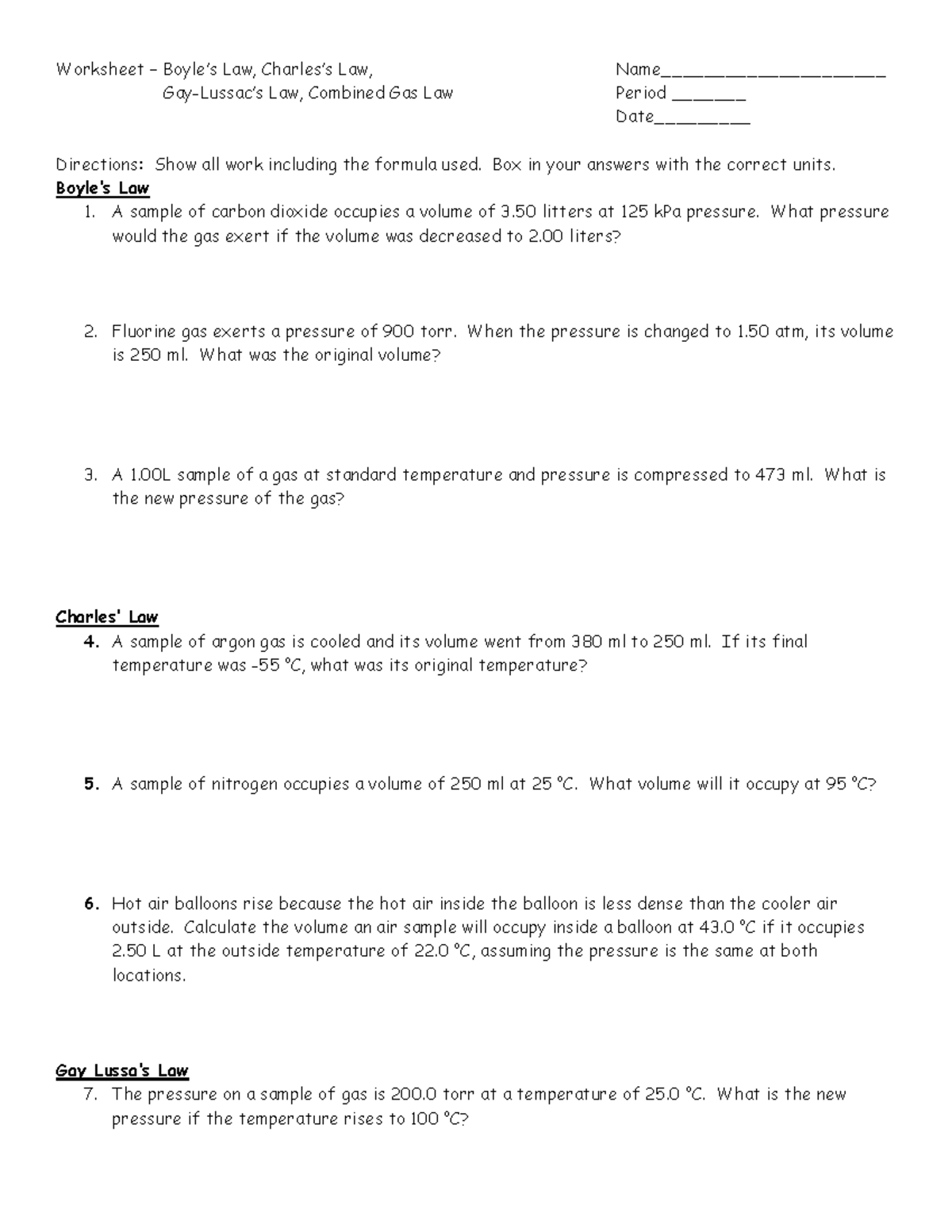
Interactive Practice: Creating Your Own Boyle’s Law Worksheet
1. Select a Context
Choose a real‑world scenario, such as a soda can under pressure or a deep‑sea submersible. Identify the key variables you can control or measure.
2. Design Scenarios
Create problems that vary one variable while keeping others constant. For example, “If the volume of a gas in a sealed syringe decreases from 10 L to 5 L at a constant temperature, calculate the new pressure given an initial pressure of 2 atm.”
3. Provide Step‑by‑Step Solutions
Draft detailed answers that mirror the step‑by‑step guide above. This practice not only reinforces your own understanding but also equips peers with a reliable resource.
Advanced Techniques for Challenging Problems

Using the Combined Gas Law When Temperature Varies
If a worksheet introduces a temperature change, remember the combined gas law: (P₁ × V₁)/T₁ = (P₂ × V₂)/T₂. Boyle’s Law is a special case where temperature is constant, so setting T₁ = T₂ simplifies the formula back to P₁ × V₁ = P₂ × V₂. Knowing when to switch between these equations is crucial for higher‑level questions.
Employing the Ideal Gas Law for Calculations Involving Amount of Substance
When the number of moles of gas changes or when dealing with non‑ideal behavior, the ideal gas law P × V = n × R × T becomes handy. Although Boyle’s Law focuses on pressure and volume, integrating it with the ideal gas law allows students to tackle more complex problems that involve multiple gas parameters.
Graphical Representation for Intuitive Understanding
Plotting pressure against volume on a logarithmic scale can visually demonstrate the inverse relationship. A straight line in a log–log plot confirms the 1/V dependency. Using graphing tools like Desmos or GeoGebra can provide an interactive learning experience, making abstract equations more concrete.
FAQs About Boyle’s Law Worksheet Answers
Why do I see negative results in some solutions?
Negative values usually stem from a mistake in variable assignment or unit conversion. Physically, pressure and volume cannot be negative, so a negative result signals a computational error that must be corrected.
Can Boyle’s Law be applied to real gases?
Boyle’s Law holds best for ideal gases at moderate pressures. At very high pressures or low temperatures, real gases deviate due to intermolecular forces. However, for most educational and practical purposes, treating gases as ideal provides a sufficiently accurate approximation.
Is there a limit to how far I can compress a gas using Boyle’s Law?
In theory, compressing a gas indefinitely would increase pressure without bound. In practice, materials and safety limits cap compression. For instance, a sealed syringe cannot be compressed beyond a certain point without risking rupture, regardless of the mathematical predictions.
Final Thoughts
Mastering Boyle’s Law Worksheet Answers equips students with a powerful analytical tool that translates directly into real‑world problem solving. By methodically identifying variables, applying the correct formula, and validating results, learners can confidently tackle any pressure‑volume question. Beyond the classroom, the principle of inverse proportionality between pressure and volume underpins technologies that protect lives and improve everyday experiences—from scuba gear and ventilators to sports equipment and engineering systems. Continually practicing, questioning, and contextualizing these relationships not only solidifies academic knowledge but also nurtures a deeper appreciation for the physics that shape our world.