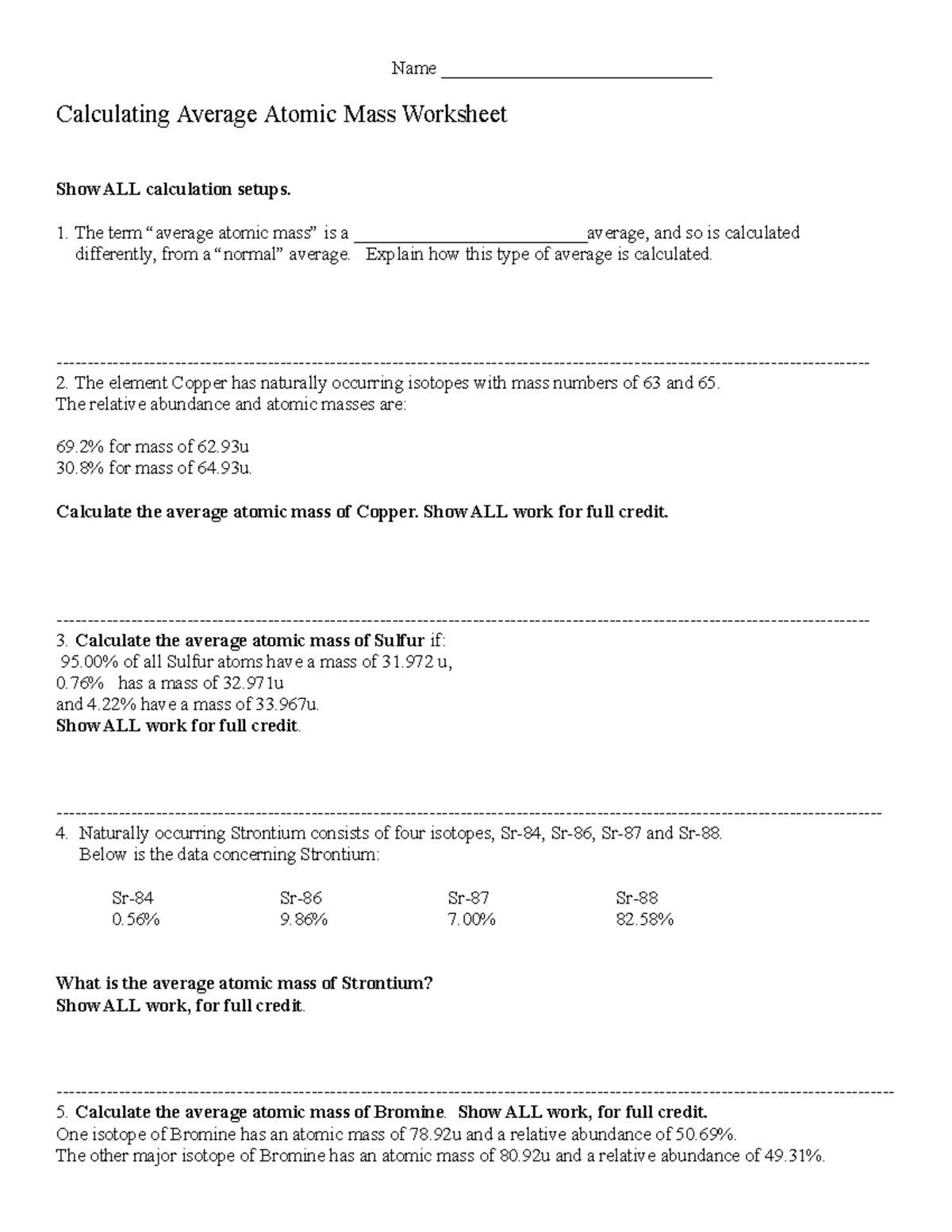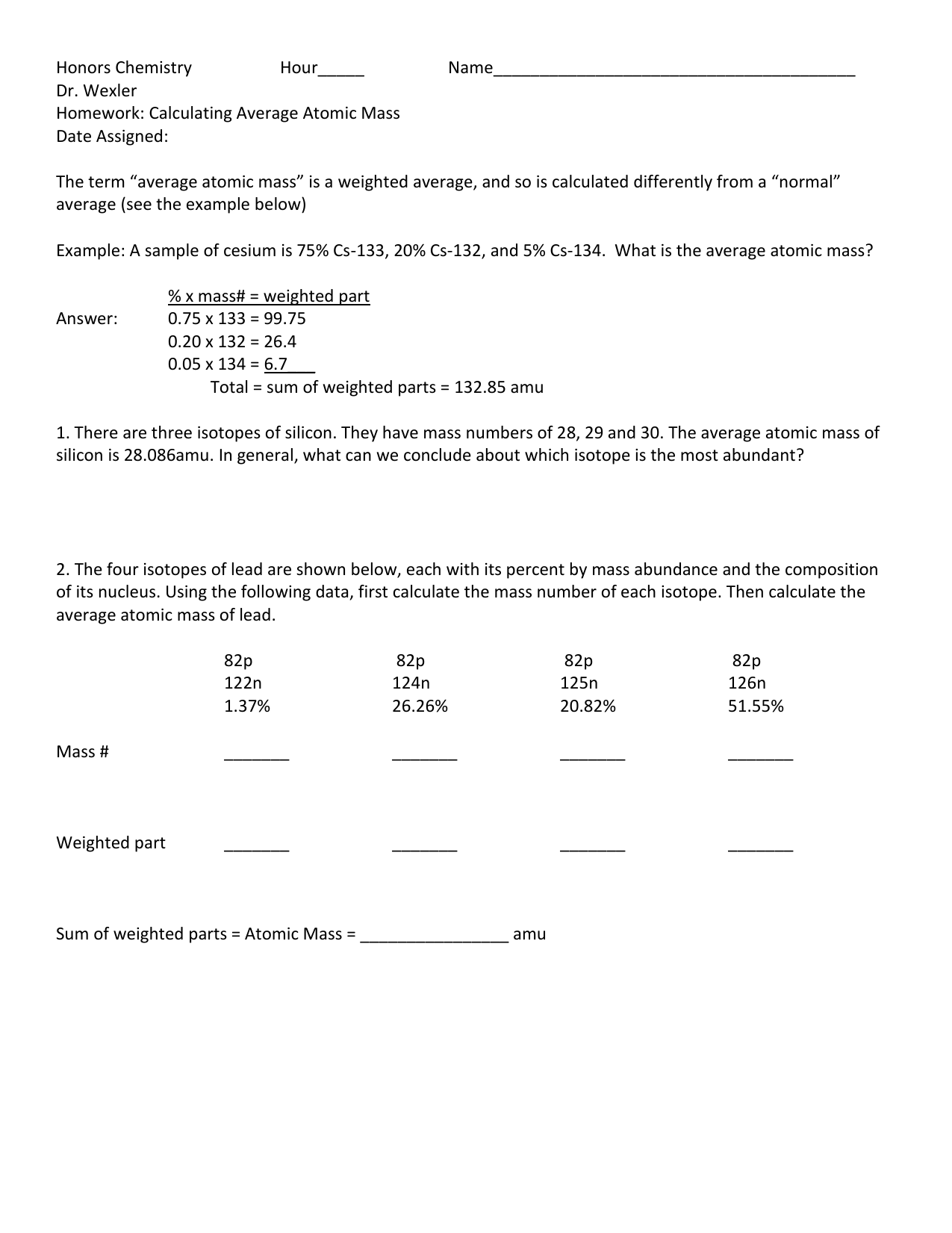
Calculating Average Atomic Mass Worksheet is more than just a classroom drill; it’s a gateway to unlocking the hidden stories that atoms tell about the elements we encounter every day, from the air we breathe to the glittering gems in jewelry stores. In this post I’ll walk you through everything you need to master these worksheets, sprinkle in personal anecdotes from my own chemistry journey, and give you practical tools you can apply right away whether you’re a student, teacher, or lifelong learner.
Understanding Average Atomic Mass
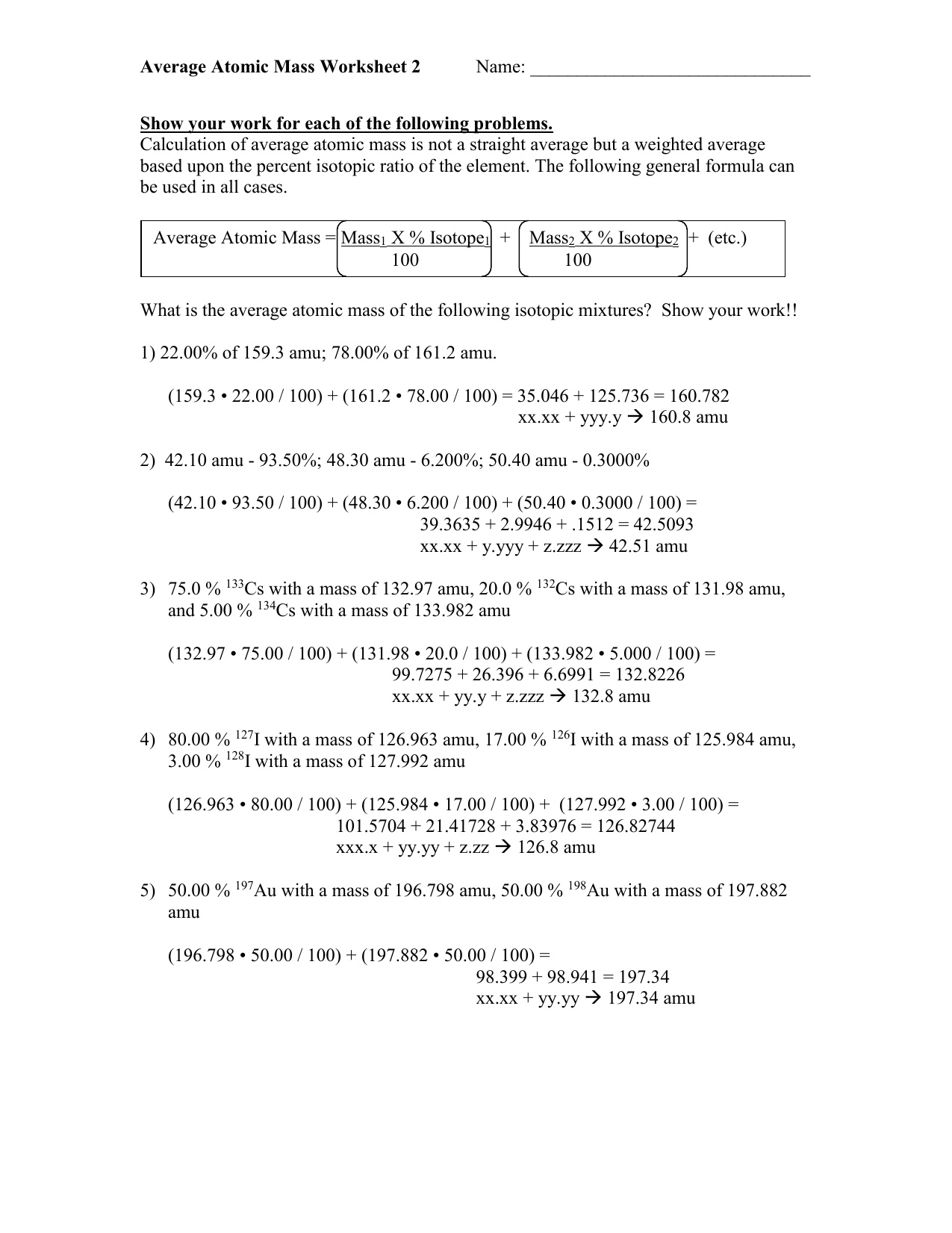
Before you can breeze through any worksheet, you need a solid grasp of what average atomic mass actually means. At its core, average atomic mass is the weighted mean of an element’s isotopic masses, taking into account each isotope’s natural abundance. Imagine a jar of marbles where each color represents a different isotope; the average atomic mass is like the overall weight of the jar divided by the total number of marbles, weighted by how many of each color you have.
Isotopes: The Building Blocks
Every element can have one or more isotopes—atoms with the same number of protons but different numbers of neutrons. For example, carbon has two stable isotopes: ¹²C (about 98.9% abundant) and ¹³C (about 1.1% abundant). Their masses are roughly 12 u and 13 u, respectively. The average atomic mass you see on the periodic table (12.01 u for carbon) reflects this blend.
How to Calculate It
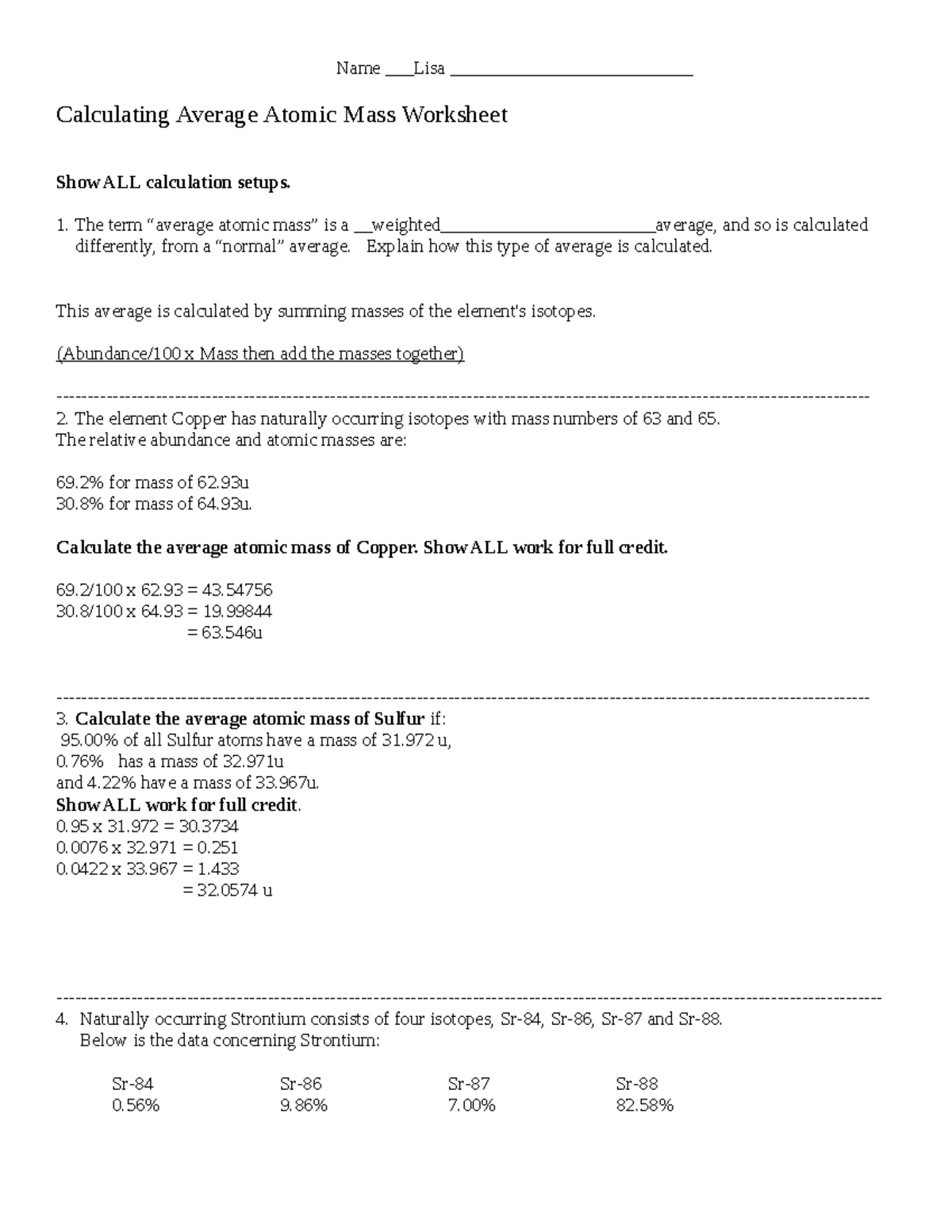
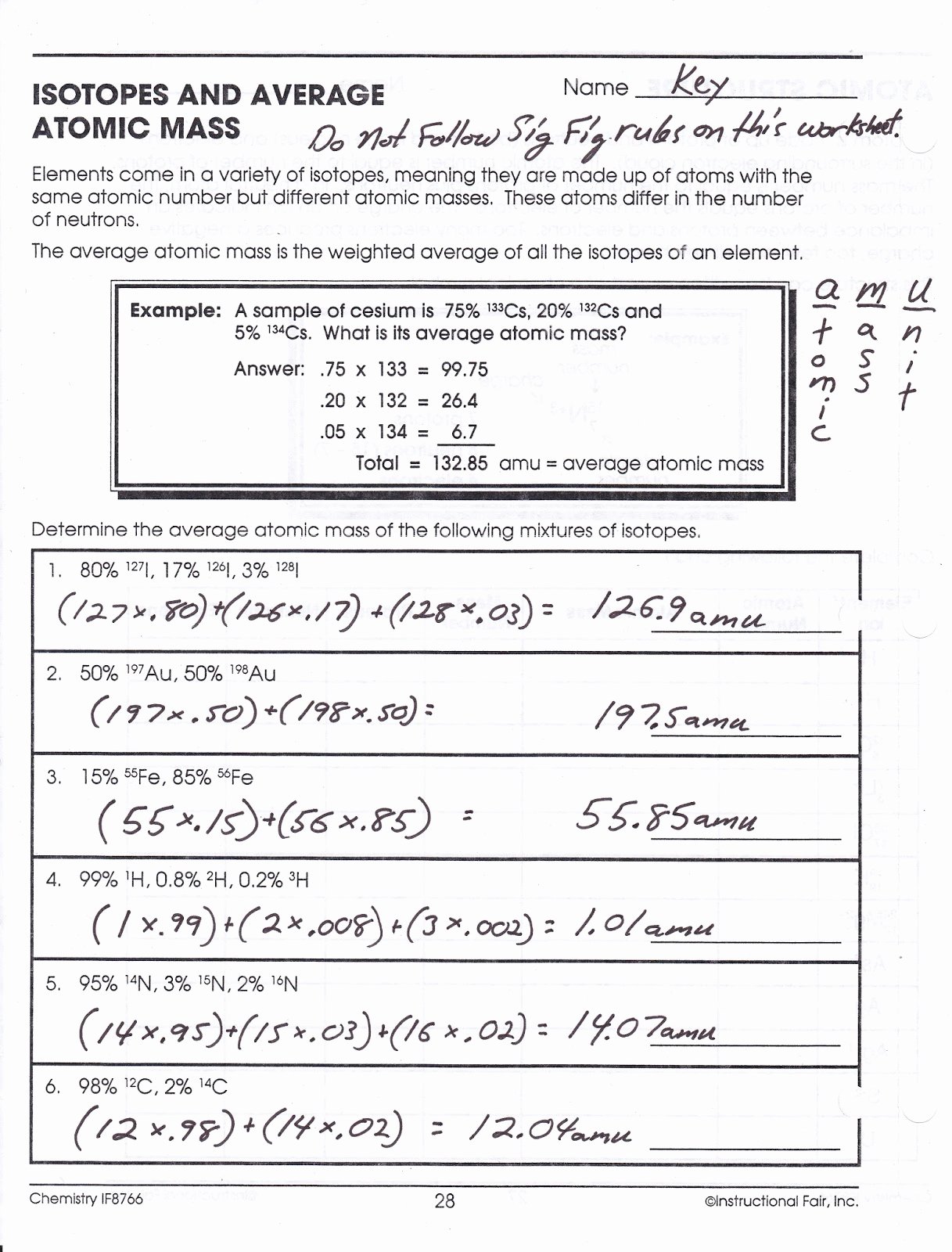
The formula is straightforward: multiply each isotope’s atomic mass by its fractional abundance (percentage divided by 100) and sum the results. Using carbon as an example:
- ¹²C: 12.000 u × 0.989 = 11.868 u
- ¹³C: 13.003 u × 0.011 = 0.143 u
Adding them together gives 12.011 u, which matches the periodic table value.
Why Worksheets Matter
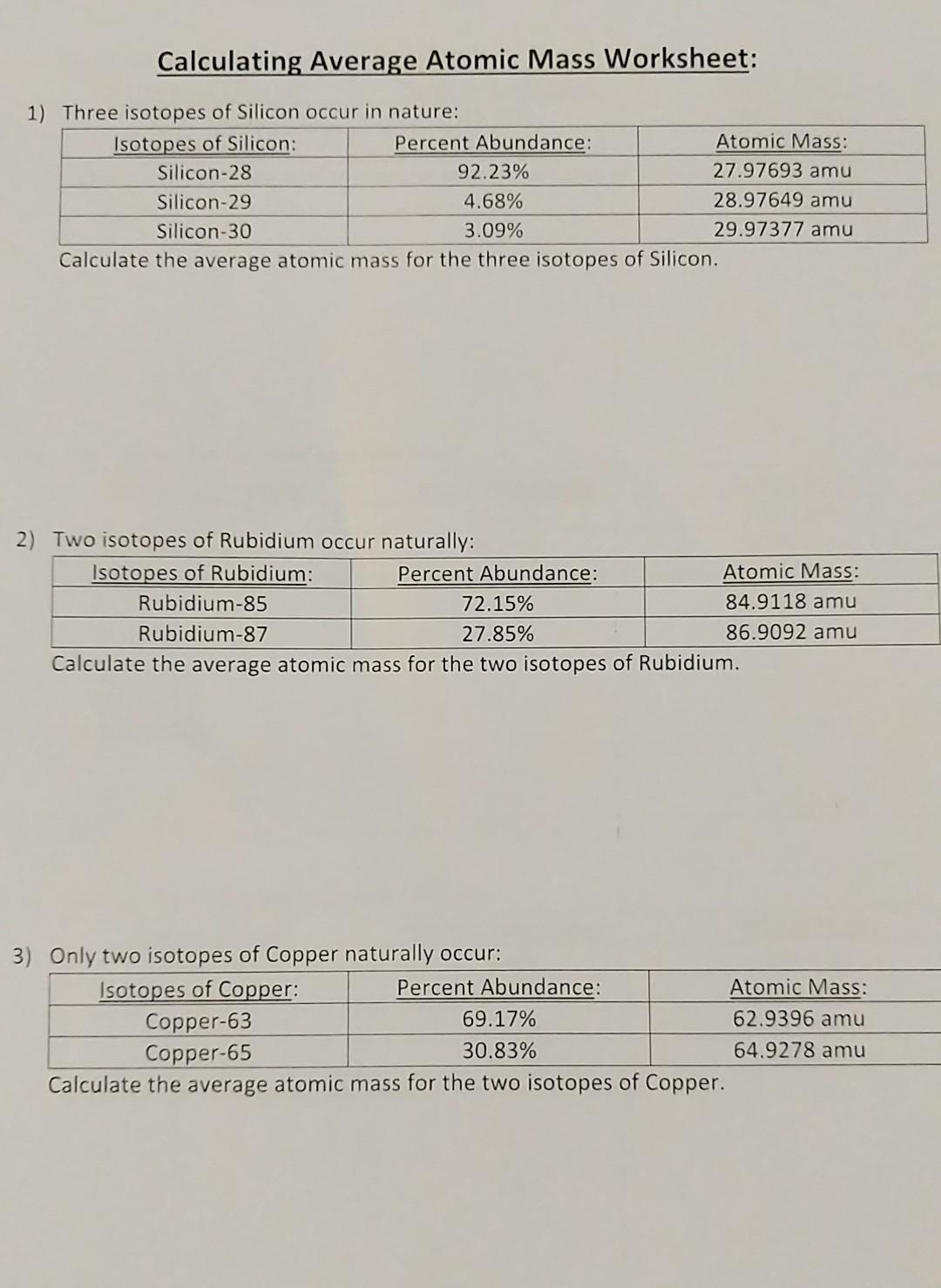
Worksheets might feel like repetitive practice, but they serve several critical educational purposes. First, they reinforce the calculation steps until they become second nature. Second, they expose you to a variety of isotopic scenarios, sharpening your ability to interpret real data. Finally, they help you develop a systematic problem‑solving mindset that translates to other areas of chemistry and beyond.
Building Muscle Memory
Just as a musician practices scales, chemistry students practice calculations. The more you write out the steps—identifying isotopes, converting percentages, performing the multiplication—the more fluid the process becomes. By the time you face a timed test, you’ll instinctively know which numbers to pull out of the periodic table and how to arrange them.
Developing Critical Thinking
Each worksheet question can be a little puzzle. Some will give you the isotopic masses and ask for the average; others will provide the average and require you to back‑solve for an unknown abundance. These variations train you to read carefully, identify knowns versus unknowns, and decide which algebraic route to take.
Step‑by‑Step Guide to Solving Worksheet Problems
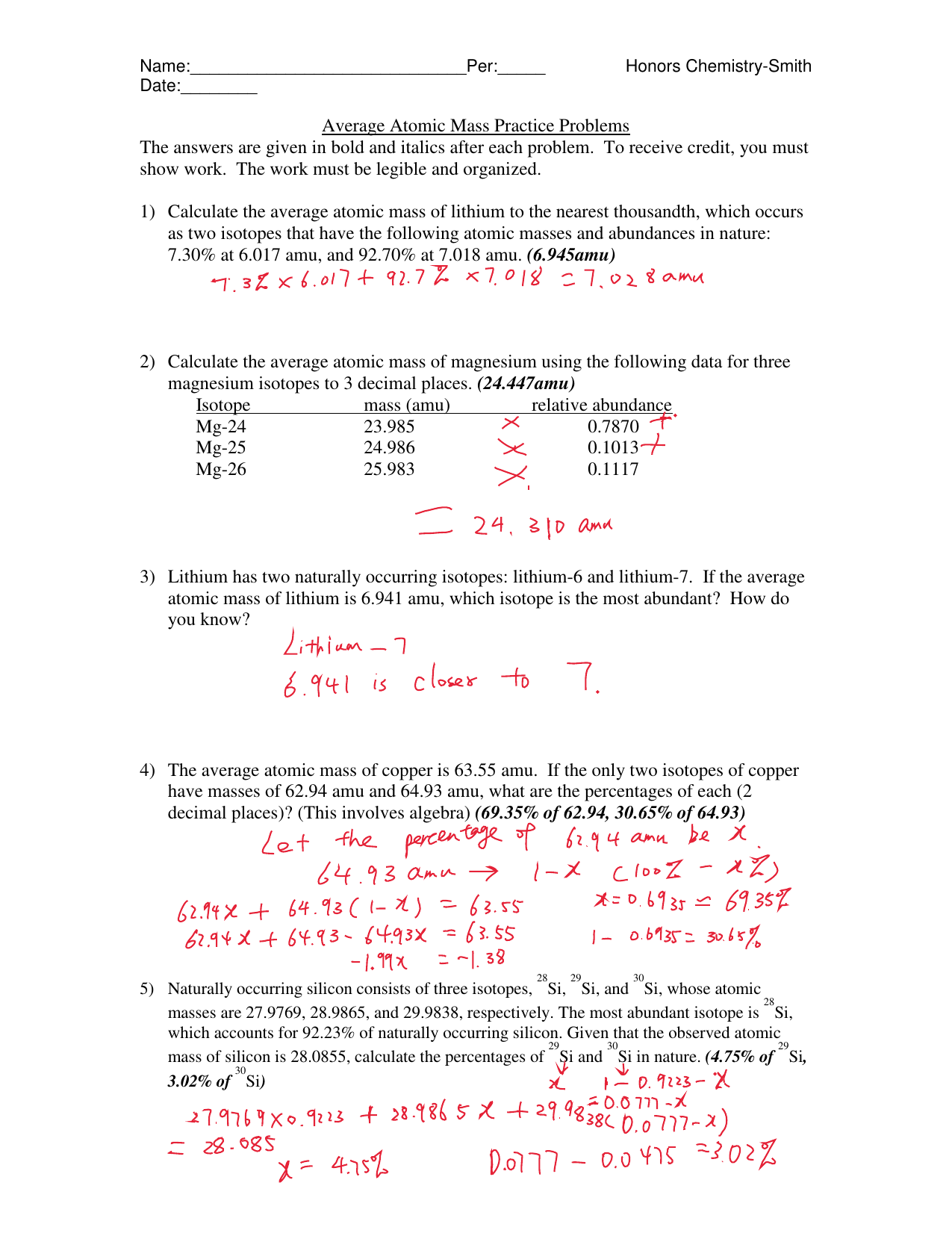
Now let’s dive into a practical, step‑by‑step framework you can apply to any average atomic mass worksheet question. Follow these steps in order, and you’ll reduce errors dramatically.
Step 1: Read the Prompt Carefully
Identify what the problem is asking for. Is it the average atomic mass, an isotope’s abundance, or perhaps the mass of a sample? Highlight key numbers and units.
Step 2: List All Given Data
Create a quick table on your paper. Include each isotope’s mass, its given abundance (or the unknown you’ll solve for), and any additional constants. For example:
| Isotope | Mass (u) | Abundance (%) |
|---|---|---|
| ¹⁶O | 15.994 | 99.76 |
| ¹⁷O | 16.999 | 0.04 |
| ¹⁸O | 17.999 | 0.20 |
Having a visual layout prevents numbers from getting lost in the paragraph.
Step 3: Convert Percentages to Fractions
Divide each percentage by 100 to get a decimal fraction. In the table above, 99.76% becomes 0.9976, and so on. This conversion is essential because the formula uses fractional abundances.
Step 4: Apply the Weighted Average Formula
Multiply each isotope’s mass by its fractional abundance, then sum the products. Write the equation explicitly on the page; it helps you track each term.
For oxygen:
- ¹⁶O: 15.994 u × 0.9976 = 15.956 u
- ¹⁷O: 16.999 u × 0.0004 = 0.007 u
- ¹⁸O: 17.999 u × 0.0020 = 0.036 u
Total = 15.999 u (rounded to three decimal places).
Step 5: Double‑Check Units and Rounding
Average atomic masses are usually reported to two or three decimal places, depending on the element’s natural variation. Verify that you haven’t inadvertently rounded too early—carry extra decimal places through the calculation and round only at the final step.
Step 6: Answer the Question Directly
Restate the result in a complete sentence, matching the format the worksheet expects. For example, “The average atomic mass of oxygen is 15.999 u.” This reinforces clarity and ensures you receive full credit.
Common Mistakes and How to Avoid Them

Even seasoned students stumble over a few recurring pitfalls. Recognizing them early can save you hours of frustration.
Mixing Up Percentages and Fractions
It’s easy to plug a percentage directly into the formula without dividing by 100. A quick mental check—does the number look like a fraction (e.g., 0.85) rather than a percent (85)?—can catch this error.
Forgetting to Account for All Isotopes
Some elements have three or more stable isotopes. If a worksheet only lists two, verify whether the third’s abundance is negligible or intentionally omitted. Ignoring a non‑negligible isotope will skew the average.
Rounding Too Early
Rounding intermediate results can compound errors. Keep at least four significant figures throughout the calculation, then round the final answer to the appropriate number of sig figs.
Misreading the Question’s Direction
When the problem asks for an unknown abundance, you’ll need to set up an equation where the sum of all fractional abundances equals 1. Forgetting this constraint leads to impossible answers.
Real‑World Applications of Average Atomic Mass

Understanding average atomic mass isn’t confined to textbook exercises; it has tangible implications across science and industry.
Geology and Radiometric Dating
Isotopic abundances of elements like uranium and lead are the foundation of radiometric dating techniques. By calculating the average atomic mass of a mineral sample, geologists can infer the age of rocks and the history of Earth’s crust.
Medical Diagnostics
Radioisotopes used in PET scans rely on precise knowledge of isotopic masses to calculate dosage and decay rates. Accurate average atomic mass values ensure safe and effective imaging.
Environmental Monitoring
Isotope fractionation—tiny shifts in isotopic ratios caused by chemical processes—helps scientists track pollution sources and climate change patterns. Calculating these subtle variations starts with a solid grasp of average atomic mass.
Tips for Teachers and Students
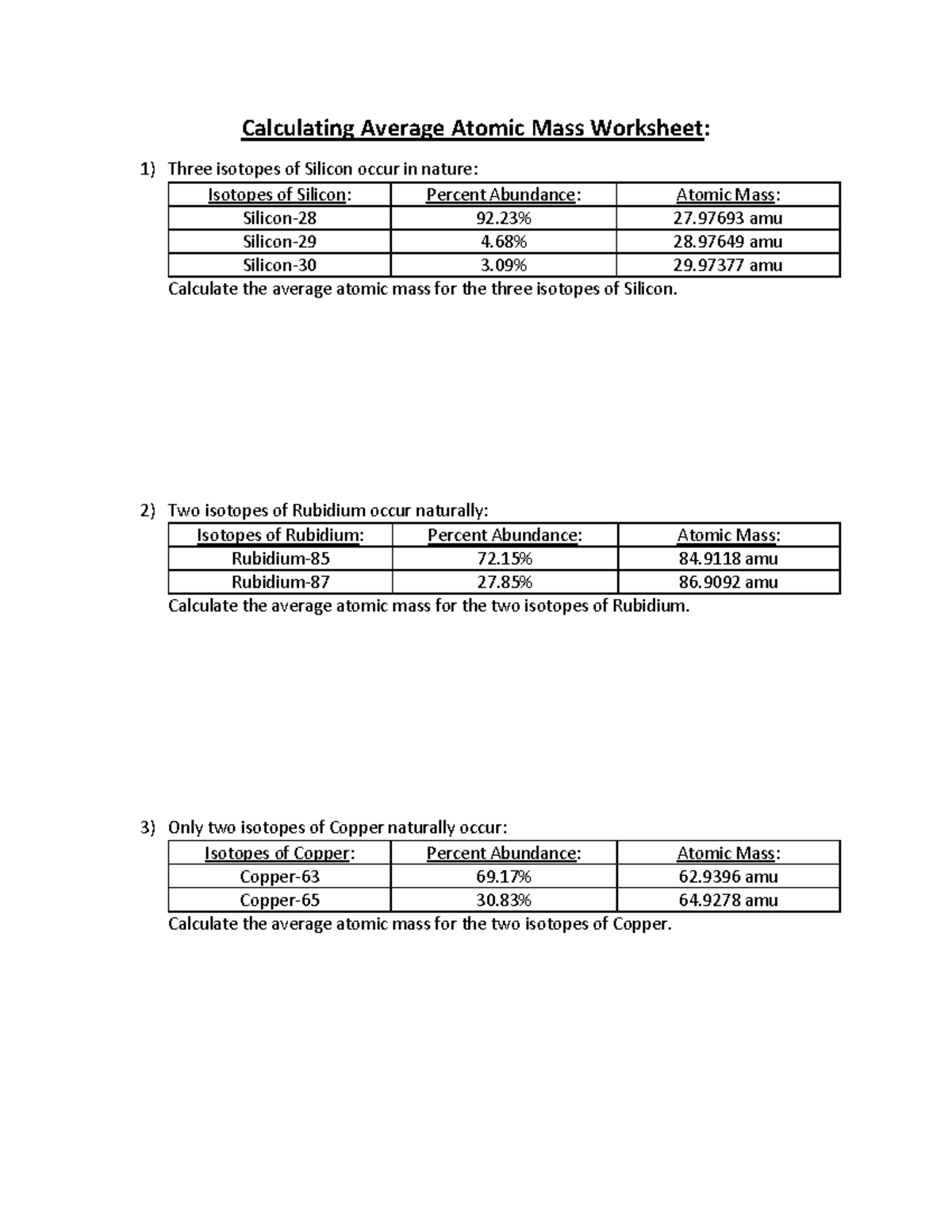
Whether you’re designing a worksheet or tackling one, a few strategic tips can elevate the learning experience.
For Teachers
- Incorporate Real Data: Use current isotopic abundance tables from reputable sources to give students authentic practice.
- Vary Difficulty Levels: Begin with single‑isotope problems, then progress to multi‑isotope and reverse‑calculation questions.
- Encourage Explanation: Ask students to write a brief rationale for each step; this reinforces conceptual understanding.
For Students
- Create a Cheat Sheet: Summarize the formula, common isotopic masses, and conversion steps on a single page for quick reference.
- Practice with Real‑World Scenarios: Try calculating the average atomic mass of elements in everyday items—like the calcium in milk or the iron in a nail.
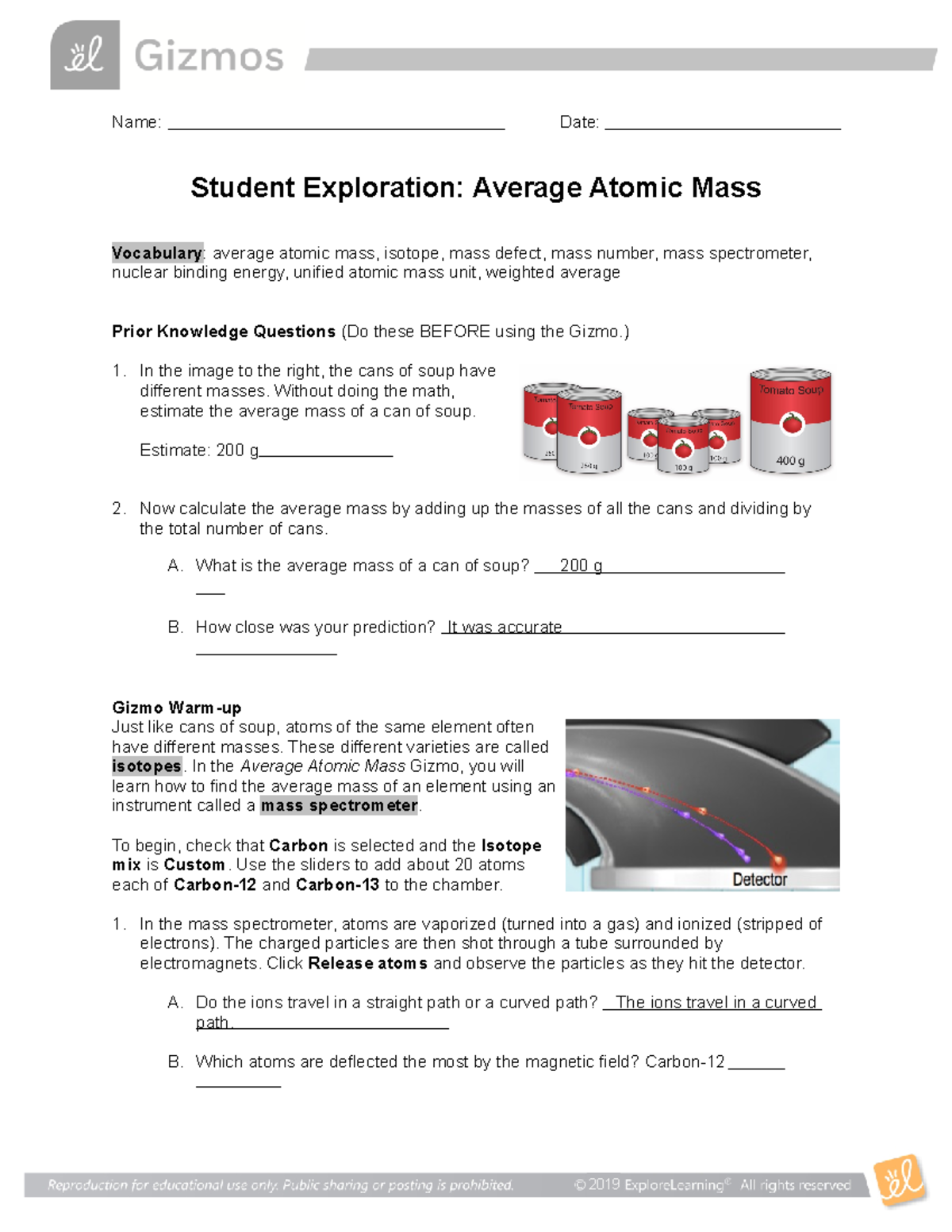
- Use Online Simulators: Interactive tools let you adjust isotopic abundances and instantly see the effect on average mass, reinforcing the weighted‑average concept.
Frequently Asked Questions

What is the difference between atomic mass and atomic weight?
Atomic mass refers to the mass of a single atom, usually expressed in atomic mass units (u). Atomic weight, often used interchangeably, actually denotes the average atomic mass of an element as it occurs naturally, reflecting isotopic distribution.
Why do some elements have only one stable isotope?
Elements like fluorine (¹⁹F) have a single stable isotope because the combination of protons and neutrons yields a particularly stable nuclear configuration. Others have multiple stable isotopes due to a balance of nuclear forces that allow several configurations to persist.
Can average atomic mass ever be a whole number?
Only if an element’s isotopic distribution happens to align perfectly with integer values, which is rare. Most average atomic masses contain decimal places because isotopic masses are not whole numbers and natural abundances are fractional.
How accurate are the average atomic masses listed on the periodic table?
They are extremely accurate, derived from high‑precision mass spectrometry measurements and constantly updated as analytical techniques improve. However, for most educational purposes, the standard values provided are sufficient.
Conclusion

Mastering the Calculating Average Atomic Mass Worksheet equips you with a versatile skill set that bridges fundamental chemistry concepts and real‑world applications. By understanding isotopic contributions, following a disciplined step‑by‑step problem‑solving routine, and avoiding common pitfalls, you’ll not only ace your worksheets but also appreciate the deeper narrative that atomic masses tell about the natural world. Whether you’re a student sharpening your grades, a teacher crafting engaging lessons, or a curious mind exploring the atomic realm, the tools and strategies outlined here will guide you toward confidence and competence in every calculation you encounter.