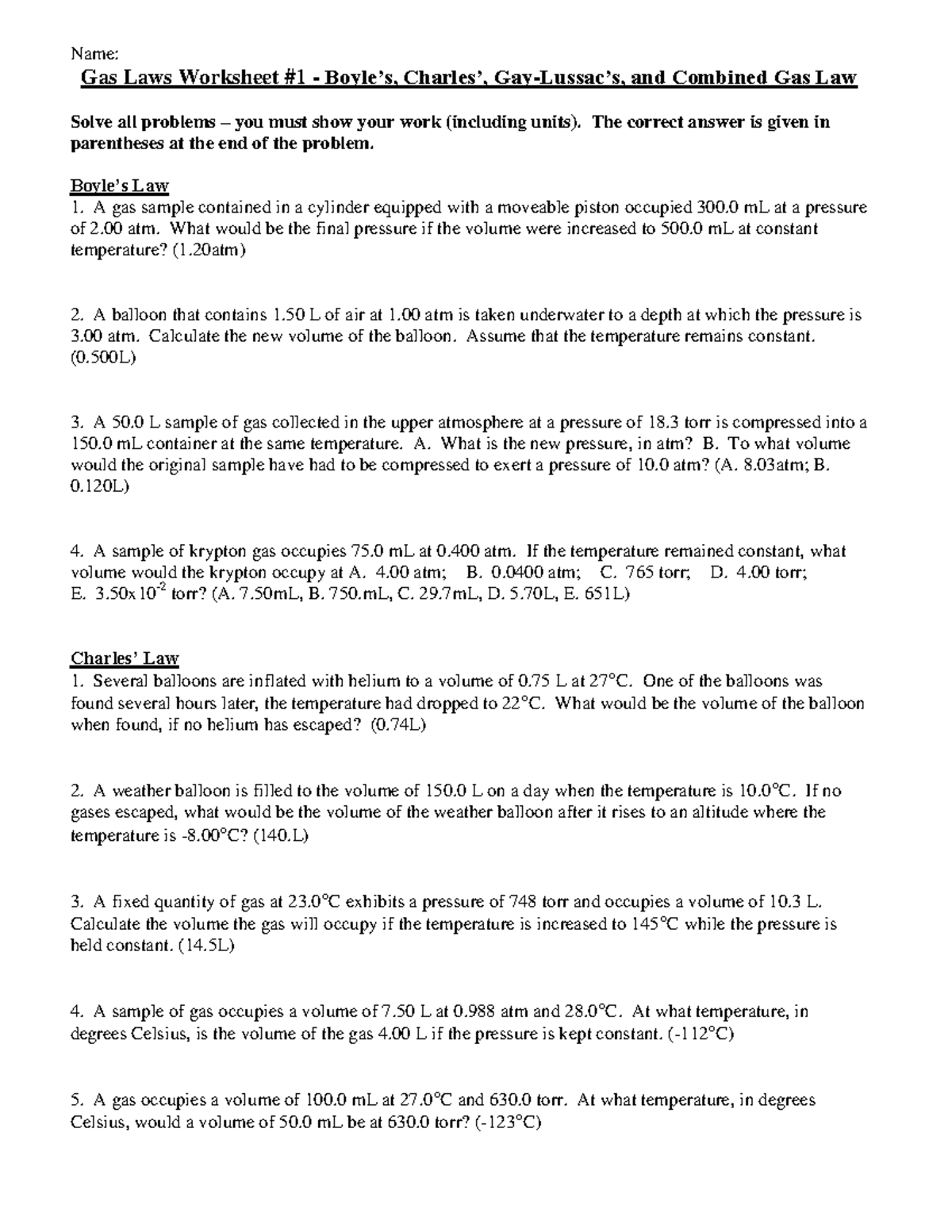
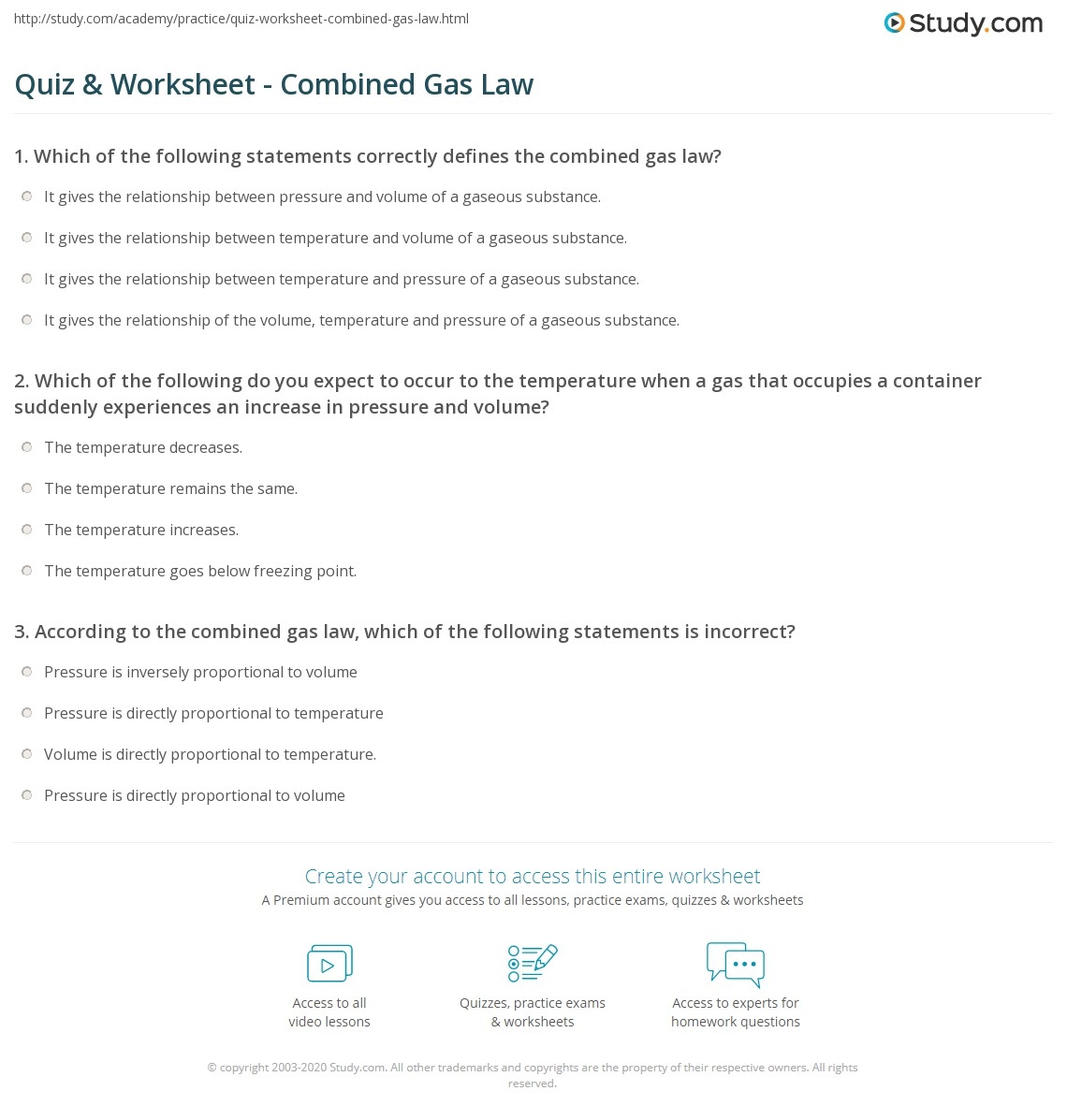
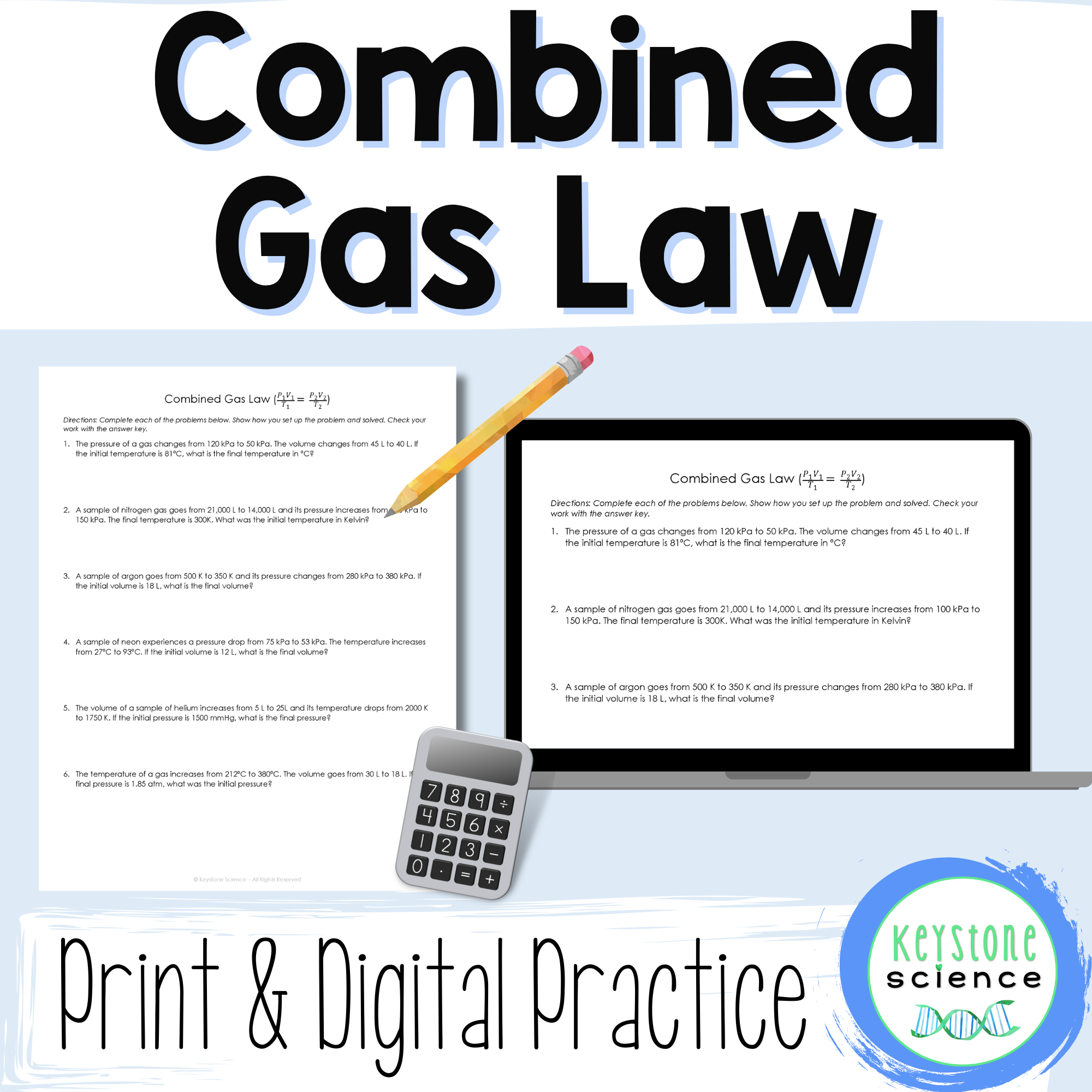
Combined Gas Law Worksheet offers a focused, hands‑on approach to mastering the relationships between pressure, volume, and temperature in gases. By engaging students with targeted practice problems, this worksheet turns abstract equations into concrete, solvable challenges, fostering confidence and a deeper understanding of how gases behave under changing conditions.
Understanding the Combined Gas Law
What is the Combined Gas Law?
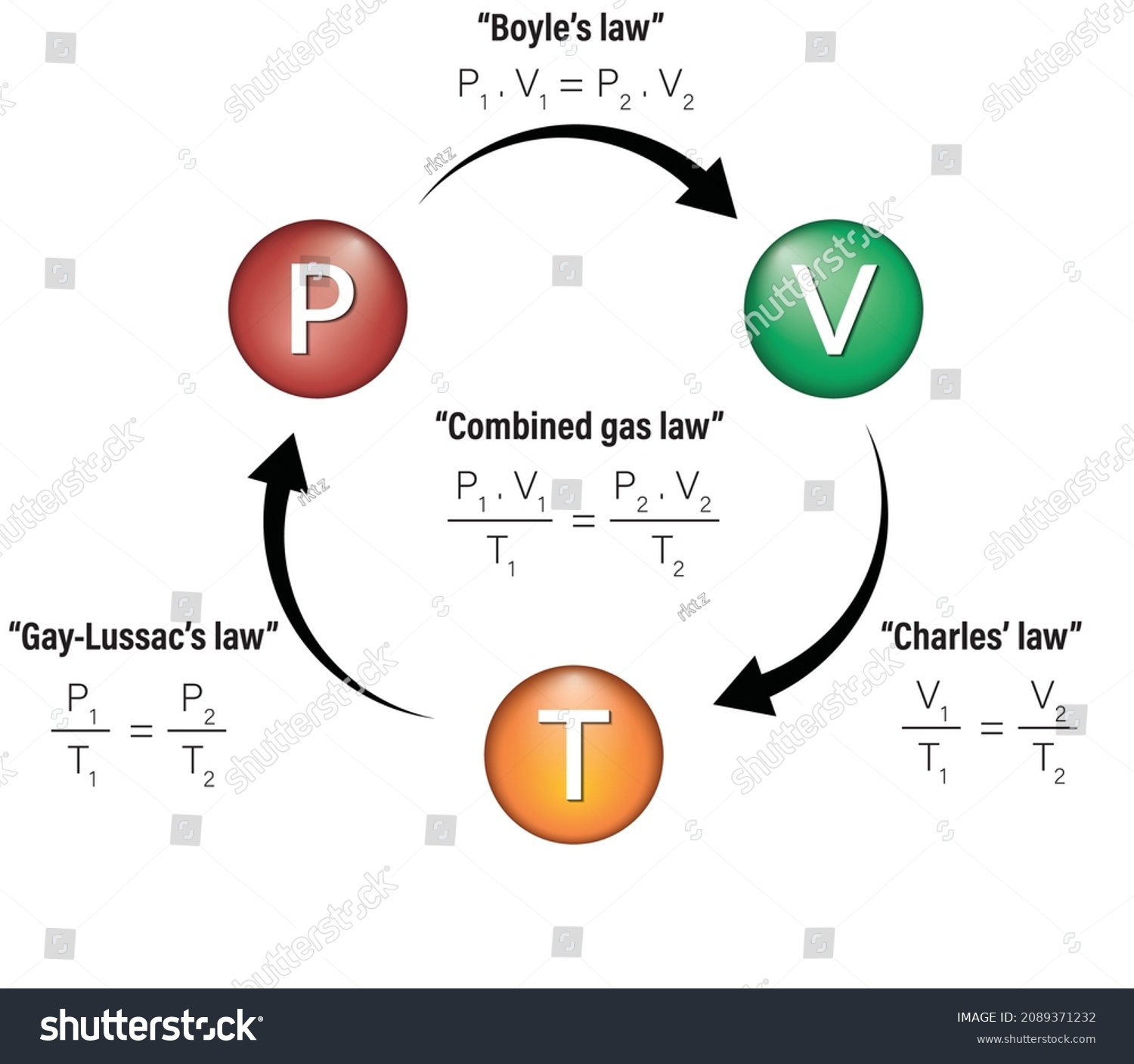
The Combined Gas Law merges Boyle’s, Charles’s, and Gay–Lussac’s laws into a single equation, expressing the proportional relationship among pressure (P), volume (V), and temperature (T) for a fixed amount of gas:
- P × V ÷ T = constant
This principle shows that when any two variables change, the third adjusts to keep the ratio constant, assuming the number of moles remains unchanged.
How the Variables Interact
Consider a sealed balloon at 25 °C (298 K) and 1 atm. If the temperature rises to 75 °C (348 K) while the pressure stays at 1 atm, the volume must increase proportionally. The law quantifies that increase, enabling students to predict outcomes before performing experiments.
Deriving the Formula
By starting from Boyle’s Law (P₁V₁ = P₂V₂) and Charles’s Law (V₁/T₁ = V₂/T₂) and eliminating the volume variable, students can derive the Combined Gas Law. A worksheet that asks learners to manipulate the equations themselves reinforces algebraic fluency and conceptual clarity.
Why Worksheets Matter for Mastery

Repetition and Retention
Regular, structured practice allows students to internalize variable relationships and common pitfalls. Repeated exposure to diverse problem sets ensures that the mental shortcuts required for quick, accurate calculations are ingrained.
Immediate Feedback
When worksheets provide solutions or guided answer keys, learners can assess their reasoning in real time. Immediate corrections help prevent the reinforcement of misconceptions and keep motivation high.
Key Components of a Great Combined Gas Law Worksheet

Clear Problem Statements
Each question should begin with a concise, context‑rich scenario, such as “A scuba diver’s tank starts at 200 psi and 5 L at 20 °C.” Clear wording reduces ambiguity and focuses attention on the relevant variables.
Diverse Problem Types
Include single‑variable questions, multi‑step scenarios, and real‑world applications. Variation challenges students to adapt the law to unfamiliar contexts, promoting flexible thinking.
Step‑by‑Step Solutions
Providing a scaffolded solution path—identify knowns, choose the correct equation form, solve algebraically—helps students trace each calculation step and recognize common algebraic errors.
Realistic Units
Incorporating SI units (P in atm, V in L, T in K) and conversion exercises teaches proper unit handling, a critical skill for scientific accuracy.
Step‑by‑Step Guide to Using the Worksheet

Read the Problem Carefully
Identify the given values, the unknown, and the temperature scale. A quick mental check prevents misreading of the scenario.
Identify Known Variables
List the knowns: P₁, V₁, T₁, P₂, V₂, or T₂. Organize them in a simple table to avoid confusion when substituting into the formula.
Set Up the Equation
Write the Combined Gas Law in the form that isolates the unknown. For example, to find V₂:
- V₂ = (P₁ × V₁ × T₂) ÷ (P₂ × T₁)
Solve for the Unknown
Perform the arithmetic carefully, using a calculator if needed. Verify that each step follows logically from the previous one.
Check Units and Reasonableness
Confirm that the final answer’s units match the expected output (e.g., liters for volume). Compare the result with the initial conditions—if it seems off, re‑evaluate the calculation for errors.
Real‑World Applications to Keep Students Engaged

Air Pressure in Balloons
Students can model how a helium balloon expands as it rises, illustrating the decrease in ambient pressure and the resulting volume increase.
Car Tire Inflation
Understanding how temperature changes during a long drive affect tire pressure helps learners connect theory with everyday life.
Chemistry Lab Experiments
Calculating the amount of gas needed to achieve a target pressure in a sealed flask demonstrates the law’s relevance to experimental design.
Space Exploration
Exploring how a spacecraft’s airlock must adjust pressure during docking illustrates the critical nature of accurate gas law calculations in high‑stakes environments.
Common Pitfalls and How to Avoid Them
Unit Inconsistency
Mixing atm with kPa or Celsius with Kelvin leads to erroneous results. Always convert temperatures to Kelvin and pressures to a single consistent unit before plugging values into the equation.
Incorrect Variable Placement
Substituting known values into the wrong side of the equation can reverse the calculation. Practice arranging the formula carefully and double‑check the variable positions.
Neglecting to Convert Temperature to Kelvin
Since the gas law requires absolute temperature, failing to convert Celsius to Kelvin will produce misleading answers. Remind students to add 273.15 to any Celsius value.
Tips for Teachers and Parents

Scaffold the Worksheet
Begin with guided problems, gradually removing hints as students gain confidence. This incremental approach prevents overwhelm and builds competence.
Use Visual Aids
Charts showing how pressure, volume, and temperature change together help visual learners grasp the proportional relationships at a glance.
Encourage Peer Review
Having students exchange worksheets for peer evaluation fosters collaborative learning and exposes them to alternative problem‑solving strategies.
Creating Your Own Worksheet Variations

Altering Difficulty Levels
Adjust the complexity by changing the number of unknowns or by introducing additional variables, such as the amount of gas (n) to explore the ideal gas law’s connection.
Integrating Technology
Incorporate spreadsheet models where students can manipulate input values and instantly see the impact on the outcome. This hands‑on interaction enhances engagement.
Collaborative Projects
Design group challenges where teams must design a small experiment to test the law, collect data, and then solve the corresponding worksheet questions.
Resources to Expand Learning

Online Calculators
Encourage students to use reputable gas law calculators for verification, while emphasizing the importance of understanding the underlying math.
Simulations
Virtual labs that allow manipulation of pressure, volume, and temperature provide interactive reinforcement of theoretical concepts.
Further Reading
Direct students to concise explanatory texts that delve into the derivation of the combined law and its historical context, enriching their appreciation of the subject.
Conclusion
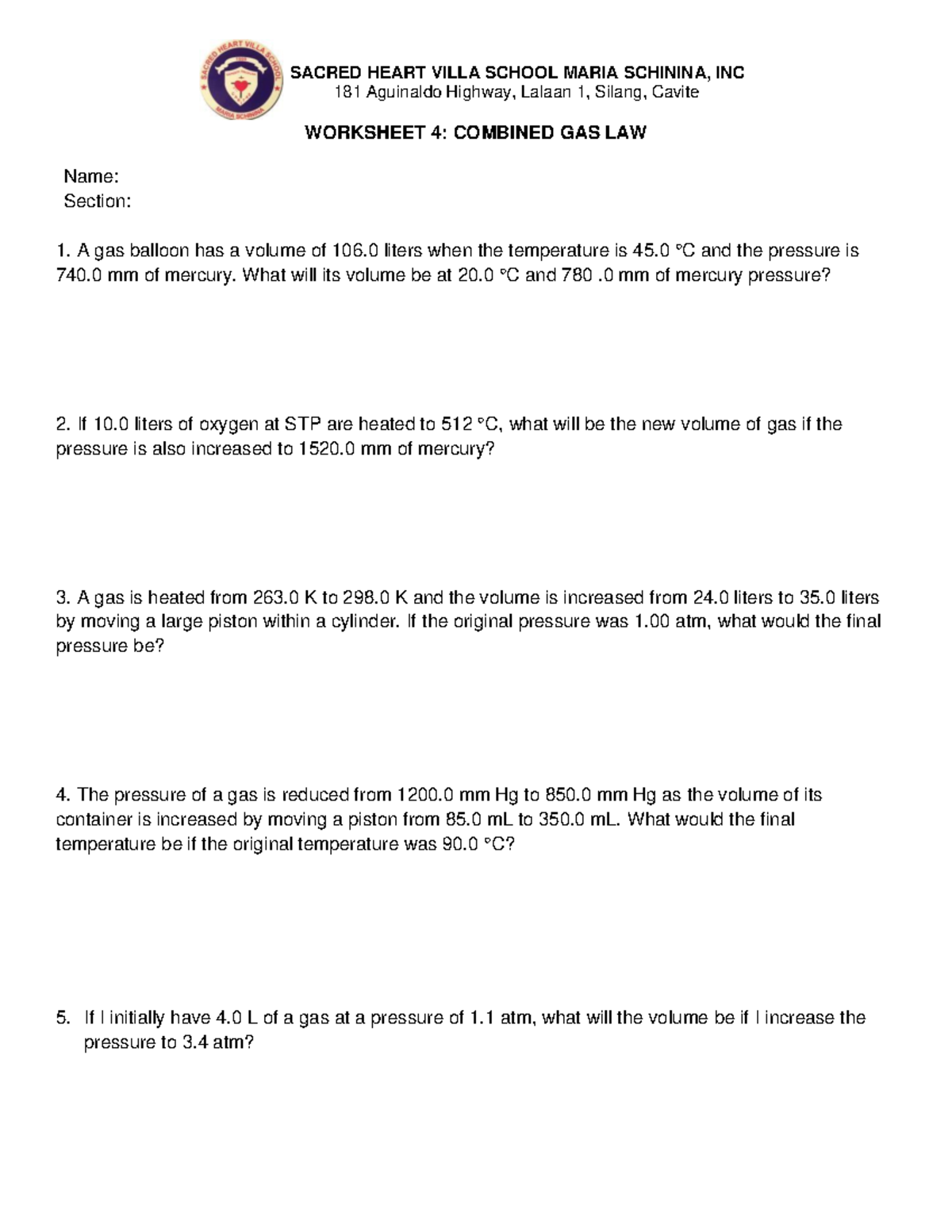
Mastering the Combined Gas Law Worksheet equips learners with the analytical tools needed to predict gas behavior in a wide range of scenarios—from everyday experiences like inflating tires to complex missions such as spacecraft docking. By focusing on clear problem statements, diverse contexts, and step‑by‑step guidance, students develop robust problem‑solving habits. With consistent practice, careful unit management, and real‑world applications, the Combined Gas Law becomes not just an academic exercise but a practical framework for understanding the dynamic world of gases.