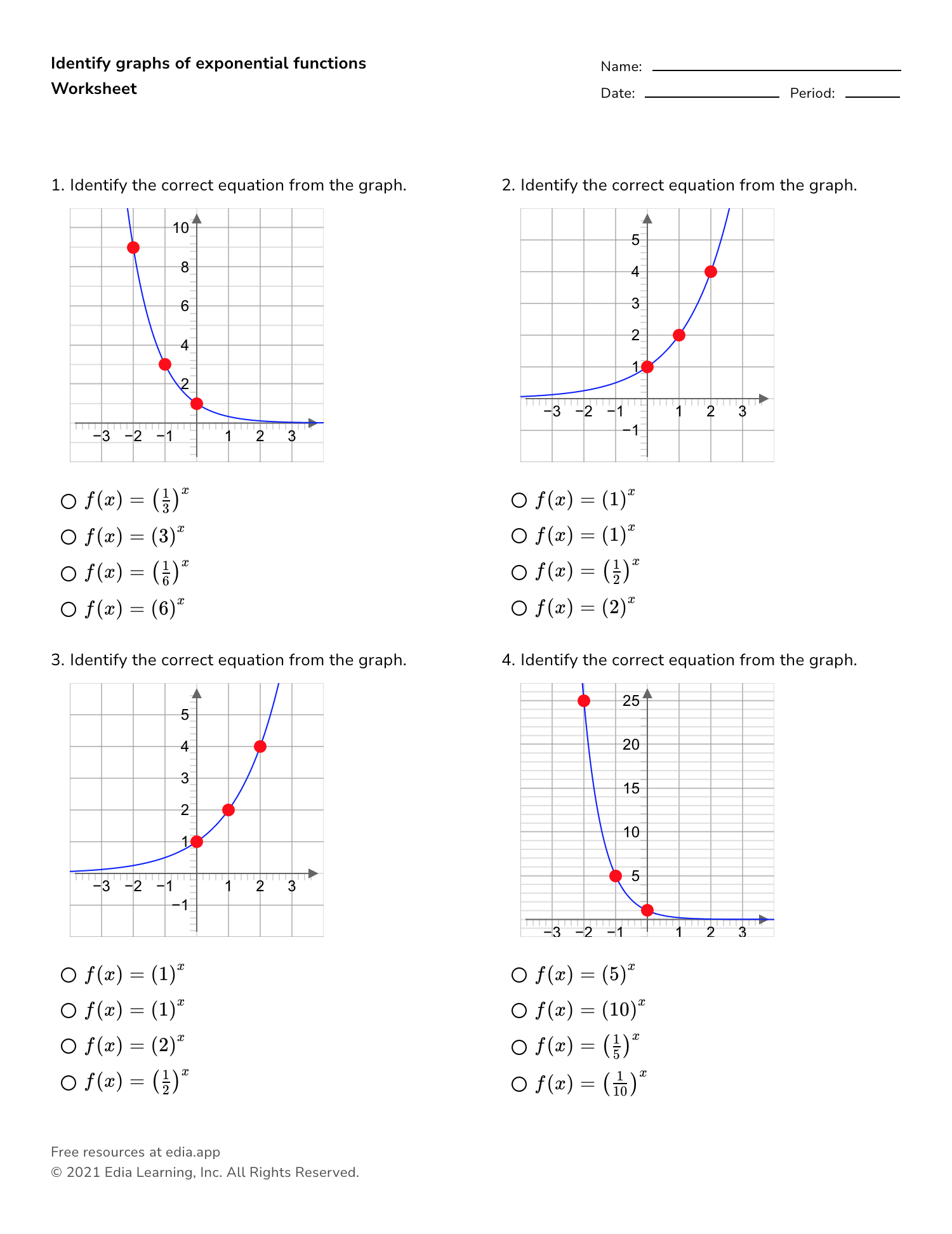
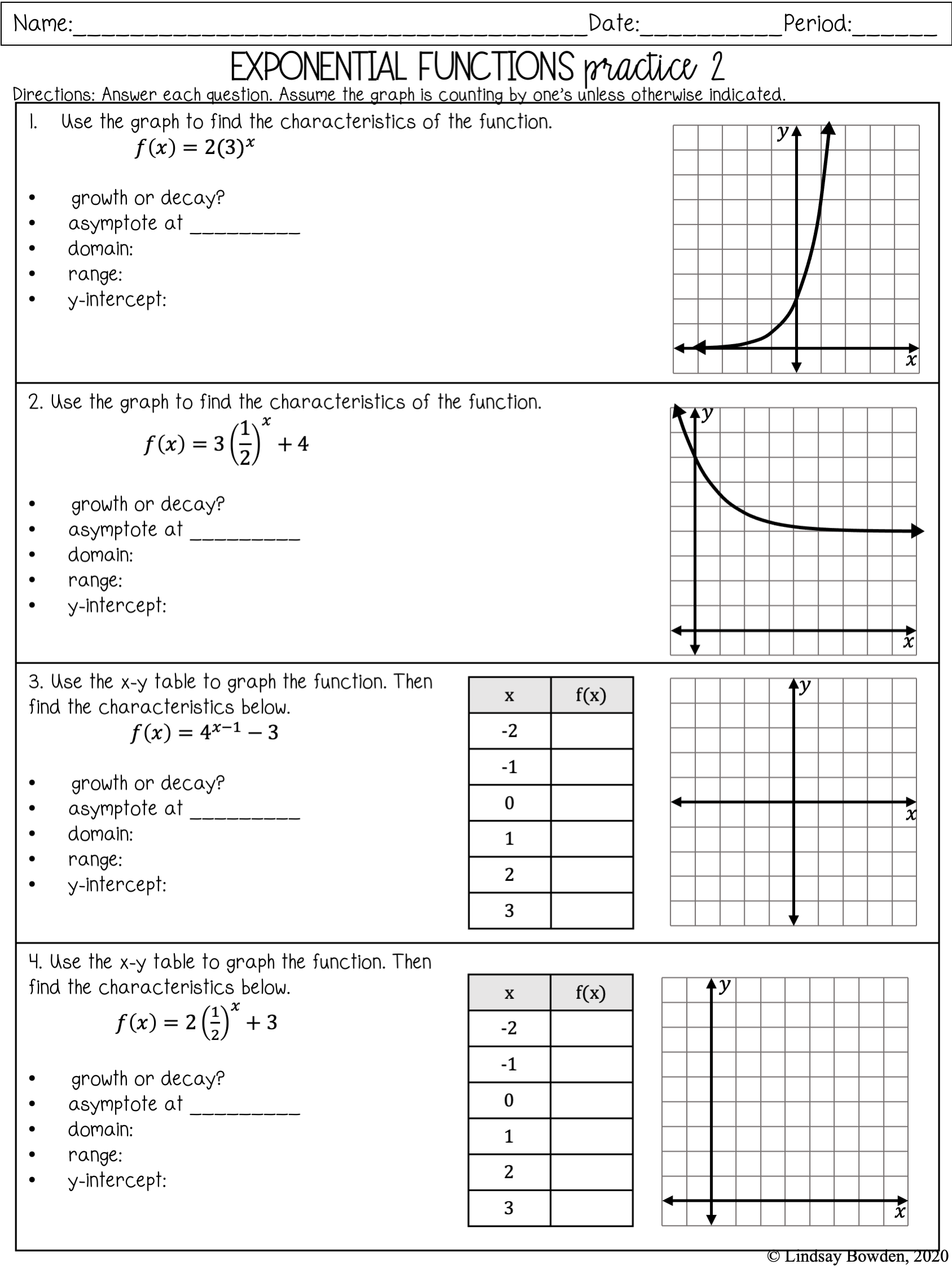
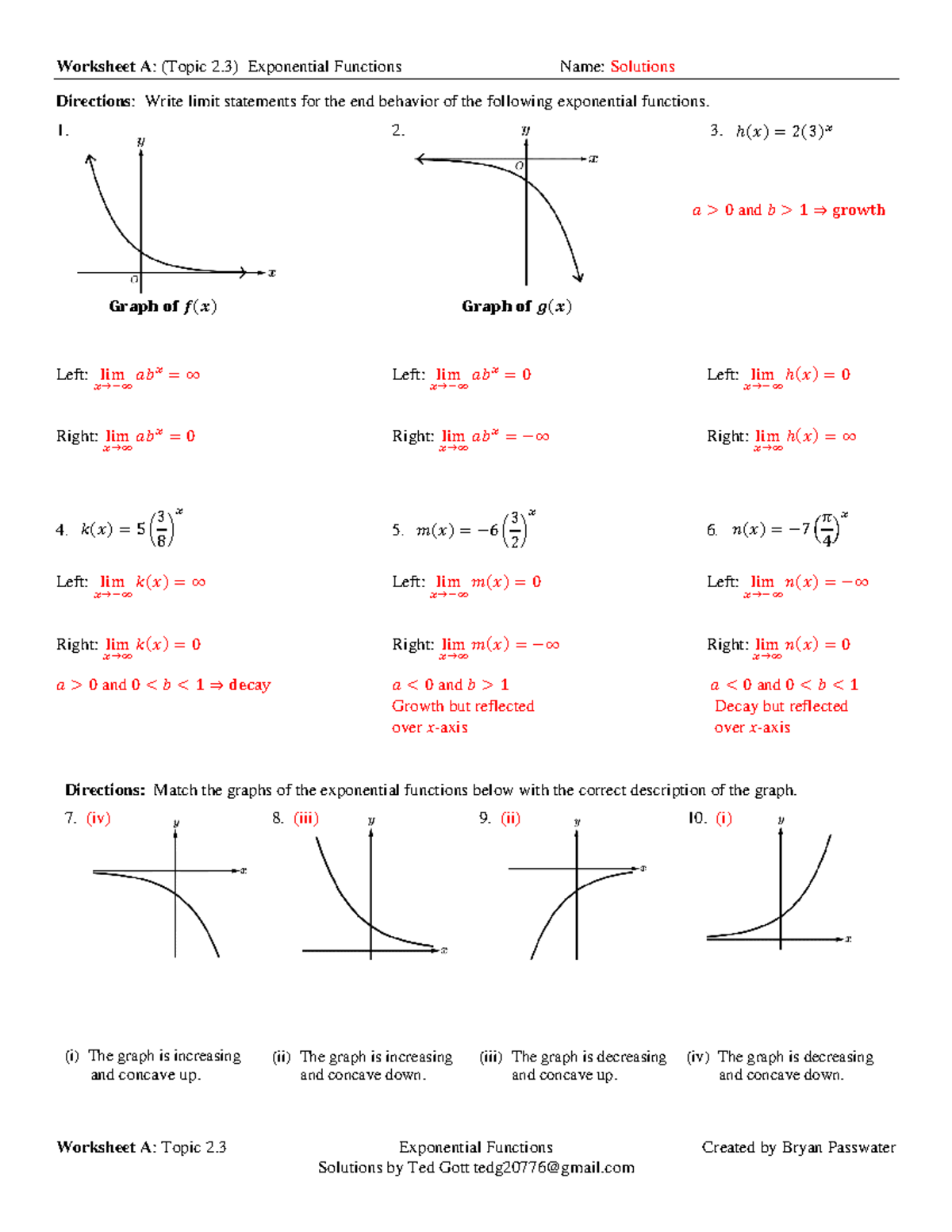
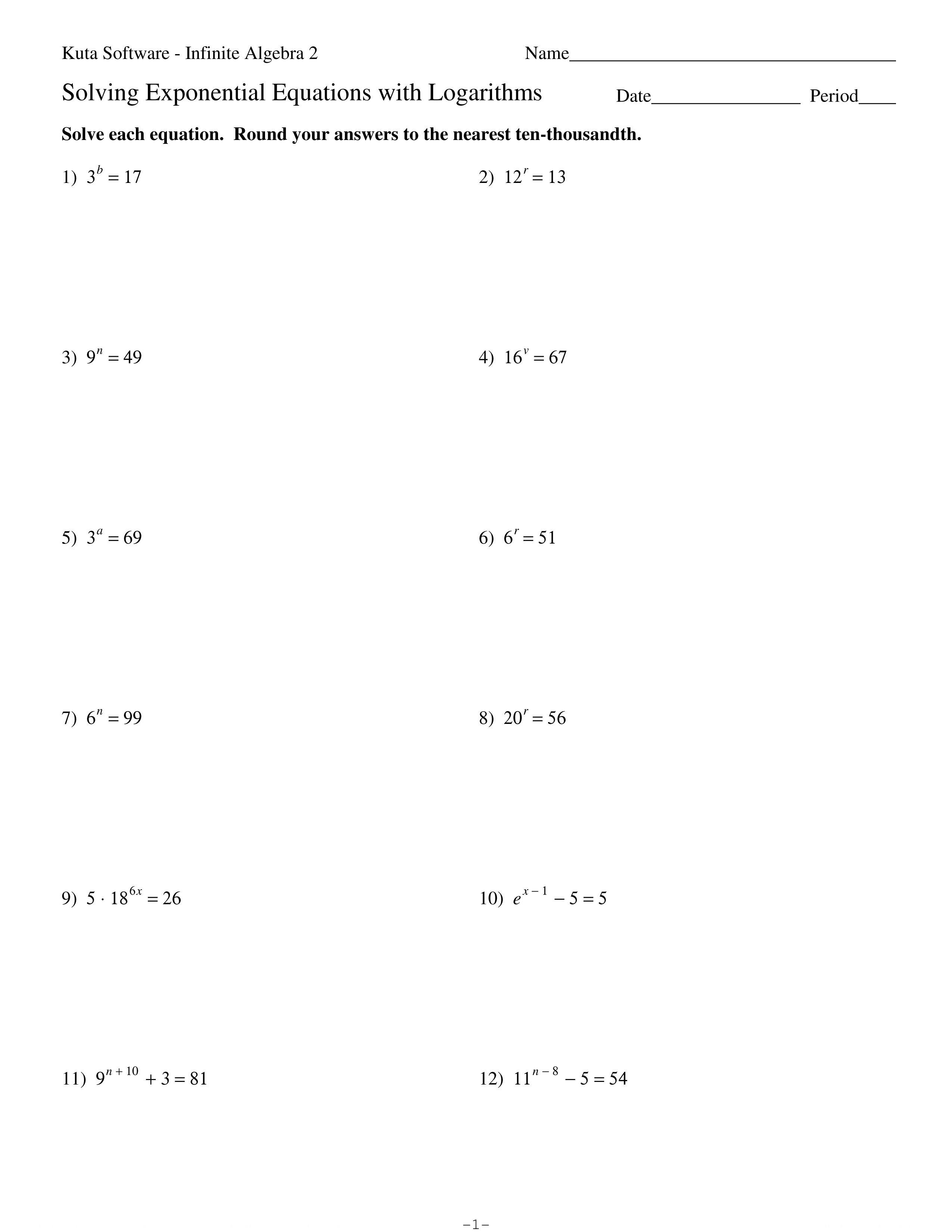
Exponential Functions Worksheet Answers are the golden key to unlocking confidence in algebra and calculus. I remember the first time I stared at a sheet of exponential problems, feeling the urge to scream, only to realize that with the right strategy, the answers come neatly to light. In this post, I’ll walk you through the process of tackling those worksheets, share real‑world examples, and give you actionable tips that I’ve learned from years of teaching and problem‑solving.
Understanding the Core Concepts Behind Exponential Functions
What Makes an Exponential Function Exponential?
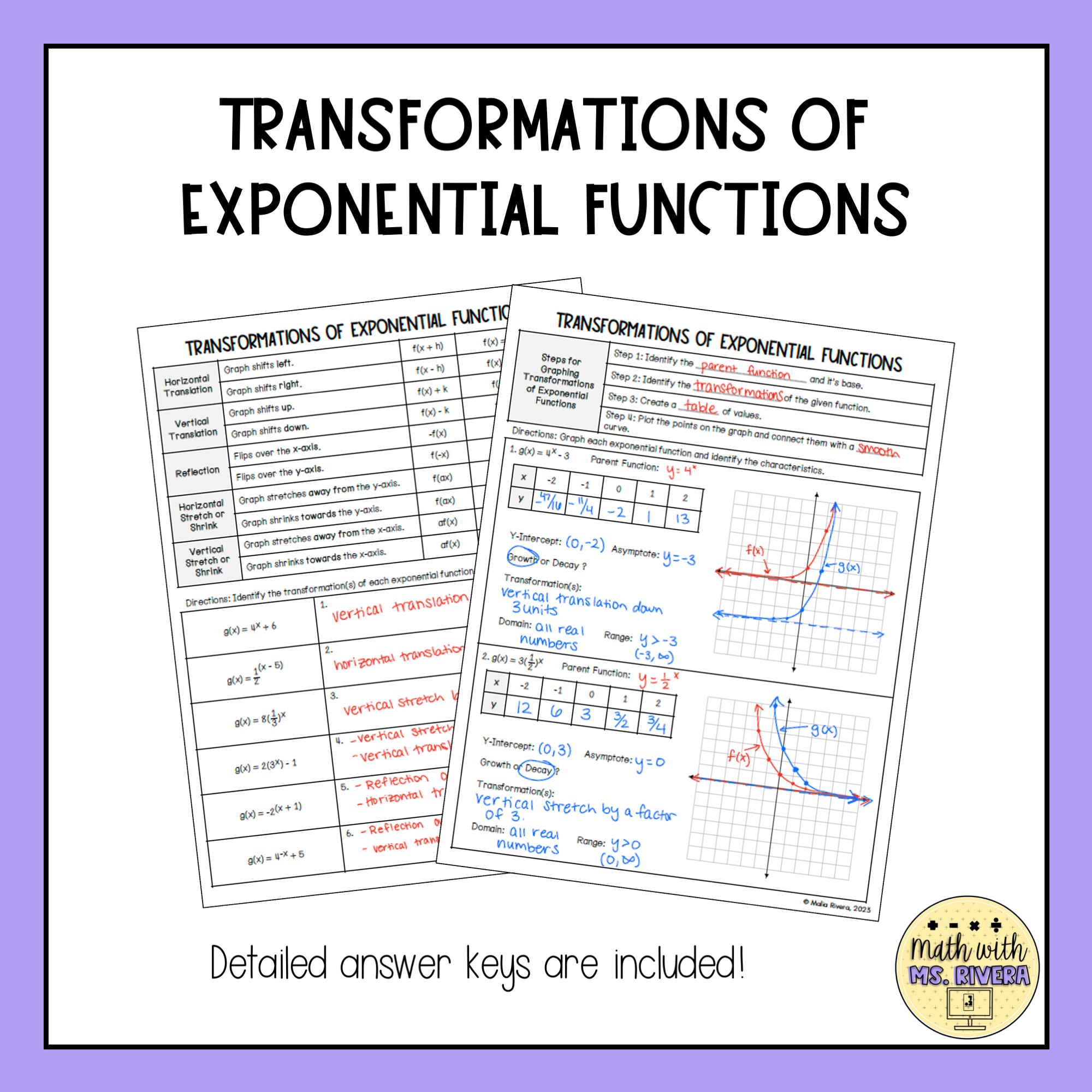
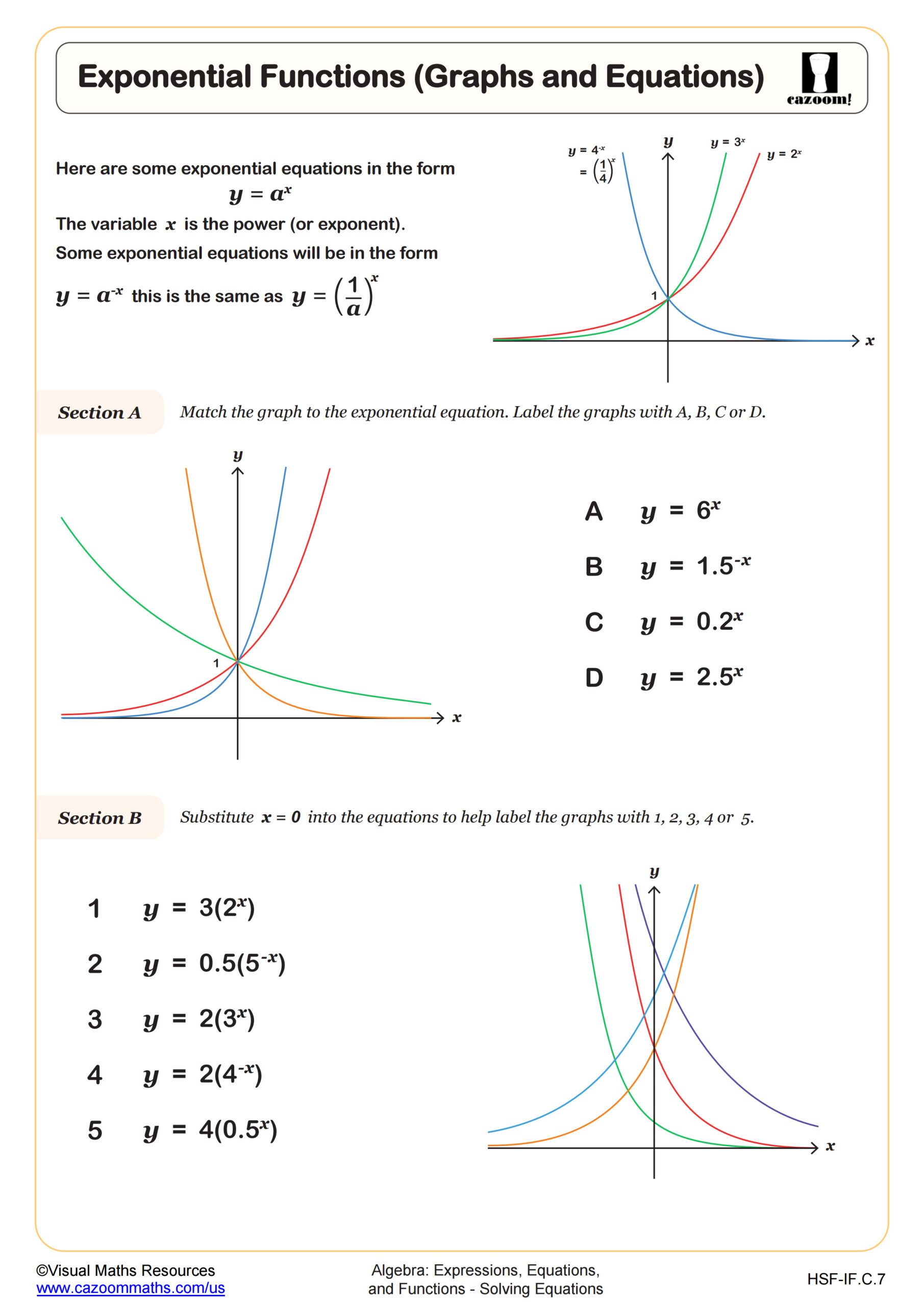
When we talk about exponential functions, we’re dealing with equations of the form \(f(x) = a^\,x\), where the base \(a\) is a constant and \(x\) is the exponent. The most common base in worksheets is 2 or e, but any positive number except 1 works. Recognizing that the variable sits in the exponent is the first step toward mastering the problems.
Key Properties That Simplify Calculations
- Product Rule: \(a^m \cdot a^n = a^m+n\)
- Quotient Rule: \(\dfraca^ma^n = a^m-n\)
- Power of a Power: \(\bigl(a^m\bigr)^n = a^mn\)
- Logarithmic Conversion: \(\log_a(b) = \dfrac\ln b\ln a\)
Why Logarithms Are Your Best Friends
When the variable is in the exponent, we often need to apply the inverse operation—logarithms—to isolate it. For example, solving \(2^x = 32\) requires taking \(\log_2\) of both sides, yielding \(x = \log_232 = 5\). Mastering natural logs (\(\ln\)) and common logs (\(\log_10\)) will save you a lot of time on those worksheets.
Common Problem Types You’ll Find in the Worksheets

1. Direct Evaluation of Exponential Expressions
These questions ask you to compute a numeric value, like \(3^4 + 2^3\). Remember to follow the order of operations and double‑check your power calculations. A quick mental trick: \(3^4 = 81\) and \(2^3 = 8\), so the sum is 89.
2. Solving for the Variable in an Exponential Equation
Example: Solve \(5^x = 125\). Since \(125 = 5^3\), it follows that \(x = 3\). If the equation is not so obvious, apply logarithms: take \(\ln\) of both sides and solve for \(x\).
3. Systems of Exponential Equations
Sometimes you’ll encounter two or more equations sharing the same variable. For instance, \(2^x = 8\) and \(3^y = 27\). These are separate; however, a system might involve \(2^x = 3^y\), requiring a more creative approach. Rewrite both sides with a common base or take logarithms of both sides: \(x\ln 2 = y\ln 3\).
4. Exponential Growth and Decay Models
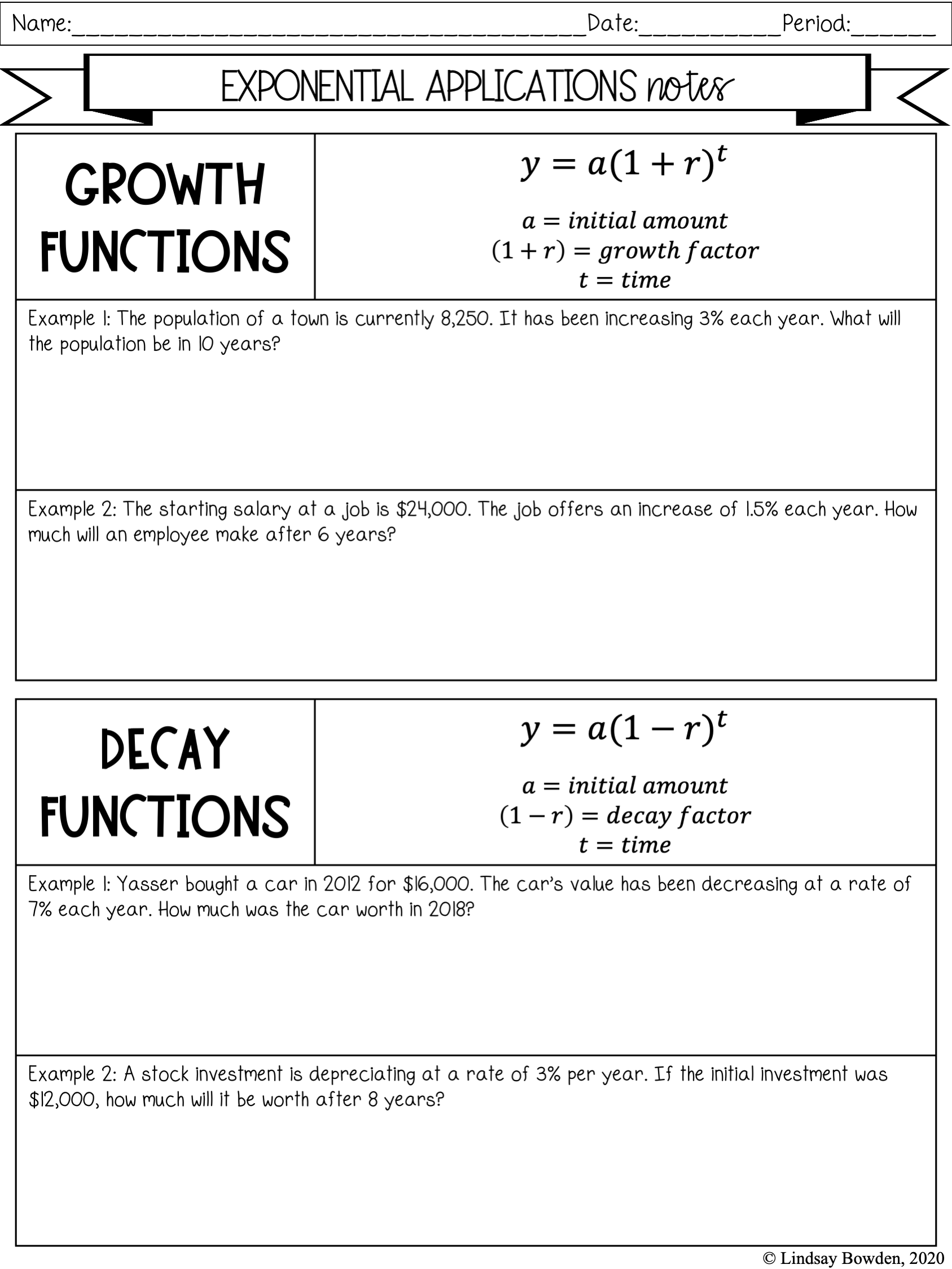
Real‑world problems often model population growth or radioactive decay. A typical form is \(P(t) = P_0e^kt\). Understanding how to solve for \(k\) or \(t\) is essential, and the worksheets frequently test these skills.
A Step‑by‑Step Guide to Answering Worksheet Problems

Step 1: Identify the Type of Problem
Quickly categorize whether you’re dealing with a pure evaluation, a variable solving, or a modeling question. This determines the tools you’ll need.
Step 2: Simplify the Expression
Apply power and product rules to reduce the expression before you attempt to evaluate it. For instance, \(4^3 \times 4^2 = 4^5\). Reducing helps avoid calculation errors.
Step 3: Use Logarithms When Necessary
When the variable is hidden inside an exponent, take the logarithm of both sides. For a base \(a\), use \(\log_a\). For most calculators, you can use natural logs and divide: \(\dfrac\ln b\ln a\).
Step 4: Double‑Check with a Calculator
Even though these worksheets are meant to reinforce mental math, a quick calculator check can save you from a slip. Especially for growth models, rounding errors can accumulate.
Step 5: Verify the Answer in Context
Plug the answer back into the original equation to confirm it satisfies the problem. For example, if you solved \(x = 5\), verify by substituting back into the equation \(2^x = 32\). A quick check ensures that you didn’t misapply a rule.
Real-World Applications That Make the Answers Come Alive
Population Growth
Suppose a city’s population follows \(P(t) = 100,000 \cdot 1.05^t\), where \(t\) is years. If you’re asked to find when the population will reach 150,000, set up \(100,000 \cdot 1.05^t = 150,000\). Divide both sides by 100,000 to get \(1.05^t = 1.5\). Taking \(\log_1.05\) of both sides gives \(t = \dfrac\log 1.5\log 1.05 \approx 8.5\) years. That’s a neat, practical application of the worksheet skills!
Radioactive Decay
When dealing with half‑life, the formula \(N(t) = N_0 \left(\tfrac12\right)^t/T_1/2\) pops up. If you’re asked to find the time when the substance reduces to a third of its initial quantity, solve \(\left(\tfrac12\right)^t/T_1/2 = \tfrac13\). Taking natural logs gives \(t = T_1/2 \cdot \dfrac\ln(1/3)\ln(1/2)\).
Compound Interest
The formula \(A = P(1 + r)^n\) mirrors exponential growth. A worksheet might ask, “What is the balance after 12 months with a 5% yearly rate?” Simply compute \(P(1 + 0.05)^1\) for monthly compounding. Understanding these applications helps cement the algebraic steps in your mind.
Common Pitfalls and How to Avoid Them
1. Forgetting the Base of the Logarithm
When taking logs, it’s tempting to use \(\log\) (base 10) without adjusting. Always convert: \(\log_ab = \dfrac\log_10b\log_10a\). Skipping this step can yield wrong answers.
2. Misapplying the Order of Operations
Remember PEMDAS: Parentheses, Exponents, Multiplication/Division, Addition/Subtraction. In the expression \(2^3 + 4 \times 2^2\), compute the exponentials first: \(8 + 4 \times 4 = 8 + 16 = 24\).
3. Ignoring Negative Exponents
Expressions like \(5^-2\) are equal to \(\dfrac15^2\). A worksheet might test this by asking for the value of \(\dfrac15^2\). Don’t overlook this rule.
4. Overlooking the Need for a Common Base
When solving systems like \(2^x = 3^y\), you might attempt to equate exponents directly. Instead, transform each side into a common base or use logarithms to linearize the relationship.
Practical Tips for Mastering Worksheet Answers

1. Create a Cheat Sheet of Exponent Rules
Having a quick reference for product, quotient, and power rules helps reduce mental load during timed worksheets.
2. Practice with Flashcards
Write down common exponential identities on one side and their applications on the other. Reviewing daily cements the patterns.
3. Use Online Calculators for Confirmation
When stuck, double‑check your answer with a trusted calculator. This is especially useful for large exponents like \(9^7\).
4. Solve Problems in Context
Instead of abstract numbers, frame problems in real-life scenarios. This builds intuition and reduces the feeling of “just numbers” anxiety.
5. Review Past Mistakes
Keep a log of questions you answered incorrectly. Identify the common theme—whether it’s a misapplied rule or a calculation slip—and focus on that area.
Sample Practice Problems to Cement Your Knowledge

Problem 1: Evaluate \(7^3 – 2^4\)
Compute \(7^3 = 343\) and \(2^4 = 16\). Subtract to get \(343 – 16 = 327\).
Problem 2: Solve \(10^x = 1000\)
Recognize \(1000 = 10^3\), so \(x = 3\).
Problem 3: If \(4^y = 256\), find \(y\).
Since \(256 = 4^4\), \(y = 4\).
Problem 4: Find the time \(t\) when a population doubling occurs, given \(P(t) = P_0 2^t/5\).
Set \(P(t) = 2P_0\), so \(2^t/5 = 2\). Taking log base 2: \(t/5 = 1\), thus \(t = 5\) years.
Problem 5: Solve the system \(e^x = 5\) and \(e^2x = 25\).
Both equations are consistent since \(e^2x = (e^x)^2 = 5^2 = 25\). Thus, \(x = \ln 5\).
Conclusion: Turning Answers into Confidence

Mastering Exponential Functions Worksheet Answers is more than memorizing rules—it’s about building a toolkit that lets you approach each problem methodically. By recognizing the structure of exponential equations, applying logarithmic techniques, and validating your results, you turn uncertainty into certainty. Whether you’re tackling growth models, decay scenarios, or pure algebraic challenges, the steps outlined above will guide you from confusion to clarity. Keep practicing, stay curious, and remember that every exponential puzzle is a stepping stone toward greater mathematical fluency. Happy solving!