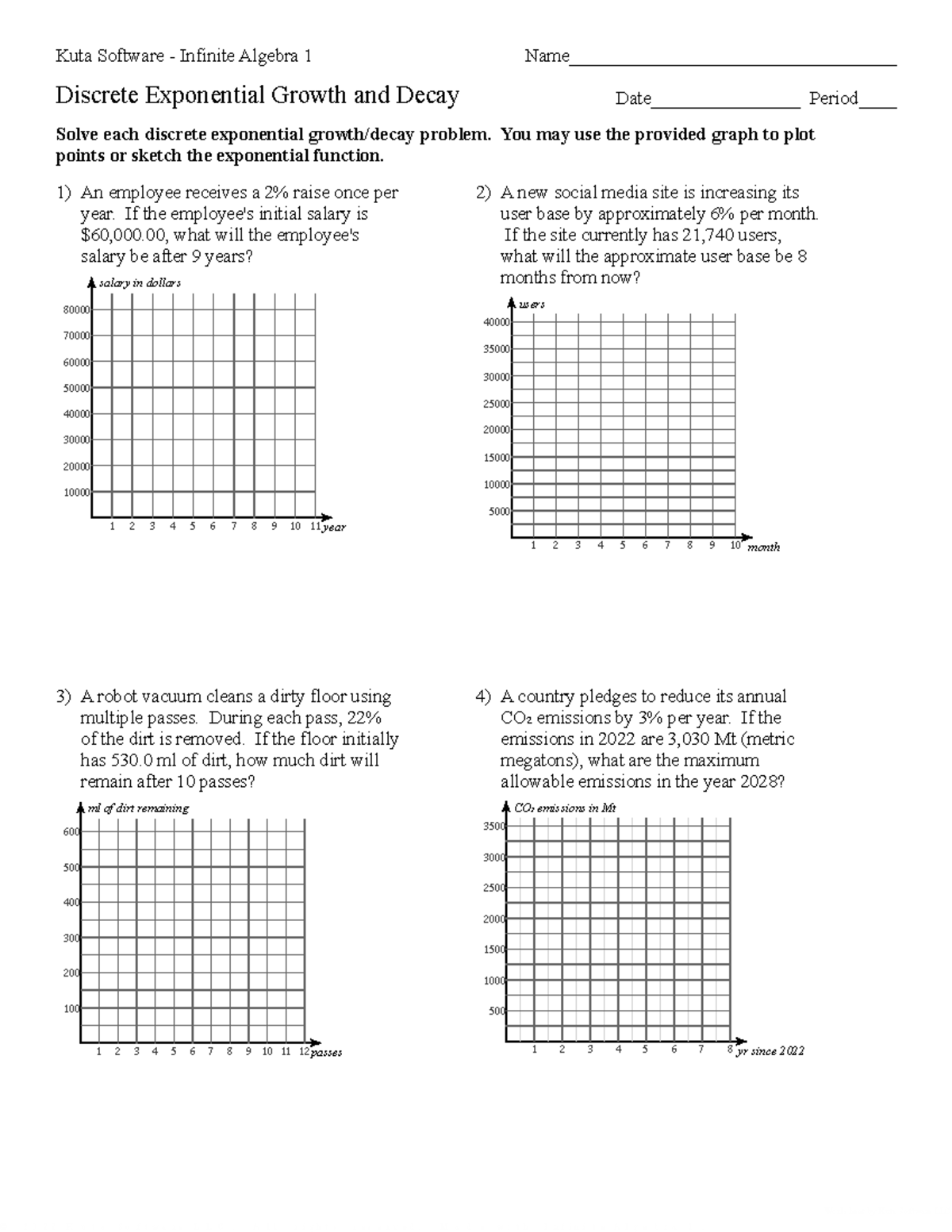
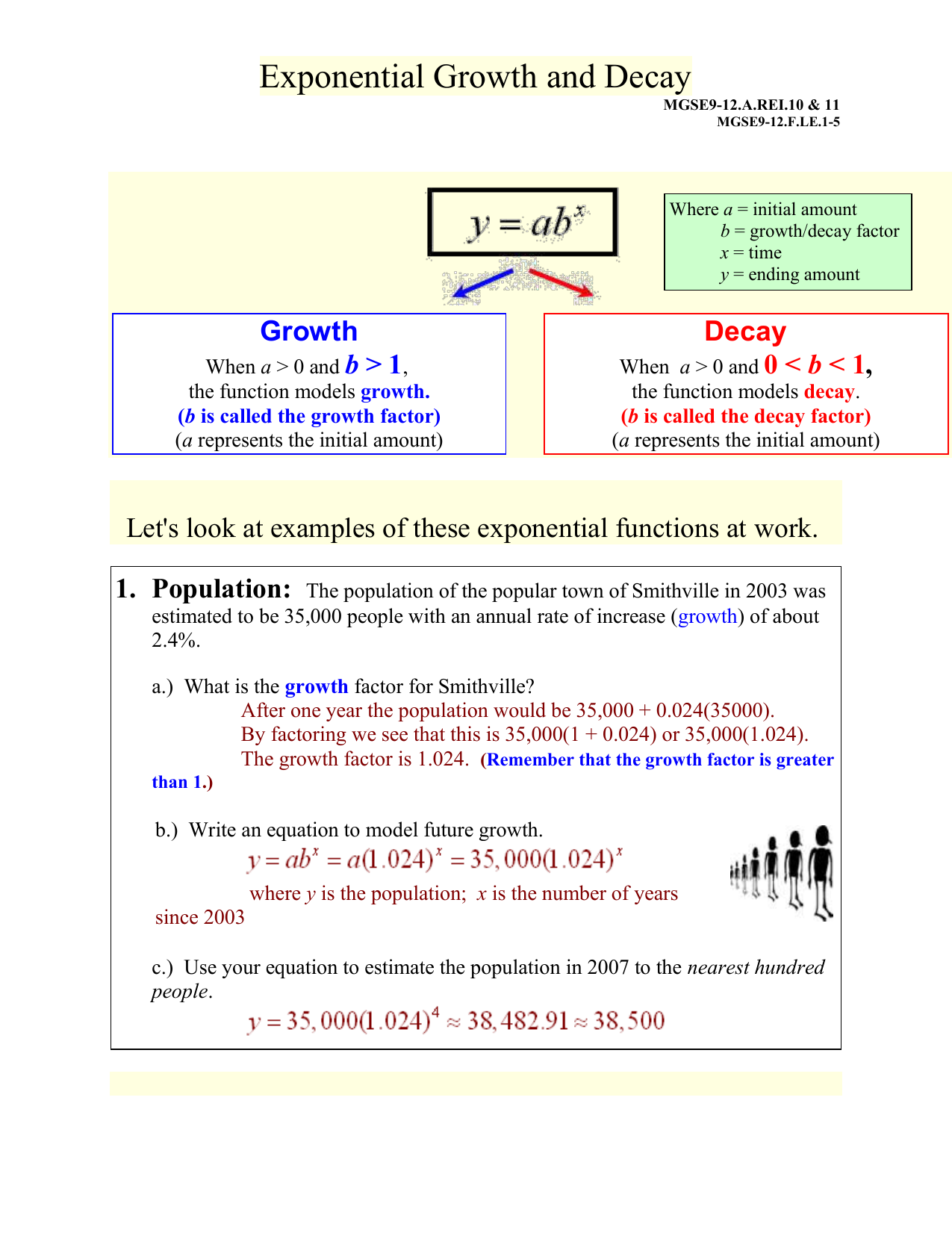
Exponential Growth Decay Worksheet is your golden ticket to mastering the wild rollercoaster of numbers that either balloon like a popcorn storm or shrink faster than a magician’s rabbit—without turning your brain into a mush of confusion.
Why This Worksheet is More Fun Than a Math Party

Picture this: you’re at a birthday party, and someone pulls out a cake that keeps multiplying with every slice you take. That’s exponential growth in disguise. Now imagine that same cake disappearing half as fast every time you stare at it. That’s exponential decay. Our worksheet lets you play with both without actually losing any cake.
Instant Math Magic
With a few numbers, a little algebra, and a pinch of curiosity, you can predict the future of a bank account, a population of rabbits, or even the amount of coffee left in your mug. No crystal ball required.
It’s Not a Puzzle – It’s a Puzzle-Shooter
Instead of solving riddles, you’ll calculate real-life scenarios: how long until a viral meme saturates the internet, or when a radioactive sample will shrink to harmless levels. The worksheet turns math into a game, and every answer is a victory lap.
What to Expect Inside the Worksheet

Below we break down the sections you’ll find in the most beloved exponential worksheet, and why each one deserves a spot in your study arsenal.
Section 1: The Classic Growth Formula
y = a(1 + r)^t—the bread-and-butter equation. You’ll learn how to:
- Identify the initial amount, a.
- Determine the growth rate, r, expressed either as a percentage or a decimal.
- Calculate time, t, in the units that make sense for your problem (days, years, etc.).
Section 2: The Decay Counterpart
When things vanish—like your motivation after a pizza binge—use y = a(1 – r)^t. This part teaches you how to:
- Set a decay rate that can be more than 50% if you’re dealing with fast‑evolving tech gadgets.
- Figure out “half-life” situations with a handy shortcut: t½ = ln(0.5) / ln(1 – r).
Section 3: Real‑World Applications (and a few jokes)
These examples make the numbers come alive:
- Population Explosion: Predict how many squirrels will rule your neighborhood if each pair produces another pair every year.
- Investment Growth: How long till your savings double if the interest rate is 7% compounded annually.
- Radioactive Decay: Determine how many days before your pizza’s calories become a harmless myth.
- Social Media Virality: Estimate how fast a meme will spread if every viewer shares it with 3 new friends each day.
Section 4: Graphing the Fun
Seeing the curve is like watching a dramatic plot twist. A quick graph shows:
- Linear vs. exponential growth side by side—why the line looks so flat in comparison.
- Decay curves that eventually plateau at zero, which can be a visual cue for “don’t worry, it’ll be fine soon.”
- How to use online graphing tools or spreadsheet software to animate the data.
Tips for Mastering the Worksheet

These practical tips will turn you from a “math mortal” into a “exponential superhero.”
1. Keep Units Consistent
Time, rate, and initial values must share compatible units. Mixing minutes and years will give you a result that feels like a bad joke. Stick to one unit system until you’re comfortable.
2. Use the “Rule of 70” (or 69) for Quick Estimates
To approximate doubling time, divide 70 by the growth rate percentage. For decay, it’s handy for “half-life” predictions. It’s not perfect but works like a cheat code.
3. Practice with “What If” Scenarios
Change the growth rate from 1% to 10% in a single problem. Notice how dramatically the outcome shifts. It’s a great way to see how sensitive exponential functions are to small changes.
4. Visualize the Curve in Your Head
Try to imagine a steep hill versus a gentle slope. That mental image will help you spot errors before you even punch a number into a calculator.
5. Cross‑Check with Online Calculators
Even the smartest minds need a second opinion. Use reputable math websites to verify your results and catch sneaky errors.
Common Pitfalls & How to Avoid Them

Even seasoned mathematicians trip over a few classic snags. Let’s dodge them together.
Misinterpreting Percentages
Remember, 5% growth is 0.05 in decimal form. A misplaced decimal point can make your result feel like a sitcom rerun—predictable and wrong.
Forgetting the Base (1 + r) or (1 – r)
Leaving out the “1 + r” or “1 – r” will turn exponential into linear. That’s a plot twist you never asked for.
Applying Decay to Growth Problems
When a problem is about accumulation, don’t accidentally use the decay formula. Mixing them up is like putting salt on a dessert—confusing and unappetizing.
Not Using Natural Logarithms for Decay
When working with continuous decay, use the natural log (ln). Trying to approximate with common logs will give a slightly off result—think of it as a half‑finished joke.
When to Use Exponential Calculations in Your Life

Exponential logic isn’t just for math class—it’s a life hack. Here are some everyday contexts where it shines.
Health & Fitness
Track muscle growth or calorie burn over time using a growth/decay model to set realistic goals and avoid disappointment.
Finance
Compound interest, loan amortization, and retirement planning all rely on exponential equations. The worksheet turns those intimidating numbers into manageable steps.
Technology Adoption
From smartphones to electric cars, adoption curves follow exponential patterns. Understanding them helps marketers and investors spot emerging trends.
Environmental Science
Population dynamics of bacteria, algae blooms, and carbon emissions use exponential decay or growth. A worksheet helps environmentalists make predictions that could save the planet—or at least keep you from burning out.
Sample Problems to Try Right Now

Ready to get your hands dirty? Pick a problem from each category and see how the worksheet guides you to the answer.
Problem A: Bank Account Doubling
Suppose you invest $1,000 at an annual interest rate of 5% compounded yearly. How many years will it take for your money to double?
- Answer: Use the rule of 70: 70 ÷ 5 ≈ 14 years.
- Verification: Plug into the formula and check the calculation.
Problem B: Decaying Radioisotope
A sample has a half-life of 3 years and currently weighs 200 grams. After 6 years, how much remains?
- Answer: After two half-lives, 200 ÷ 2 ÷ 2 = 50 grams.
- Verification: Use the decay formula.
Problem C: Viral Meme Spread
If a meme is shared by each viewer with 4 new people each day, how many total viewers will there be after 7 days, starting from 1 viewer?
- Answer: 1 × 5^7 ≈ 78,125 viewers.
- Tip: Recognize the base 5 as 1 + 4 shares.
Why This Worksheet Stays Fresh for Students and Professionals

Unlike static textbook pages, this worksheet is a living document. It adapts to different difficulty levels, offers interactive charts, and encourages creative thinking. By mastering it, you’re not just learning a formula—you’re learning how to anticipate future trends, make smarter decisions, and impress friends with your newfound exponential prowess.
Wrap‑Up: The Power of Exponential Thinking

From the way your savings grow to the way a meme spreads, exponential growth and decay are everywhere. The worksheet serves as your trusty guide to navigate these wild number highways. So grab a pencil, a cup of coffee, and let the numbers do the dancing. And remember: with exponential math, small changes can make a big splash—so keep the curiosity flowing and the humor high.