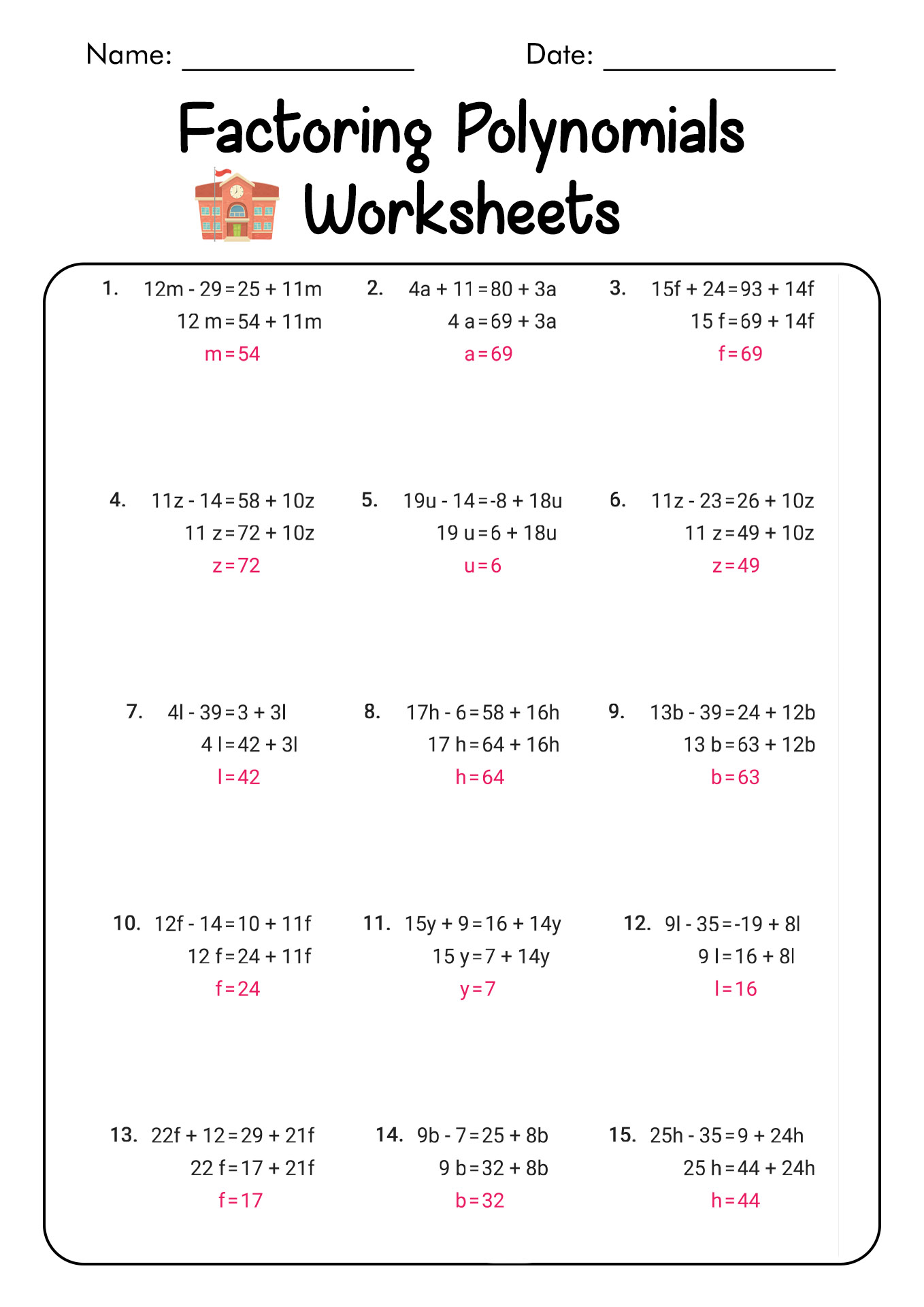
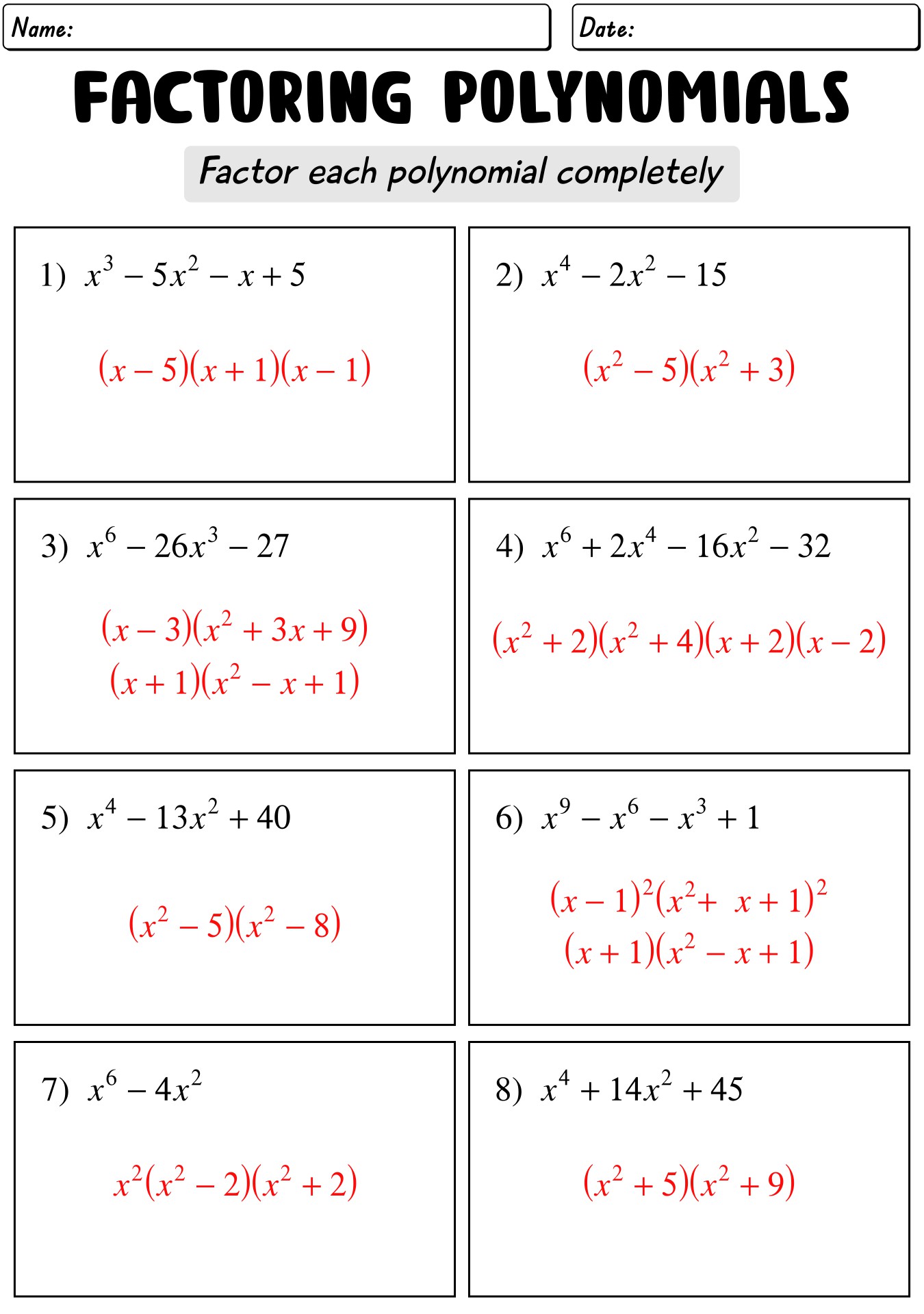
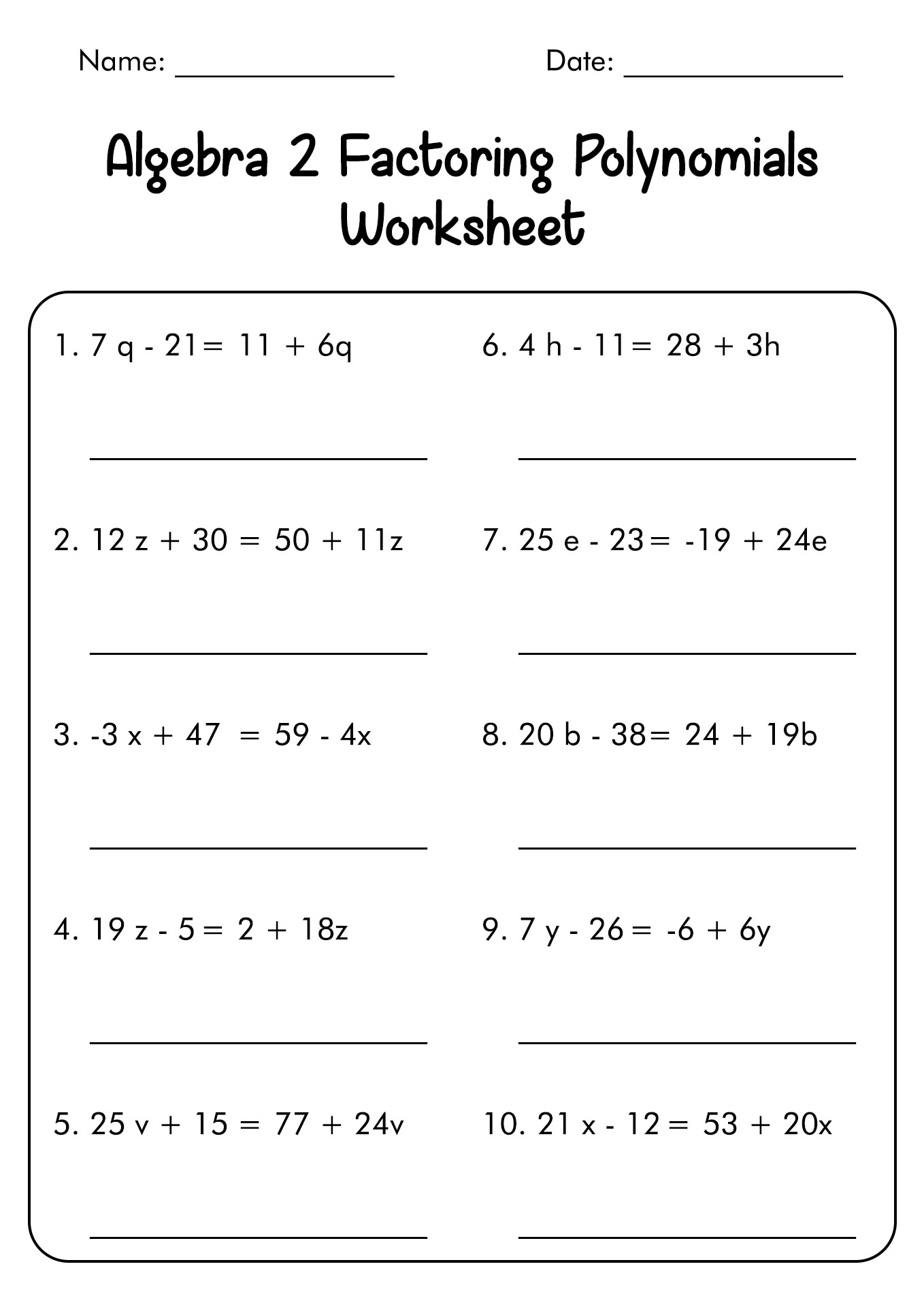
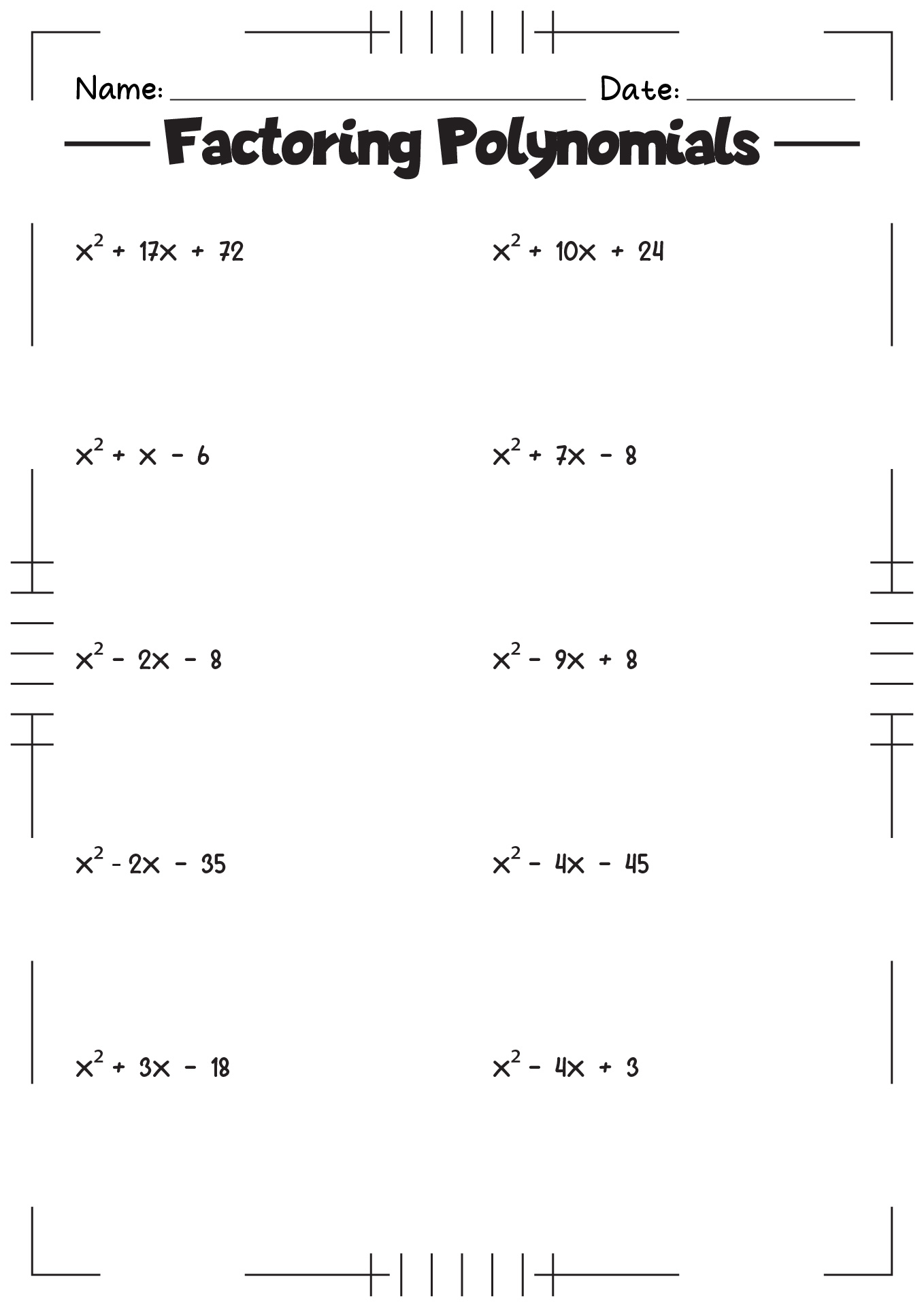
Factor The Polynomial Worksheet is like the Swiss Army knife of algebra homework—compact, versatile, and a little bit of a party trick. If you’ve ever stared at a stubborn polynomial and felt like a broken pencil, this tool is your ticket to triumph, and I promise it will be more entertaining than a cat video marathon (well, at least that’s my hope).
Why Factor The Polynomial Worksheet Is Your New Best Friend

Picture this: you’re on a math test, the clock is ticking, and the problem screams “factor me!” Your brain does a quick mental sprint—”uh, I don’t remember anything about polynomials!”—and suddenly, a golden lightbulb flashes: a worksheet that walks you through every step. That is exactly what Factor The Polynomial Worksheet delivers—practice, tips, and a dash of humor to keep the algebraic dread at bay. By investing a few minutes into this resource, you’ll develop a muscle memory that turns intimidating equations into easy peasy lemon squeezy problems.
The Anatomy of a Polynomial: The Building Blocks

What Is a Polynomial?
A polynomial is simply a sum (or difference) of terms that are a constant, variable, or product of a constant and a variable raised to a nonnegative integer power. Think of it as a recipe: the constants are your spices, the variable is your main ingredient, and the exponents tell you how much of each spice you need. The more terms, the more complex the recipe—until you learn how to break it down.
Why Factorization Matters
Factorization is like deconstructing a LEGO set back into its original pieces. It’s essential for simplifying equations, finding roots, and solving higher-level math problems such as calculus and differential equations. Moreover, factoring is the secret sauce that can turn a baffling expression into a neat, solvable form. That’s why a well-crafted worksheet focusing on factoring polynomials is a must-have for anyone serious about mastering algebra.
Common Factorization Techniques
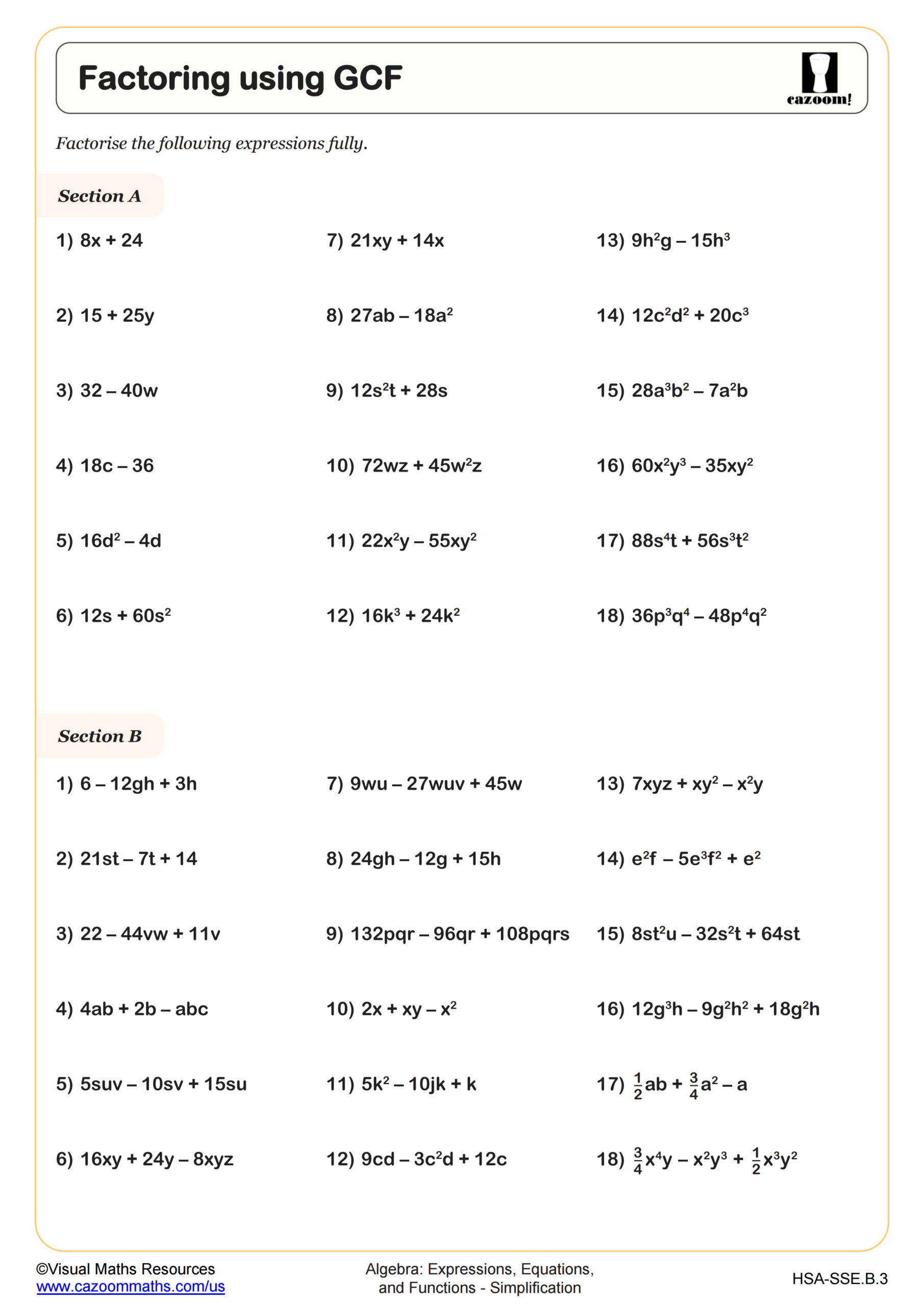
Greatest Common Factor (GCF) First
Every time you see a polynomial, the first step should be to hunt down the GCF. Pull it out, like a magician pulling a rabbit from a hat, and watch the expression shrink. For example, in \(6x^3 + 12x^2\), the GCF is \(6x^2\). Factor it out to get \(6x^2(x + 2)\). This simple trick sets the stage for deeper factorization.
Grouping
Grouping is ideal when a polynomial has four or more terms. Split it into pairs or groups that share a common factor and then factor each group individually before pulling out a final factor. A classic example is \(x^3 + 3x^2 + 2x + 6\). Group as \((x^3 + 3x^2) + (2x + 6)\), factor each: \(x^2(x + 3) + 2(x + 3)\), then pull out \((x + 3)\) to get \((x + 3)(x^2 + 2)\).
Quadratic Trinomial
When you see a three-term polynomial in the form \(ax^2 + bx + c\), you’re in the realm of quadratics. The goal is to find two binomials whose product yields the original expression. A quick mnemonic: “Find two numbers that add to b and multiply to ac.” For \(x^2 + 5x + 6\), the numbers 2 and 3 do the job: \((x + 2)(x + 3)\). If you’re feeling fancy, use the quadratic formula to double-check the roots.
Perfect Square Trinomial
Recognize patterns like \(a^2 + 2ab + b^2\) or \(a^2 – 2ab + b^2\) and you’ve found a perfect square. These are just \((a + b)^2\) or \((a – b)^2\). Spotting a perfect square can instantly reduce the complexity of a polynomial. Example: \(9x^2 + 12x + 4\) is \((3x + 2)^2\).
Difference of Squares
Any expression like \(a^2 – b^2\) can be factored into \((a + b)(a – b)\). This rule applies to any two terms where one is a square and the other is a square, or any power that can be expressed as a square. For instance, \(16 – 25x^2\) becomes \((4 – 5x)(4 + 5x)\). This technique is handy when you encounter negative signs or variable squares.
Special Cases: Sum or Difference of Cubes
The sum or difference of cubes can be factored using formulas: \(a^3 + b^3 = (a + b)(a^2 – ab + b^2)\) and \(a^3 – b^3 = (a – b)(a^2 + ab + b^2)\). Recognizing these patterns can save you time and frustration, especially when dealing with higher-degree polynomials.
How to Read and Approach a Factor The Polynomial Worksheet

Step 1: Identify the Polynomial’s Degree and Structure
Before you even scratch a pencil, scan the expression. Is it a quadratic? Does it have more than four terms? This quick assessment guides which technique to prioritize.
Step 2: Pull Out the Greatest Common Factor (GCF)
Even if you’re not sure what to do next, GCF is always a safe starting point. It simplifies the expression and may reveal hidden patterns that make other techniques easier.
Step 3: Look for Familiar Patterns
Check for perfect squares or difference of squares first. These are usually the quickest wins. If not found, move on to grouping or quadratic methods.
Step 4: Verify Your Factors
Always multiply your factors back together. A good practice: use the distributive property or a quick check by plugging in a value (e.g., x=0) to ensure the original expression is recreated.
Step 5: Simplify Further if Necessary
Sometimes the first factorization is not fully factored. Keep going until all factors are linear (or irreducible). A fully factored polynomial looks like a chain of parentheses that can’t be broken down any further.
Step‑By‑Step Walkthrough with Examples

Example 1: Factoring a Simple Quadratic
Take \(x^2 – 4x + 4\). Notice the constant 4 is a perfect square of 2, and the middle term \(-4x\) is twice 2 multiplied by x. Hence it’s \((x – 2)^2\). This simple pattern is a quick win—no guessing, no long calculations.
Example 2: Factoring a Cubic with Grouping
Factor \(x^3 – 3x^2 + 4x – 12\). Group as \((x^3 – 3x^2) + (4x – 12)\). Pull out \(x^2\) from the first group and 4 from the second: \(x^2(x – 3) + 4(x – 3)\). Now factor out \((x – 3)\): \((x – 3)(x^2 + 4)\). A neat final result!
Example 3: Factoring with a GCF and Perfect Square
Consider \(18x^4 – 12x^3 + 6x^2\). The GCF is \(6x^2\), leaving \(3x^2 – 2x + 1\). This inner expression is \((\sqrt3x – 1)^2\) when you square it out: \((\sqrt3x – 1)^2 = 3x^2 – 2x + 1\). Therefore, the full factorization is \(6x^2(\sqrt3x – 1)^2\). This example demonstrates how a combination of GCF and perfect square techniques can yield elegant results.
Tips, Tricks, and Hilarious Missteps to Avoid

Don’t Panic When Numbers Look Mysterious
If a polynomial seems like a labyrinth of numbers, start simple: factor out the GCF. Even a single factor can change the entire landscape.
Beware of “Sign Slip-ups”
When you have a difference of squares, remember the minus sign in the middle of the binomials flips: \((a + b)(a – b)\). A tiny sign error can transform a correct factorization into a comedic disaster.
Keep an Eye on Your Variables
Mixing up variables—like using x instead of y—can derail your solution. Double-check each step. If you find yourself chasing a phantom variable, you’re probably not factoring correctly.
Use Color-Coding for Brain Clarity
When working by hand, color each factor with a different hue. It turns an intimidating algebra worksheet into a visual puzzle—just like a Rubik’s cube, but with fewer stickers.
Practice with “Real-World” Examples
Why not factor the area of a pizza? The formula for the area of a circle is \(A = \pi r^2\). If a pizza’s radius is \(r = 2x + 3\), its area becomes \(\pi(2x + 3)^2\). Factorization isn’t just for exams; it’s also a great way to visualize everyday problems.
Real-World Applications and Fun Facts

From Cryptography to Computer Graphics
Factoring polynomials underlies many algorithms in cryptography—think RSA, where prime factorizations secure digital communication. In computer graphics, polynomial factorization helps optimize rendering calculations, making 3D games look smoother.
The Polynomial Factorization in Nature
Some natural phenomena can be modeled by polynomials. For instance, the growth of a population might follow a quadratic curve; factoring it can reveal the turning point where growth stops increasing and starts decreasing.
Historical Humor
The mathematician Pierre de Fermat once claimed, “I have a truly marvelous proof… but this is just too small to fit in the margin.” Factoring polynomials was a favorite pastime for him and his contemporaries, who would joke that if they couldn’t factor it, they’d just write “infinite” on a blackboard.
Turning Practice into Performance: How to Use This Worksheet Like a Pro

Set a Time Challenge
Pick a random polynomial from the worksheet and give yourself 30 seconds to factor it. Over time, your speed and accuracy will improve—just like a speed-runner mastering a video game level.
Teach a Friend or Pet
Explaining the steps to someone else forces you to clarify your own understanding. If you can explain factoring to a cat, you’re on the right track.
Turn Mistakes into Memes
When you stumble on a factoring problem, capture the moment and create a meme. Sharing it with classmates not only spreads laughs but also reinforces the correct method.
Use Technology Wisely
Online polynomial calculators can validate your answers, but resist the urge to rely on them completely. Think of the worksheet as a training ground—practice is the key to mastery.
FAQs
What if a polynomial can’t be factored into rational numbers?
Some polynomials only factor over the reals or complex numbers. In such cases, use the quadratic formula to find roots, or leave it in its factored form using radicals.
Can a polynomial be factored more than once?
Yes. If after factoring, the resulting factors themselves are non-constant polynomials, continue factoring each until you reach linear terms or irreducible quadratics.
What’s the difference between “factor” and “expand”?
Factoring means breaking a polynomial into smaller polynomial factors. Expanding does the reverse—multiplying the factors back together. Both skills are essential; the worksheet trains you on both.
Is there a “one-size-fits-all” rule for factoring?
No. Each polynomial has its own personality. The best approach is a toolbox: start with GCF, look for patterns, try grouping, and never forget to double-check your work.
Wrap‑Up

Factoring polynomials isn’t a dull chore; it’s a puzzle, a story, and a backstage pass to higher math. Factor The Polynomial Worksheet provides the scaffolding you need to master this skill—step-by-step guidance, real-life examples, and enough humor to keep you awake during the tedious grind. By incorporating GCF, grouping, quadratic tricks, and pattern recognition, you’ll turn any polynomial into a well‑structured, bite‑size problem that can be solved with confidence. Keep practicing, keep joking, and soon you’ll be able to factor like a pro—no more “what’s this term?” moments, just pure, unapologetic algebraic joy. Happy factoring, fellow number adventurers!