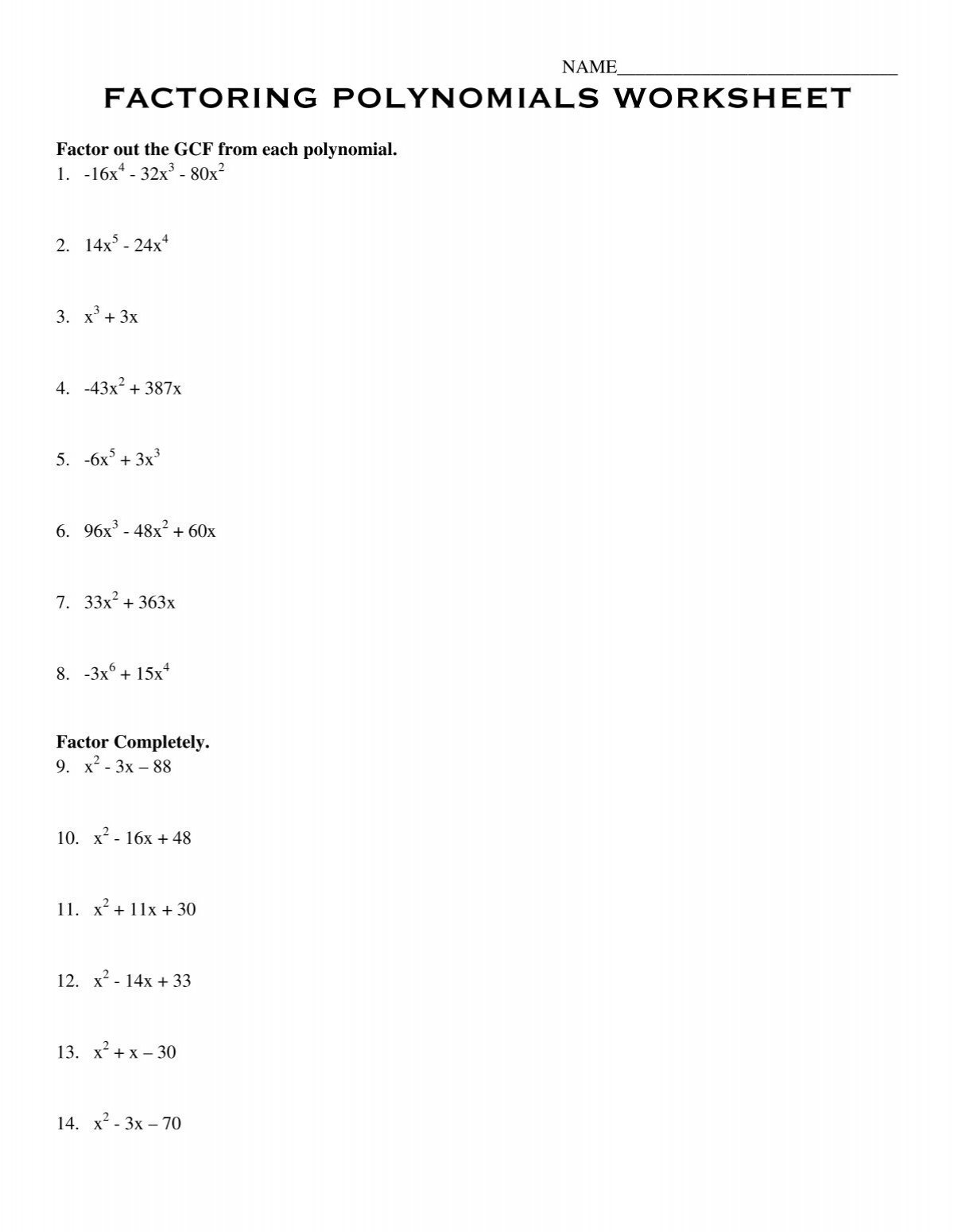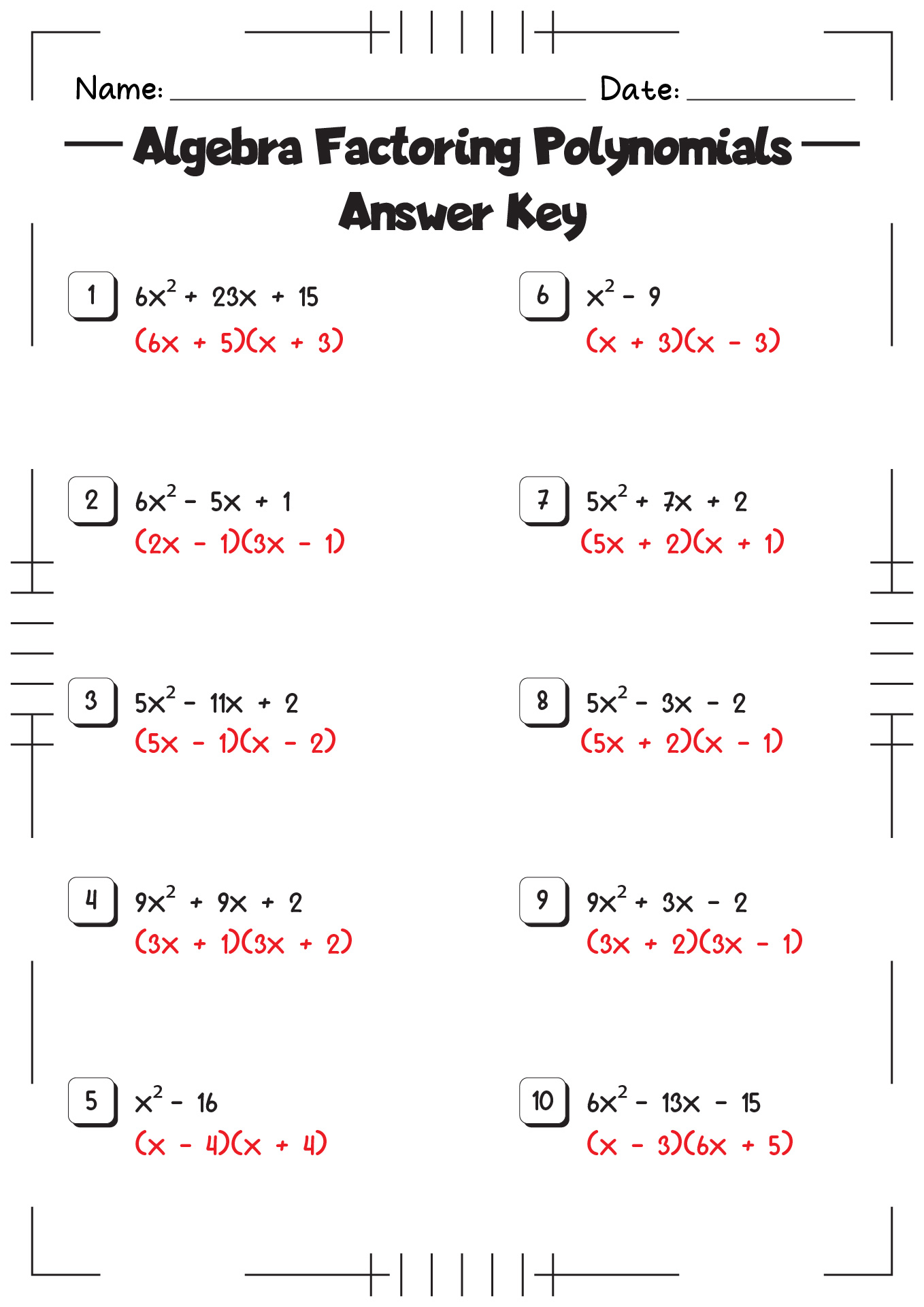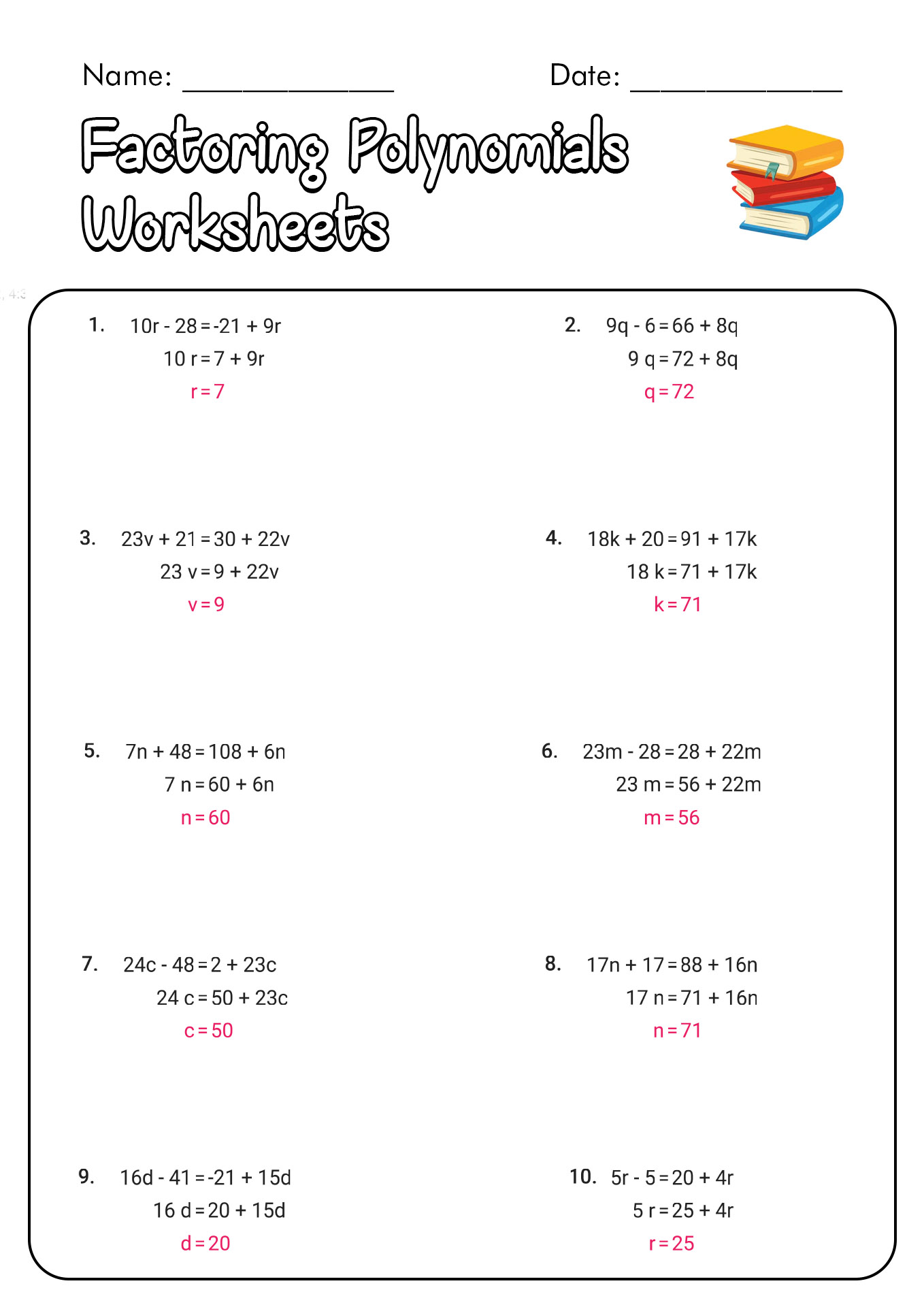
Factoring Polynomials A 1 Worksheet offers students a focused, hands‑on experience that bridges theory with practice, turning abstract algebraic rules into concrete problem‑solving skills. Whether you’re a teacher looking to reinforce curriculum standards, a parent supporting homework, or a self‑learner sharpening your math toolkit, a well‑designed worksheet can make the difference between memorizing patterns and truly understanding why those patterns work. In this article we’ll explore the essential concepts behind polynomial factoring, break down the most effective strategies presented on a typical worksheet, and provide actionable tips to ensure every learner extracts maximum benefit from each exercise.
Understanding the Core Concept of Factoring Polynomials

Why Factoring Matters in Algebra
Factoring is the algebraic equivalent of decomposition—it takes a complex expression and rewrites it as a product of simpler, more manageable pieces. This process is essential for solving equations, simplifying rational expressions, and analyzing functions. When students master factoring, they gain a versatile tool that appears in everything from quadratic formula derivations to calculus limits.
Common Terminology and Symbols
Before diving into worksheet problems, it’s helpful to clarify the language that often appears alongside factoring tasks. Terms such as “greatest common factor (GCF),” “difference of squares,” “perfect square trinomial,” and “factor by grouping” each describe a specific pattern or method. Understanding these labels reduces cognitive load, allowing learners to instantly recognize which technique applies to a given polynomial.
The Role of Structure in Polynomials
Polynomials are ordered sums of terms, each consisting of a coefficient multiplied by a variable raised to a non‑negative integer exponent. Recognizing the degree (the highest exponent) and the number of terms guides the choice of factoring strategy. For instance, a quadratic trinomial (degree 2 with three terms) often invites the AC method, while a four‑term polynomial might be best approached through grouping.
Key Techniques Covered in a Factoring Polynomials A 1 Worksheet
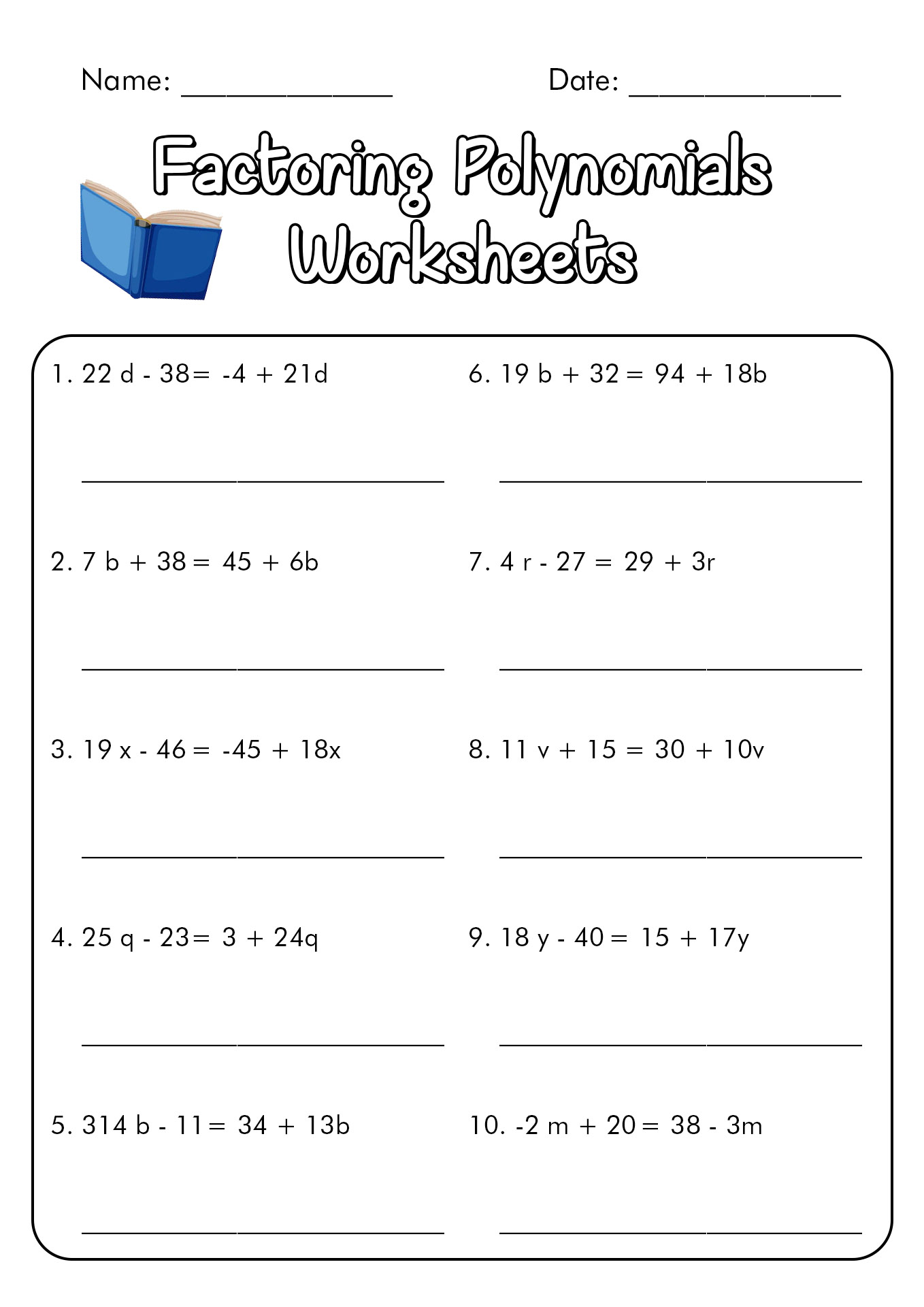
Factoring out the Greatest Common Factor (GCF)
Every worksheet typically begins with the simplest step: extracting the GCF. This reduces the polynomial’s size and can reveal hidden patterns. For example, the expression 6x³ − 9x² + 12x shares a GCF of 3x, which simplifies the problem to 3x(2x² − 3x + 4). While the inner quadratic may not factor further over the integers, the act of pulling out the GCF is itself a valuable skill that students must master before moving on to more intricate techniques.
Factoring Trinomials
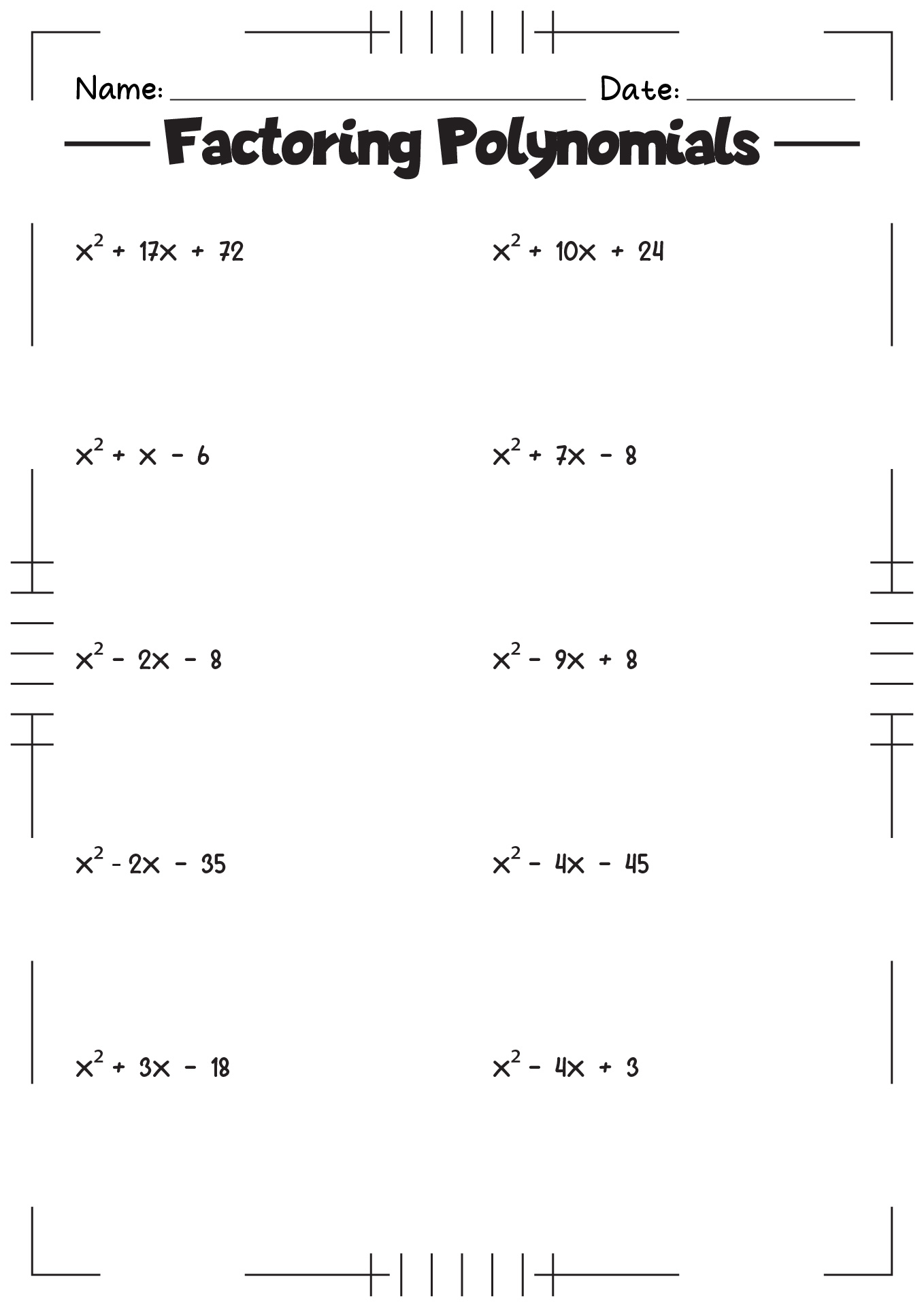
Trinomials of the form ax² + bx + c dominate most middle‑school worksheets. The most reliable approach is the “AC method,” which involves multiplying the leading coefficient a by the constant term c, finding two numbers that multiply to ac and add to b, then splitting the middle term. For example, to factor 2x² + 7x + 3, we compute ac = 6, locate 6 & 1 as the pair that sums to 7, and rewrite the expression as 2x² + 6x + x + 3. Grouping yields 2x(x + 3) + 1(x + 3), which finally factors to (2x + 1)(x + 3). Worksheets often vary the difficulty by altering the sign of b or using larger coefficients, prompting students to practice the method repeatedly.
Difference of Squares and Perfect Square Trinomials
Special products appear frequently on worksheets because they provide quick shortcuts. The difference of squares follows the identity a² − b² = (a − b)(a + b). Recognizing that 9x² − 25 fits this pattern leads instantly to (3x − 5)(3x + 5). Perfect square trinomials, such as x² + 6x + 9, match the form (a + b)² = a² + 2ab + b², factoring to (x + 3)². Worksheets usually intersperse these problems among more generic trinomials to reinforce pattern recognition.
Factoring by Grouping
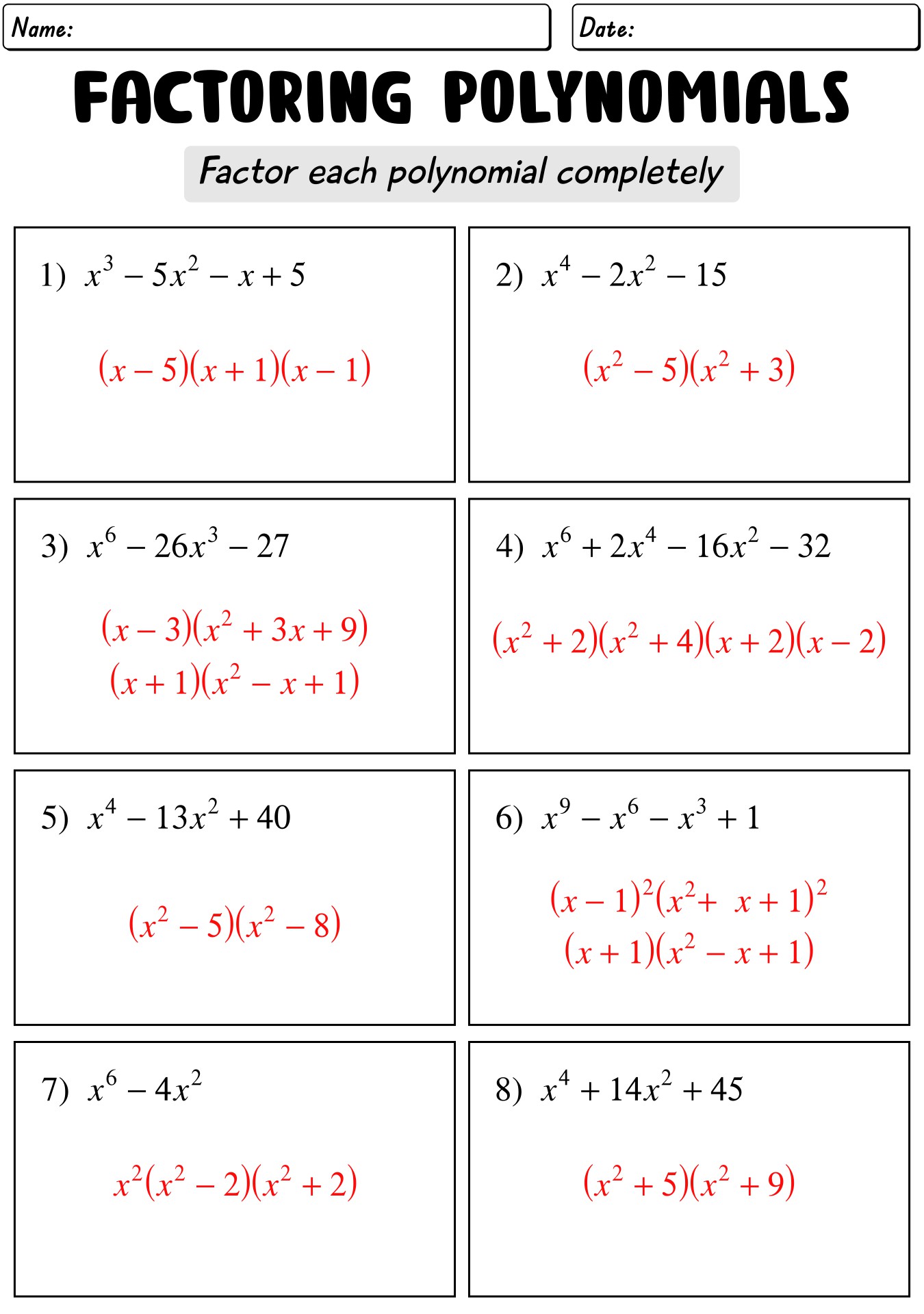
When a polynomial contains four or more terms, grouping can be the most efficient strategy. The key is to arrange the terms so that each pair shares a common factor. Take x³ + 3x² + 2x + 6 as an example. Grouping the first two and last two terms gives (x³ + 3x²) + (2x + 6), which factors to x²(x + 3) + 2(x + 3). The shared binomial (x + 3) can then be factored out, yielding (x² + 2)(x + 3). Worksheets often challenge students to reorder terms before grouping, sharpening both algebraic flexibility and logical reasoning.
Factoring Higher‑Degree Polynomials
Although A‑level worksheets usually focus on quadratics, some advanced sections introduce cubic and quartic expressions that factor into linear and quadratic components. Techniques such as synthetic division, the Rational Root Theorem, or recognizing sum‑of‑cubes identities (a³ + b³ = (a + b)(a² − ab + b²)) become relevant. Providing at least one example, such as factoring x³ − 8 into (x − 2)(x² + 2x + 4), ensures learners see the continuity between lower‑ and higher‑degree factoring.
Step‑by‑Step Guide to Solving Worksheet Problems

Reading the Problem Carefully
Students should start by scanning the polynomial for obvious common factors, noting the degree, and identifying any special forms. Highlighting terms mentally or with a pencil can prevent missed opportunities. For instance, a quick glance at 4x⁴ − 9 may reveal a difference of squares after recognizing it as (2x²)² − 3².
Choosing the Right Method
After the initial scan, the learner must decide which technique aligns with the observed structure. A helpful decision tree includes: (1) Is there a GCF? (2) Does the expression fit a special product pattern? (3) Is it a trinomial that can be split using AC? (4) Does grouping simplify the expression? By systematically answering these questions, students avoid trial‑and‑error and develop a disciplined approach.
Executing the Chosen Technique
Each method follows a predictable sequence. For the AC method, the steps are: multiply a and c, find the pair of numbers, rewrite the middle term, factor by grouping, and finally combine the common binomial. For grouping, the sequence involves pairing terms, factoring each pair, and extracting the common binomial. Providing a concise checklist at the top of the worksheet can serve as a mental cue.
Checking Your Work
Verification is often omitted on hurried worksheets, yet it is vital for solidifying understanding. Students should expand the factored result to ensure it reproduces the original polynomial. In addition, substituting a simple value (such as x = 1) into both the original and factored forms offers a quick sanity check. Encouraging this habit reduces errors and builds confidence.
Real‑World Applications that Reinforce Learning

Physics and Trajectories
Projectile motion equations often simplify to quadratic expressions that describe height over time. Factoring the quadratic can reveal the times when the projectile reaches a specific height or lands on the ground. For example, the height equation h(t) = ‑5t² + 20t + 15 factors to ‑5(t − 3)(t + 1), indicating that the object is at ground level when t = 3 seconds (the negative root is extraneous). Connecting worksheet problems to such tangible scenarios helps students see the relevance of abstract factoring.
Economics and Profit Functions
Profit often follows a quadratic model: P(q) = ‑2q² + 120q − 800, where q is quantity. Factoring yields ‑2(q − 20)(q − 20), showing that profit is maximized at q = 20. Worksheets that ask students to factor profit functions and interpret the roots foster critical thinking about optimization and real‑world decision making.
Computer Science and Algorithm Analysis
Complexity analysis sometimes produces polynomial bounds. For instance, an algorithm with running time T(n) = n³ − 3n² + 2n can be factored to n(n − 1)(n − 2), highlighting that performance drops dramatically when n approaches 0, 1, or 2. Including such examples on a worksheet bridges the gap between pure mathematics and computational thinking.
Tips for Teachers and Parents to Maximize Worksheet Impact
Scaffolding Difficulty Gradually
Begin with GCF extraction problems, then progress to simple trinomials, followed by special products, and finally introduce grouping and higher‑degree cases. This gradual increase mirrors the natural learning curve and prevents overwhelm. Providing a clear progression on the worksheet’s header can guide students through the intended learning path.
Incorporating Visual Aids
Color‑coding terms that share a factor or using graphic organizers that map each step of the AC method can make abstract manipulations concrete. For example, shading the two numbers that multiply to ac helps visual learners internalize the pairing concept. Including a small legend on the worksheet page reinforces the visual cues.
Encouraging Collaborative Learning
Pairing students to discuss their approach fosters peer instruction. One student might spot a GCF while the other recognizes a difference of squares, leading to a richer problem‑solving dialogue. Teachers can allocate a brief “discussion window” after each section of the worksheet, prompting learners to compare strategies before moving on.
Providing Immediate Feedback
Answer keys that include not only the final factored form but also a step‑by‑step breakdown allow students to self‑diagnose mistakes. Digital worksheets with interactive fields can offer instant validation, reinforcing correct methodology and highlighting specific errors for remediation.
Common Pitfalls and How to Avoid Them
Misidentifying the Greatest Common Factor
Students sometimes overlook a numeric GCF, focusing only on variable terms. Emphasizing the importance of checking coefficients first—especially when dealing with negative numbers—prevents this oversight. A quick tip is to write the absolute values of coefficients and find their GCF before re‑applying the sign.
Skipping Verification Steps
Rushing to the next problem without expanding the factored expression can embed misconceptions. Encouraging a habit of “multiply‑back” after each solution ensures that the factorization is correct and that the learner understands the reversible nature of the process.
Over‑reliance on Memorization
Memorizing a list of factorable forms is useful, but without comprehension, students may misapply patterns. Worksheets should include “challenge” problems that deliberately break common patterns, forcing learners to analyze rather than recall. This builds adaptability for unfamiliar algebraic expressions.
Incorrect Sign Management
When splitting the middle term, the two numbers must have the correct signs to sum to b while multiplying to ac. A common error is to choose numbers that multiply correctly but add to the opposite sign. Teaching a quick “sign check”—write the two numbers, verify both product and sum—helps catch this mistake early.
Conclusion
Mastering the Factoring Polynomials A 1 Worksheet is more than an exercise in rote calculation; it equips learners with a versatile analytical toolkit that applies across mathematics, science, economics, and technology. By understanding the underlying structures, selecting the appropriate factoring method, and rigorously verifying each result, students transform a seemingly daunting algebraic task into a series of logical, manageable steps. Teachers and parents can amplify this learning by scaffolding difficulty, incorporating visual supports, encouraging collaboration, and providing detailed feedback. When common pitfalls are addressed proactively, confidence grows, and the abstract world of polynomials becomes a playground for problem‑solvers. Ultimately, a well‑designed worksheet not only reinforces classroom instruction but also cultivates a lifelong appreciation for the elegance and power of algebraic reasoning.