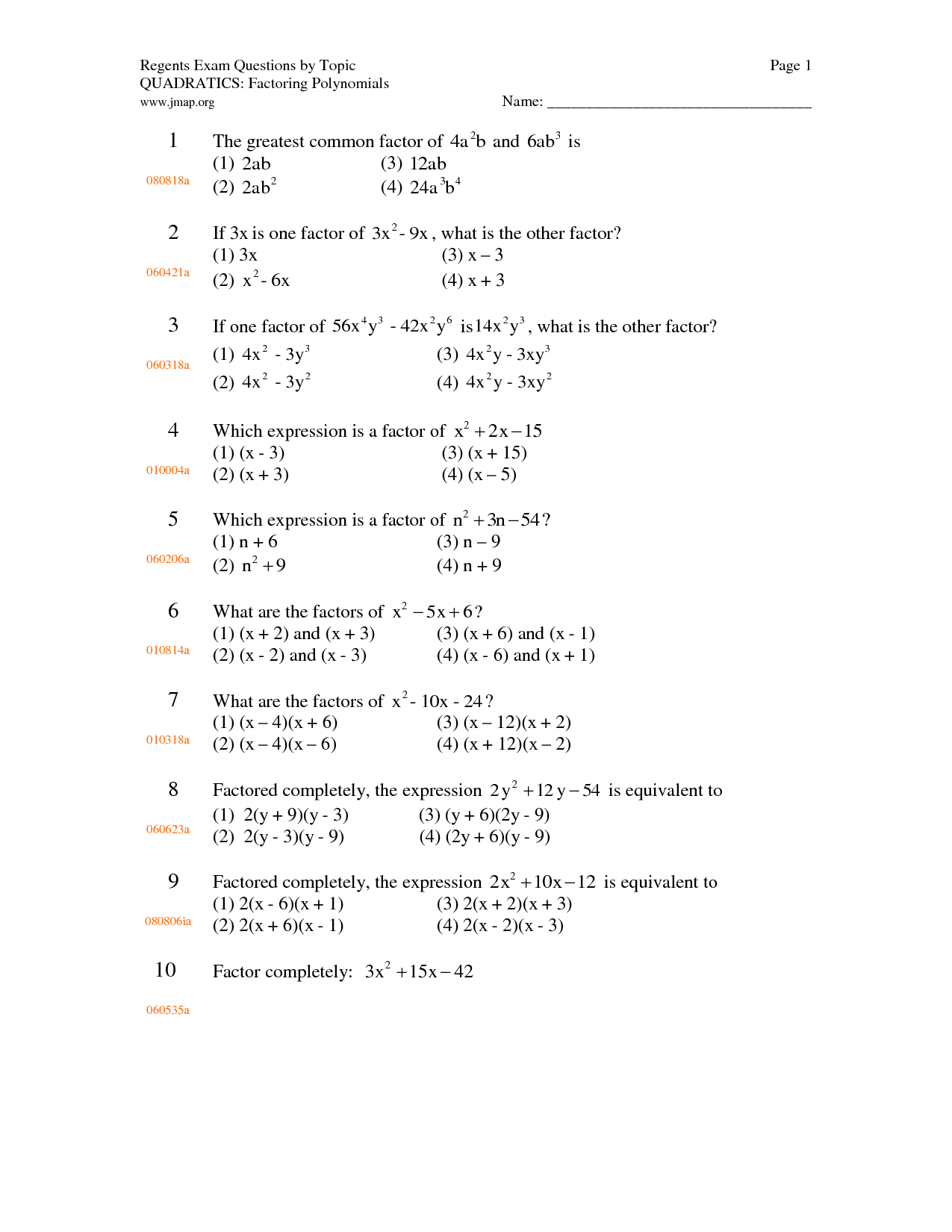
Factoring Trinomials Worksheet Algebra offers students a focused, hands‑on way to turn abstract polynomial concepts into concrete problem‑solving skills, and the benefits start the moment the first page is turned. By systematically breaking down each three‑term expression into the product of two binomials, learners not only reinforce core algebraic rules but also build confidence that carries over to higher‑level math. This introductory paragraph sets the stage for a deep dive into why dedicated worksheets are essential, how to approach each problem with proven strategies, and where to apply these skills in real‑world contexts.
Understanding the Basics of Trinomial Factoring

What Is a Trinomial?
A trinomial is a polynomial consisting of exactly three terms, typically written in the form ax2 + bx + c, where a, b, and c are constants and a ≠ 0. The quadratic term ax2 determines the degree of the expression, while the linear term bx and the constant term c shape its graph and factorability. Recognizing this structure is the first step toward successful factoring, because each term plays a specific role in the product of two binomials.
Common Forms and Their Implications
Most factoring worksheets focus on two primary patterns: the “simple” case where a = 1 (e.g., x² + 5x + 6) and the “general” case where a ≠ 1 (e.g., 2x² − 7x + 3). The simple case allows students to practice matching two numbers whose product equals c and whose sum equals b. The general case introduces an extra layer of complexity, requiring the product of a and c to be considered during the search for factor pairs. Understanding these distinctions helps teachers design worksheets that scaffold learning from easy to challenging.
Why Worksheets Matter for Mastery

Active Practice Reinforces Memory
Repeated exposure to varied trinomial problems strengthens neural pathways associated with pattern recognition. When learners solve multiple worksheet items, they begin to anticipate the right factor pair without conscious calculation, which speeds up problem solving on tests and in timed environments.
Immediate Feedback Accelerates Growth
Well‑crafted worksheets include answer keys or space for self‑checking, enabling students to verify each step instantly. This rapid feedback loop prevents the reinforcement of incorrect methods and encourages corrective adjustments before misconceptions become entrenched.
Confidence Building Through Incremental Success
Each correctly factored trinomial provides a small victory that compounds over the worksheet’s length. The sense of progress fuels motivation, especially for learners who may feel intimidated by abstract algebraic symbols.
Step‑by‑Step Strategies for Factoring Trinomials
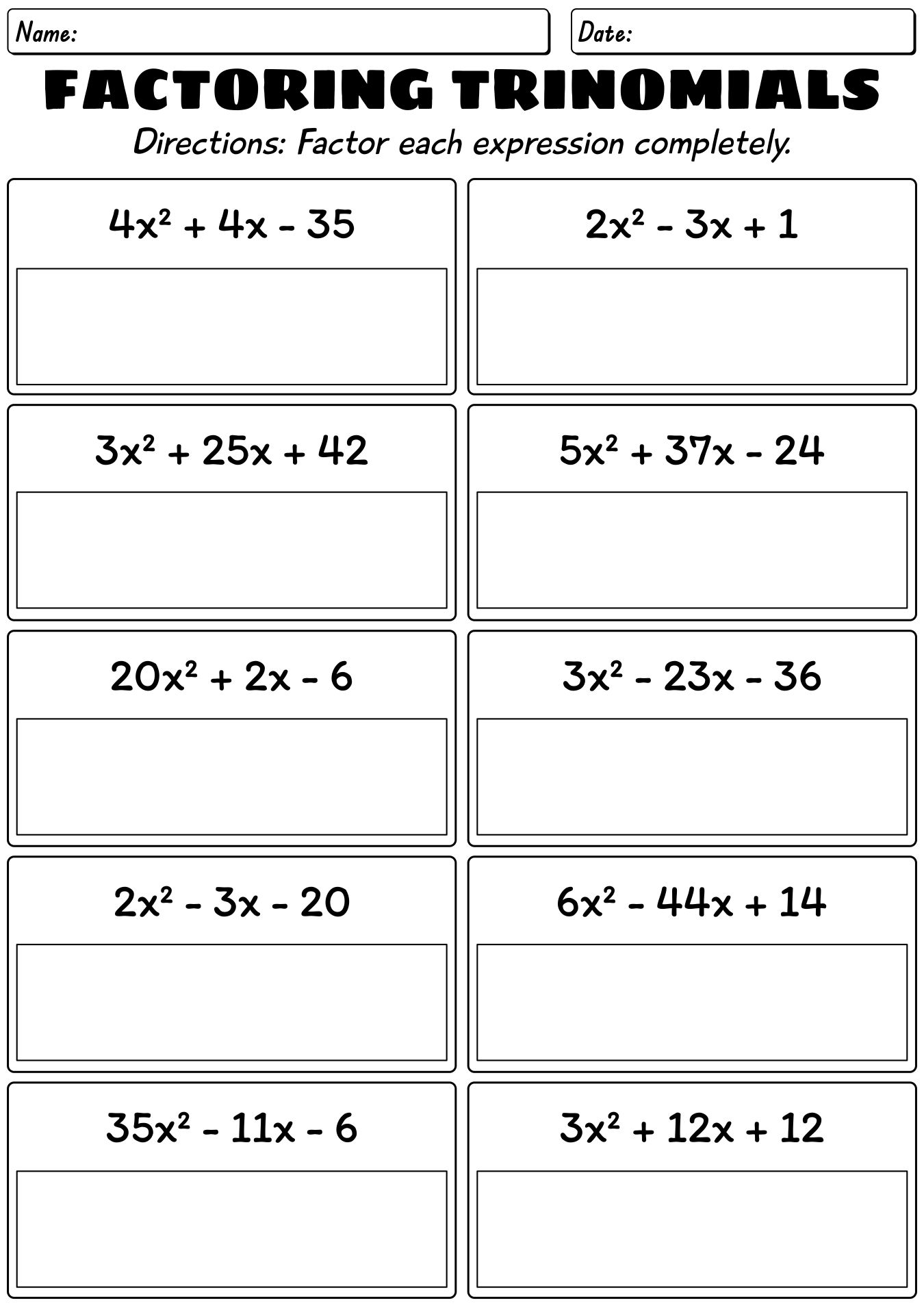
The “AC” Method Explained
The “AC” method—also known as the “split‑the‑middle‑term” technique—is the most reliable approach for general trinomials. First, multiply a (the coefficient of x2) by c (the constant term). Next, list all factor pairs of the product that add to b (the coefficient of the linear term). Once the appropriate pair is identified, rewrite the middle term using those two numbers, then factor by grouping. This systematic process eliminates guesswork and works consistently for any integer coefficients.
Factoring When a = 1
When the leading coefficient is one, the process simplifies dramatically. Students only need to locate two numbers that multiply to c and add to b. For example, to factor x² + 7x + 12, they find 3 and 4, because 3 × 4 = 12 and 3 + 4 = 7, yielding (x + 3)(x + 4). Worksheets that begin with several of these problems help learners internalize the sum‑product relationship before tackling more complex cases.
Factoring When a ≠ 1
Consider the trinomial 3x² − 14x + 8. Multiply a and c to get 24. The factor pair that adds to –14 is –12 and –2. Rewrite the middle term: 3x² − 12x − 2x + 8. Group the first two and last two terms: (3x² − 12x) + (‑2x + 8). Factor each group: 3x(x − 4) − 2(x − 4). Finally, factor out the common binomial (x − 4) to obtain (3x − 2)(x − 4). Providing worksheets that walk through each of these steps reinforces the algorithmic mindset necessary for success.
Checking Your Work Efficiently
After factoring, multiply the resulting binomials to ensure they reproduce the original trinomial. This verification step catches sign errors, missed common factors, and incorrect pair selections. Encourage students to include a short “check” line on their worksheets, reinforcing the habit of self‑validation.
Real‑World Applications of Factored Trinomials

Geometry and Area Problems
Many geometry problems reduce to quadratic equations. For instance, finding the dimensions of a rectangular garden with a fixed perimeter often leads to an expression like x² − 10x + 21 = 0, which factors to (x − 3)(x − 7) = 0. The solutions correspond to the possible side lengths, illustrating how factoring directly informs practical design decisions.
Physics: Projectile Motion
In kinematics, the height of a projectile can be modeled by h(t) = ‑4.9t² + vt + h₀. Setting h(t) = 0 to find the landing time yields a quadratic equation that often factors cleanly when the initial velocity and height are integer values. Factoring the resulting trinomial provides the exact times when the object reaches ground level, a concrete example of algebra supporting physical predictions.
Economics and Business Optimization
Profit functions frequently appear as quadratics, such as P(x) = ‑2x² + 30x − 40. Factoring this expression reveals the break‑even points and helps identify the production level that maximizes profit. Worksheets that tie factoring to these economic scenarios make the abstract process relevant and memorable for students interested in real‑world problem solving.
Tips for Creating Your Own Factoring Worksheets

Selecting Problems With Purpose
Start by choosing a mix of simple and challenging trinomials. Include a handful of “easy wins” (a = 1) to build confidence, then gradually introduce more complex cases (a ≠ 1) that require the AC method. Balance numeric coefficients with negative signs to expose students to the full range of sign interactions.
Varying Difficulty Through Constraints
Introduce constraints such as “factor without using the greatest common factor first” or “factor and then simplify the result.” These variations prevent rote memorization and encourage deeper comprehension of underlying principles.
Providing Clear Answer Keys
Each worksheet should end with a concise answer key that shows the fully factored form and a brief verification step. For more advanced learners, include a short explanation of the chosen factor pair to reinforce the reasoning process.
Common Mistakes and How to Avoid Them

Sign Errors in the Middle Term
Students often misplace a negative sign when splitting the middle term, leading to incorrect groupings. Emphasize the importance of writing the exact numbers found in the factor pair, and encourage a double‑check of the sum before proceeding.
Overlooking the Greatest Common Factor
Failing to factor out the GCF first can complicate the AC method unnecessarily. A quick scan for a common factor—especially when all terms share a number or variable—streamlines the problem and reduces the chance of arithmetic mistakes.
Assuming All Trinomials Are Factorable Over the Integers
Some trinomials have no integer factor pairs that satisfy the sum‑product condition (e.g., x² + x + 1). Teach students to recognize these cases and transition to the quadratic formula or completing the square, ensuring they do not waste time attempting impossible factorizations.
Digital Resources and Printable Options

Printable PDFs for Classroom Use
Many educational websites offer free, teacher‑ready PDF worksheets that can be printed on standard letter‑size paper. Look for resources that include both the problem set and a separate answer key page, allowing for easy distribution and grading.
Interactive Platforms for Immediate Feedback
Online tools that generate random trinomials and evaluate student input in real time provide a dynamic supplement to static worksheets. These platforms often track progress, highlight recurring errors, and adapt difficulty based on performance, making them ideal for differentiated instruction.
Conclusion

Mastering Factoring Trinomials Worksheet Algebra is a cornerstone of algebraic fluency, and the structured practice offered by well‑designed worksheets transforms theory into instinct. By understanding the fundamentals, applying systematic strategies like the AC method, recognizing real‑world connections, and avoiding common pitfalls, learners can confidently navigate quadratic expressions in both academic and practical settings. Whether you opt for printable PDFs, create custom problem sets, or leverage interactive digital tools, the key to lasting proficiency lies in consistent, purposeful practice—backed by clear verification and thoughtful reflection on each solution. Armed with these insights, educators and students alike can turn every worksheet into a stepping stone toward higher‑level mathematical success.