Factorization By Grouping Worksheet offers students a hands‑on way to master one of the most versatile techniques in algebra, turning seemingly tangled polynomials into neatly factored expressions through strategic pairing. Whether you are a classroom teacher, a homeschooling parent, or a self‑directed learner, this worksheet provides clear, step‑by‑step practice that builds confidence and deepens conceptual understanding. Below, we explore why grouping matters, how to design effective worksheets, common pitfalls to avoid, and real‑world scenarios where this skill shines.
Why Grouping Is a Core Algebraic Skill

Grouping is more than a shortcut; it is a logical framework that reinforces the distributive property and the concept of common factors. When students learn to identify pairs of terms that share a greatest common factor (GCF), they develop a habit of looking for structure rather than brute‑force manipulation. This habit translates to better performance on standardized tests, higher‑order problem solving, and a smoother transition to topics like factoring trinomials, solving quadratic equations, and simplifying rational expressions.
Key Concepts Behind Factorization By Grouping

Identifying the Greatest Common Factor
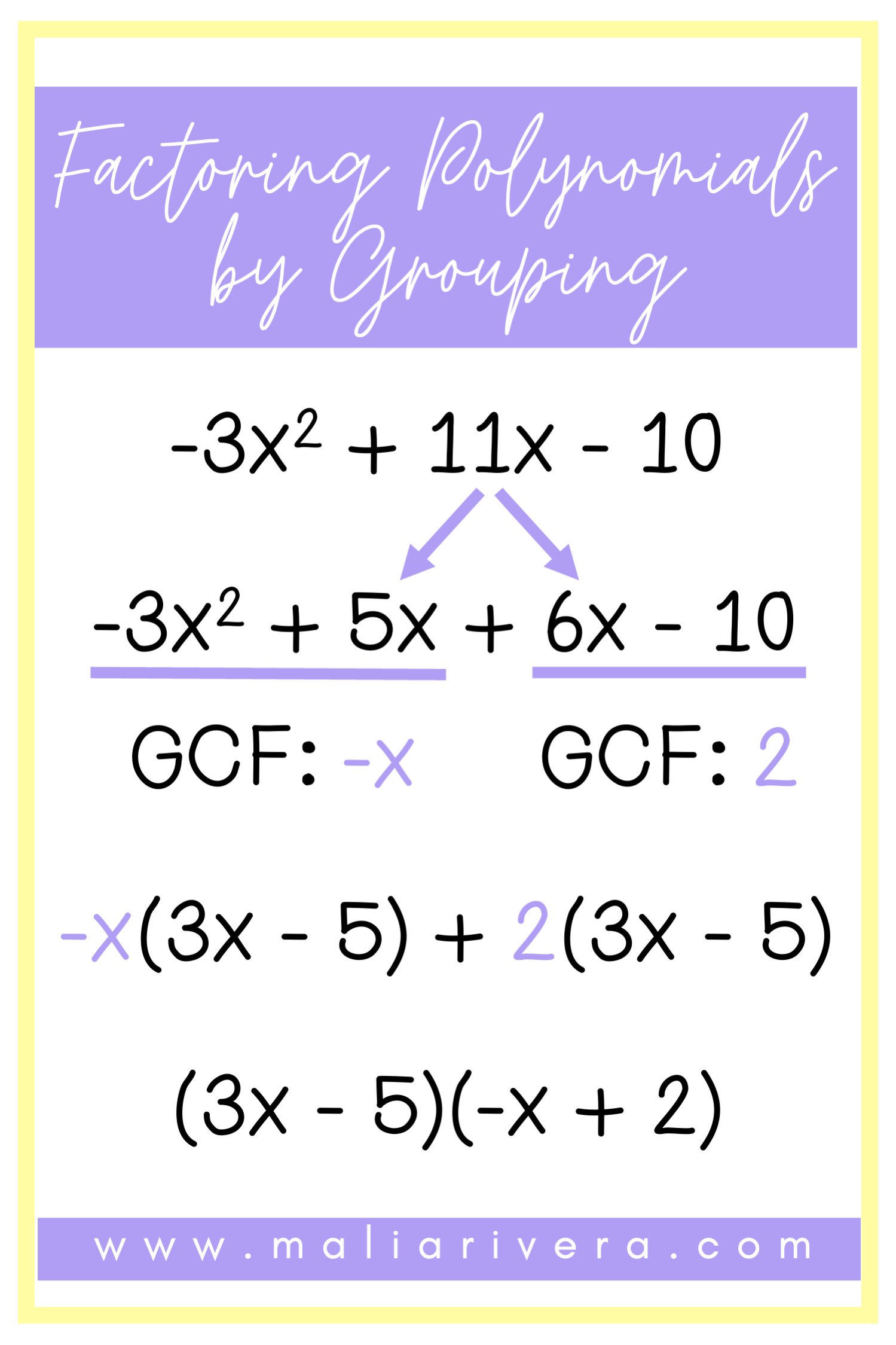
The first step in any grouping exercise is to scan the polynomial for the largest factor that appears in at least two terms. This GCF may be a numeric coefficient, a variable, or a combination of both. For example, in the expression 6x³ + 9x² − 4x − 6, the first two terms share a factor of 3x² while the last two share a factor of ‑2. Recognizing these patterns sets the stage for successful grouping.
Strategic Pairing of Terms
After the GCF is identified, the next decision is how to pair the terms. The typical approach is to group the first two terms together and the last two together, but sometimes alternative pairings yield a common binomial factor. For instance, the polynomial ax + bx + ay + by groups naturally as (ax + bx) + (ay + by), which simplifies to x(a + b) + y(a + b) and finally to (a + b)(x + y). Teaching students to test different groupings prevents them from getting stuck on a single arrangement.
Factoring Out the Common Binomial
Once the terms are grouped and each group is factored by its GCF, the resulting expression often reveals a common binomial factor. Pulling this factor out completes the factorization. In the previous example, (a + b) is the common binomial. The final product, (a + b)(x + y), illustrates the power of grouping to uncover hidden structures.
Designing an Effective Factorization By Grouping Worksheet

A well‑crafted worksheet balances scaffolded practice with opportunities for independent thinking. Below are essential components to include, along with suggested layouts.
Clear Instructions and Learning Objectives
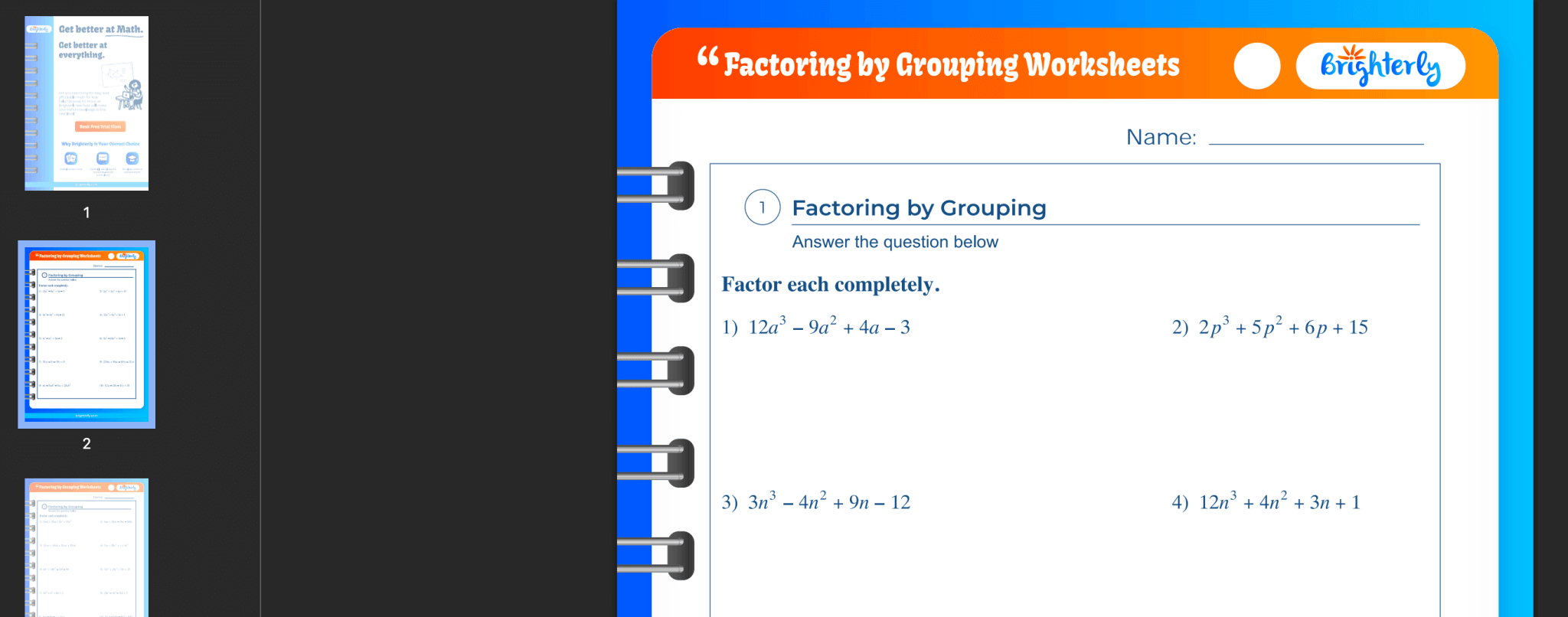
Begin with a concise prompt such as, “Factor each polynomial by grouping. Show all steps, including the GCF for each group and the final factored form.” Follow this with a brief bullet list of objectives: identifying GCFs, grouping strategically, and verifying results by expansion.
Progressive Difficulty Levels
- Level 1 – Simple Four‑Term Polynomials: Use monomials with coefficients of 1 or 2, e.g., x + y + x − y. These reinforce the basic pattern.
- Level 2 – Mixed Coefficients and Variables: Introduce terms like 3ab − 6a + 9b − 18, requiring students to factor numeric GCFs as well as variable GCFs.
- Level 3 – Higher‑Degree Polynomials: Include cubic or quartic terms, such as 2x⁴ + 4x³ − 3x² − 6x, encouraging learners to look beyond the obvious.
- Level 4 – Real‑World Word Problems: Pose scenarios like “The area of a rectangular garden can be expressed as 5x² + 15x − 4x − 12 square meters. Factor to find possible dimensions.”
Space for Work and Reflection
Allocate generous blank lines beneath each problem for students to write out each step. End the worksheet with a “Reflection” section prompting learners to answer questions such as, “Which step was most challenging and why?” or “How did recognizing a common binomial help you simplify the expression?” This metacognitive component reinforces retention.
Answer Key with Detailed Explanations
Provide a separate answer key that not only lists the final factored forms but also walks through each grouping decision. For example, for 4x³ + 8x² − 3x − 6, the key would show: (i) Group as (4x³ + 8x²) + (‑3x − 6); (ii) Factor out 4x² from the first group and ‑3 from the second; (iii) Recognize the common binomial (x + 2); (iv) Write the final answer (4x² − 3)(x + 2).
Step‑by‑Step Walkthrough of Sample Problems

Example 1: Simple Four‑Term Polynomial
Factor x + 3y + 2x + 6y by grouping.
- Group the terms: (x + 3y) + (2x + 6y).
- Factor the GCF from each group: x(1 + 3y/x) becomes x(1 + 3y/x) – actually better to factor numeric GCF: (x + 3y) stays as is, (2x + 6y) = 2(x + 3y).
- Now the expression is (x + 3y) + 2(x + 3y) = (1 + 2)(x + 3y).
- Combine coefficients: 3(x + 3y).
- Final factored form: 3(x + 3y).
Example 2: Mixed Coefficients
Factor 6ab − 9a + 8b − 12.
- Group as (6ab − 9a) + (8b − 12).
- Factor GCFs: 3a(2b − 3) + 4(2b ‑ 3).
- Identify the common binomial (2b ‑ 3).
- Factor it out: (2b ‑ 3)(3a + 4).
- Result: (2b ‑ 3)(3a + 4).
Example 3: Higher‑Degree Polynomial
Factor 2x⁴ + 4x³ − 3x² ‑ 6x.
- Group: (2x⁴ + 4x³) + (‑3x² ‑ 6x).
- Factor GCFs: 2x³(x + 2) ‑ 3x(x + 2).
- Common binomial (x + 2) appears.
- Factor out (x + 2): (x + 2)(2x³ ‑ 3x).
- Further factor the second part if possible: 2x³ ‑ 3x = x(2x² ‑ 3).
- Complete factorization: (x + 2)x(2x² ‑ 3).
Common Mistakes and How to Fix Them

Even seasoned students can stumble on grouping tasks. Recognizing these errors early helps teachers intervene effectively.
- Skipping the GCF Step: Students sometimes jump straight to factoring the whole expression, missing the chance to simplify each group first. Encourage a “pause and check” habit after every grouping.
- Choosing the Wrong Pairing: When the initial grouping does not yield a common binomial, students may become frustrated. Teach the “re‑group” strategy: if (first + second) + (third + fourth) fails, try (first + third) + (second + fourth).
- Sign Errors: Negatives are a frequent source of confusion, especially when factoring out a negative GCF. Remind learners to distribute the negative sign across the entire group before pulling out the factor.
- Overlooking Variable GCFs: A term like 6xy² and 9x²y share 3xy as GCF, not just numeric 3. Reinforce the practice of factoring both numbers and variables together.
Integrating the Worksheet Into Classroom Instruction

Mini‑Lesson Sequence
1. Warm‑up (5 minutes): Quick mental drills on finding GCFs of simple monomials.
2. Modeling (10 minutes): Teacher demonstrates a complete grouping problem on the board, verbalizing each decision.
3. Guided Practice (15 minutes): Students work on the first three worksheet problems in pairs, with the teacher circulating to correct misconceptions.
4. Independent Work (20 minutes): Remaining problems are tackled individually, encouraging students to self‑check by expanding their factored answers.
5. Reflection (5 minutes): Quick exit ticket asking “What was the most useful clue that helped you find the common binomial?”
Differentiation Strategies
- For Struggling Learners: Provide a “clue sheet” that lists common GCF patterns and a checklist for grouping steps.
- For Advanced Students: Include polynomials with five or more terms, requiring multiple rounds of grouping, or ask them to create their own grouping problems.
- For English Language Learners: Pair visual symbols (e.g., colored boxes around grouped terms) with written instructions to reinforce understanding.
Real‑World Applications of Grouping Factorization

Factorization by grouping isn’t confined to textbook exercises; it appears in many practical contexts.
Engineering and Physics
When analyzing forces or simplifying algebraic expressions in kinematics, engineers often encounter polynomials that factor neatly by grouping. For example, the equation for the displacement of a projectile with air resistance may reduce to a product of two simpler expressions, making it easier to solve for time or velocity.
Economics and Business
Profit functions that involve multiple variables, such as P(x,y) = 4xy + 8x ‑ 6y ‑ 12, can be factored by grouping to reveal break‑even points or optimal production levels. Recognizing the factorized form helps decision‑makers isolate the impact of each variable.
Computer Science
Algorithmic optimization sometimes requires simplifying polynomial time‑complexity expressions. Grouping can transform n³ + 2n² − n − 2 into (n² − 1)(n + 2), clarifying asymptotic behavior.
Tips for Students to Master the Technique

- Write each term clearly and align them vertically; visual alignment aids grouping.
- Always factor out the GCF first before looking for a common binomial.
- Check your work by expanding the factored form; the result should match the original polynomial.
- Practice re‑grouping when the first attempt fails—flexibility is key.
- Keep a “factoring toolbox” notebook with common patterns, such as a b + a c = a(b + c), for quick reference.
Frequently Asked Questions

Can every polynomial be factored by grouping?
No. Grouping works best when the polynomial can be split into two pairs that share a common binomial after factoring out GCFs. If no such pairing exists, other methods—such as the AC method for quadratics or synthetic division for higher degrees—are more appropriate.
What if the worksheet includes a term with no obvious partner?
Encourage students to consider factoring a negative GCF or to rearrange the terms. Sometimes moving a term to a different position reveals a hidden common factor.
How many times should I practice grouping before it becomes automatic?
Consistent daily practice with a variety of problems—approximately 10–15 minutes per session—over a two‑week period typically leads to fluency. Incorporate mixed‑skill worksheets to maintain engagement.
Conclusion

Mastering the Factorization By Grouping Worksheet equips learners with a powerful algebraic lens, enabling them to dissect complex expressions, verify solutions, and apply mathematical reasoning across disciplines. By structuring worksheets with clear objectives, progressive difficulty, and reflective prompts, educators can foster deep comprehension and confidence. Remember to emphasize the three‑step rhythm—identify GCFs, group strategically, factor out the common binomial—and to reinforce learning through expansion checks. With diligent practice and thoughtful instruction, students will transition from hesitant manipulators of symbols to confident problem solvers who can recognize and exploit structure in any algebraic challenge.