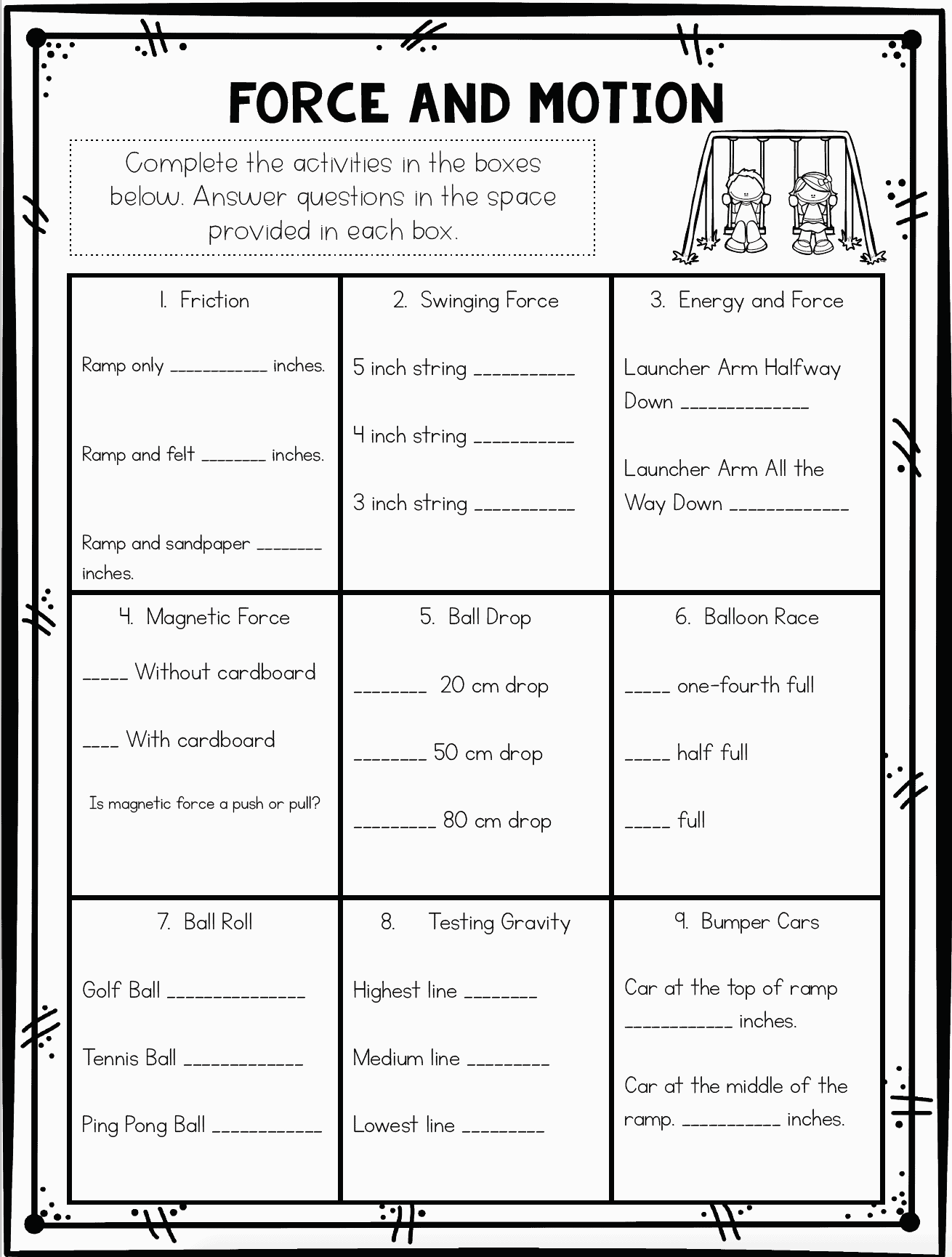
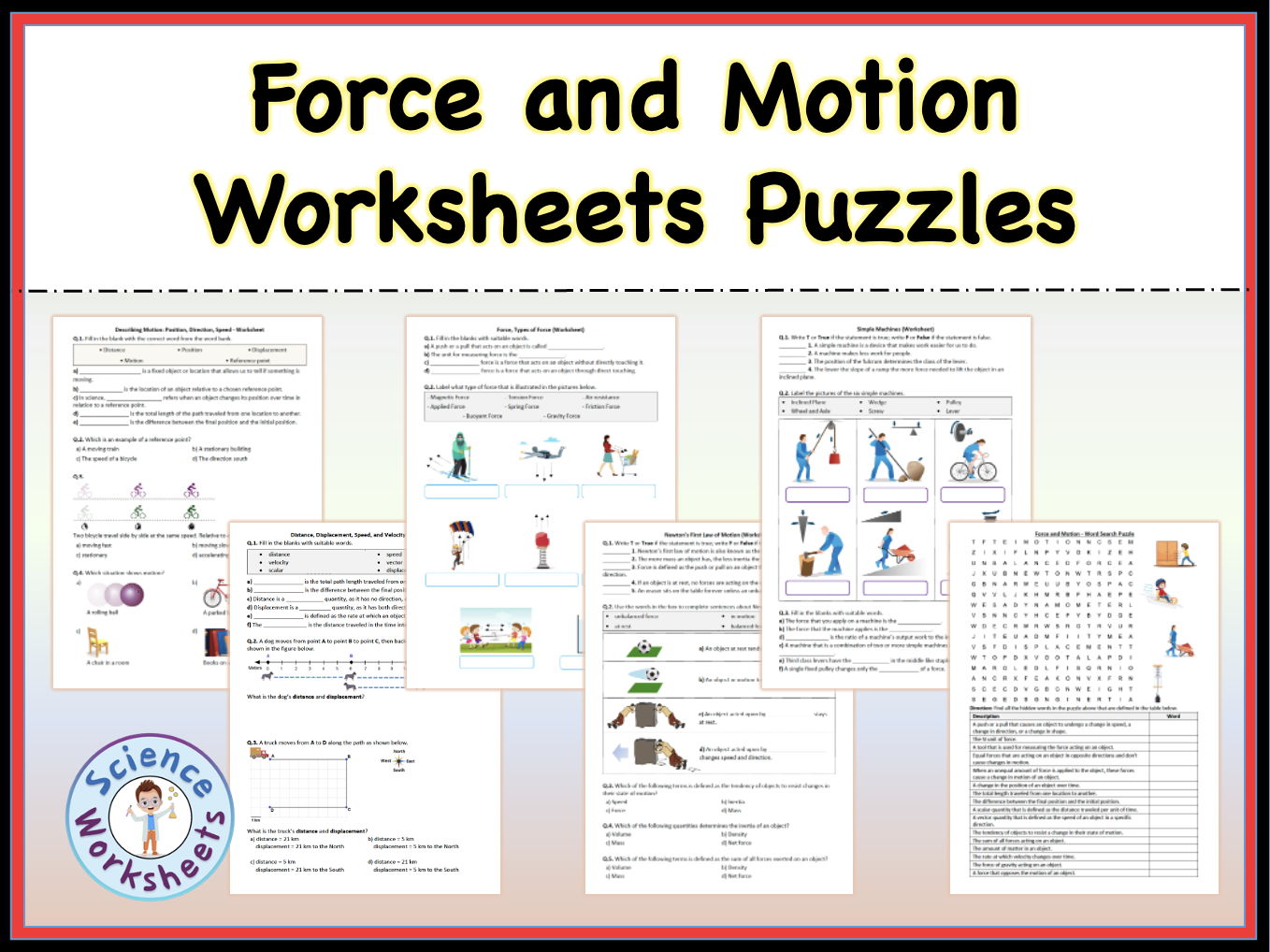
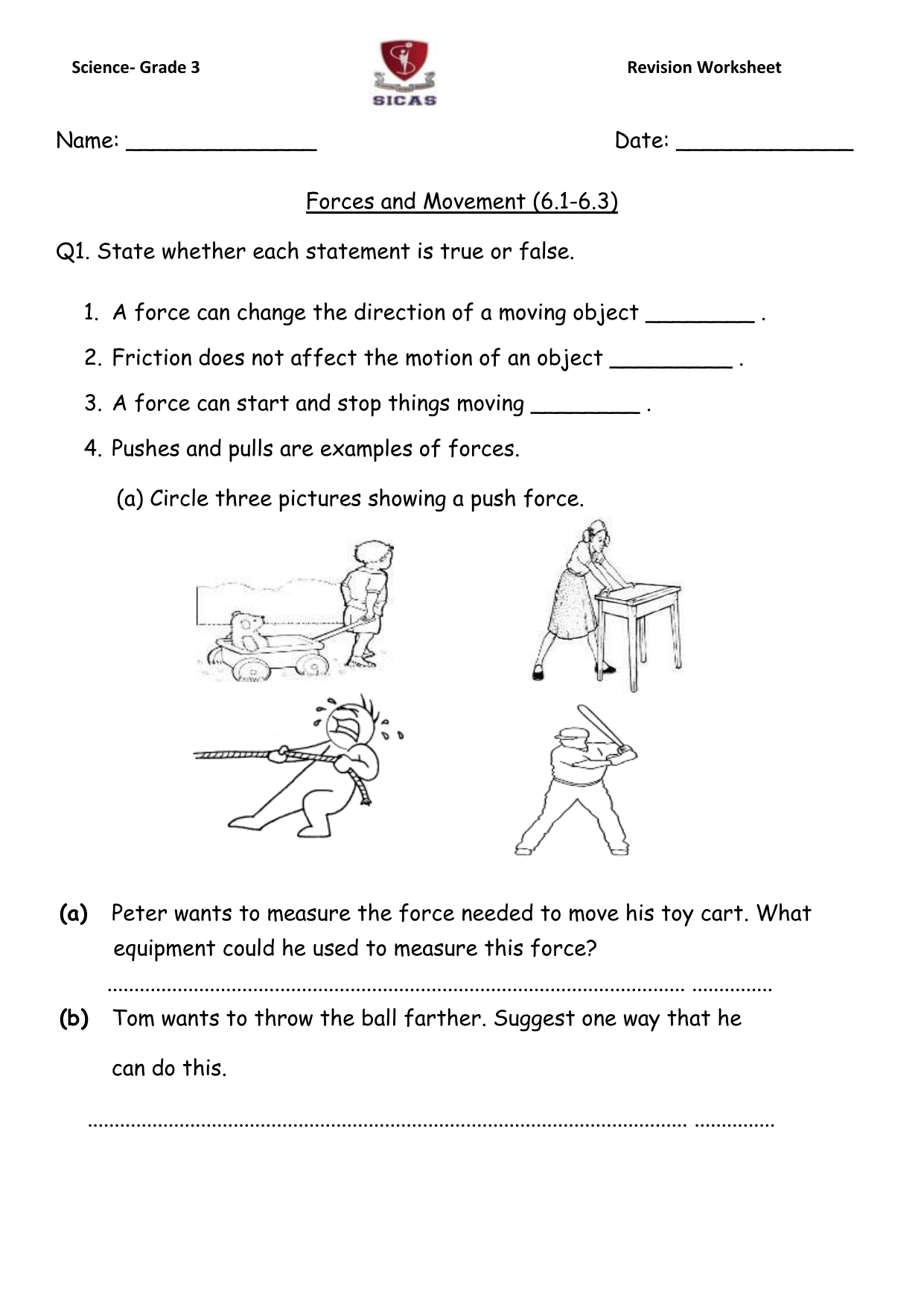
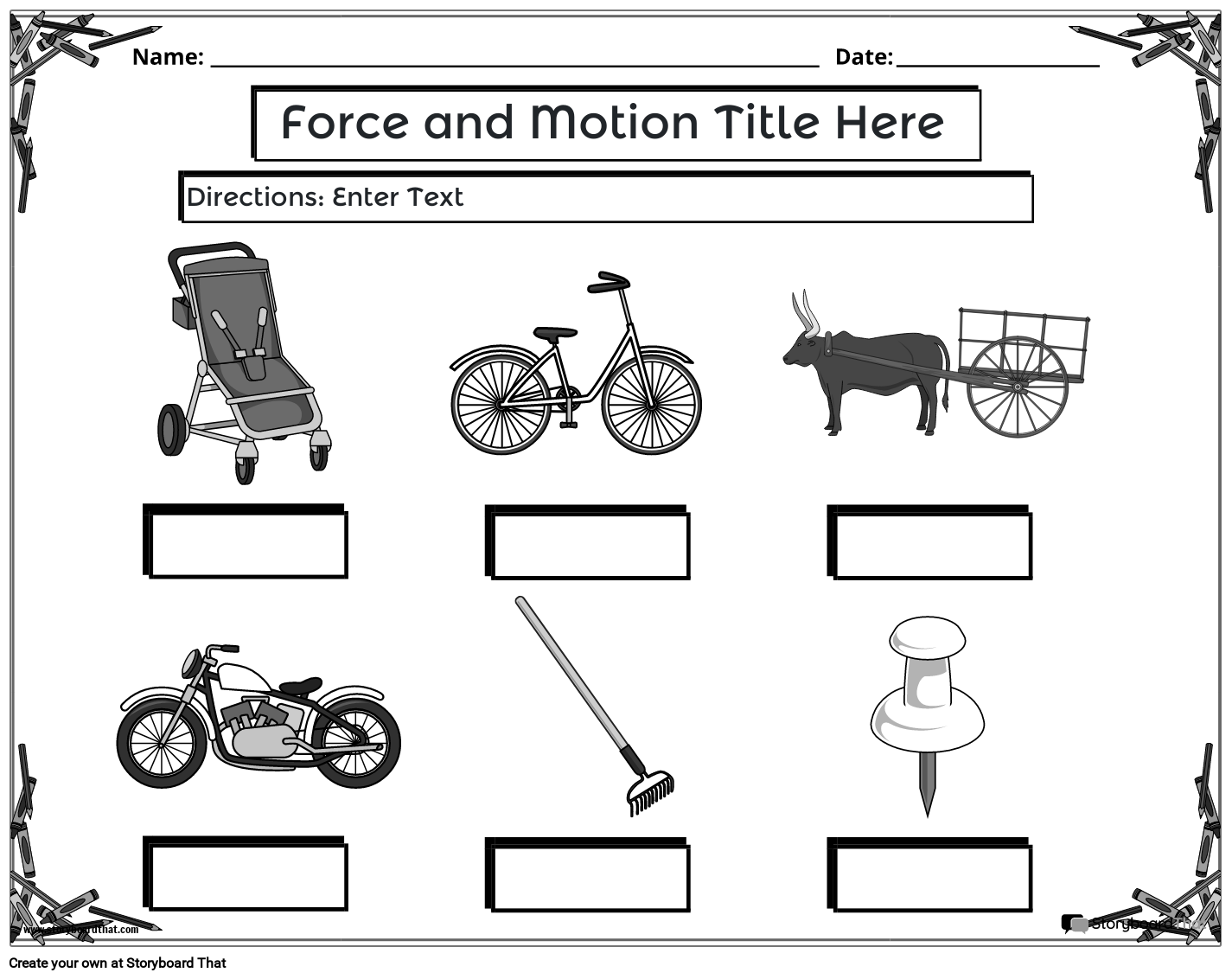
Force And Motion Worksheets provide a dynamic bridge between abstract physics concepts and tangible student experiences, turning textbook theories into hands‑on discovery. As a teacher or parent, you’re always looking for tools that translate the language of motion—speed, acceleration, force—into clear, memorable lessons. These worksheets do exactly that, offering structured practice, instant feedback, and real‑world relevance that keeps students engaged and builds confidence in scientific reasoning.
Why Force And Motion Worksheets Are Essential
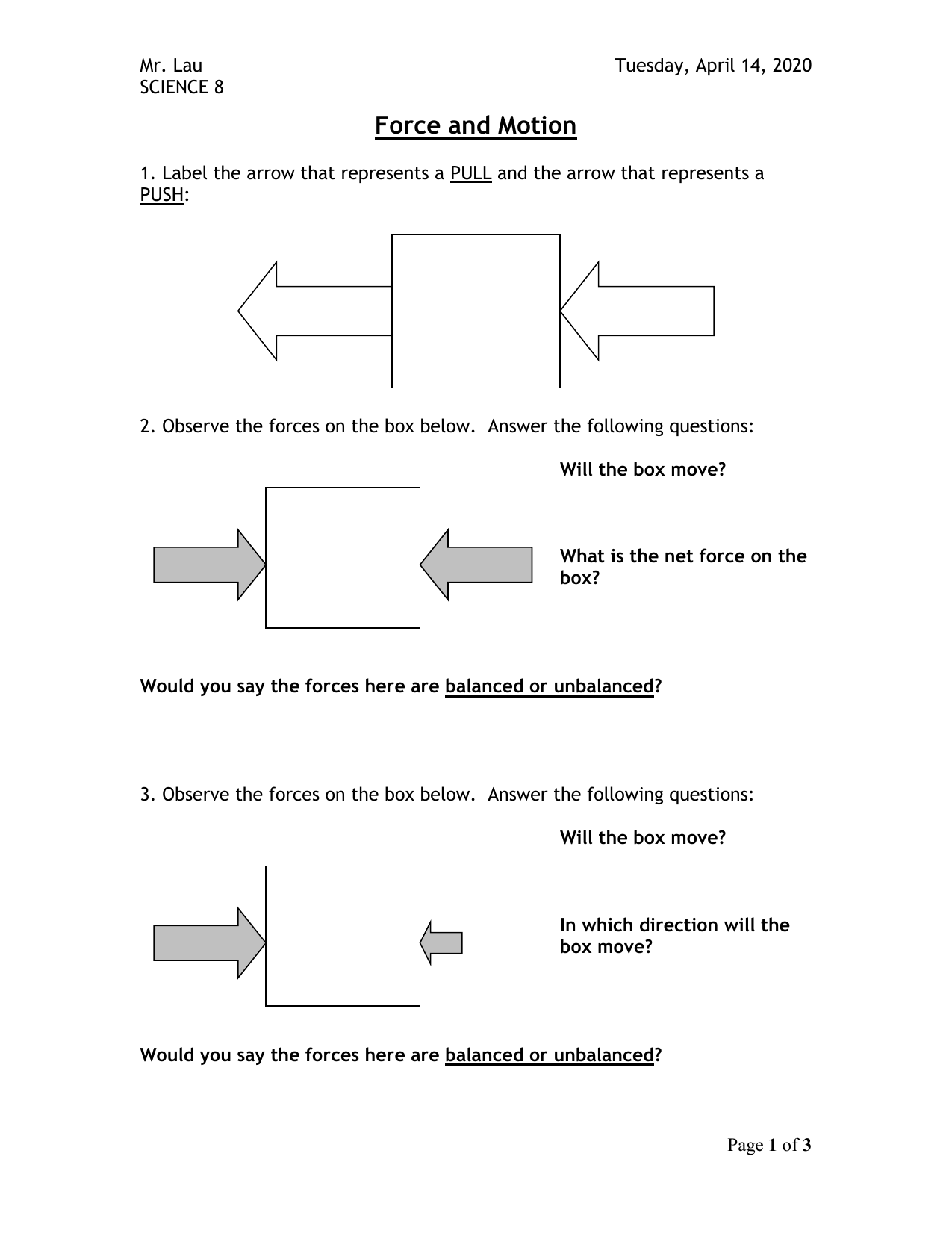
In the classroom, the challenge of teaching physics often lies in making invisible forces visible. Students can calculate acceleration using equations, but they rarely grasp how those numbers translate into everyday actions. Force And Motion Worksheets solve this problem by:
- Encouraging active problem solving rather than rote calculation.
- Providing context that links theory to real‑world phenomena like car brakes, sports, or household appliances.
- Reinforcing learning through repetition while varying difficulty levels.
- Offering immediate assessment opportunities for both teachers and students.
By integrating these worksheets into lessons, educators create a scaffold that supports conceptual growth, fosters curiosity, and promotes higher‑order thinking skills such as analysis, synthesis, and evaluation.
How to Use Them Effectively

Start with Clear Learning Objectives
Before handing out a worksheet, align each activity with specific learning goals. For example, if the unit goal is to understand Newton’s third law, craft a worksheet that asks students to identify action–reaction pairs in various scenarios. This focused approach ensures that every question serves a purpose and that students can see how each problem builds toward a deeper understanding.
Layer Complexity Gradually
Begin with straightforward, calculation‑based problems that reinforce formulaic knowledge. Once students master these, introduce applied questions that require diagram interpretation, critical reasoning, or even simple experimental design. By gradually increasing the cognitive load, you help students transition from “I can solve for *a*” to “I can apply the concept in unfamiliar contexts.”
Integrate Visual Aids and Interactive Elements
Whenever possible, pair worksheets with diagrams, force vectors, or short video clips. Visual representations help students internalize the direction and magnitude of forces. Even a simple sketch on a worksheet—such as drawing the forces acting on a moving cart—can make abstract equations tangible.
Facilitate Collaborative Work
Assign worksheets in pairs or small groups to promote discussion. Encourage students to explain their reasoning aloud, challenge assumptions, and correct mistakes together. This collaborative environment mirrors the scientific method and deepens conceptual retention.
Provide Timely Feedback
After students complete a worksheet, review responses collectively. Highlight common misconceptions, such as confusing mass with weight or neglecting frictional forces. Offer a quick recap of key principles and, if time allows, a brief extension activity to reinforce learning.
Common Mistakes and How to Avoid Them

Misinterpreting Force Directions
Students often draw vectors that do not accurately represent the direction of forces. Remind them that force vectors are directional arrows, and the arrow’s tip points toward the direction of the force. Practice drawing vectors in multiple scenarios—push, pull, gravity—to solidify this convention.
Overlooking Friction and Air Resistance
Many worksheets assume a frictionless environment, which can mislead students when they later encounter real‑world problems. Explicitly incorporate questions that ask students to calculate net forces when friction or drag is present. This prepares them for later units on energy conservation or dynamics.
Forgetting to Show Work
Students often jump straight to the answer, missing the opportunity to demonstrate their problem‑solving process. Encourage step‑by‑step notation in worksheets and award partial credit for correct reasoning even if the final answer is incorrect.
Assuming All Forces Are Known
Some problems give you the force magnitude but not the direction or the angle. Teach students to break forces into components using sine and cosine functions before applying Newton’s laws.
Real‑World Applications and Classroom Examples

Sports Science
Use worksheets that explore the forces involved in a basketball shot or a soccer kick. Ask students to calculate the optimal launch angle, the impact force on the ball, or the role of friction between the ball and the ground. By connecting physics to the games they love, students see the immediate relevance of the concepts.
Transportation and Safety
Analyze how car brakes work by calculating the deceleration required for a safe stop. Provide scenarios with varying masses and friction coefficients to illustrate how vehicle design impacts safety. Students can then explore how airbags and crumple zones mitigate impact forces.
Everyday Household Items
Challenge students to investigate the forces in a simple lever, such as a kitchen scale or a crowbar. They can calculate the mechanical advantage and explore how changing the fulcrum position alters the effort required.
Environmental Science
Integrate worksheets that examine the forces acting on wind turbines or the drag experienced by fish swimming through water. These examples reveal the importance of physics in sustainability and biology.
Tips for Parents and Teachers

Create a Dedicated Workspace
Set aside a quiet corner with a large table and all necessary tools: pencils, rulers, calculators, and the worksheets themselves. A consistent environment helps students focus and signals that the activity is a serious learning opportunity.
Encourage Reflection
After completing each worksheet, prompt students to write a brief reflection on what they learned, any challenges they faced, and how they might apply the concept elsewhere. Reflection reinforces metacognition and deepens understanding.
Use Technology Wisely
Leverage interactive simulations or graphing calculators to visualize force vectors, motion trajectories, and acceleration curves. These digital tools complement worksheets and offer instant visual feedback that can clarify confusing concepts.
Provide Diverse Practice
Offer worksheets that vary in style—multiple choice, fill‑in, diagram labeling, short essays—to cater to different learning preferences. This diversity ensures that every student engages with the material in a way that suits them best.
Celebrate Progress
Track milestones, such as mastering Newton’s second law or accurately predicting projectile motion. Celebrate these achievements with certificates, badges, or a simple verbal acknowledgment. Positive reinforcement motivates continued effort and builds a growth mindset.
Where to Find High-Quality Worksheets

While the internet hosts many free resources, the most effective worksheets are those designed with clear objectives, progressive difficulty, and engaging real‑world contexts. Look for materials that:
- Include step‑by‑step solutions or answer keys for self‑assessment.
- Provide visual aids or diagrams that illustrate force vectors.
- Offer adjustable difficulty levels to accommodate varying skill sets.
- Come with supplemental activities, such as lab experiments or group projects.
Teachers often share custom worksheets through professional learning communities or classroom blogs, allowing you to adapt content to your students’ needs. Additionally, reputable educational publishers produce science activity books that align with curriculum standards and contain curated worksheets.
Conclusion

Force And Motion Worksheets are more than just worksheets; they are gateways that transform abstract physics principles into concrete, memorable learning experiences. By thoughtfully integrating these tools—setting clear objectives, layering complexity, providing visual support, encouraging collaboration, and giving timely feedback—you equip students with the skills they need to analyze, predict, and innovate. As you guide young minds through the mechanics of the world, remember that each problem solved, each vector drawn, and each reflection written brings them closer to becoming confident, critical thinkers ready to tackle the physical challenges of tomorrow. The journey from numbers on paper to understanding the forces that shape our daily lives begins with a simple worksheet and ends with a lifetime of curiosity and discovery.