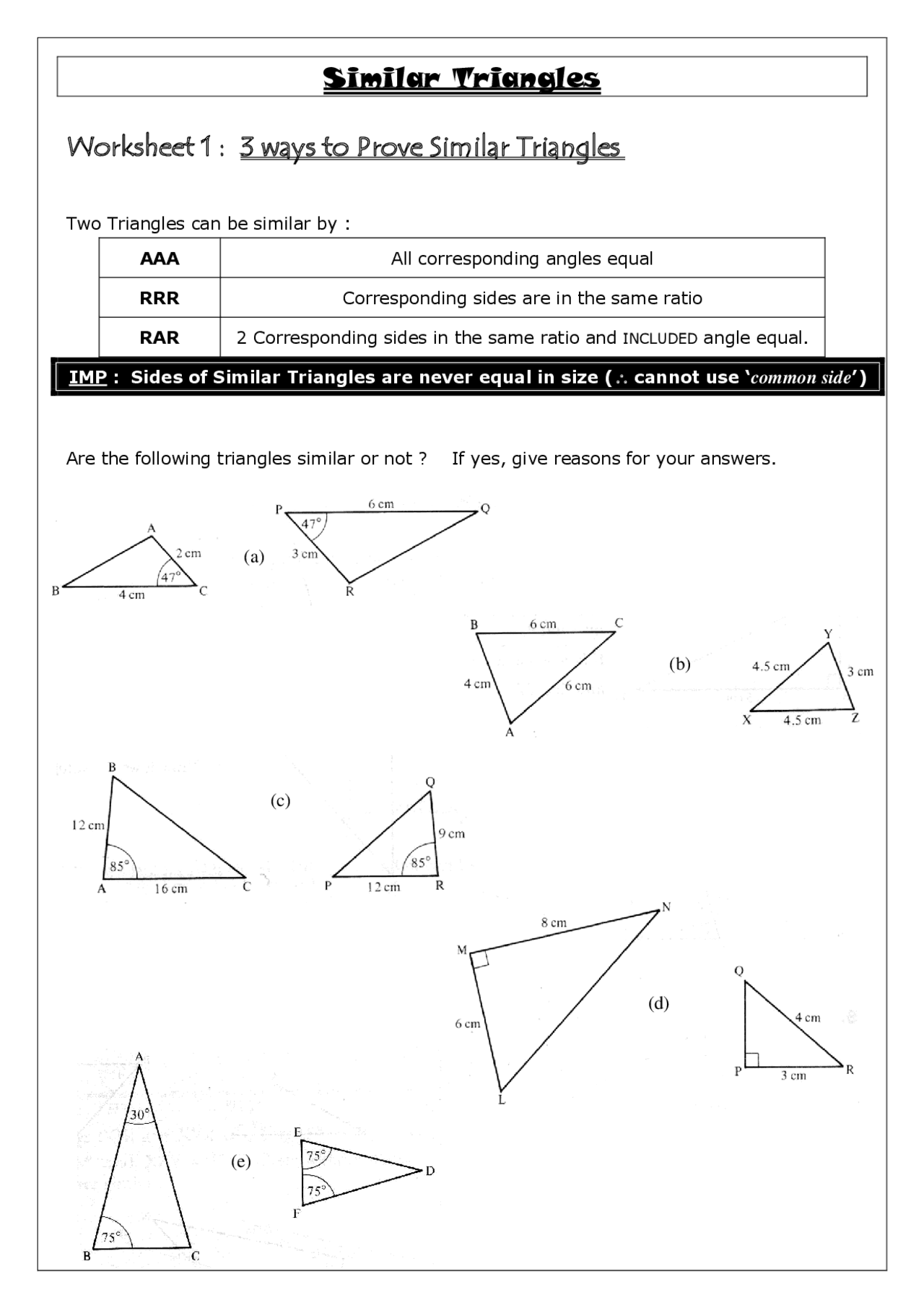
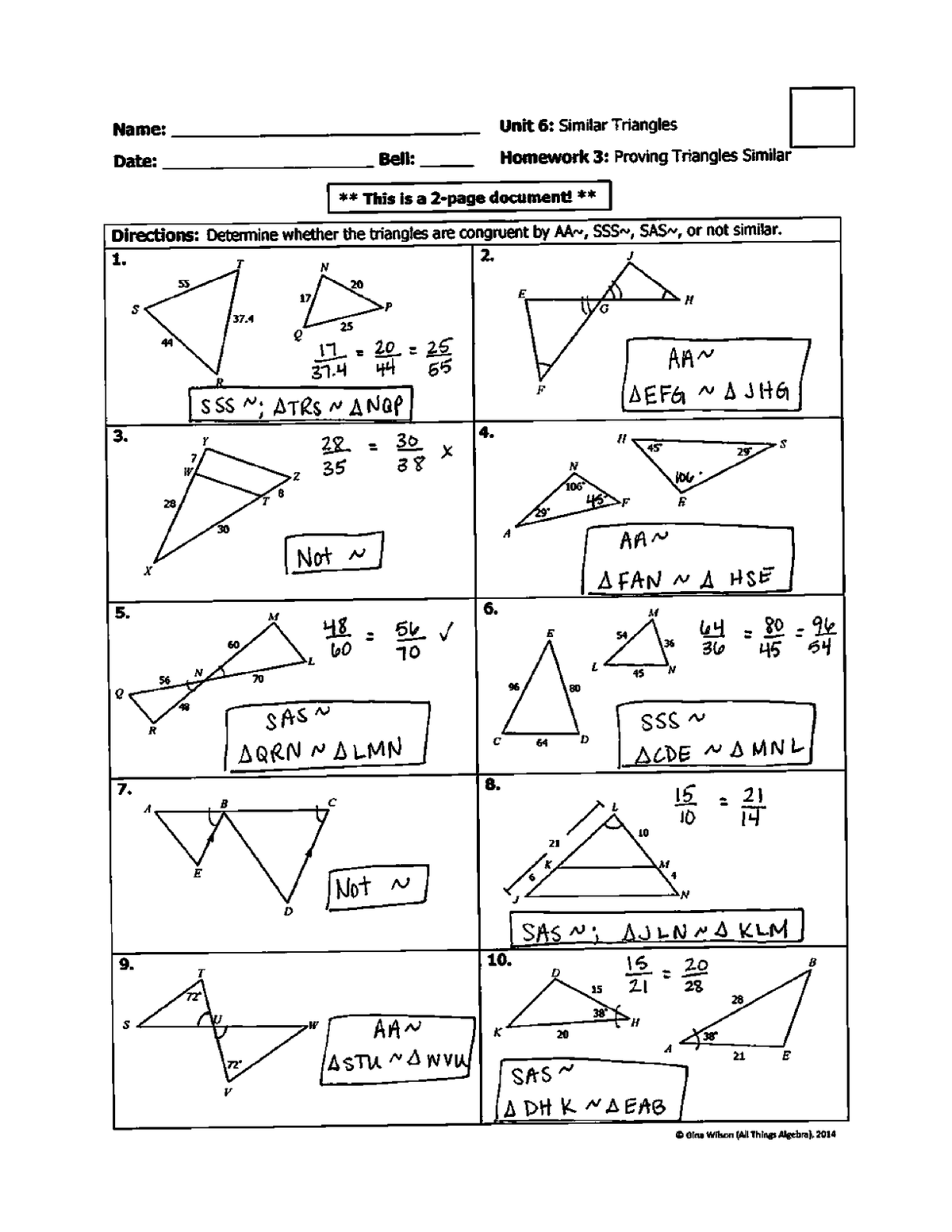
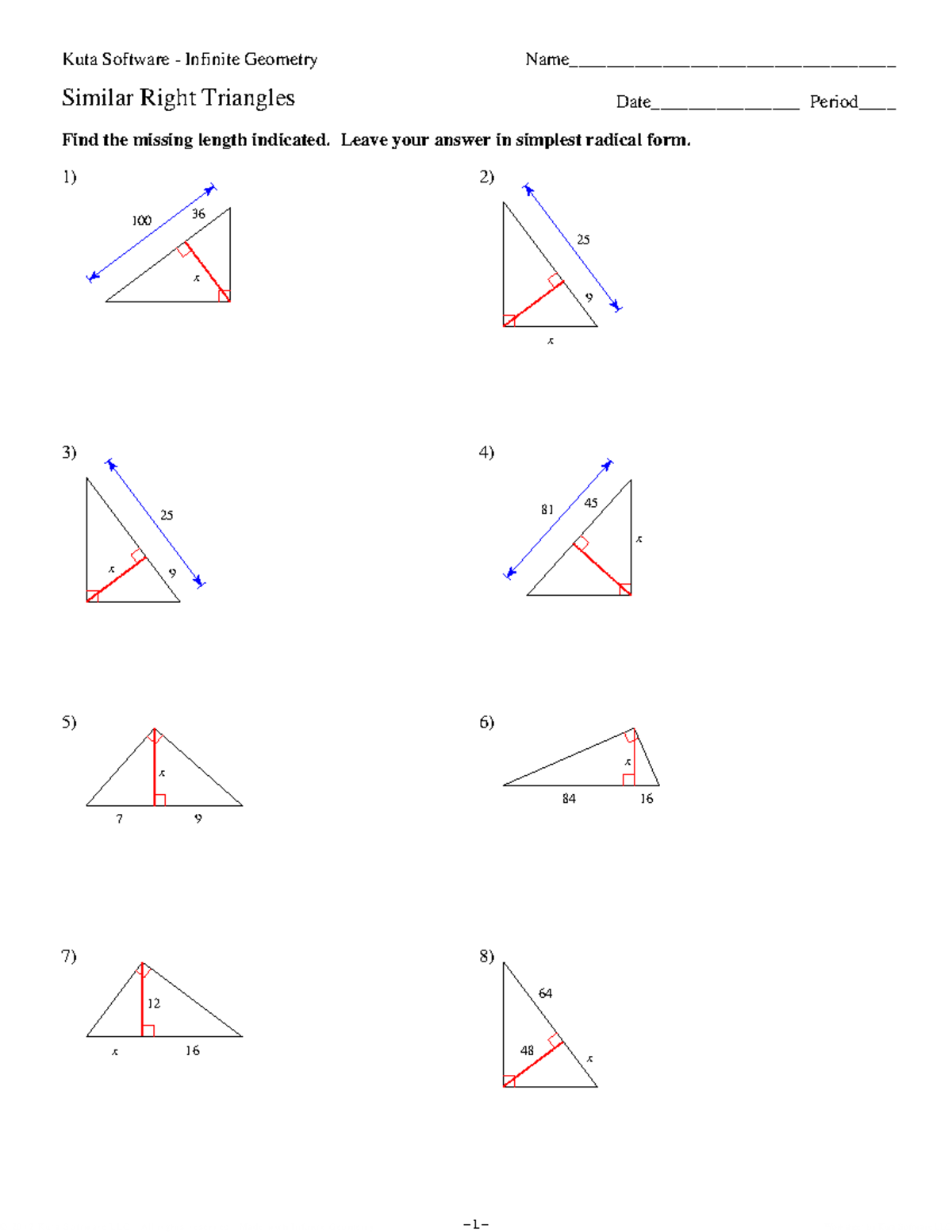
Geometry Similar Triangles Worksheet serves as a cornerstone for building students’ spatial reasoning, proportional thinking, and problem‑solving confidence, making it an indispensable tool in any middle‑school or high‑school math curriculum. Whether you are a teacher seeking to reinforce core concepts, a tutor looking for targeted practice, or a parent eager to support home learning, a well‑crafted worksheet can transform abstract similarity ideas into concrete, visual, and interactive experiences that resonate with learners of diverse abilities.
Understanding Similar Triangles

Definition and Key Properties
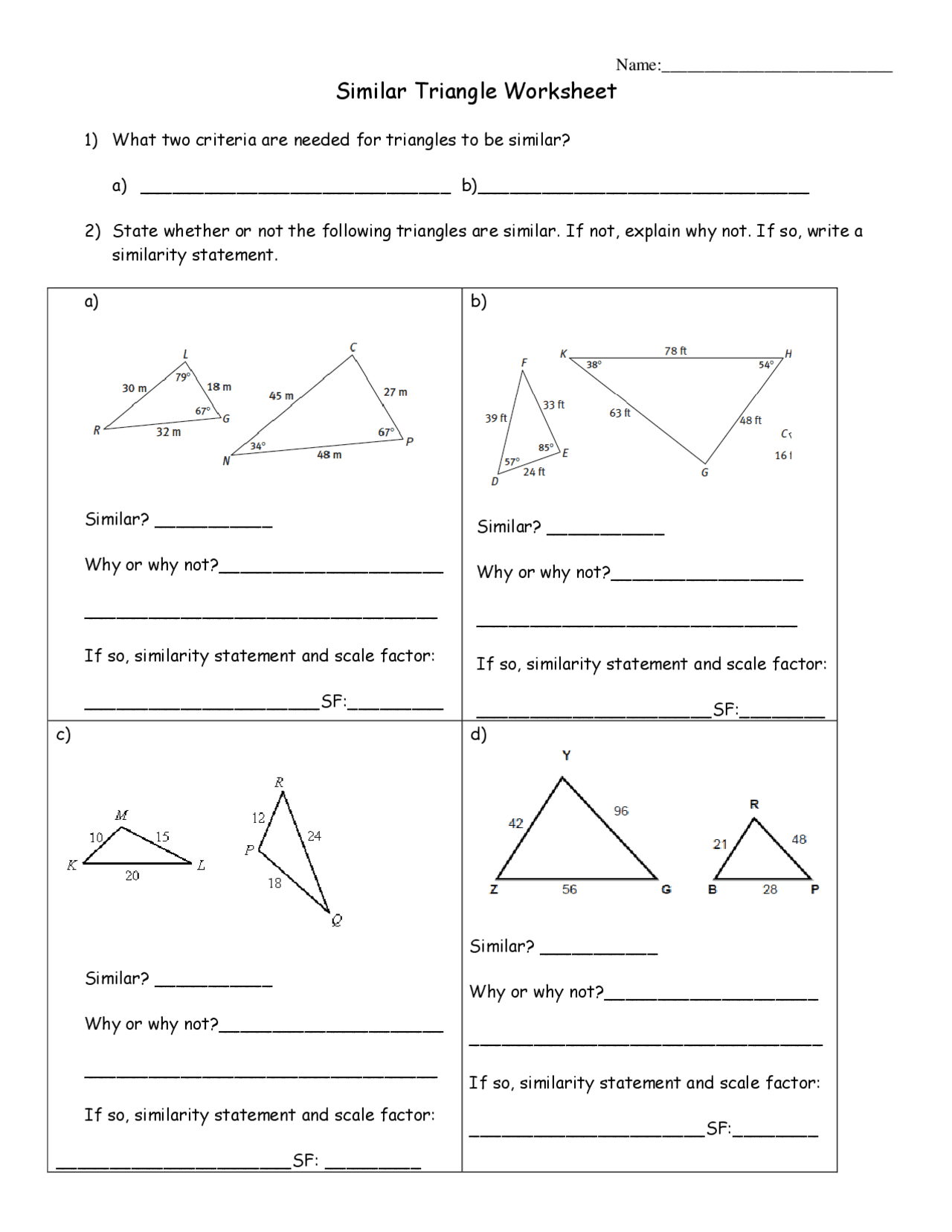
Two triangles are considered similar when their corresponding angles are congruent and the lengths of their corresponding sides are proportional. This relationship is expressed mathematically as ΔABC ∼ ΔDEF if ∠A = ∠D, ∠B = ∠E, ∠C = ∠F, and the side ratios AB/DE = BC/EF = AC/DF hold true. The similarity symbol (∼) captures both the angle equality and the constant scale factor that links the sizes of the figures.
The three foundational properties of similar triangles are:
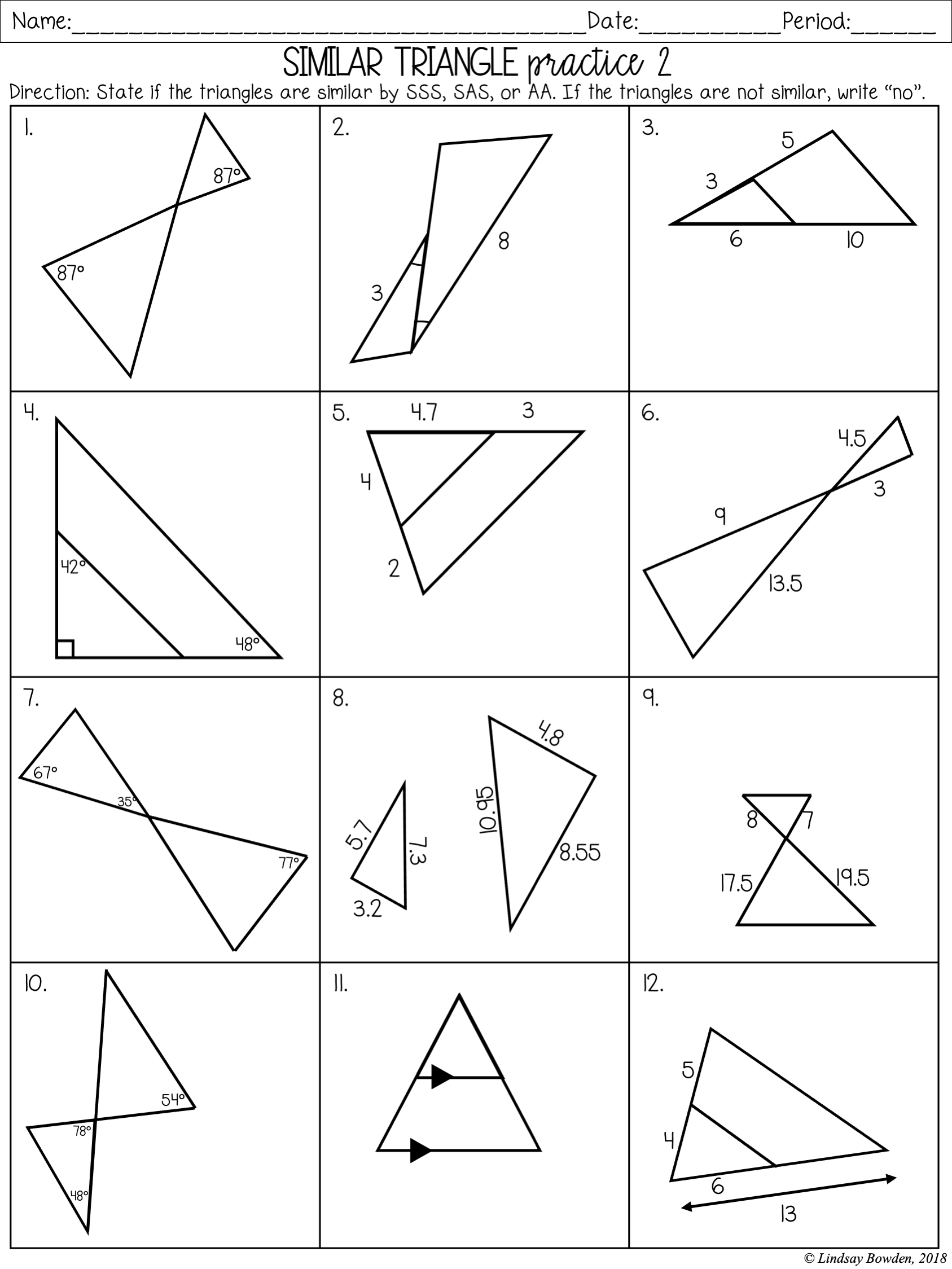
- AA (Angle‑Angle) Criterion: If two angles of one triangle match two angles of another, the triangles are automatically similar.
- SSS (Side‑Side‑Side) Criterion: If the three pairs of corresponding sides are in the same proportion, similarity is guaranteed.
- SAS (Side‑Angle‑Side) Criterion: If two sides are in proportion and the included angle is equal, the triangles are similar.
These criteria provide multiple pathways for students to verify similarity, allowing worksheets to present a variety of problem types that cater to different learning styles.
Why Similar Triangles Matter in Geometry
Beyond the classroom, similarity underpins many real‑world applications such as map reading, architectural scaling, and engineering design. Mastery of similar triangles equips students with a mental toolkit for estimating distances, constructing scale models, and solving indirect measurement problems without the need for advanced technology. By embedding these authentic contexts into a worksheet, educators can demonstrate relevance and motivate deeper engagement.
Features of an Effective Geometry Similar Triangles Worksheet
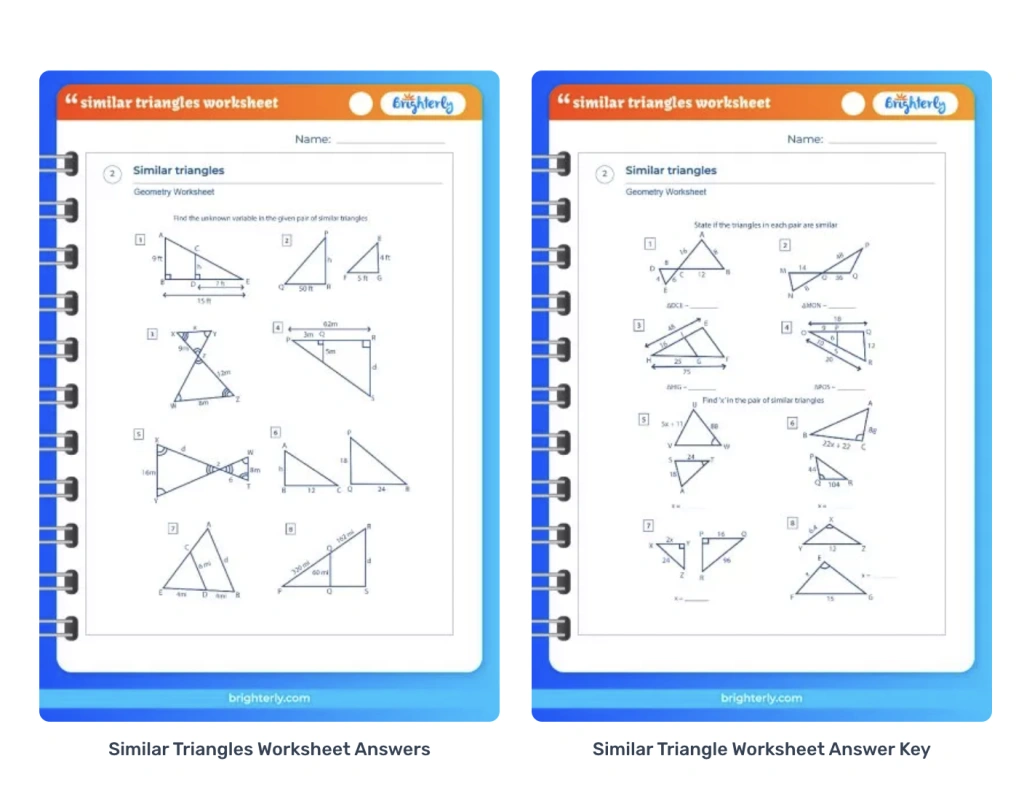
Clear Objectives and Learning Outcomes
An effective worksheet begins with concise, observable objectives that align with curriculum standards. For instance, “Students will identify pairs of similar triangles using the AA criterion and compute missing side lengths using proportional reasoning.” When objectives are explicit, learners can self‑monitor progress, and teachers can assess mastery more efficiently.
Balanced Mix of Question Types
To cater to a range of cognitive demands, a high‑quality worksheet incorporates:
- Identification Tasks: Diagrams where students label congruent angles or mark proportional sides.
- Computation Problems: Exercises that require solving for unknown lengths or scale factors.
- Proof‑Based Items: Short written explanations that ask learners to justify similarity using a specific criterion.
- Real‑World Scenarios: Word problems that translate similarity concepts into contexts such as shadow length, map scale, or model building.
Visual Clarity and Accessibility
Well‑designed diagrams are the heart of any similar triangles worksheet. Clear line weights, labeled vertices, and consistent use of color or shading help students focus on the essential features. For accessibility, include alternative text descriptions and ensure that any color coding is accompanied by patterns or labels, allowing all learners to interpret the figures accurately.
Progressive Difficulty
Start with straightforward AA identification, then gradually introduce mixed‑criterion problems, and finally present multi‑step challenges that integrate algebraic expressions. This scaffolding respects the zone of proximal development, encouraging confidence while pushing learners toward higher‑order thinking.
Designing Your Own Worksheet

Step‑by‑Step Guide
Step 1: Define the Target Standards. Review state or national standards to pinpoint the exact similarity concepts you need to cover. Write them down as bullet points to keep the design focused.
Step 2: Choose a Theme. Select a unifying context—such as “Designing a Miniature Garden” or “Exploring Planetary Orbits”—that will thread through each problem. Thematic continuity boosts engagement and aids memory retention.
Step 3: Draft Core Problems. Create a set of 5–7 base triangles that can be reused across multiple question types. Vary the orientation, size, and labeling to prevent pattern recognition from becoming a shortcut.
Step 4: Add Scaffolded Prompts. For each core problem, write three prompts:
- A basic identification question (e.g., “Which angles are congruent?”).
- A proportional reasoning question (e.g., “If side AB = 6 cm and the scale factor is 1.5, find the corresponding side in the similar triangle.”).
- A real‑world application (e.g., “A model of a lighthouse is built at a 1:100 scale. If the model’s height is 2 m, what is the actual height of the lighthouse?”).
Step 5: Include Reflection Prompts. End the worksheet with a short open‑ended question such as “Explain in your own words why the AA criterion guarantees similarity, and give an example from everyday life.” This encourages metacognition and solidifies conceptual understanding.
Step 6: Review for Clarity and Errors. Verify that each diagram matches the written description, that side labels are consistent, and that answer keys reflect correct calculations. Peer review by a fellow educator can catch ambiguities before distribution.
Common Challenges and How to Overcome Them
Misidentifying Corresponding Angles
Students often confuse interior angles with exterior ones, especially when triangles are drawn in overlapping configurations. To address this, include a “spot‑the‑error” section where learners must correct mislabeled angles. Visual cues such as arrows pointing to the vertex can reinforce proper identification.
Confusion Between Similarity and Congruence
Because both concepts involve angle relationships, learners sometimes assume that similar triangles are also congruent. A comparative table that lists the defining properties of congruence (all sides equal, all angles equal) versus similarity (proportional sides, equal angles) can clarify the distinction. Follow the table with a mixed‑type problem that asks students to decide whether a given pair is similar, congruent, or neither.
Difficulty Setting Up Proportions
When solving for unknown sides, students may write ratios in the wrong order, leading to incorrect cross‑multiplication. Provide a consistent template such as “Corresponding side in triangle 1 : Corresponding side in triangle 2 = …” and model the process with a worked example before asking for independent practice.
Limited Transfer to Real‑World Problems
Abstract geometry can feel detached from daily life. Incorporate tangible scenarios—like calculating the height of a tree using its shadow or determining the correct screen size for a projector based on a given distance. Encourage learners to draw their own real‑world problem, reinforcing the idea that similarity is a practical tool, not just a classroom exercise.
Integrating Worksheets into Classroom Practice

Warm‑Up Activities
Begin a lesson with a quick 5‑minute “similarity sprint” where students label angles on a projected diagram. This activates prior knowledge and sets a focused tone for the deeper worksheet work that follows.
Collaborative Learning
Pair students and assign each pair a different section of the worksheet. After completing their portion, they rotate, reviewing each other’s solutions and providing constructive feedback. This peer‑teaching model promotes discussion of reasoning steps and reduces the likelihood of superficial copying.
Formative Assessment
Use the worksheet as a low‑stakes checkpoint. Collect answer sheets, skim for common errors, and address misconceptions on the spot. The immediate feedback loop helps prevent the entrenchment of misunderstandings before moving on to more complex topics like similarity transformations.
Homework Extension
Provide a shortened version of the worksheet for home practice, focusing on the most challenging problems. Include a concise answer key and a brief reflection prompt, allowing students to self‑assess and identify areas that need further review.
Assessment Strategies Linked to the Worksheet

Rubric Development
Create a rubric that evaluates three dimensions: conceptual accuracy (correct identification of similar triangles), procedural fluency (accurate computation of side lengths), and communication (clear justification of reasoning). Assign weighted points to each dimension to guide grading and provide transparent expectations.
Performance Tasks
Design a culminating project where students must apply similarity concepts to design a scale model of a park, a room layout, or a simple machine. The worksheet serves as the foundational practice, while the performance task assesses synthesis, creativity, and real‑world application.
Data‑Driven Instruction
Analyze item‑level performance on the worksheet using a simple spreadsheet. Track which criteria (AA, SSS, SAS) produced the most errors. Use this data to plan targeted mini‑lessons, reteach problematic concepts, or differentiate instruction for advanced learners.
Real‑World Applications of Similar Triangles

Architecture and Engineering
Architects rely on similarity to create scaled blueprints that accurately reflect the dimensions of a building. Engineers use similar triangles to determine forces in truss systems, where the geometry of a small model can predict stress distribution in a full‑size structure.
Navigation and Cartography
Map scales are a classic example of similarity. A 1 cm distance on a map might represent 1 km in reality, and using similar triangles, travelers can convert map distances into actual travel distances, a skill that remains vital even in the age of GPS.
Medical Imaging
Techniques such as X‑rays and CT scans produce two‑dimensional representations of three‑dimensional anatomy. Radiologists use principles of similarity to infer the size of internal structures, allowing for accurate diagnosis without invasive procedures.
Photography and Visual Arts
Photographers use similarity when composing shots, especially when employing perspective techniques to make objects appear larger or smaller. Understanding the proportional relationships helps artists create realistic depth and proportion in their work.
Conclusion
By thoughtfully designing a Geometry Similar Triangles Worksheet that blends clear objectives, diverse question types, visual clarity, and real‑world relevance, educators can empower students to master similarity concepts with confidence and enthusiasm. The worksheet becomes more than a set of practice problems; it evolves into a dynamic learning experience that builds critical thinking, problem‑solving skills, and an appreciation for the pervasive role of geometry in everyday life. Implementing the strategies outlined above—scaffolding difficulty, addressing common misconceptions, integrating collaborative activities, and linking assessment to authentic applications—ensures that the worksheet not only reinforces curriculum standards but also prepares learners to apply geometric reasoning beyond the classroom walls.