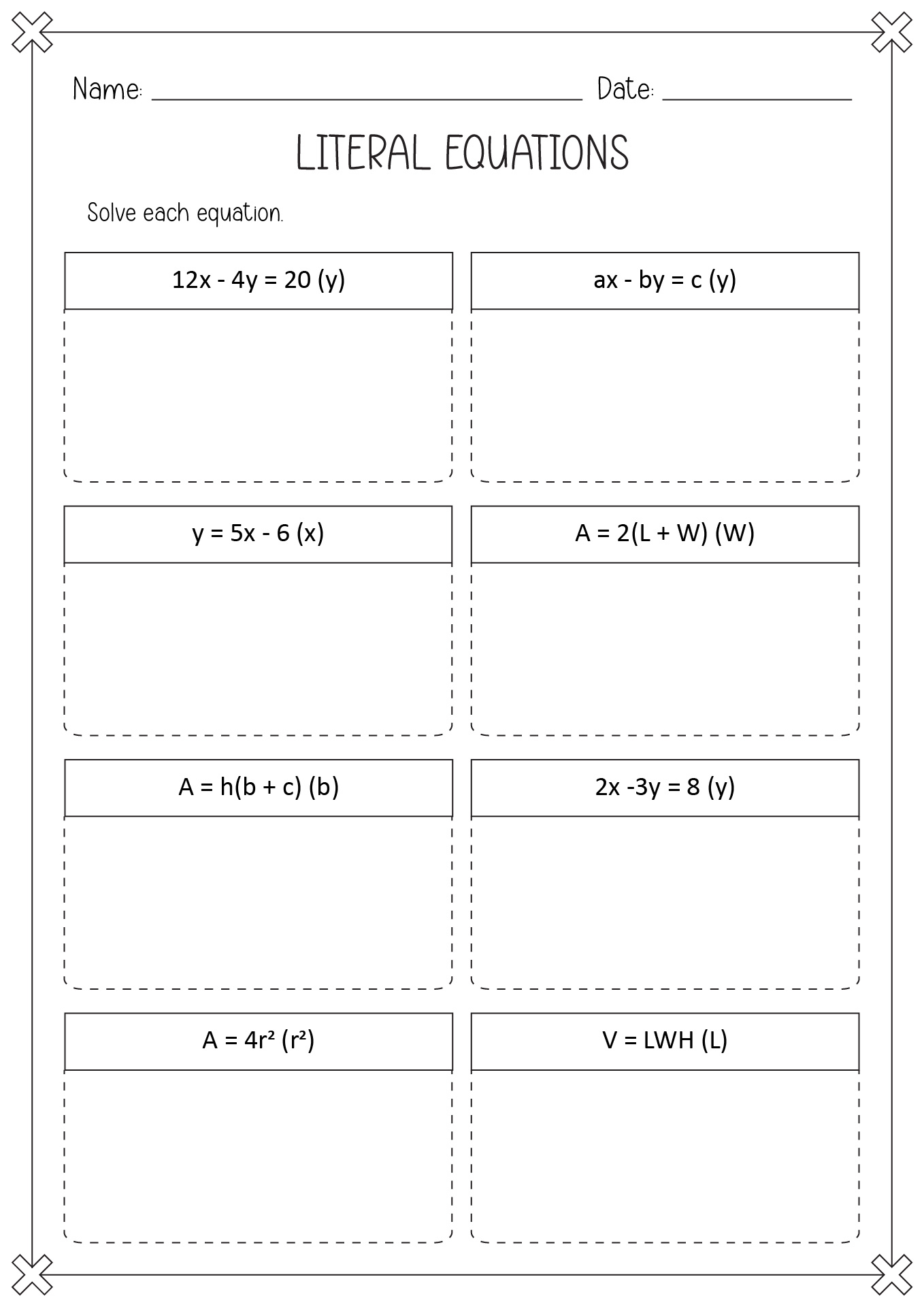
Literal Equations Worksheet Algebra serves as a cornerstone for developing algebraic fluency, enabling learners to manipulate expressions, isolate variables, and comprehend the relationships between terms. By engaging with targeted worksheets, students transform abstract symbols into concrete problem‑solving tools that translate across science, engineering, and everyday scenarios.
What Are Literal Equations?

Literal equations express one quantity in terms of one or more others, often without assigning specific numeric values. They are a generalized form of algebraic equations and can be rearranged to solve for any variable. For example, the formula for the area of a circle, A = πr², allows a student to solve for radius, circumference, or area depending on the given data.
Structure of a Literal Equation
- Dependent Variable – the term you are solving for.
- Independent Variables – the terms that provide context or known values.
- Constants – numeric multipliers or coefficients.
Why Literal Equations Worksheets Matter in Algebra 1

Traditional algebra focuses on equations with numerical values, but real life demands flexibility. Worksheets that emphasize literal equations:
- Encourage *symbolic reasoning* by isolating variables in diverse contexts.
- Build a foundation for *future STEM subjects*, where formulas often contain multiple variables.
- Strengthen *mathematical communication*, enabling students to describe relationships verbally and visually.
Key Strategies for Solving Literal Equations

Mastering literal equations requires a systematic approach. Below are actionable steps that can be applied to any worksheet problem.
Step 1: Identify the Target Variable
Read the problem to determine which symbol must be isolated. This guides every subsequent manipulation.
Step 2: List Known Quantities
Write down all given variables and constants. Mark them clearly so you don’t confuse them during rearrangement.
Step 3: Apply Inverse Operations
- Use division or multiplication to cancel coefficients.
- Move terms across the equals sign by adding or subtracting.
- Factor or expand when necessary to simplify expressions.
Step 4: Verify Dimensional Consistency
In physics or engineering contexts, ensure that units match. For instance, solving for time in a speed formula should produce a result in seconds, minutes, or hours as expected.
Step 5: Check for Extraneous Solutions
After rearranging, substitute the solution back into the original equation to confirm its validity.
Common Mistakes and How to Avoid Them

Students often stumble on literal equations due to subtle errors. Recognizing and correcting these pitfalls increases accuracy.
Misinterpreting the Equals Sign
Confusing “=” with “≠” or “≈” can lead to incorrect isolation. Double‑check the equation before proceeding.
Forgetting to Apply the Distributive Property
When expanding a term like 3(2x + 5), failing to distribute the 3 results in a loss of a variable or wrong coefficient.
Overcomplicating the Problem
Applying unnecessary steps, such as squaring both sides, can introduce extraneous solutions. Stick to the simplest method that preserves equality.
Ignoring Domain Restrictions
Variables like “x” may be restricted (e.g., x ≠ 0) due to denominators or square roots. Worksheets should remind students to check domain constraints.
Real-World Applications of Literal Equations

Literal equations translate mathematical concepts into practical problem solving. Highlighting these applications keeps students motivated.
Engineering Design
Calculating the stress on a beam involves rearranging formulas like σ = F/A to solve for force or area, enabling engineers to design safer structures.
Finance and Economics
Determining interest rates or loan payments requires manipulating formulas such as P(1 + r/n)^(nt). Worksheets can guide students through isolating interest or time variables.
Environmental Science
Estimating CO₂ emissions from transport uses equations that relate distance, fuel consumption, and vehicle efficiency. Solving for emissions helps quantify environmental impact.
Health and Medicine
Dosage calculations in pharmacology often rely on formulas like dose = (weight × concentration). Worksheets help students determine appropriate medication amounts for patients.
Designing Effective Worksheets for Students
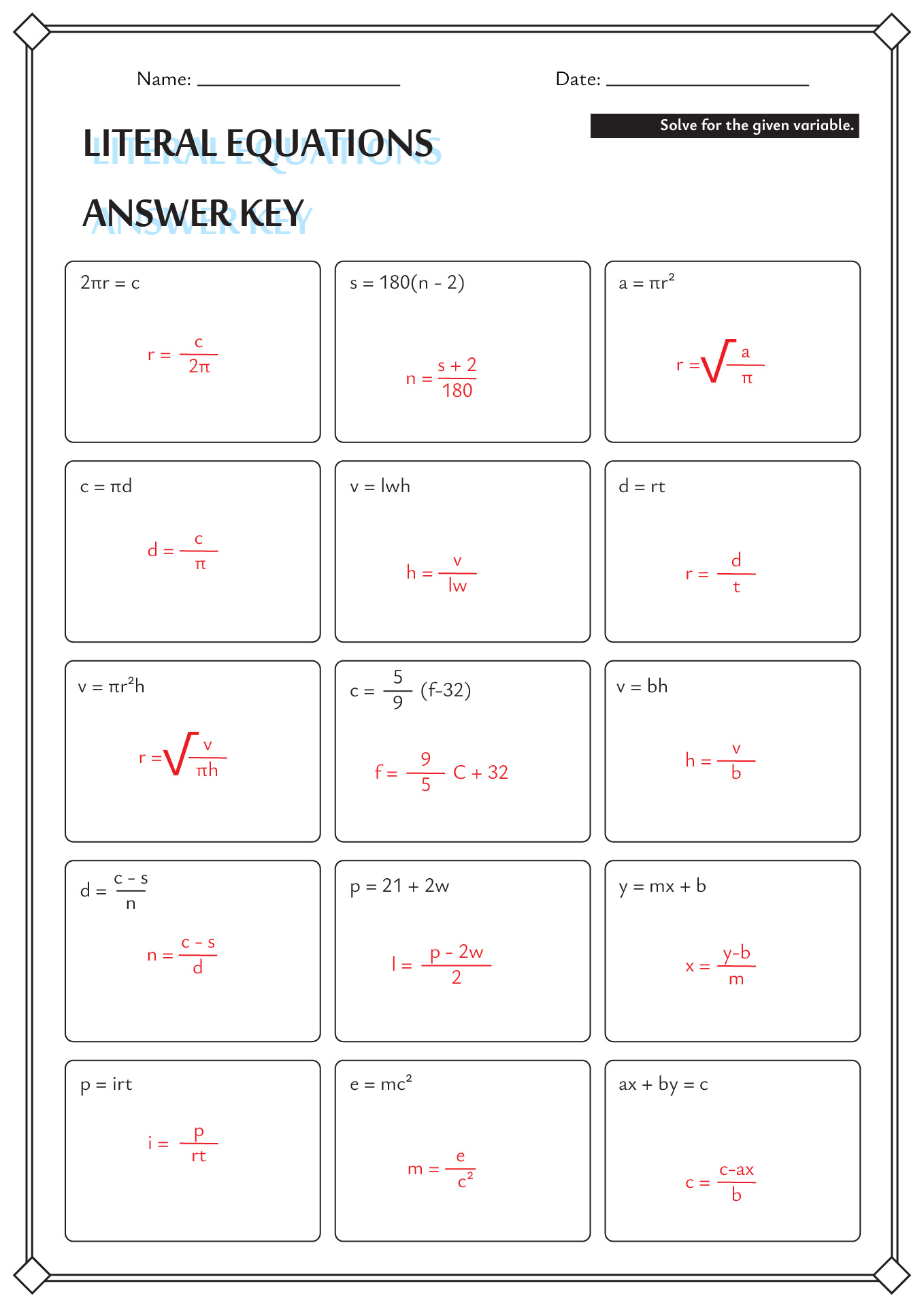
A well‑crafted worksheet balances challenge, clarity, and progression. Below are essential design principles.
Progressive Difficulty Levels
- Start with straightforward isolation of a single variable.
- Introduce multiple variables and nested operations as confidence grows.
- Include real‑world context problems at higher levels to test application skills.
Clear Instructions and Examples
Each worksheet should feature a model solution that walks through the process step by step. Highlight common pitfalls directly within the example.
Visual Aids and Symbols
Use colored text or shaded boxes to differentiate variables, constants, and operations. This visual separation helps prevent confusion during manipulation.
Self‑Check Sections
Provide a short answer section where students can verify their final result against a known value or a plug‑in check.
Tips for Teachers: Integrating Worksheets into Lesson Plans

Effective integration maximizes student learning and reduces class time wasted on confusion.
Pre‑Work Assessment
Begin a lesson with a diagnostic worksheet to gauge baseline skills. Use results to tailor instruction.
Guided Practice Sessions
After covering the theory, lead students through a few problems as a class. Encourage discussion about different solving strategies.
Independent Practice and Group Work
Assign worksheets as homework or in‑class work. Pair students to solve problems together, fostering peer learning.
Feedback Loops
Provide annotated corrections and brief explanations. Highlight why a particular step was misapplied or why an alternative approach could be more efficient.
Using Digital Tools and Resources for Literal Equations Practice

Technology can enhance engagement and provide instant feedback.
Interactive Equation Solvers
Web apps that allow students to input a formula and rearrange terms automatically help them verify manual solutions.
Dynamic Worksheets in Learning Management Systems
Platforms like Google Classroom or Canvas can host printable PDFs or fillable PDFs, enabling teachers to track progress.
Gamified Practice Platforms
Online math games that focus on variable isolation keep students motivated while reinforcing skills.
Spreadsheet Templates
Students can use Excel or Google Sheets to manipulate symbolic expressions, especially when dealing with multiple variables and large data sets.
Assessment and Feedback: Measuring Success

Consistent assessment ensures that students are mastering literal equations and applying them correctly.
Formative Assessments
- Quick exit tickets featuring a single literal equation.
- Peer‑review exercises where students swap solutions and provide critique.
Summative Assessments
Include a mix of word problems, algebraic manipulations, and real‑world scenario questions to evaluate comprehensive understanding.
Rubrics and Scoring Guides
Define explicit criteria: correct isolation, logical reasoning, unit consistency, and final verification.
Reflection Journals
Ask students to write a brief explanation of the method used for each problem, encouraging metacognition.
Conclusion

Mastering Literal Equations Worksheet Algebra equips learners with a versatile toolkit for academic success and real‑world problem solving. By understanding the structure of literal equations, employing systematic strategies, avoiding common mistakes, and applying them to diverse contexts, students build confidence and analytical depth. Thoughtfully designed worksheets, combined with strategic teaching approaches and modern digital resources, create a holistic learning environment where algebra transcends the classroom and becomes an indispensable skill in everyday life. With continued practice and reflective feedback, students will not only solve equations but also unlock the underlying relationships that shape our physical and social worlds.