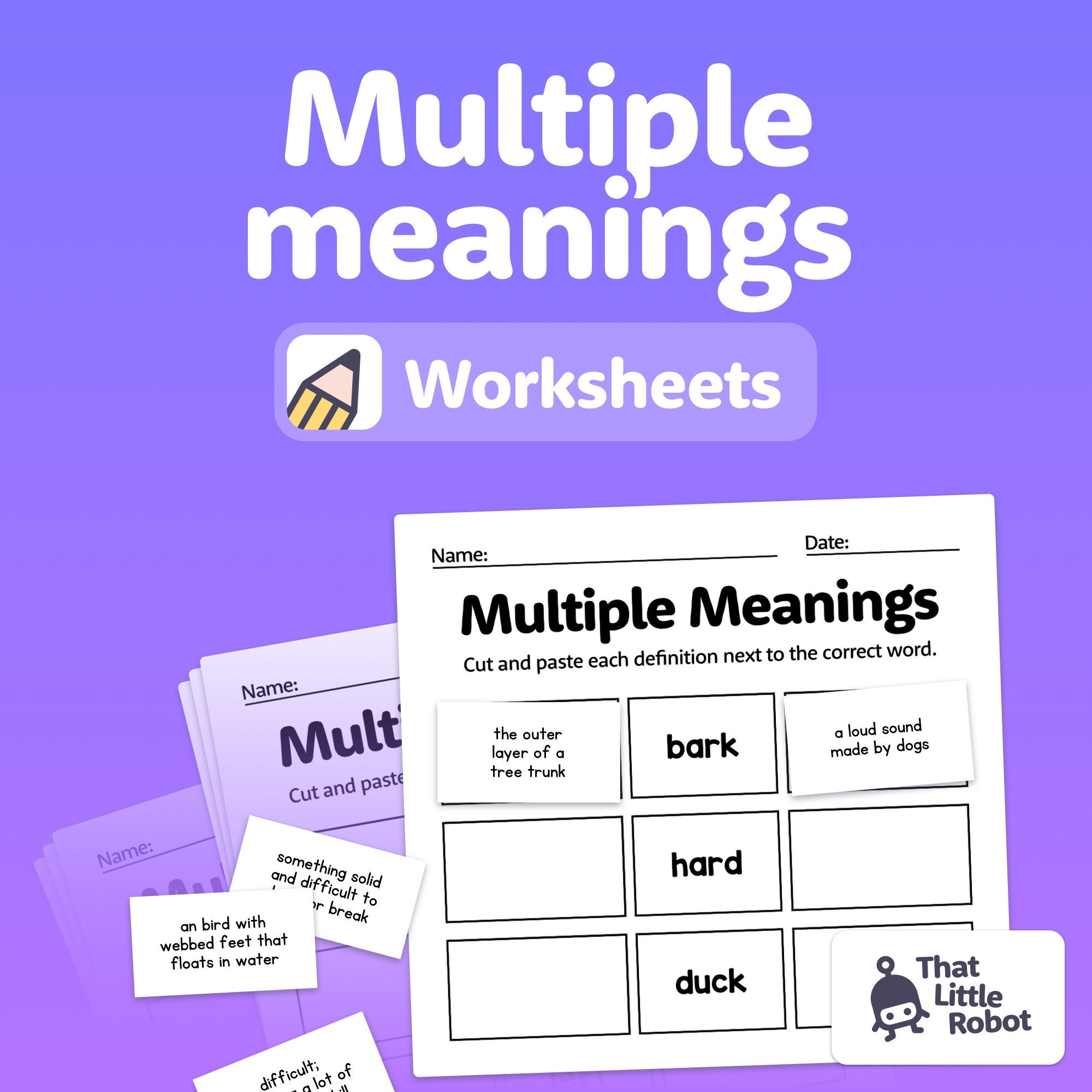
Multiple Meaning Words Worksheets are a powerful tool for unlocking the hidden richness of language in young learners, and they can turn a seemingly ordinary spelling drill into a dynamic adventure of discovery.
Why Multiple Meaning Words Matter

Words that wear more than one hat—such as “bat” (the flying mammal or the sports equipment) or “lead” (to guide or a type of metal)—challenge students to think beyond literal definitions. This deepens vocabulary, sharpens context clues, and builds critical thinking skills that are essential for reading comprehension and effective communication.
Boosting Vocabulary Depth
When students encounter a word in multiple contexts, they naturally expand their mental lexicon. Instead of memorizing a single definition, they learn to store a network of meanings, synonyms, and nuances. This networked approach makes it easier to retrieve the right meaning during reading or writing tasks.
Enhancing Reading Comprehension
Multiple meaning words often appear in literary texts, news articles, and everyday conversation. By mastering these words, learners can decode ambiguous sentences, infer author intent, and avoid misunderstandings that arise from literal interpretations.
Developing Critical Thinking
Choosing the correct meaning requires students to analyze surrounding clues, consider tone, and evaluate genre. This process mirrors the problem‑solving steps they will use in math, science, and real‑world decision making.
Benefits of Using Worksheets

Worksheets provide a structured yet flexible framework for practicing multiple meaning words. They combine visual, auditory, and kinesthetic elements, catering to diverse learning styles.
Immediate Feedback
Well‑designed worksheets include answer keys or self‑checking sections, allowing students to see instantly whether they chose the right meaning. This rapid feedback loop reinforces learning and builds confidence.
Portability and Accessibility
Printed or digital worksheets can be used at the classroom desk, in a quiet corner, or at home. They require minimal equipment—just a pencil or a tablet—and can be easily customized for any skill level.
Scalable Difficulty
Educators can start with simple two‑meaning words and progress to words with three or more meanings, or even idiomatic expressions. This scalability ensures that worksheets remain challenging without being overwhelming.
How to Choose Effective Worksheets

Not all worksheets are created equal. Selecting the right resource involves evaluating content, design, and alignment with learning objectives.
Relevance to Curriculum
Look for worksheets that tie directly into the language arts standards for your grade level. For example, a third‑grade worksheet might focus on homographs, while a fifth‑grade one could explore polysemous verbs.
Clear Instructions
Students should never be left guessing what to do. Effective worksheets feature concise, step‑by‑step directions, often reinforced with visual icons or bolded keywords.
Balanced Visuals and Text
Images that illustrate each meaning help visual learners make connections. However, avoid clutter; each illustration should support the word’s definition, not distract from it.
Variety of Task Types
Incorporate matching, fill‑in‑the‑blank, sentence creation, and short‑answer sections. This variety keeps engagement high and addresses multiple cognitive skills.
Creative Activities and Games

Beyond static worksheets, interactive games reinforce multiple meaning words in a lively, memorable way.
Word Bingo
Create bingo cards where each square contains a meaning (e.g., “a fruit” or “a musical instrument”). Call out the ambiguous word, and students cover the square that matches the definition they think applies. This encourages quick contextual reasoning.
Meaning Relay
Divide the class into teams. One student runs to a board, writes a sentence using a multiple meaning word, and tags the next teammate, who must identify the intended meaning. The relay continues until all meanings are covered.
Digital Flashcards
Use free online flashcard tools to display a word on one side and multiple example sentences on the other. Students flip through the deck, categorizing each sentence by meaning.
Step‑by‑Step Guide to Implementing Worksheets in the Classroom

Integrating worksheets seamlessly requires planning, execution, and reflection. Follow these steps to maximize impact.
Step 1: Diagnose Prior Knowledge
Start with a quick pre‑assessment—perhaps a short quiz or a class discussion—to gauge which multiple meaning words students already know and which need introduction.
Step 2: Introduce the Concept
Present a few examples on the board, highlighting how context determines meaning. Use think‑aloud strategies to model the reasoning process.
Step 3: Distribute Targeted Worksheets
Hand out worksheets that align with the pre‑assessment data. For mixed‑ability groups, provide differentiated versions—simpler rows for emerging readers and more complex sentences for advanced learners.
Step 4: Guided Practice
Work through the first few items together. Encourage students to underline clues, annotate margins, and discuss their thought process with a partner.
Step 5: Independent Completion
Allow students to finish the worksheet on their own. Circulate the room, offering prompts rather than answers to keep them engaged in critical thinking.
Step 6: Review and Reflect
Collect the worksheets, then review common errors on the board. Discuss why a particular meaning was chosen or missed, reinforcing the importance of context.
Step 7: Extend Learning
Assign a creative writing task where students must use a set of multiple meaning words each in a different sense. This solidifies mastery and encourages transfer to authentic writing.
Adapting Worksheets for Different Grade Levels
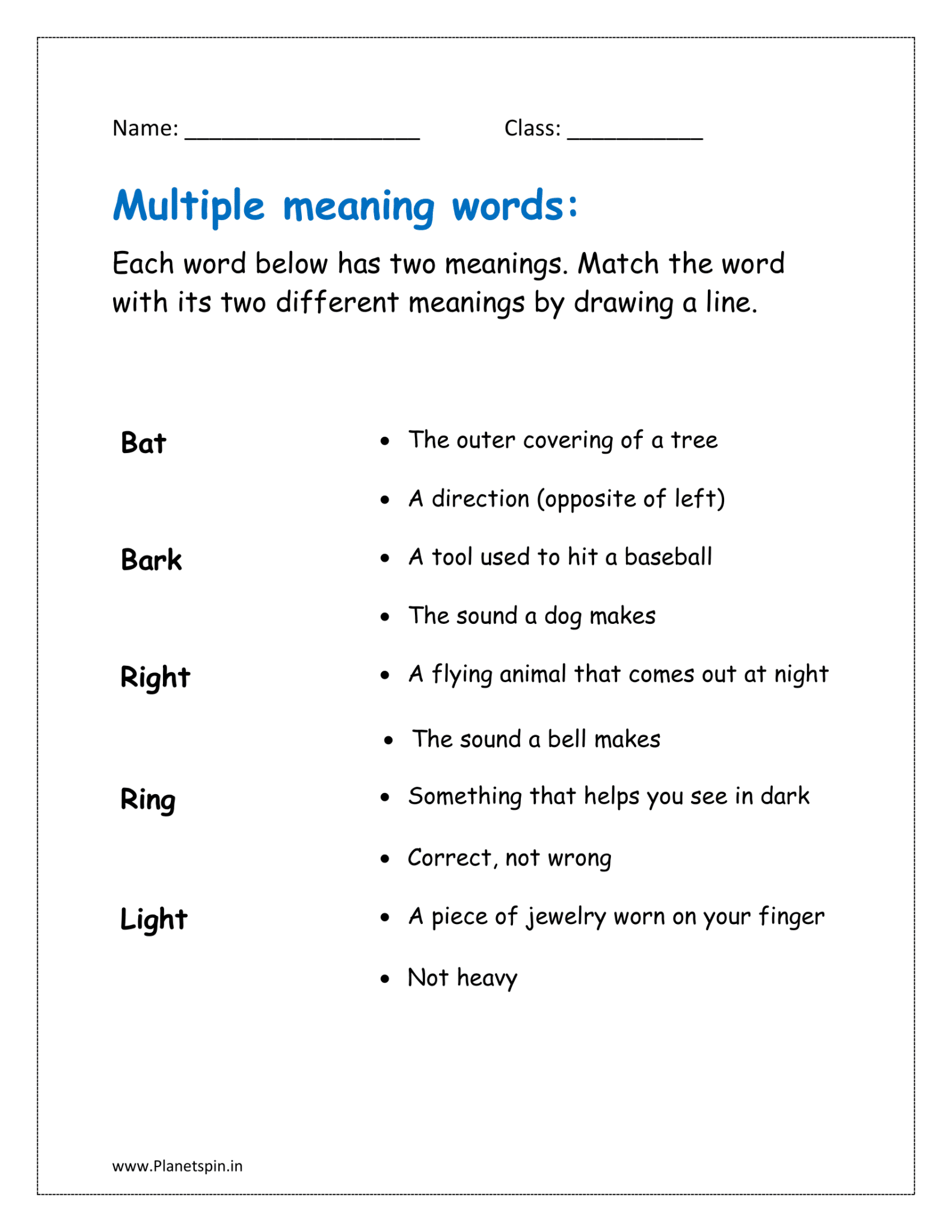
Customization ensures that worksheets meet developmental needs and keep learners challenged.
Early Elementary (K‑2)
- Focus on simple homophones like “pair/pear” and “see/sea.”
- Use large fonts, bright colors, and picture cues.
- Include tactile elements such as cut‑out word cards for matching.
Upper Elementary (3‑5)
- Introduce homographs and polysemous verbs like “run” (to jog or to manage).
- Incorporate short reading passages where the same word appears with different meanings.
- Add a column for students to draw a quick sketch that represents each meaning.
Middle School (6‑8)
- Explore idiomatic expressions and figurative language (e.g., “break the ice”).
- Require students to write sentences that illustrate each meaning, emphasizing proper syntax.
- Include a critical thinking section where learners must decide which meaning fits a given scenario.
High School (9‑12)
- Challenge students with academic vocabulary that has multiple senses (e.g., “theory,” “model,” “significant”).
- Integrate analysis of literary excerpts, asking students to annotate and justify word meanings.
- Combine worksheet tasks with research components, such as tracing the etymology of a word.
Assessing Student Progress with Multiple Meaning Words

Effective assessment goes beyond right‑or‑wrong answers; it measures depth of understanding and transferability.
Formative Checks
- Exit tickets where students write a sentence using a word in a less common meaning.
- Think‑pair‑share discussions that reveal reasoning pathways.
- Quick polls using digital platforms to gauge confidence levels for each meaning.
Summative Evaluation
- Timed quizzes that present sentences without the target word; students must supply the correct word and its meaning.
- Project‑based assessments where learners create a “multiple meaning word portfolio,” including definitions, example sentences, and personal reflections.
- Rubrics that assess accuracy, context analysis, and the ability to explain reasoning.
Tips for Parents and Homeschoolers

Learning doesn’t stop at the school door. Parents can reinforce multiple meaning words through everyday interactions.
Word of the Day
Choose a word each morning, discuss its possible meanings, and ask children to spot it in books, news articles, or TV shows throughout the day.
Contextual Storytelling
Encourage kids to tell short stories that incorporate a set of ambiguous words, explicitly stating which meaning they intend in each instance.
Household Labeling
Label objects with words that have multiple meanings (e.g., “bark” on a dog picture and a tree illustration) to create visual reminders.
Game Nights
Play board games like Scrabble or Boggle, but add a rule: each played word must be used in two distinct sentences before the next turn.
Conclusion

Integrating Multiple Meaning Words Worksheets into daily instruction transforms language learning from rote memorization into a vibrant exploration of nuance and context. By selecting purposeful worksheets, pairing them with engaging activities, and systematically assessing progress, educators and parents can empower students to navigate the rich tapestry of English with confidence and curiosity. The result is not just a stronger vocabulary, but a generation of learners who think critically, communicate clearly, and appreciate the playful depth of words.