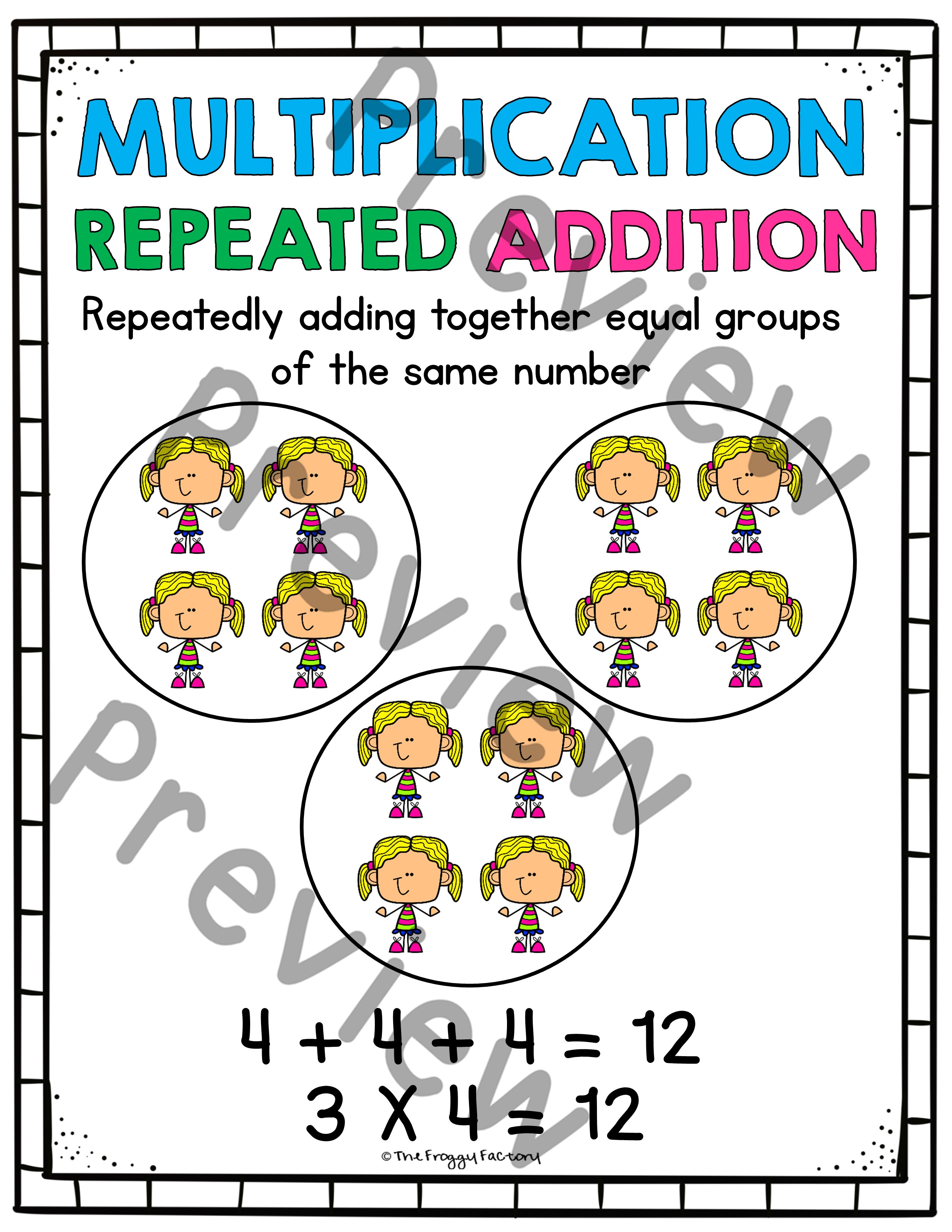
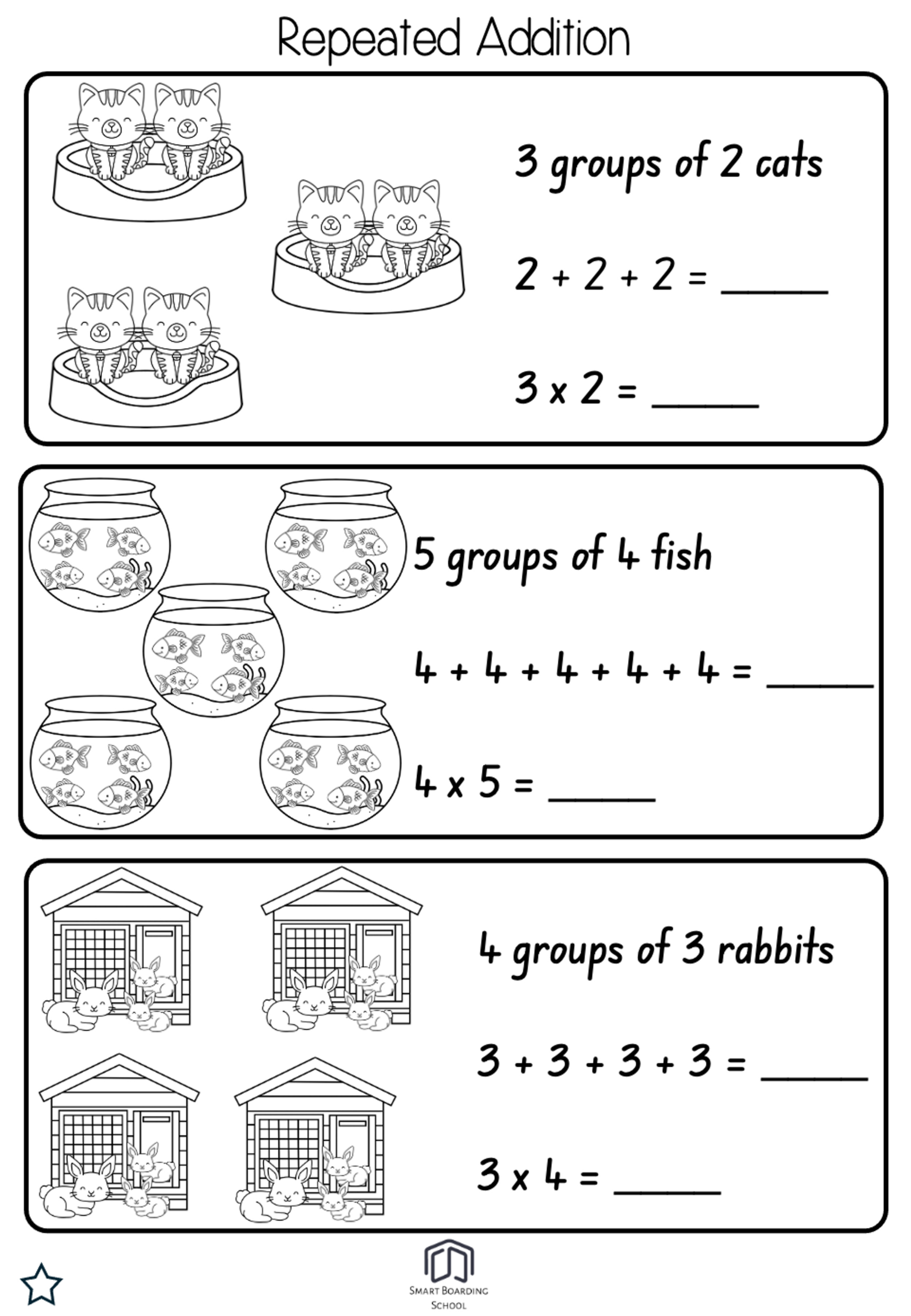
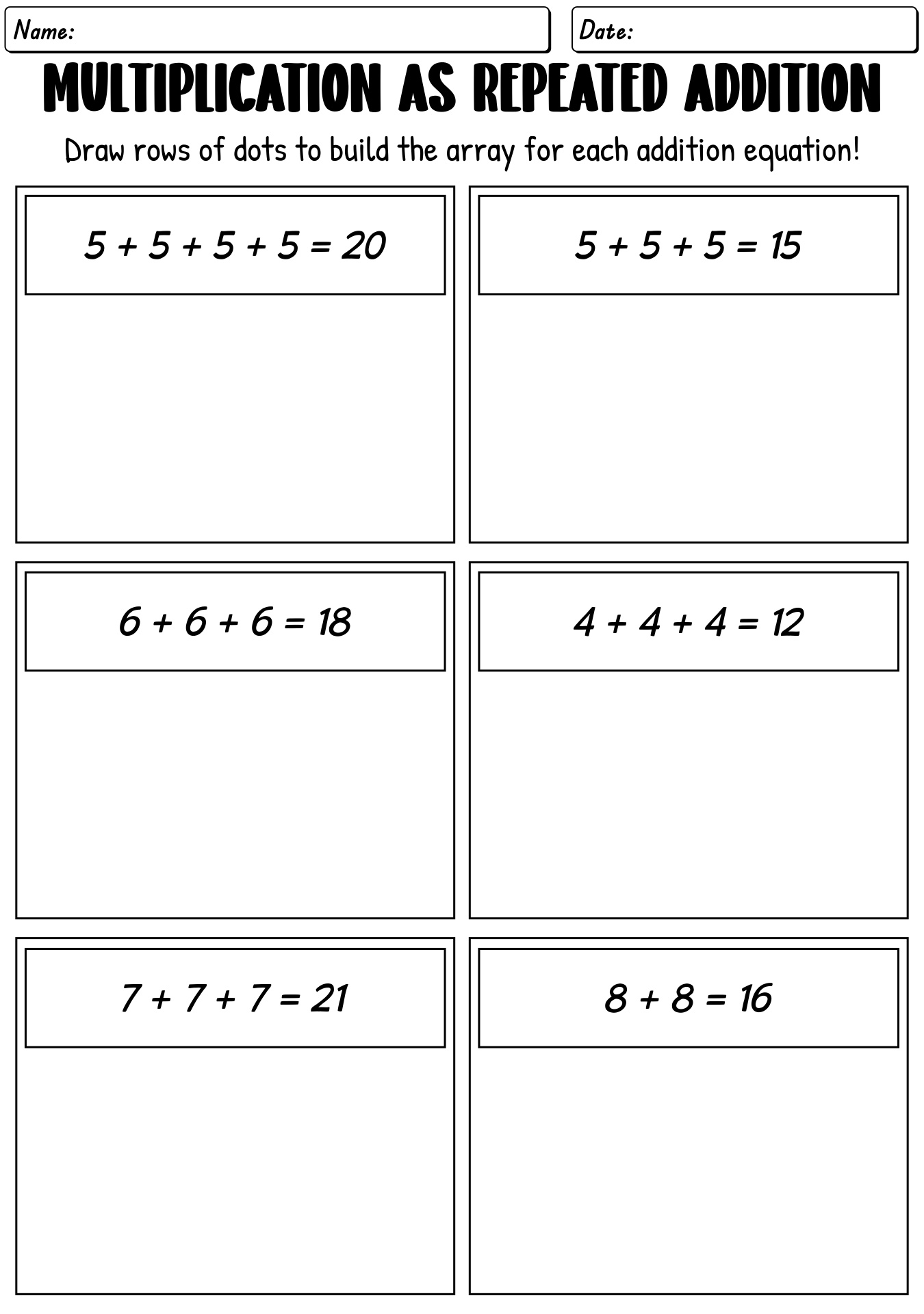
Multiplication As Repeated Addition Worksheets provide a bridge between basic addition skills and more advanced algebraic thinking, allowing students to see the underlying pattern that connects both concepts. By practicing repeated addition through engaging activities, learners can build confidence, recognize multiplication tables, and apply these skills across real‑world scenarios.
Why Teaching Multiplication Through Repeated Addition Matters

In early math curricula, the idea that multiplication is “repeated addition” is a foundational principle. This conceptual understanding demystifies the process, turning a seemingly mysterious operation into something tangible. Students who grasp this link tend to:
- Remember multiplication facts more naturally because they associate them with familiar addition patterns.
- Translate word problems into mathematical equations more quickly.
- Develop a deeper sense of number relationships, which supports future topics such as fractions and algebra.
Repeated addition worksheets encourage students to think of multiplication as a series of groups, fostering both visual and numerical fluency.
How to Use Repeated Addition Worksheets Effectively
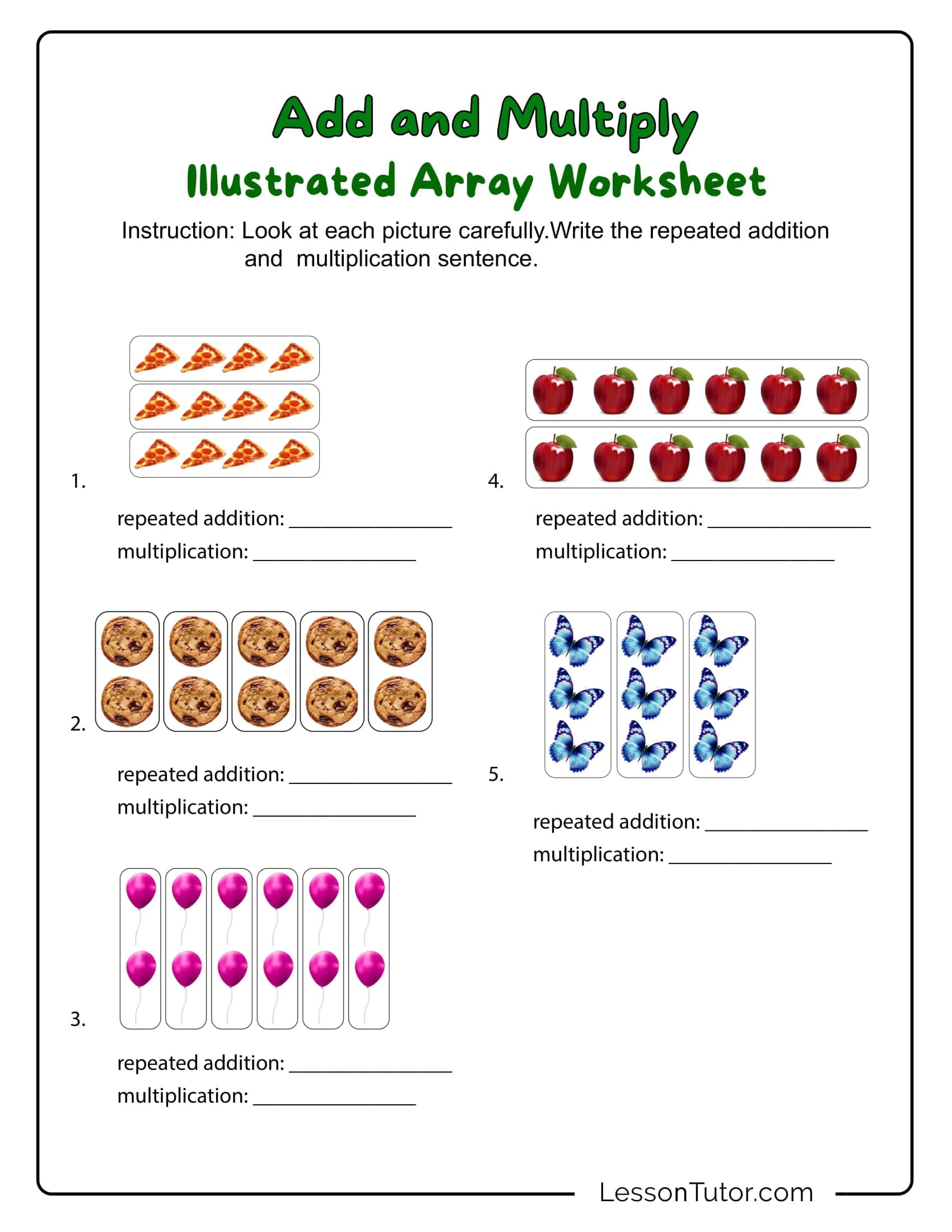
Choosing the Right Level of Difficulty
Start with simple two‑digit products and progressively introduce more complex numbers. A graded approach ensures that learners don’t feel overwhelmed yet still see incremental growth.
- Grade 2 Level: 2–5 multiplied by 1–5 using addition trees and small arrays.
- Grade 3 Level: 6–9 multiplied by 1–9 with visual arrays or repeated addition sequences.
- Grade 4 and Beyond: Include 10’s multiples, factor pairs, and multi‑step problems that combine addition and multiplication.
Integrating Visuals and Arrays
Visual aids are powerful in illustrating the “groups” aspect of multiplication. Consider the following tools:
- Grid Arrays: Draw a 3×4 grid for 3×4 to show how groups of three fit into four rows.
- Number Lines: Use a number line to count by fives or tens, reinforcing the concept of skipping steps.
- Dot Patterns: Place dots in circles or squares to represent each unit, then group them.
These visual methods make the abstract operation of multiplication concrete, especially for visual learners.
Interactive Activities and Digital Tools
While printable worksheets are handy, interactive tools can provide instant feedback and keep motivation high. Try these strategies:
- Drag-and-Drop Apps: Let students arrange objects into groups to see how many are created.
- Online Multiplication Games: Competitive quizzes that reward quick, repeated‑addition reasoning.
- Virtual Manipulatives: Digital blocks or beads that students can group to solve problems.
Sample Worksheet Ideas and Structure
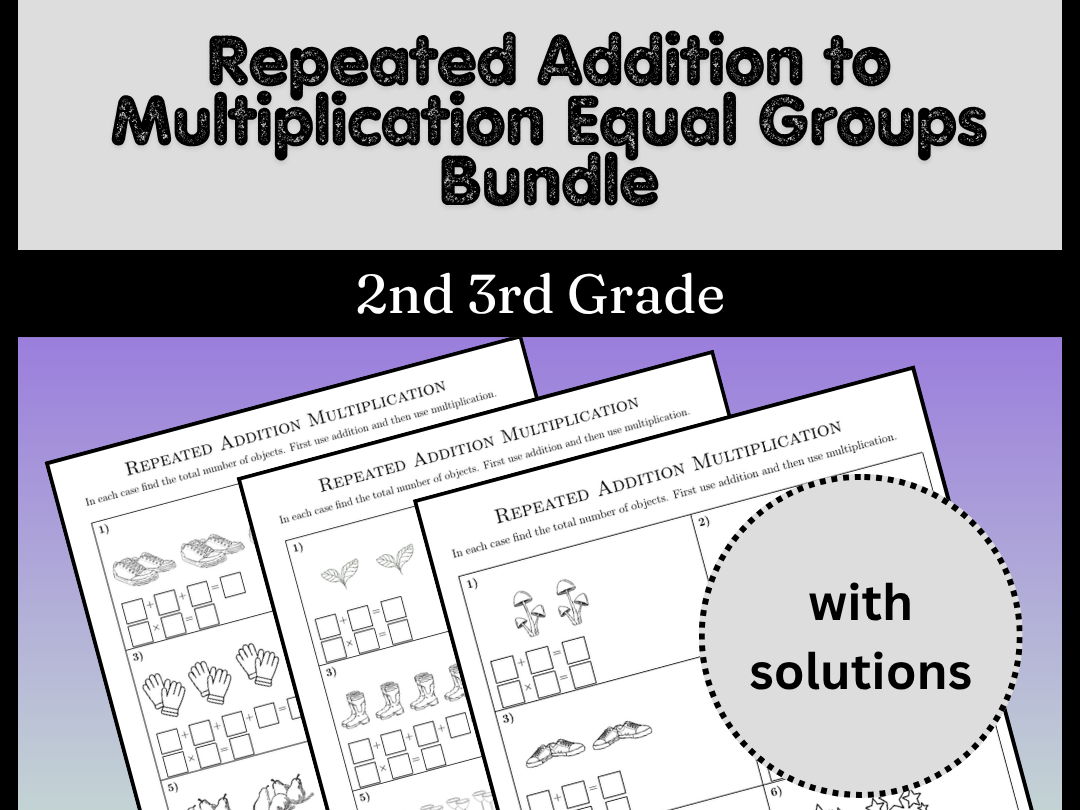
Simple Addition Arrays
Create grids that allow students to fill in values by adding rows or columns. For example, a 4×5 array can start with 4+4+4+4+4, which students can solve by adding four fours.
Word Problems with Repetition
Translate everyday situations into repeated‑addition challenges. Sample prompts include:
- “A classroom has 5 rows of desks. Each row holds 3 desks. How many desks are there in total?”
- “If a baker puts 12 cupcakes on each of 8 trays, how many cupcakes are produced?”
- “A garden has 7 rows of tomatoes, and each row contains 6 tomatoes. How many tomatoes are in the garden?”
These problems encourage students to think critically about grouping and multiplication.
Games and Challenges
Turn worksheets into fun contests. Ideas include:
- “Speed Math”: Provide a set of repeated‑addition problems and see who can finish first.
- “Mystery Boxes”: Students calculate total contents in several boxes without counting individually.
- “Multiplication Bingo”: Use repeated‑addition equivalents of bingo numbers for a twist on the classic game.
Common Challenges and How to Address Them

Misconceptions About Repetition
Students sometimes think that “repeated addition” means literally writing out each addition. To correct this, show how a single operation can represent multiple additions. For instance, 3×4 can be expressed as 3+3+3+3, yet it can also be written as 3×4 = 12 without expansion.
Maintaining Engagement
Repetition can feel monotonous. Counter this by:
- Introducing real‑life contexts that make the math relevant.
- Using colorful visual arrays and manipulatives.
- Incorporating gamified worksheets that reward progress.
Assessing Understanding
Beyond worksheet scores, assess comprehension with:
- Oral quizzes asking students to explain their reasoning.
- Project tasks where students create their own repeated‑addition problems.
- Peer‑review activities where classmates critique each other’s work.
Real‑World Applications

Shopping and Money
Students often see multiplication when calculating total cost. Example: “A pack of stickers costs $2 each. If you buy 7 packs, how much does it cost?” This problem encourages them to use repeated addition to reach 14.
Grouping and Sharing
Dividing items into equal groups involves repeated addition or subtraction. Use scenarios such as dividing 20 apples among 4 friends, requiring 4×5 or 5+5+5+5 to see the pattern.
Patterns and Geometry
Recognizing patterns in shapes, such as the number of triangles in a triangular lattice, benefits from repeated‑addition logic. For instance, a triangular array with rows of 1, 2, 3, and 4 triangles sums to 10, demonstrating a cumulative addition sequence.
Printable and Digital Resources

Teachers and parents can design customized worksheets that align with curriculum standards. Key features to include are:
- Clear titles and problem statements.
- Space for students to write intermediate steps.
- Answer keys for quick self‑checking or teacher grading.
Digital resources, such as interactive PDFs or online platforms, allow for adaptive learning where difficulty increases as confidence grows.
Conclusion

Mastering Multiplication As Repeated Addition Worksheets equips students with a robust mental model for handling multiplication across diverse contexts. By combining visual arrays, word problems, and interactive tools, educators can transform abstract concepts into engaging, memorable lessons. The result is a student who not only solves multiplication problems accurately but also understands why the process works, laying a solid groundwork for future mathematical exploration.