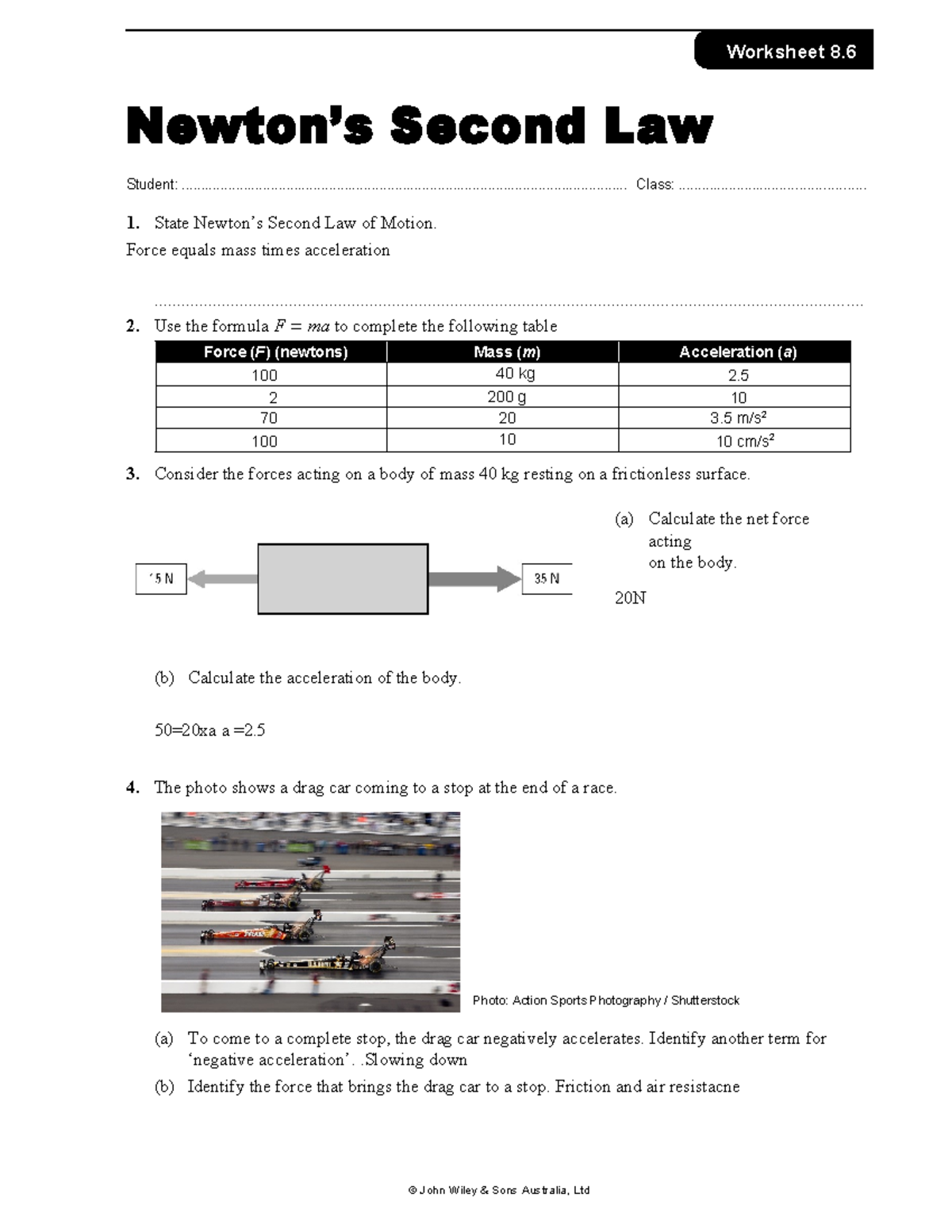
Newton’s Second Law Worksheet Answers provide a roadmap for mastering the fundamental principle that links force, mass, and acceleration. Whether you’re a physics student grappling with an inclined‑plane problem or a teacher preparing a study guide, a clear, step‑by‑step exploration of these answers can unlock the logic behind seemingly complex questions and help you build confidence in solving real‑world physics puzzles.
Understanding Newton’s Second Law: The Core Concept

F = ma and its components
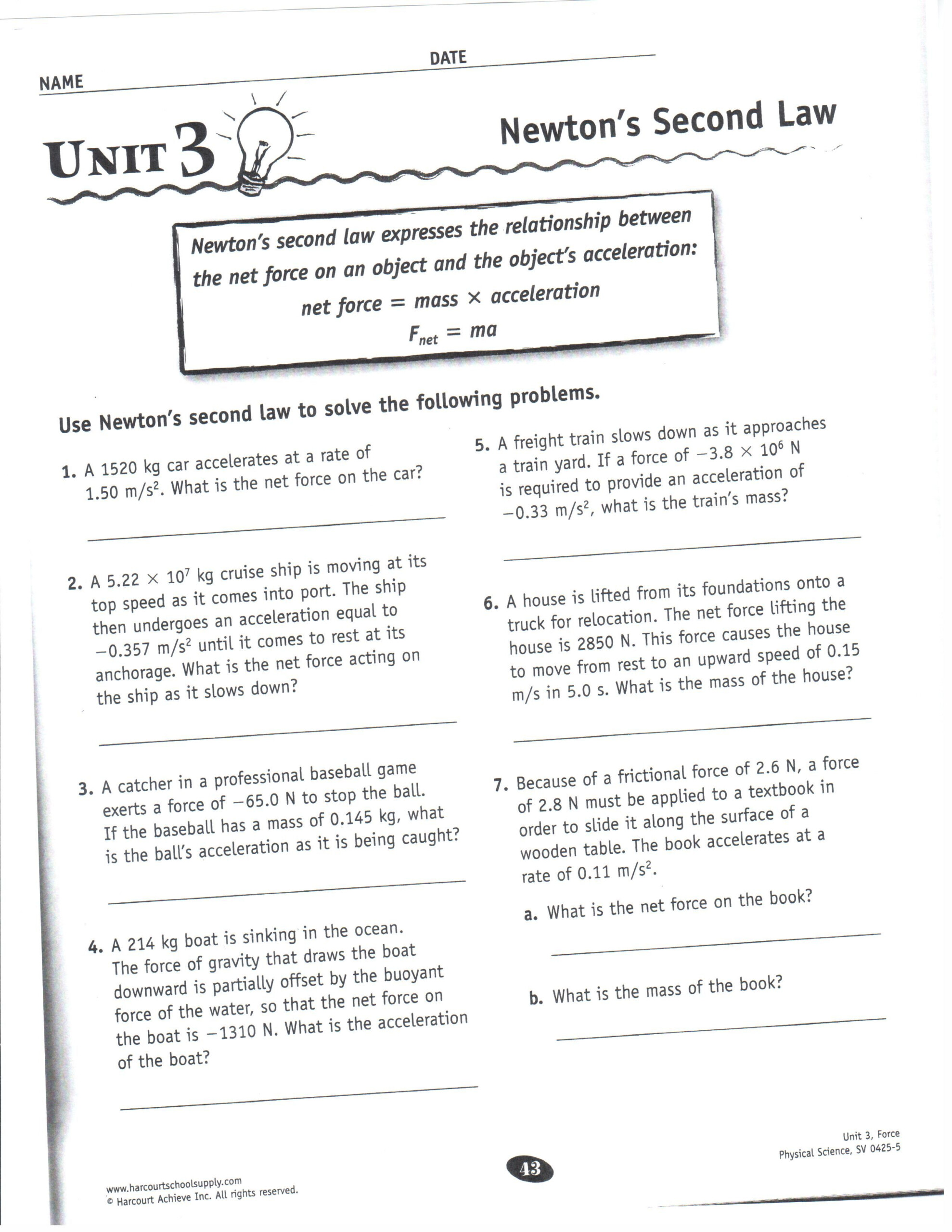
At its simplest, Newton’s Second Law states that the net force acting on an object is equal to its mass multiplied by its acceleration. Expressed mathematically as F = ma, this relationship underpins much of classical mechanics. It emphasizes that for a given mass, any change in acceleration requires a proportional change in force. Conversely, a larger mass demands a larger force to achieve the same acceleration.
Why the law matters in everyday life
Think about pushing a grocery cart: a heavier cart needs more force to accelerate at the same rate as a lighter one. Consider a car’s braking system—deceleration is just negative acceleration, and the forces involved determine stopping distance. Understanding how to calculate and apply the law allows engineers to design safer vehicles, athletes to optimize performance, and space agencies to launch rockets.
Decoding the Worksheet: Common Questions and Mistakes
Question Types You’ll Encounter
- Free‑body diagram problems: Identify all forces acting on an object.
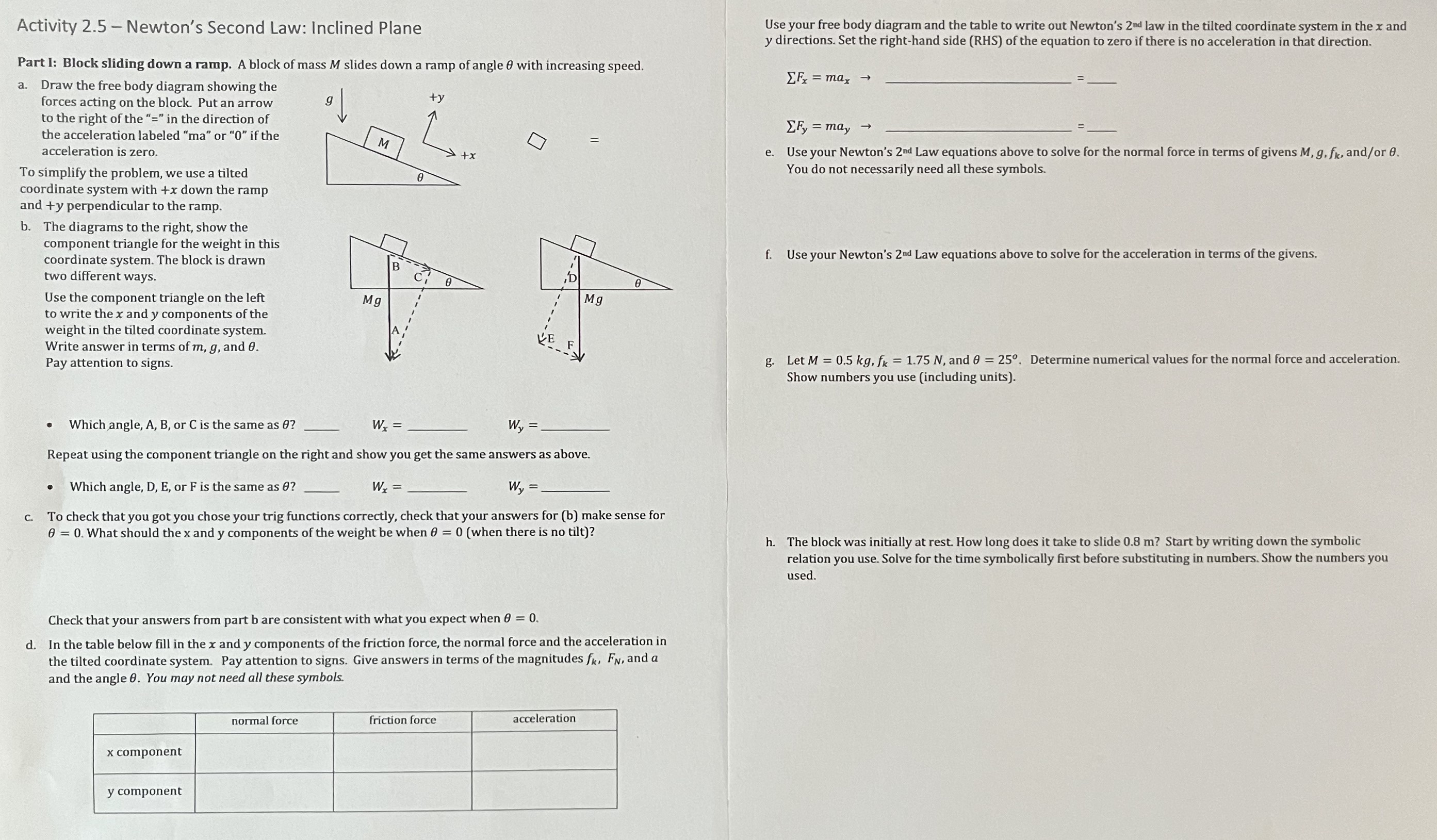
- Inclined plane calculations: Resolve forces parallel and perpendicular to the slope.
- Friction and drag: Incorporate kinetic or static friction coefficients.
- Systems of bodies: Apply the law to connected masses or pulleys.
- Variable acceleration scenarios: Use calculus or kinematic equations when acceleration changes.
Typical pitfalls in worksheets
- Forgetting to resolve forces into components.
- Mixing up the direction of acceleration with the direction of net force.
- Ignoring mass distribution in rigid bodies.
- Using inconsistent units (e.g., Newtons with grams).
Step‑by‑Step Guide to Solving Problems
1. Identify Known Quantities
Before sketching anything, write down every number given: masses, angles, coefficient of friction, applied forces, or initial velocities. This prevents the loss of critical data in later calculations.
2. Define the Free‑Body Diagram
A free‑body diagram (FBD) isolates the object and draws all external forces acting upon it. Label each force vector—gravity, normal, applied push, tension, friction, and any reaction forces. The FBD is the visual foundation that translates the problem into algebra.
3. Apply F = ma with Proper Direction
Choose a coordinate system aligned with the problem’s natural directions—commonly horizontal (x) and vertical (y). Break every force into components along these axes. The net force along each axis is the algebraic sum of all components.
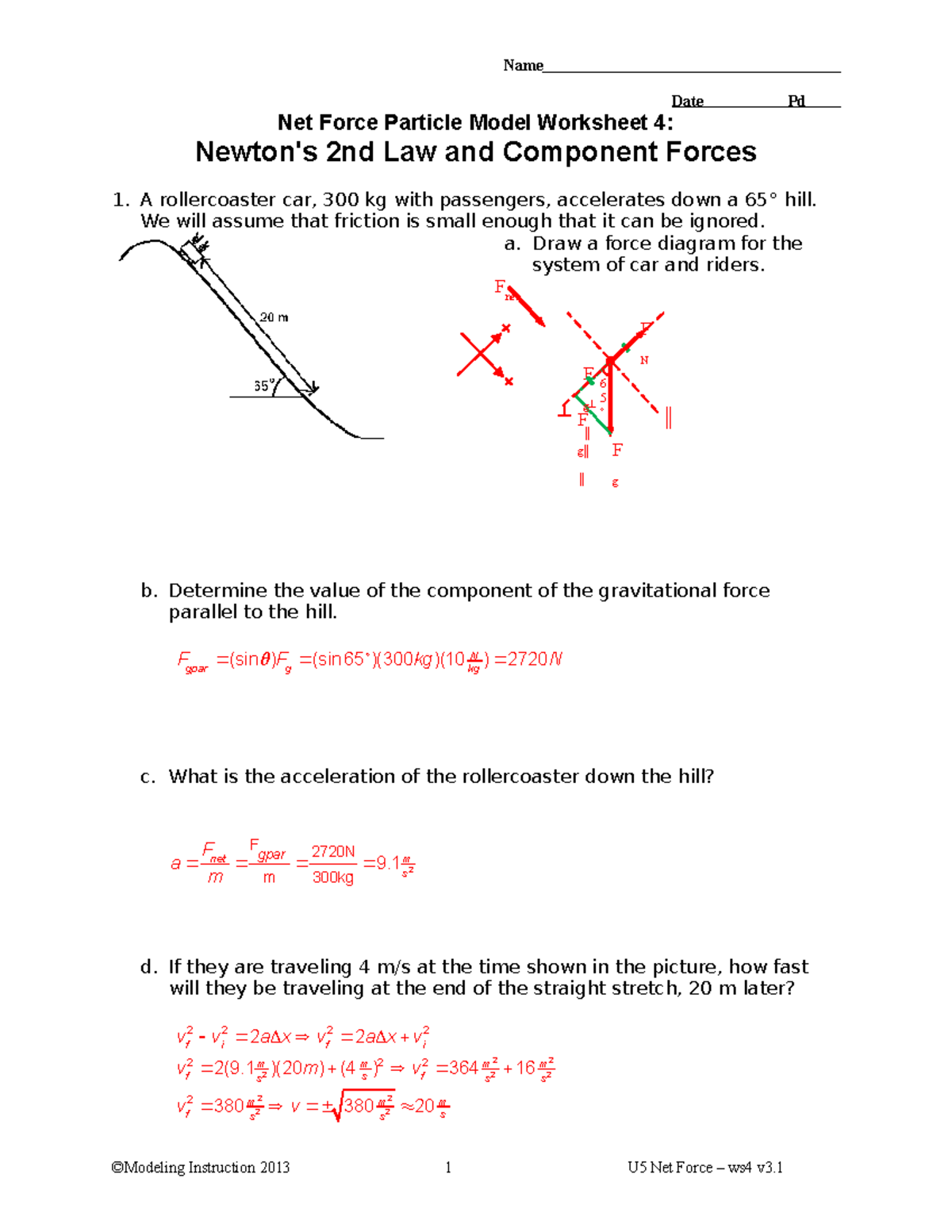
For example, on a frictionless inclined plane, the gravitational component parallel to the slope is mg sin θ, while the normal force is mg cos θ. The acceleration down the plane is then g sin θ.
4. Solve for Unknowns
Once you have the net force expression, set it equal to ma and solve for the unknown variable. If the question asks for acceleration, divide the net force by mass. If it requests the force required to maintain a constant speed, set acceleration to zero and solve for the balancing force.
Sample Answers from the Key
Example 1: Inclined Plane
Question: A 5 kg block rests on a 30° incline. The coefficient of kinetic friction is 0.2. Find the acceleration of the block down the slope.
Answer: First calculate the components of gravity: mg sin θ = 5 kg × 9.8 m/s² × sin 30° ≈ 24.5 N. The normal force is mg cos θ = 5 kg × 9.8 m/s² × cos 30° ≈ 42.5 N. The friction force is μk × normal = 0.2 × 42.5 N ≈ 8.5 N opposing motion. Net force down the slope: 24.5 N − 8.5 N = 16 N. Acceleration: a = Fnet / m = 16 N / 5 kg = 3.2 m/s².
Example 2: Force Required to Pull a Box
Question: A 12 kg crate sits on a horizontal floor. A person pulls it with a rope at a 30° angle above the horizontal. The coefficient of static friction is 0.5. What minimum tension is needed to start the crate moving?
Answer: Resolve the tension into horizontal and vertical components: Tx = T cos 30°, Ty = T sin 30°. The normal force becomes N = mg − Ty = 12 kg × 9.8 m/s² − T sin 30°. The maximum static friction is fs,max = μsN = 0.5(117.6 N − 0.5T). Setting Tx = fs,max and solving for T yields T ≈ 56 N.
Common Pitfalls and How to Avoid Them
Sign errors
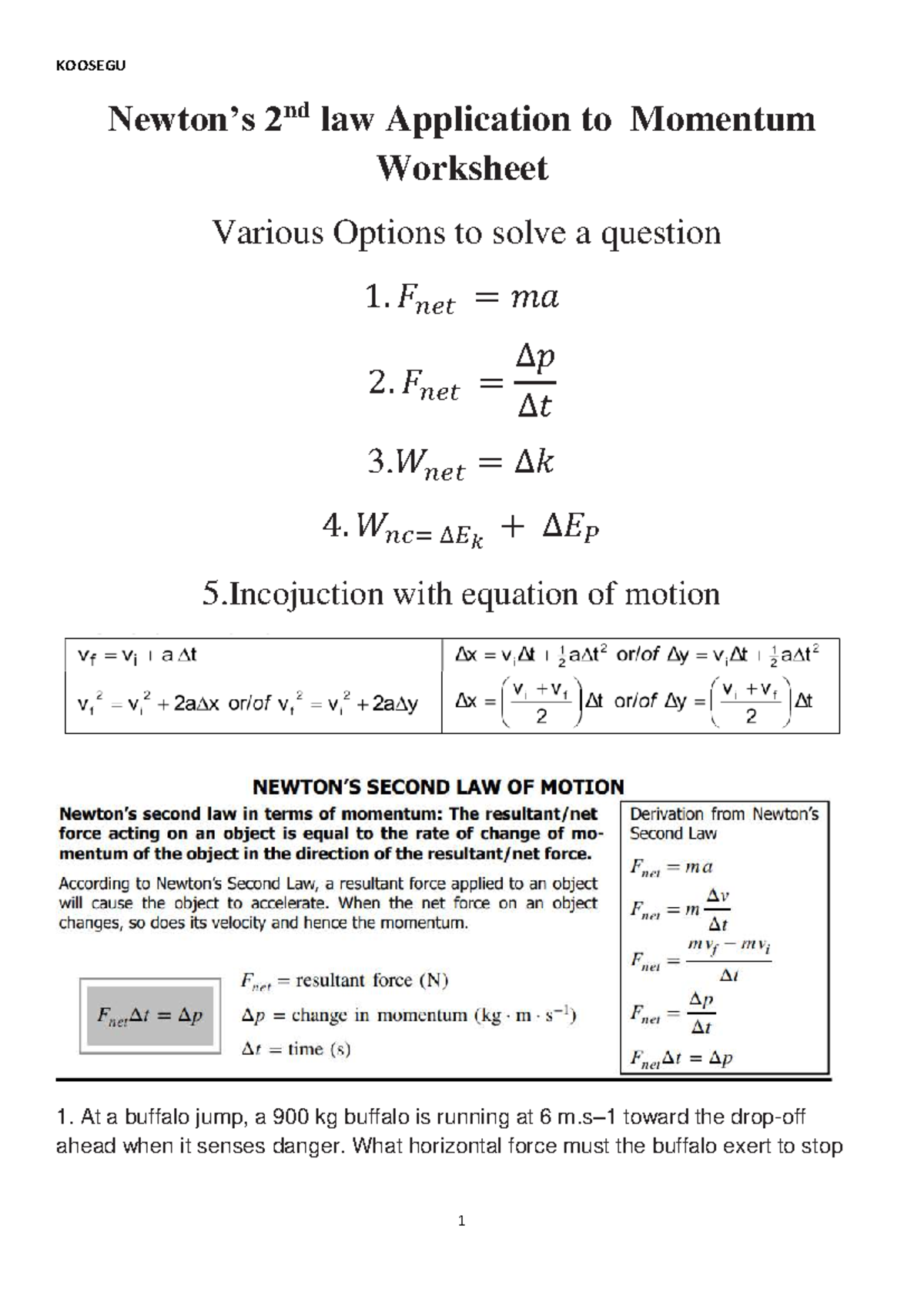
When applying the law, remember that forces opposing motion are negative. A common mistake is treating friction as positive, which inflates the net force and results in unrealistic acceleration values. Consistently assign positive direction to the coordinate axis you choose and stick with it.
Ignoring constraints
Systems often contain hidden constraints: a pulley may impose a shared acceleration, or a block on an incline cannot move upward without external support. Failing to account for these limits leads to incorrect force balances.
Misinterpreting units
Physics is unforgiving of unit mismatches. Ensure that all mass terms are in kilograms, force in Newtons, acceleration in meters per second squared, and time in seconds. If the problem gives mass in grams, convert it by dividing by 1000.
Real‑World Applications of Newton’s Second Law

Engineering and Design
Structural engineers use Newton’s Second Law to calculate stresses in beams and supports under dynamic loads. For instance, a bridge’s support columns must withstand the combined forces of wind, traffic, and thermal expansion—all quantified by F = ma or its equilibrium counterpart.
Sports Performance
Coaches analyze athlete movements to maximize acceleration while minimizing injury risk. A sprinter’s explosive start requires a large net force applied over a short distance, which can be optimized by improving stride length and force application angle.
Spacecraft and Rocket Launch
Rocket propulsion hinges on Newton’s Third Law, but the acceleration of the vehicle is directly derived from F = ma. Engineers calculate thrust required to lift payloads by balancing the gravitational pull and atmospheric drag, adjusting fuel mass to achieve target velocities.
Practice Tips and Resources

Work through the Key Answers
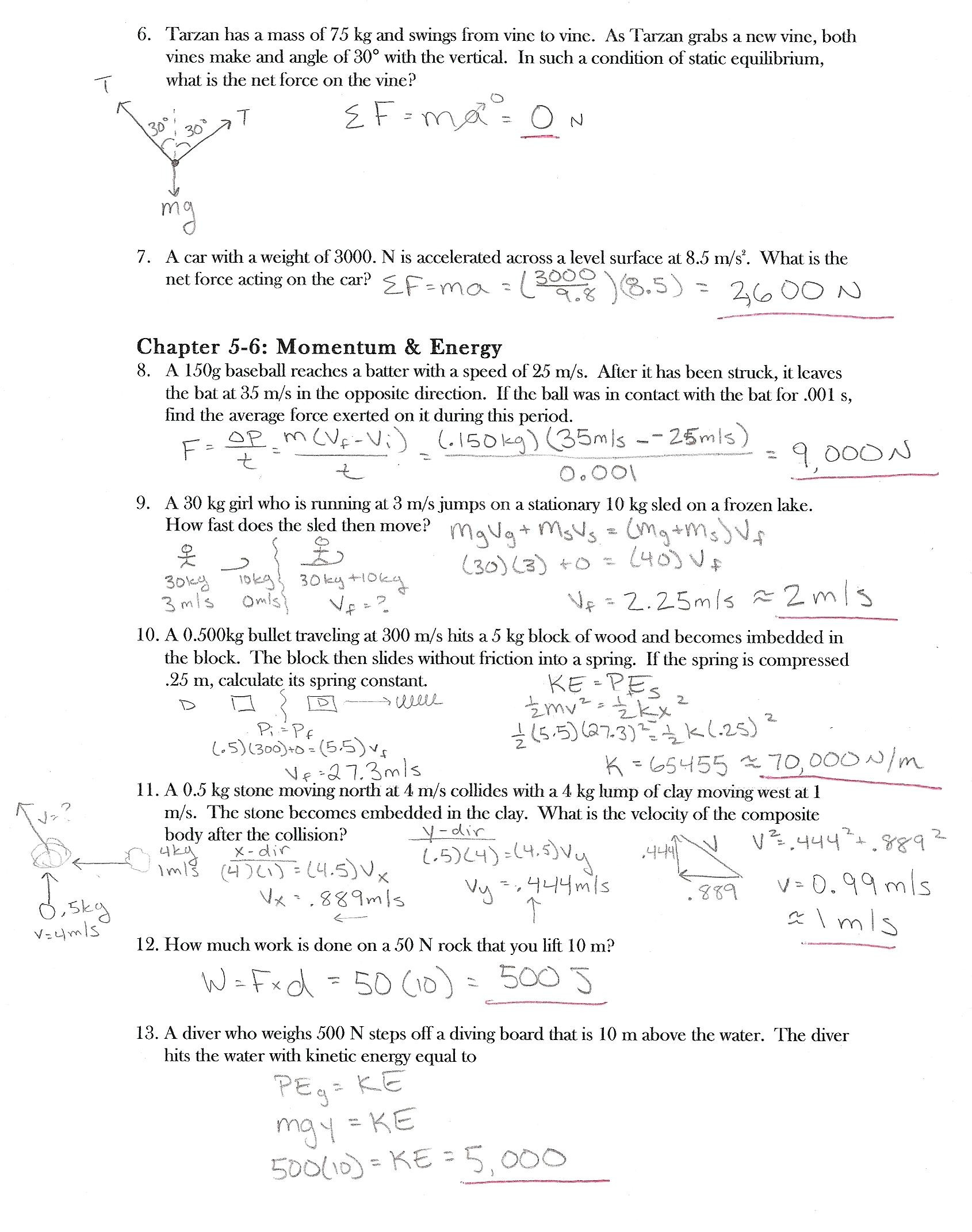
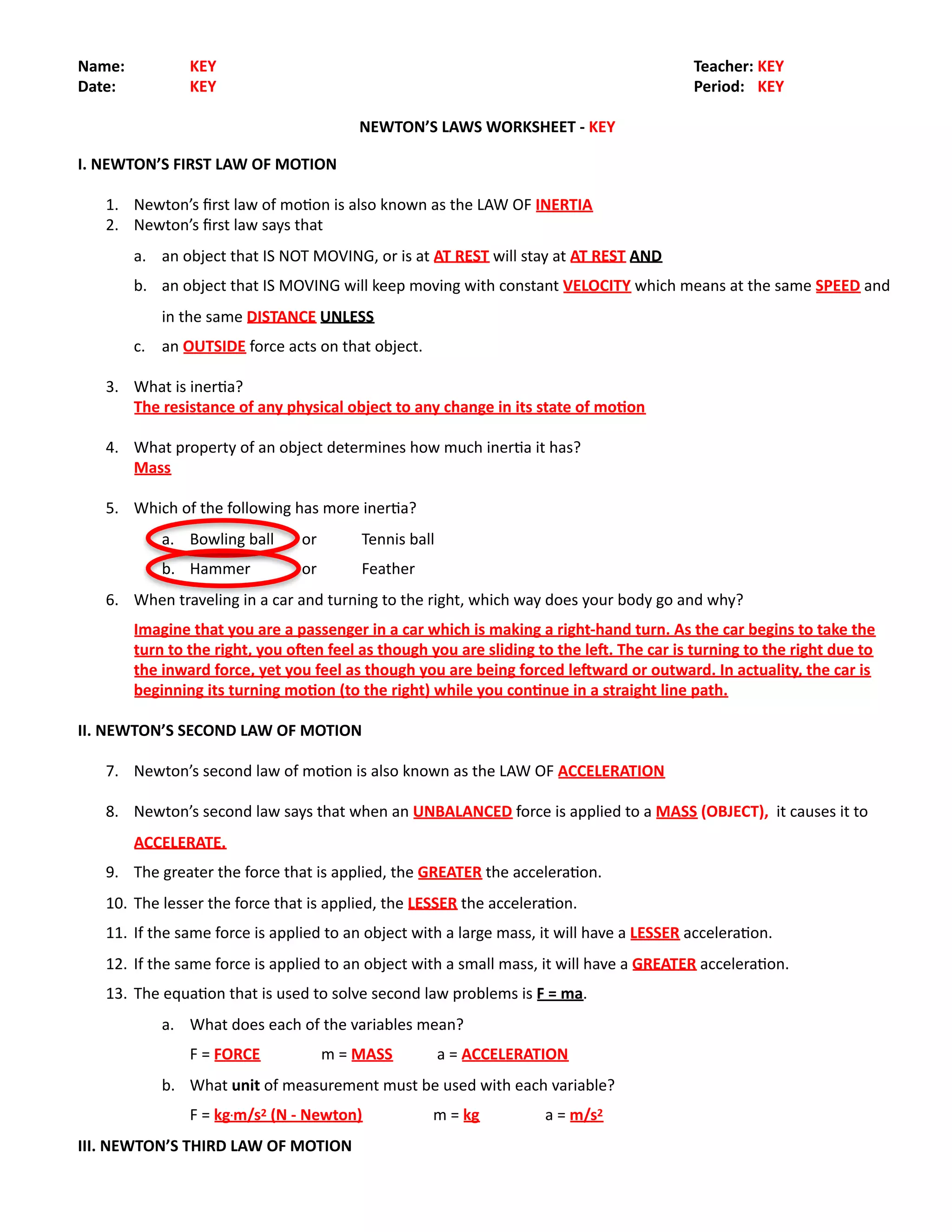
Reading the provided worksheet key helps identify patterns in answer derivation. Compare each solution step to your own work, noting where discrepancies arise. This iterative practice reinforces problem‑solving logic.
Create Your Own Problems
After mastering the key examples, challenge yourself by drafting similar but slightly altered problems—change angles, add friction, or introduce multiple bodies. This active creation solidifies conceptual understanding and prepares you for variations in exams.
Use Visual Aids
Diagrams are your best friend. Sketch the system, label every force, and annotate the direction of acceleration. A clear visual representation often reveals hidden forces that may be missed in a purely algebraic approach.
Check Units Consistently
Keep a units table handy. Whenever you introduce a new variable, double‑check that it aligns with the expected units for force or acceleration. This simple practice eliminates a majority of calculation errors.
Conclusion

Newton’s Second Law Worksheet Answers serve as a bridge between abstract theory and tangible practice. By dissecting each problem into a free‑body diagram, respecting direction and unit conventions, and applying F = ma methodically, you can tackle a wide array of physics challenges with confidence. Whether you’re studying for a test, designing a mechanical system, or simply curious about how everyday forces shape our world, mastering these answers equips you with a powerful analytical tool that extends far beyond the classroom. Armed with these strategies, you’re now ready to convert every new physics problem into an opportunity for discovery.