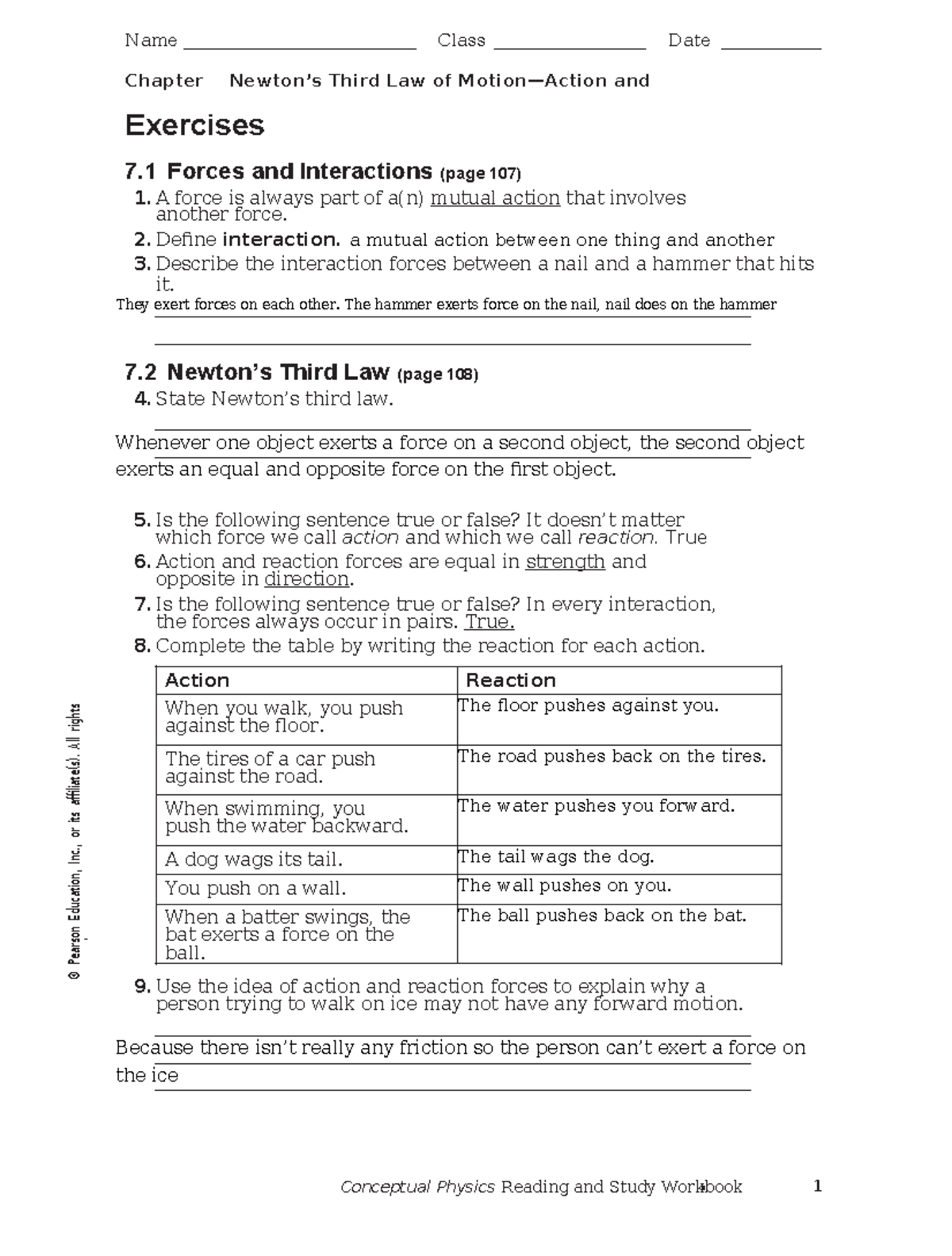
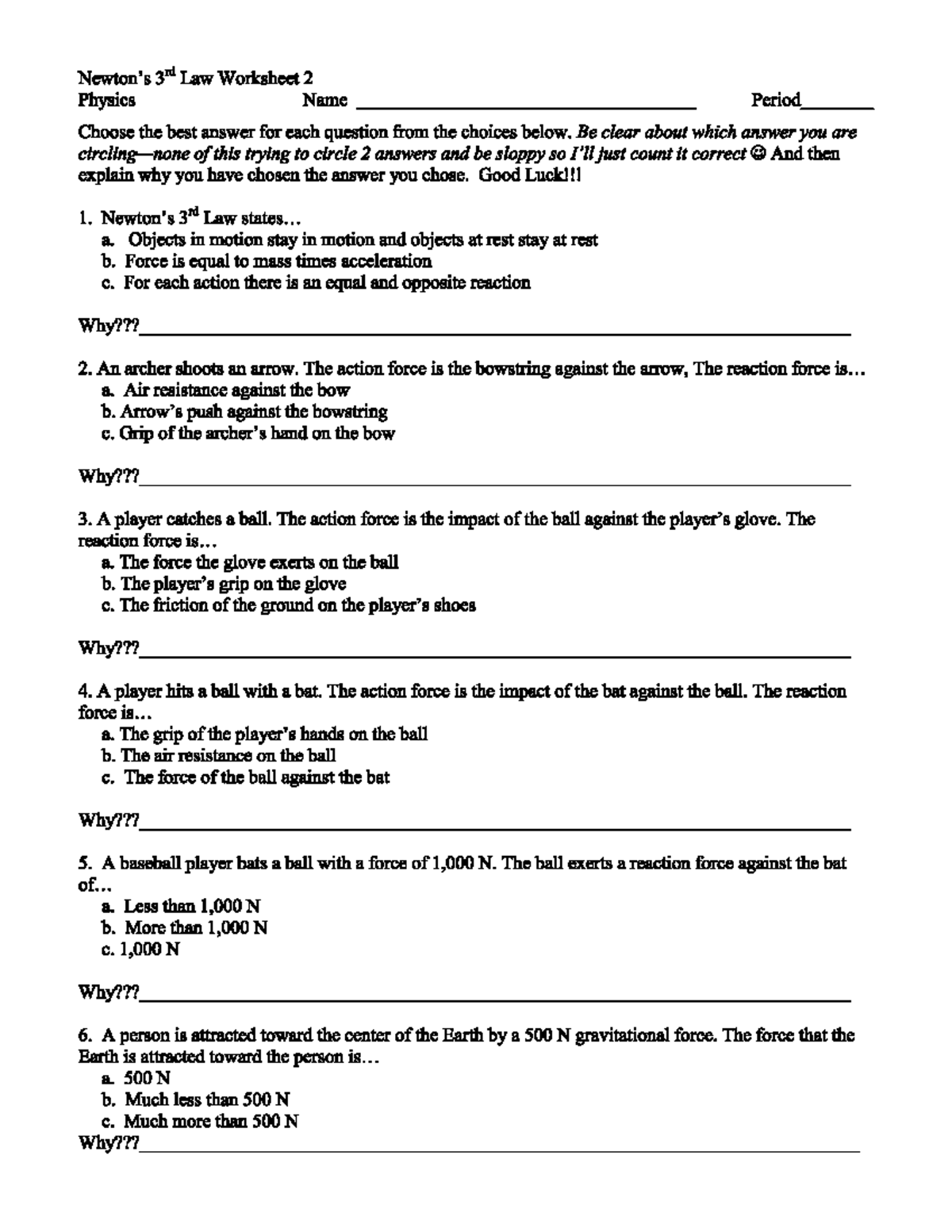
Newton’s Third Law Worksheet Answers provide a crucial bridge between theoretical physics concepts and practical classroom application, enabling students to visualize the equal and opposite forces that govern everyday interactions. By offering clear, step‑by‑step solutions, these worksheets reinforce comprehension, build confidence, and lay a solid foundation for more advanced studies in mechanics and engineering. In this article we explore how to effectively use worksheet answers, dissect common problem types, and integrate real‑world examples that make the law come alive for learners of all ages.
Understanding the Core Concept
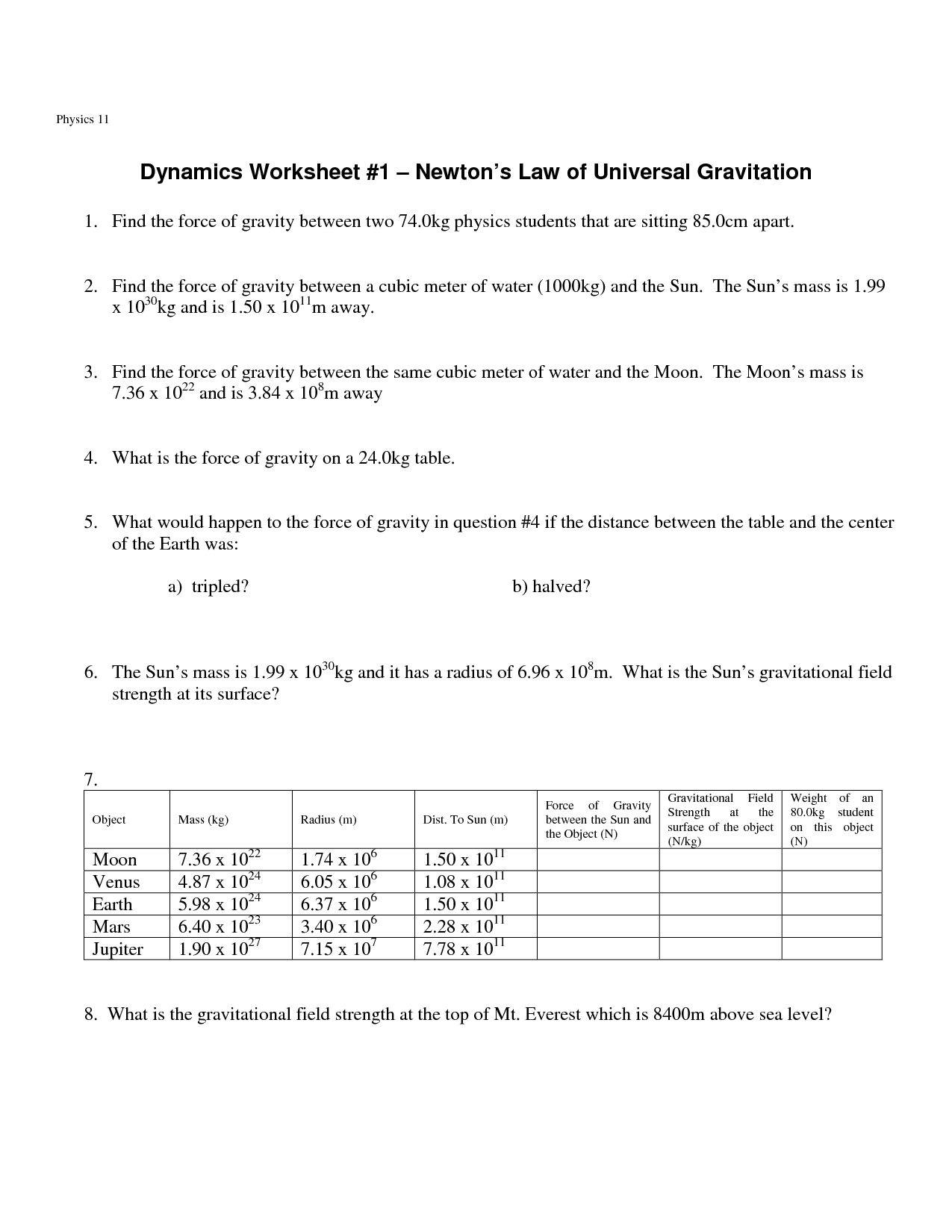
Newton’s Third Law states that for every action, there is an equal and opposite reaction. This principle means that forces always occur in pairs; when object A exerts a force on object B, object B simultaneously exerts a force of the same magnitude but opposite direction on object A. The law applies regardless of the objects’ masses, speeds, or the medium in which they interact, and it holds true in both static and dynamic scenarios.
Grasping this idea is essential before tackling worksheet problems. Students should be able to identify the two interacting bodies, label the action and reaction forces correctly, and recognize that the forces act on different objects, not on the same one. Misinterpreting this detail often leads to errors such as “adding” the forces together, which contradicts the law’s requirement that they cancel only when acting on a single system.
Why Worksheet Answers Are Valuable

Worksheet answers serve multiple pedagogical purposes. First, they provide immediate feedback, allowing learners to confirm their reasoning and correct misconceptions on the spot. Second, they act as a modeling tool; teachers can demonstrate the logical flow from problem statement to solution, highlighting the importance of vector direction, magnitude, and free‑body diagrams. Third, well‑crafted answers include explanations, not just numerical results, which deepens conceptual understanding and promotes critical thinking.
For educators, these answers are a time‑saving resource. They can be used to design differentiated instruction, assign homework that aligns with lesson objectives, and create quick assessment tools. For students, they serve as a study guide for test preparation, especially in high‑stakes exams where mastery of Newtonian mechanics is required.
Common Misconceptions Addressed in Answers

Forces Acting on the Same Object
One frequent mistake is treating the action and reaction forces as if they act on the same object, which would incorrectly suggest they cancel each other out. Effective worksheet answers explicitly label each force with the object it acts upon, often using color‑coded diagrams to avoid confusion.
Magnitude Versus Direction
Another error involves focusing solely on the magnitude of forces while neglecting direction. Comprehensive answers emphasize vector representation, reminding students that equal magnitude does not imply identical effect unless the forces are collinear and opposite.
Impact of External Forces
Students sometimes overlook external forces, such as friction or tension, that influence the net force on a system. Detailed solutions incorporate all relevant forces, showing how the action‑reaction pair fits within the larger free‑body diagram.
Step‑by‑Step Guide to Solving Worksheet Problems

Identify the Interacting Bodies
Begin by naming the two objects involved. For example, in a collision between a car and a wall, the car and the wall are the interacting bodies. Write these names beside the diagram to keep track of which forces belong to each object.
Draw a Clear Free‑Body Diagram
Sketch each object separately and illustrate all forces acting on it. Use arrows to indicate direction and label each force (e.g., Fcar‑wall for the force the car exerts on the wall, and Fwall‑car for the reaction). Ensure that the action‑reaction pair is shown on different diagrams.
Apply Newton’s Third Law Directly
State the law in words for the specific situation: “The force that the car exerts on the wall is equal in magnitude and opposite in direction to the force that the wall exerts on the car.” Translate this statement into an equation, such as Fcar‑wall = −Fwall‑car.
Incorporate Additional Forces
Include any other forces acting on each object, such as gravity, normal force, friction, or tension. Write the net force equation for each body, combining all vectors according to the chosen coordinate system.
Solve for Unknowns
Use algebraic manipulation or vector decomposition to solve for the unknown quantity. If the problem involves acceleration, apply Newton’s Second Law (ΣF = m a) alongside the third‑law relationship to find the required values.
Check Consistency
After obtaining a solution, verify that the magnitudes of the action and reaction forces match and that directions are truly opposite. Also, confirm that the net forces on each object satisfy any given constraints, such as equilibrium or constant velocity.
Typical Problem Types and Sample Answers

Collision Scenarios
In a textbook example, a 1500 kg car traveling at 20 m/s collides with a stationary truck of 3000 kg. The worksheet asks for the force each vehicle exerts on the other during the impact. The answer explains that the forces are equal in magnitude, derived from the impulse–momentum principle, and provides the numerical value based on the collision duration.
Rocket Propulsion
Another common question involves a rocket expelling gas at a known mass‑flow rate and exhaust velocity. The solution outlines how the thrust (action force) on the expelled gas equals the reaction force propelling the rocket forward, using the equation F = ṁ vexhaust. The worksheet answer includes a step‑by‑step calculation of the resulting acceleration.
Static Equilibrium
A problem may present a book resting on a table while a person pushes down on the book. The worksheet answer demonstrates that the normal force from the table on the book is the reaction to the book’s weight, and the additional push creates an equal and opposite force on the person’s hand, illustrating how the third law operates even in static situations.
Applying the Law in Real‑World Scenarios
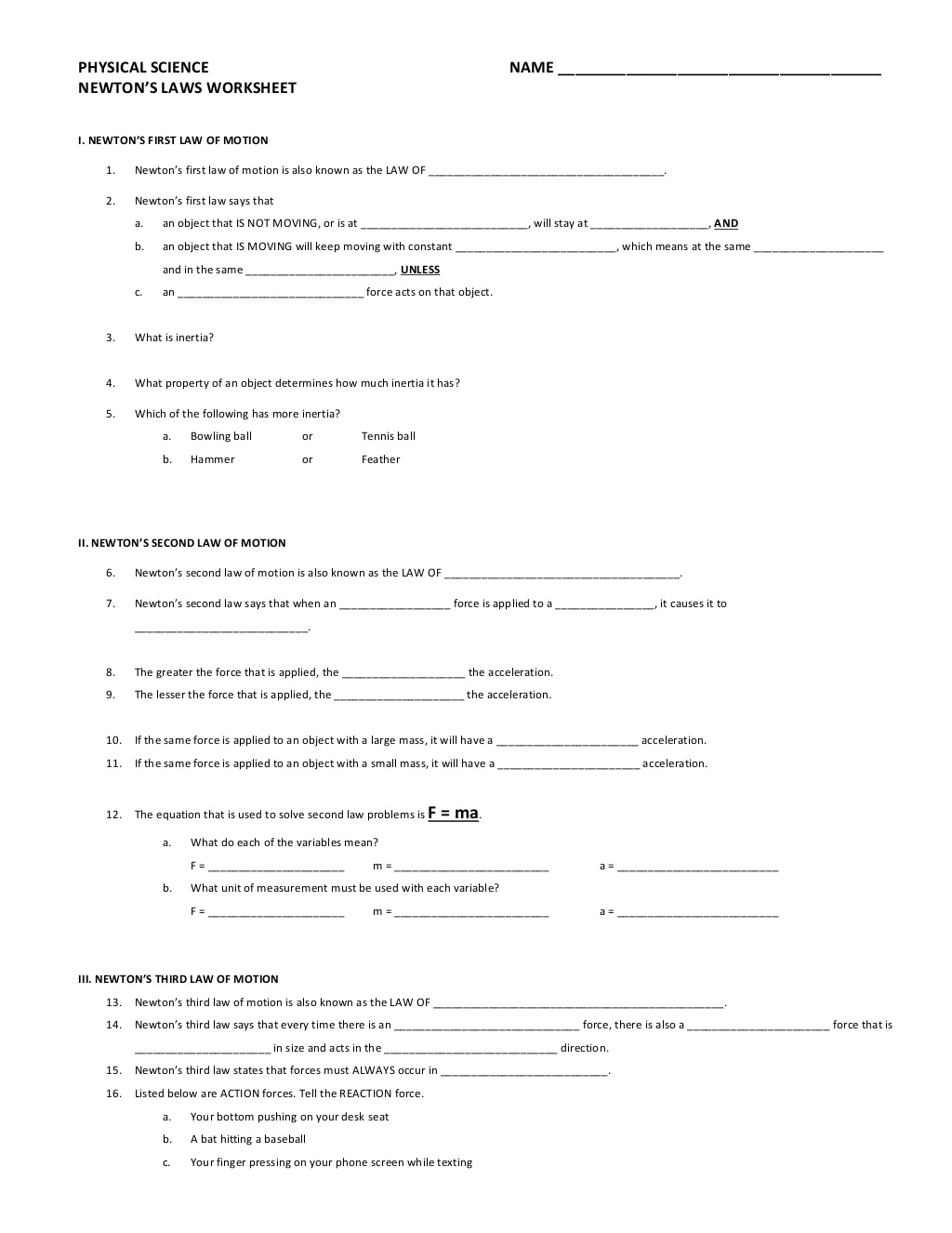
Connecting worksheet exercises to everyday experiences reinforces relevance. When a swimmer pushes against water, the water pushes back, propelling the swimmer forward—this is a direct illustration of the third law. Similarly, a person walking exerts a backward force on the ground, and the ground’s forward reaction enables motion. Including these examples in answer explanations helps students see the law beyond the classroom.
In engineering, designers calculate reaction forces on bridge supports, airplane wings, and vehicle suspensions using the same principles. Worksheet answers that reference these applications demonstrate the law’s utility in solving complex, real‑world problems.
Integrating Worksheets into Classroom Practice

Pre‑Lesson Warm‑Up
Begin each class with a short, low‑stakes worksheet that reviews key terminology and basic force pairs. Use the answers as a quick check for understanding, allowing you to address gaps before moving to more challenging material.
Collaborative Problem Solving
Assign a worksheet in small groups, encouraging students to discuss each step while referencing the answer key only after completing the problem. This promotes peer instruction and deeper engagement with the concept.
Formative Assessment
Utilize timed worksheets as formative assessments. The answer keys provide a benchmark for grading, and the detailed explanations help students review mistakes independently, fostering self‑regulated learning.
Assessing Student Mastery

Effective assessment goes beyond checking whether the numerical answer is correct. Look for evidence that students can:
- Identify the two interacting bodies correctly.
- Draw accurate free‑body diagrams with clearly labeled forces.
- Explain in words why the forces are equal and opposite.
- Apply the third law alongside the second law to solve for unknowns.
- Transfer the concept to novel situations, such as friction‑less surfaces or variable mass systems.
Worksheet answers that include rubrics or grading criteria can streamline this evaluation process, ensuring consistent and objective scoring.
Resources for Further Practice

While this article focuses on the value of worksheet answers, educators and students can expand their mastery by exploring additional resources such as interactive simulations, video tutorials, and laboratory activities that visually demonstrate action‑reaction pairs. Combining these tools with well‑structured worksheets creates a robust, multimodal learning environment.
Conclusion

Providing clear, thorough Newton’s Third Law Worksheet Answers transforms abstract physics principles into tangible skills that students can apply across disciplines. By systematically identifying interacting bodies, constructing precise diagrams, and integrating real‑world examples, educators can guide learners toward a deep, intuitive grasp of equal and opposite forces. Consistent use of these answers in classroom routines—whether for warm‑ups, collaborative work, or assessments—enhances conceptual retention and prepares students for the analytical challenges of advanced science and engineering courses. Embrace the power of well‑crafted worksheet solutions, and watch your students confidently apply Newton’s timeless law in every context they encounter.