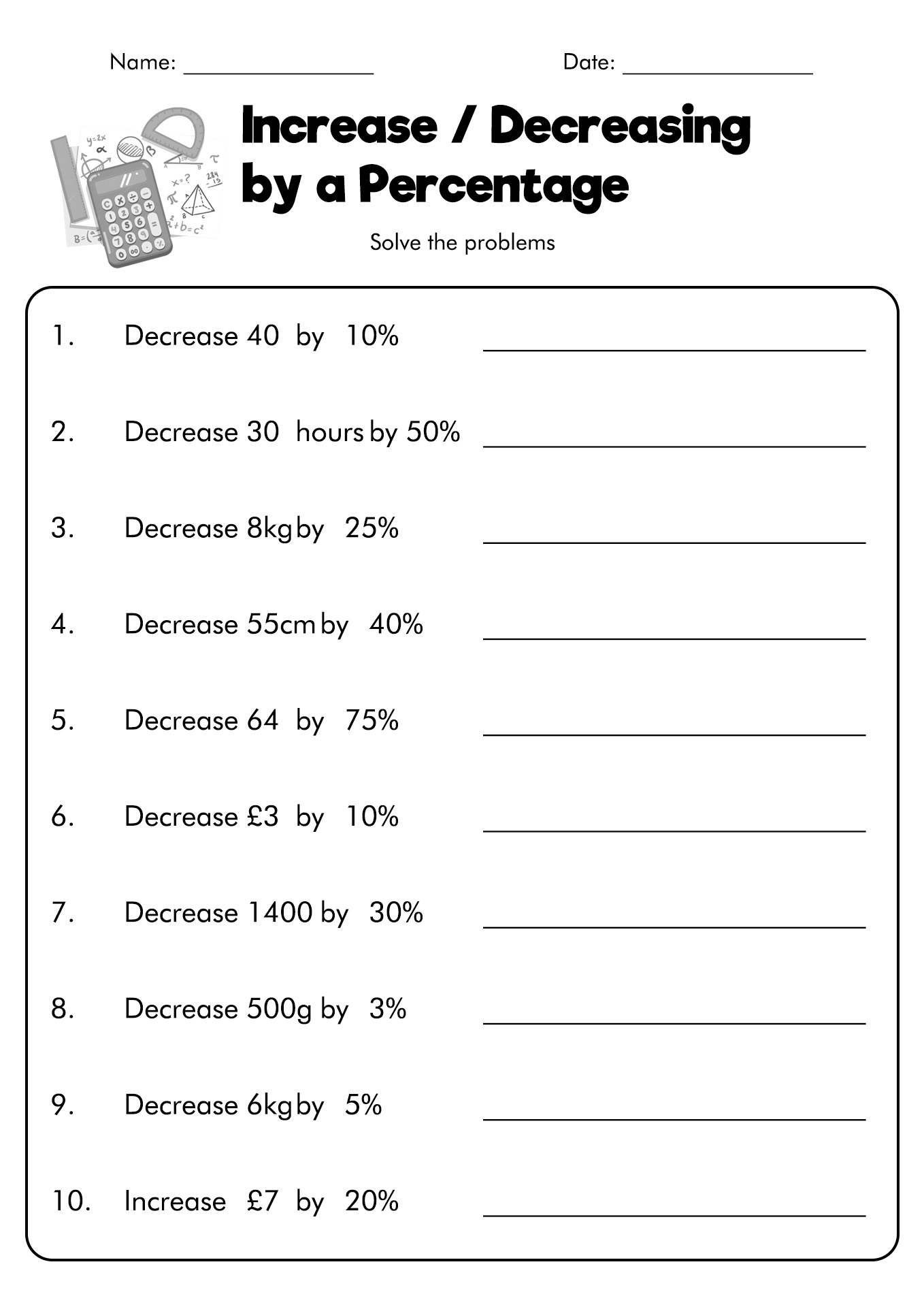
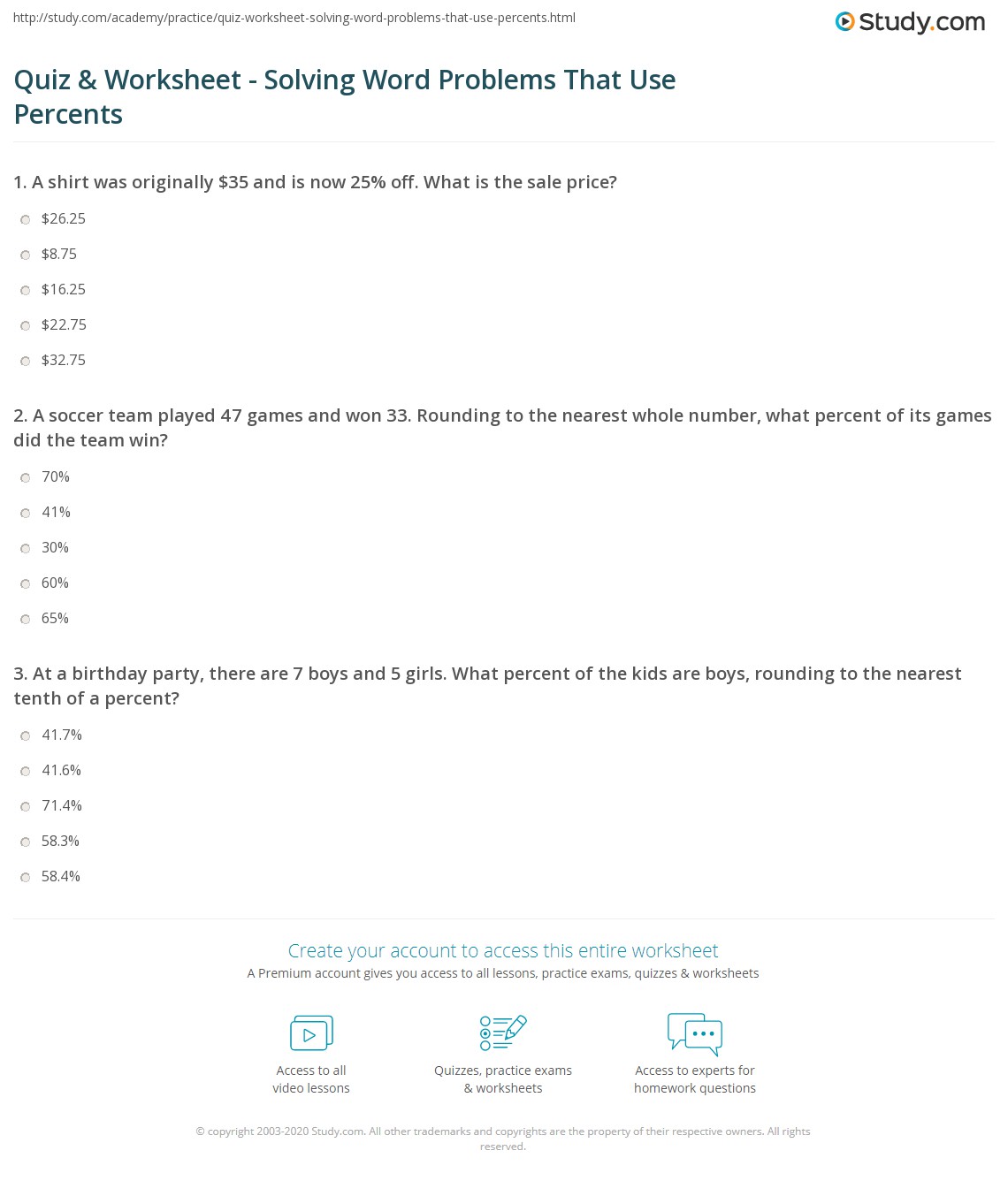
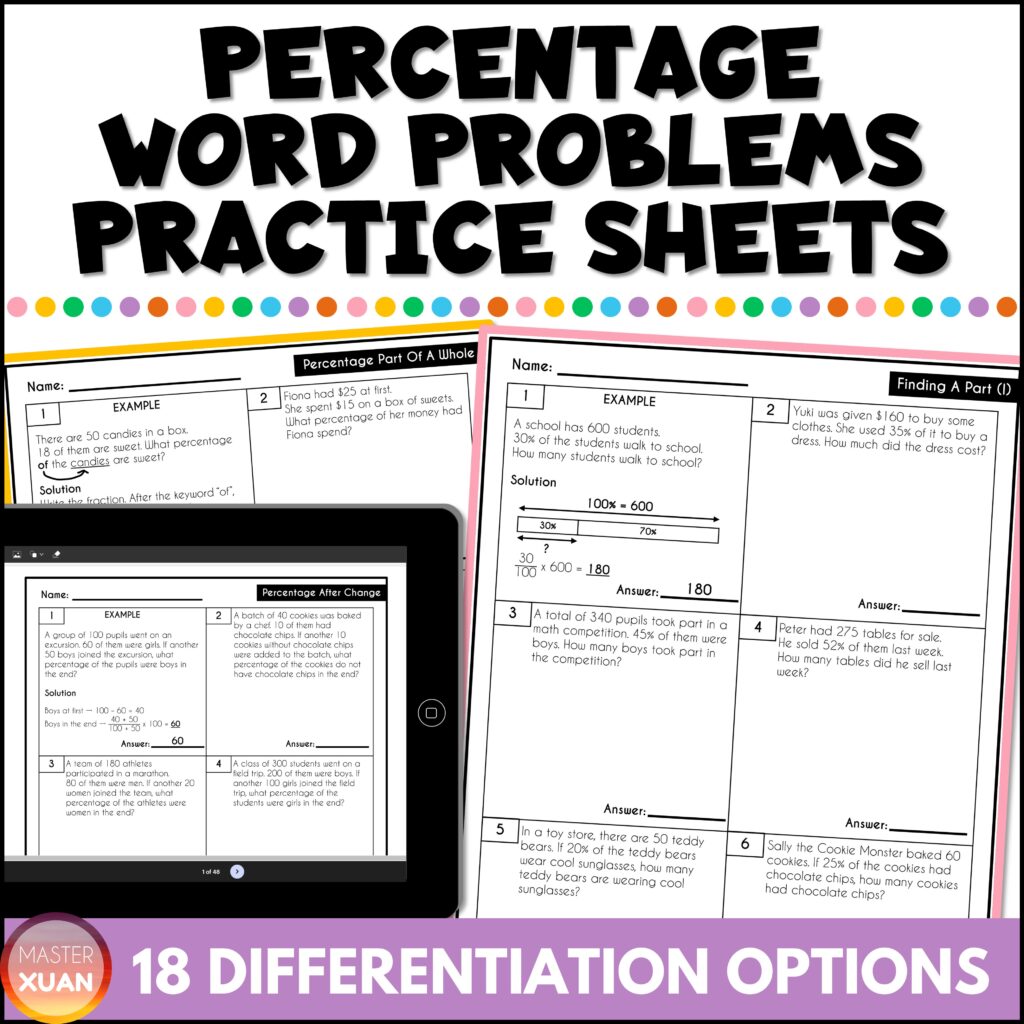
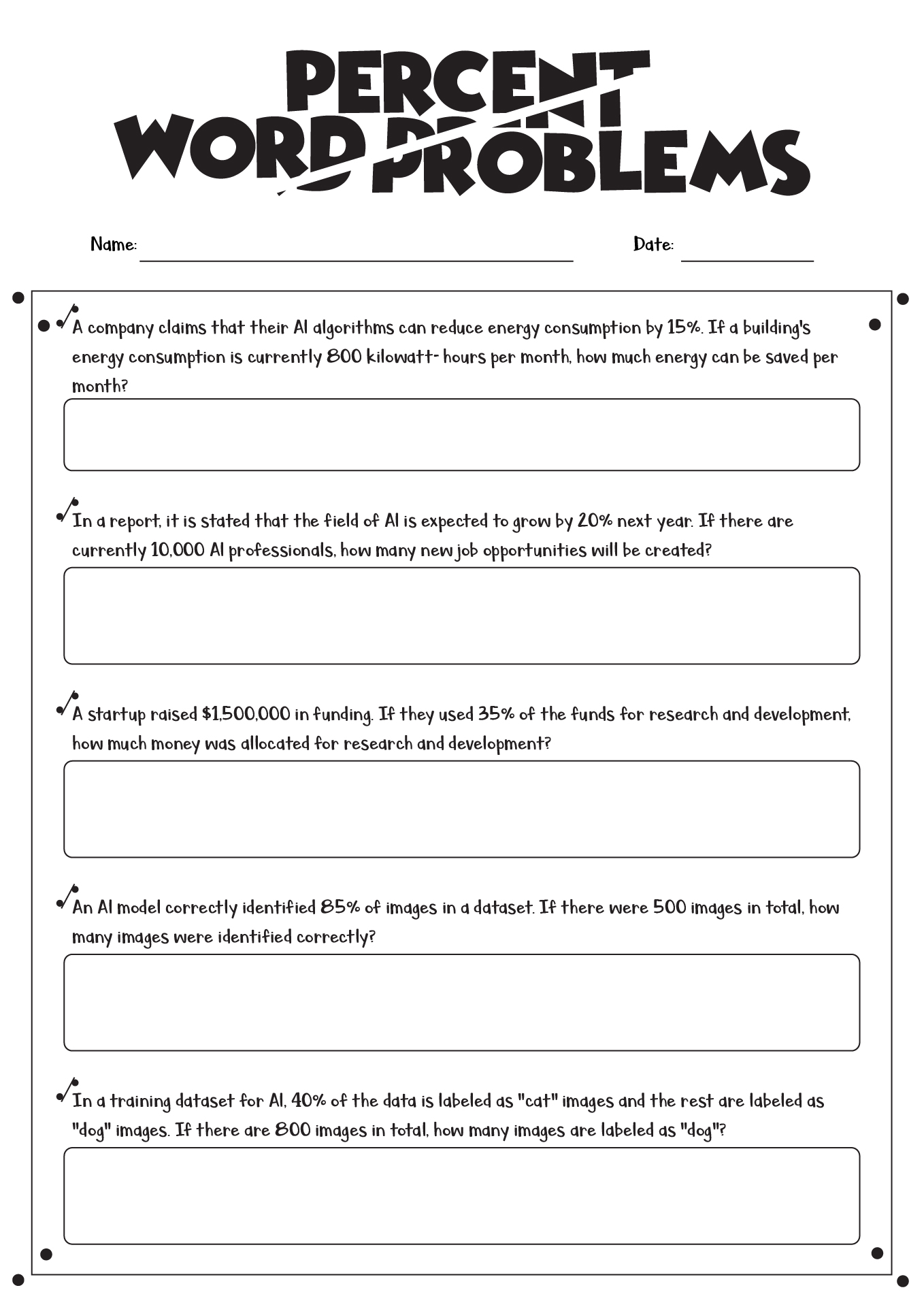
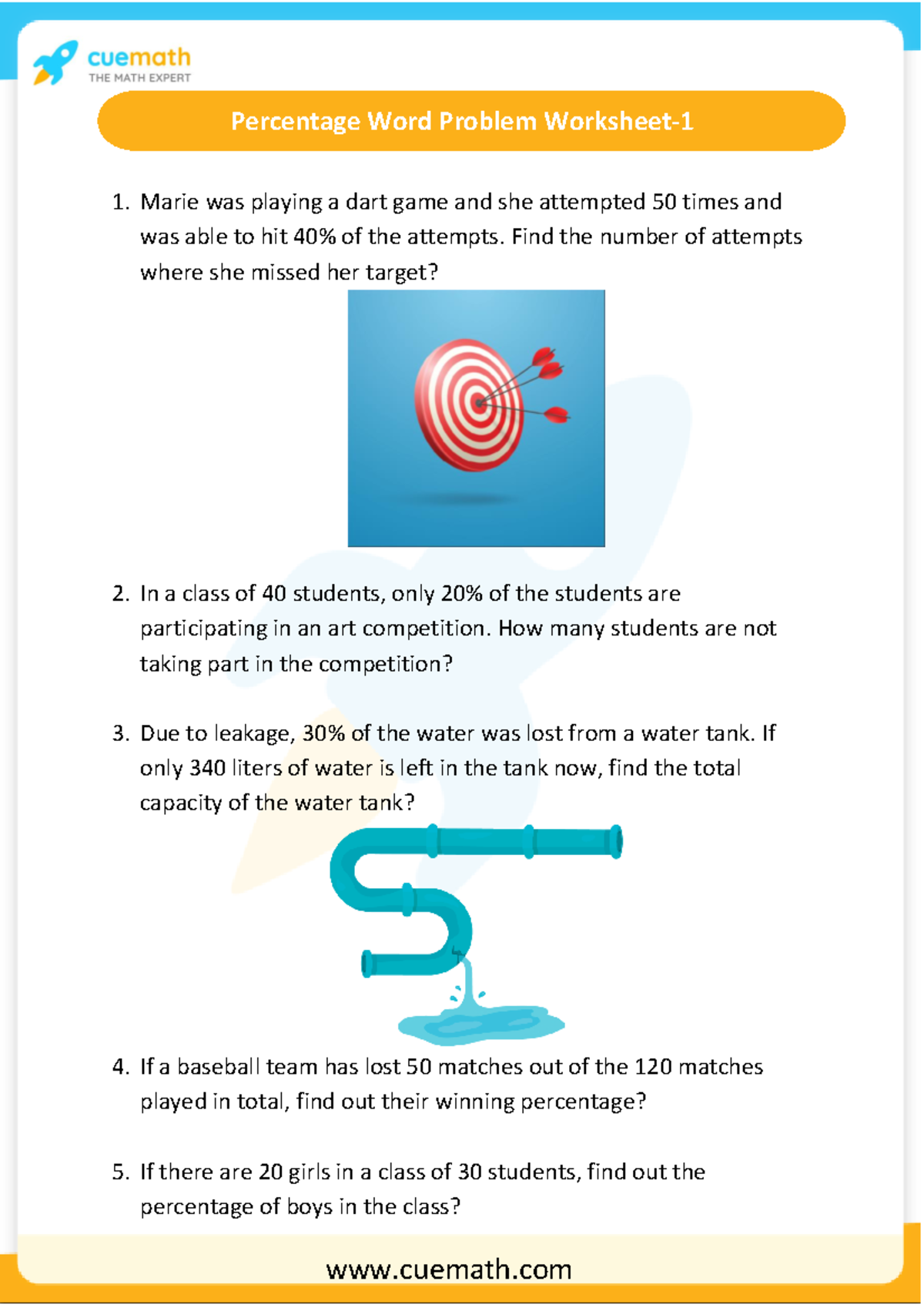
Percent Word Problems Worksheet offers a practical gateway for students to translate abstract percentage concepts into concrete, everyday scenarios, and it serves as a cornerstone for building both confidence and competence in math curricula across elementary and middle school levels. By presenting a structured set of challenges that mimic real‑life situations—such as calculating discounts, tax, tips, and population growth—this type of worksheet not only reinforces procedural fluency but also nurtures critical thinking skills that extend far beyond the classroom. In this article we’ll explore why percent word problems are essential, break down the core concepts they target, and provide actionable strategies for teachers, parents, and learners to get the most out of a well‑designed worksheet. Whether you’re looking to boost test scores, enrich a homeschooling curriculum, or simply help a child grasp the relevance of percentages, the guidance below will equip you with the tools you need for success.
Why Percent Word Problems Matter

Percentages permeate daily life, yet many students struggle to see their practical value. When learners encounter a problem that asks, “If a shirt is 25 % off, how much will it cost?” they instantly recognize the relevance, which in turn increases motivation. This relevance translates into deeper engagement, higher retention, and improved problem‑solving agility. Moreover, percent word problems develop a suite of transferable skills:
- Translating verbal descriptions into mathematical expressions.
- Choosing appropriate operations (addition, subtraction, multiplication, division).
- Estimating results to check reasonableness.
- Interpreting outcomes in context.
By regularly practicing with a Percent Word Problems Worksheet, students internalize these processes, making them more adept at tackling standardized assessments and real‑world financial decisions alike.
Key Concepts Behind Percent Problems
Understanding the Meaning of Percent
A percent represents a part per hundred, which can be expressed as a fraction (e.g., 45 % = 45/100) or a decimal (0.45). Grasping this dual representation is crucial because it enables students to switch seamlessly between forms depending on the problem’s demands.
Converting Between Forms
Conversion is a three‑step routine:
- Identify the given percent.
- Divide by 100 to obtain the decimal.
- If necessary, convert the decimal to a fraction for exact calculations.
For example, 12 % becomes 12 ÷ 100 = 0.12, which can also be written as 12/100 or simplified to 3/25.
Core Operations Involving Percentages
The most common operations include:
- Finding a percent of a quantity – Multiply the decimal form of the percent by the whole.
- Determining the whole from a part – Divide the part by the decimal form of the percent.
- Calculating percent change – Subtract the original amount from the new amount, divide by the original amount, then multiply by 100.
- Working with successive percentages – Apply each percent sequentially, remembering that each step changes the base value.
How to Use a Percent Word Problems Worksheet Effectively

A worksheet is only as powerful as the approach taken to solve it. Below are proven steps to maximize learning outcomes:
Preview the Worksheet
Before diving into calculations, skim the entire sheet to gauge difficulty levels, identify recurring themes (discounts, tax, interest), and note any unfamiliar terms. This preview primes the brain for pattern recognition.
Identify Keywords
Words such as “of,” “increase,” “decrease,” “more than,” “less than,” and “percent off” signal specific operations. Highlighting these terms helps students select the correct formula without trial‑and‑error.
Set Up a Structured Workspace
Encourage learners to write out each step clearly:
- Restate the problem in their own words.
- Define the unknown variable.
- Choose the appropriate equation.
- Perform calculations with careful attention to decimal placement.
- Interpret the final answer in context.
This systematic layout reduces errors and builds a repeatable problem‑solving routine.
Check Reasonableness
After obtaining a result, students should estimate what the answer “should” look like. If a discount on a $50 item is 20 % and the answer is $60, the result is obviously incorrect. Simple mental checks reinforce number sense.
Reflect and Review
At the end of the worksheet, a brief reflection—such as “Which problem was hardest and why?”—helps solidify learning and guides future practice.
Step‑by‑Step Strategies for Solving Percent Word Problems

Strategy One: The “Part‑Whole” Method
This approach is ideal when the problem provides either the part or the whole and asks for the missing component.
- Convert the given percent to a decimal.
- If the part is known, divide it by the decimal to find the whole.
- If the whole is known, multiply it by the decimal to find the part.
Example: “A bakery sold 150 cookies, which was 75 % of its daily production.” Convert 75 % to 0.75, then divide 150 ÷ 0.75 = 200. The bakery baked 200 cookies in total.
Strategy Two: The “Increase‑Decrease” Method
This technique shines when dealing with price hikes, tax, or interest.
- Identify whether the scenario involves an increase or a decrease.
- Convert the percent change to a decimal.
- For an increase, multiply the original amount by (1 + decimal). For a decrease, multiply by (1 − decimal).
Example: “A laptop originally costs $850 and is discounted by 18 %.” Decimal = 0.18. New price = $850 × (1 − 0.18) = $850 × 0.82 = $697.
Strategy Three: The “Successive Percentages” Method
When multiple percent changes occur, apply each one sequentially, updating the base each time.
Example: “A store raises a product’s price by 10 % and then offers a 15 % discount on the new price.” Starting price = $120. After increase: $120 × 1.10 = $132. After discount: $132 × 0.85 = $112.20.
Strategy Four: The “Proportion” Method
Useful for problems that compare two percentages or require setting up ratios.
Example: “If 30 % of a class of students are girls and there are 12 girls, how many students are in the class?” Set up the proportion 30 % / 100 = 12 / x, solve for x: x = 12 × 100 / 30 = 40 students.
Common Mistakes and How to Avoid Them

Even seasoned learners can stumble on percent word problems. Recognizing typical errors helps prevent them.
Misreading Keywords
Confusing “of” with “more than” leads to selecting the wrong operation. For instance, “20 % more than 50” requires multiplication by 1.20, not simply finding 20 % of 50.
Incorrect Decimal Placement
Failing to move the decimal two places left when converting a percent to a decimal is a frequent slip. Reinforce the habit of writing the decimal explicitly before calculation.
Skipping the Reasonableness Check
Students often trust their arithmetic blindly. A quick estimate—such as rounding 18 % to 20 %—can reveal glaring mismatches early.
Overlooking the Base Value in Successive Percentages
When applying multiple changes, the base value shifts after each step. Remind learners to update the base before the next calculation.
Mixing Up Fractions and Decimals
Converting 3/4 to a percent should yield 75 %, not 0.75. Keeping a conversion chart handy can reduce this confusion.
Real‑World Applications and Sample Problems

Embedding authentic contexts makes practice more engaging and illustrates the utility of percent calculations.
Shopping and Discounts
“A jacket is marked down 30 % from $120. During the holiday sale, an additional 10 % off is applied to the reduced price. What is the final cost?” Solve using the successive percentages method: $120 × 0.70 = $84; $84 × 0.90 = $75.60.
Financial Literacy
“A savings account offers an annual interest rate of 4.5 %. If $2,000 is deposited at the beginning of the year, how much interest will be earned after one year?” Convert 4.5 % to 0.045; interest = $2,000 × 0.045 = $90.
Health and Nutrition
“A nutrition label states that a serving contains 15 % of the daily recommended calcium intake, which is 1,000 mg. How many milligrams of calcium are in one serving?” Multiply 0.15 × 1,000 mg = 150 mg.
Population Growth
“A town’s population increased by 2.3 % over a year, reaching 12,460 residents. What was the population at the start of the year?” Convert 2.3 % to 0.023; original = 12,460 ÷ 1.023 ≈ 12,180.
Tax Calculations
“A restaurant bill totals $85 before tax. The local sales tax rate is 8.75 %. What is the total amount due?” Tax = $85 × 0.0875 = $7.44; total = $85 + $7.44 = $92.44.
Tips for Teachers and Parents
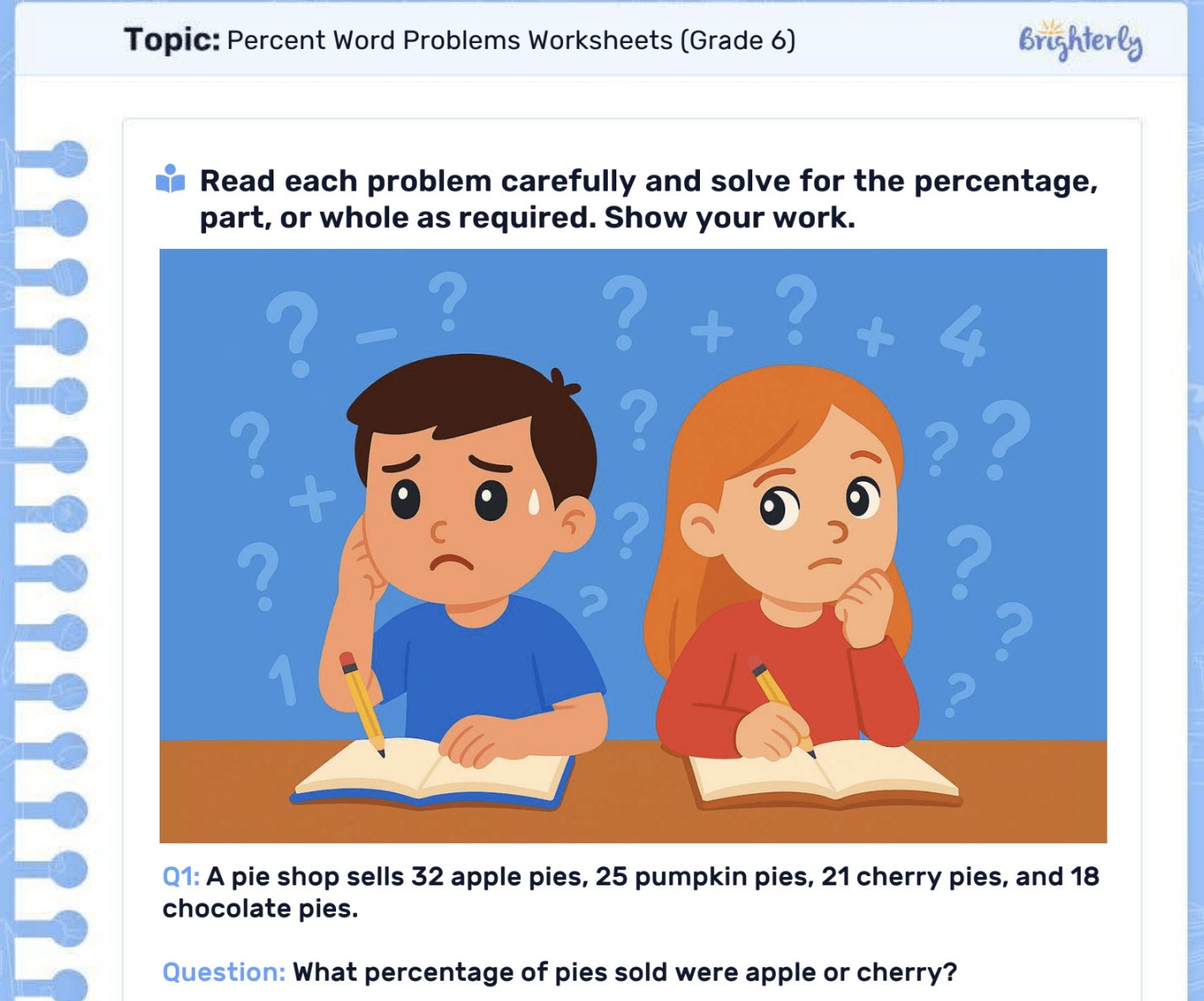
Facilitating mastery of percent word problems requires thoughtful scaffolding and consistent feedback.
Start with Concrete Manipulatives
Use visual aids such as fraction circles, base‑10 blocks, or money models to represent percentages physically before moving to abstract numbers.
Incorporate Technology Wisely
Interactive apps that simulate shopping or budgeting can provide instant feedback while keeping the learner engaged.
Differentiate Practice
Offer a mix of straightforward “percent of a whole” tasks and multi‑step problems that require combining concepts. This variety caters to diverse skill levels.
Encourage Collaborative Problem Solving
Pair students to discuss strategies aloud. Verbalizing reasoning often uncovers hidden misconceptions and promotes deeper understanding.
Provide Timely, Specific Feedback
When reviewing worksheet answers, point out not only the correct step but also why an alternative approach would be less efficient or incorrect.
Use Real‑Life Data
Pull current grocery flyers, utility bills, or sports statistics to craft customized problems that resonate with students’ interests.
Conclusion

A well‑crafted Percent Word Problems Worksheet does more than test arithmetic; it builds a bridge between abstract math and the tangible decisions people make every day. By understanding core concepts, employing systematic solving strategies, and avoiding common pitfalls, learners can confidently tackle percent challenges in academic settings and real life. Teachers and parents who provide clear guidance, authentic contexts, and consistent reflection will see students develop stronger numeracy, sharper critical thinking, and a lasting appreciation for the power of percentages. With practice, perseverance, and purposeful instruction, percent word problems become a rewarding puzzle rather than a dreaded obstacle, empowering the next generation to make informed, mathematically sound choices.