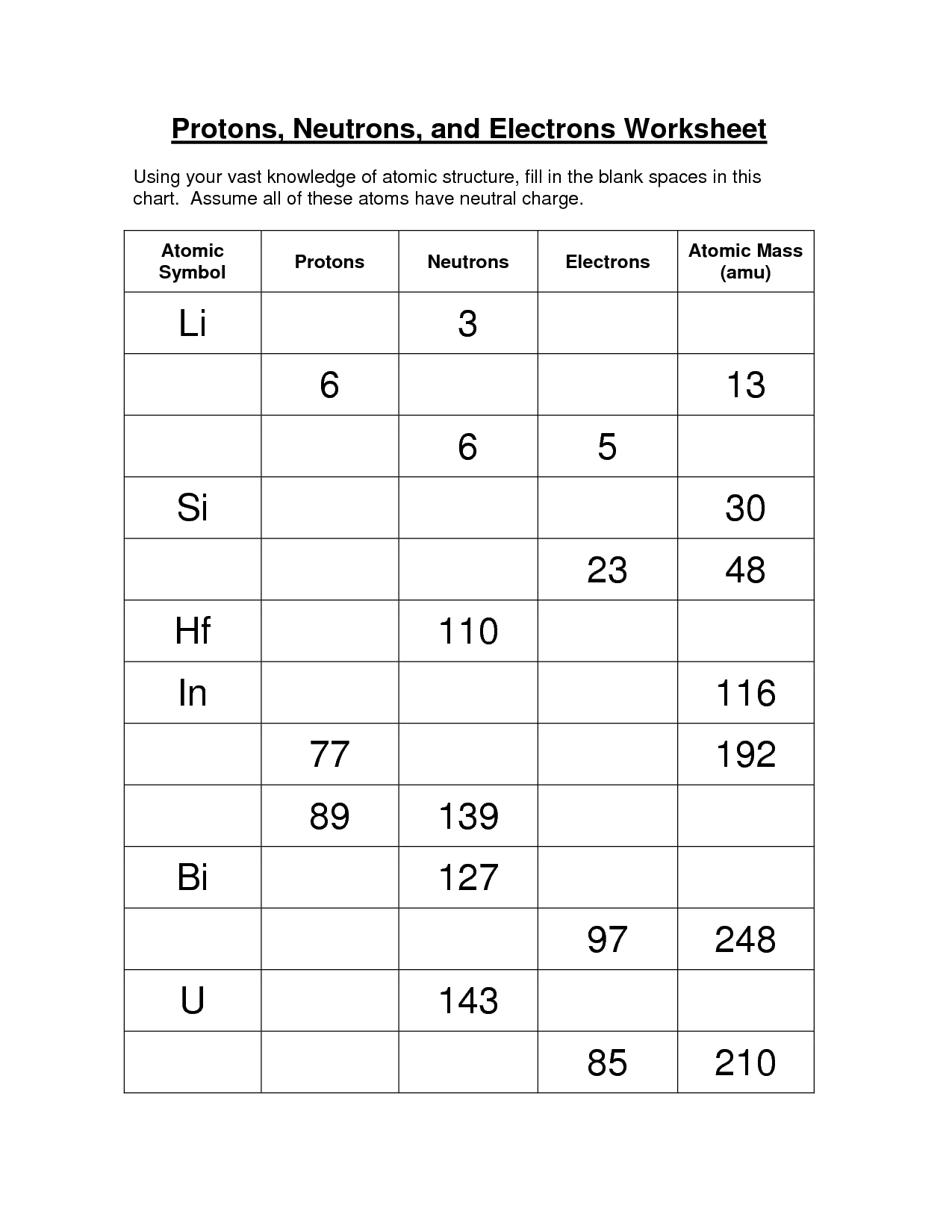
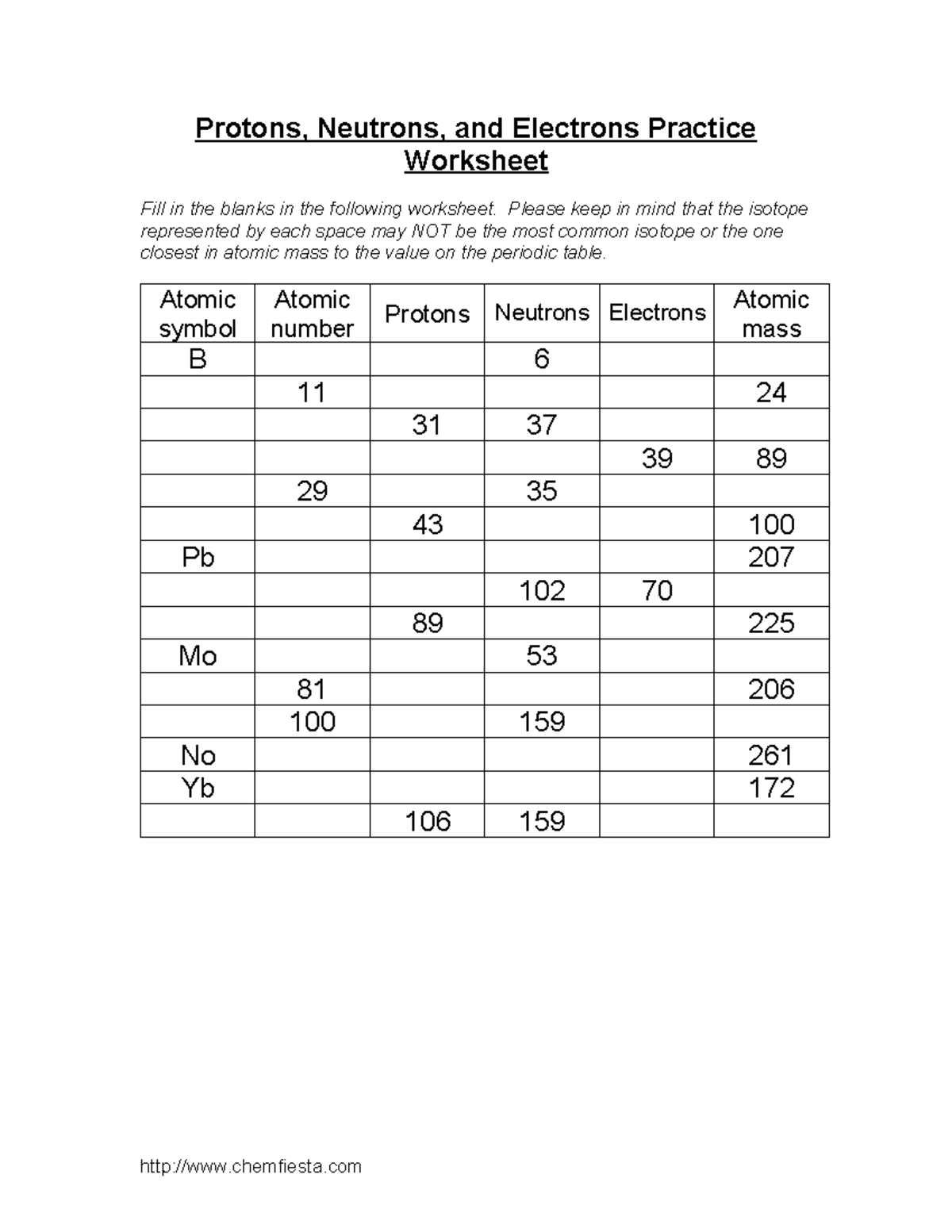
When you first hear Protons Neutrons Electrons Practice Worksheet, you might think it’s just another set of worksheets; but it’s actually a powerful, hands‑on tool that transforms how students grasp the building blocks of matter.
Why Practice Worksheets Are Essential

Building a Strong Foundation
- Repetition of core concepts solidifies memory.
- Clear, step‑by‑step questions guide reasoning.
- Immediate exposure to varied problem types reduces anxiety.
Immediate Feedback Loop
- Students can correct misconceptions right away.
- Teachers quickly identify gaps in understanding.
- Students develop a growth mindset by learning from mistakes.
Key Topics Covered in the Worksheet

Protons and Their Role in Atomic Number
- Every proton defines the element’s identity.
- Students learn to read atomic numbers from the periodic table.
- Questions often ask for the proton count to name an element.
Neutrons: The Neutral Builders
- Neutrons add mass without affecting charge.
- Students practice calculating neutron numbers using mass numbers.
- Isotope identification becomes intuitive.
Electrons: The Charge Carriers
- Electrons determine chemical behavior.
- Students determine neutrality, positive, or negative states.
- Questions involve balancing charges in molecules.
Effective Ways to Use the Worksheet in Classroom

Pre‑Assessment Strategy
- Give a quick worksheet to gauge prior knowledge.
- Use results to tailor the day’s lesson.
- Engage students by discussing common mistakes.
In‑Class Guided Practice
- Walk through a sample problem as a class.
- Invite students to explain their reasoning aloud.
- Address misconceptions in real time.
Post‑Assessment and Review
- Assign the worksheet as homework for deeper practice.
- Hold a review session where students exchange answers.
- Encourage reflection on problem‑solving strategies.
Tips for Students to Master the Material

Visualizing the Atomic Structure
- Draw a simple model of a nucleus with protons and neutrons.
- Color‑code electrons to see how they orbit.
- Use physical models or virtual simulations to reinforce visuals.
Using Mnemonics and Flashcards
- Create cards for each element’s proton and electron counts.
- Develop a rhyme to remember that neutrons are neutral.
- Quiz yourself regularly to strengthen recall.
Regular Self‑Testing
- Set a timer for 10 minutes and solve a section of the worksheet.
- Record scores and track improvement over weeks.
- Focus on sections where errors are most frequent.
Sample Problem Breakdown

Problem 1: Identify the Number of Protons
“What is the atomic number of the element with the symbol Na?” The answer is 11. Students must recognize the symbol from the periodic table, look up its atomic number, and understand that this number equals the proton count.
Problem 2: Calculate Neutron Count
“An isotope of carbon has a mass number of 14. How many neutrons does it contain?” Since carbon’s atomic number is 6, the calculation is 14 – 6 = 8 neutrons. This exercise reinforces the relationship between mass number, protons, and neutrons.
Problem 3: Determine Net Charge
“An ion has 10 protons and 12 electrons. What is its net charge?” The ion carries a 2‑negative charge. This type of problem helps students apply charge balance principles.
Assessment and Grading Strategies

Rubric Development
- Define clear criteria: accuracy, reasoning, notation.
- Use a simple table with points for each category.
- Provide constructive feedback for improvement.
Peer Review Sessions
- Students swap worksheets and check each other’s work.
- Encourage polite critique and suggestions.
- Promote collaborative learning and accountability.
Integrating Technology and Interactive Tools

Digital Worksheet Platforms
- Use online quizzes that auto‑grade for instant results.
- Provide multimedia explanations for challenging concepts.
- Allow students to practice anytime, anywhere.
Virtual Labs and Simulations
- Explore atomic structures in 3D environments.
- Manipulate proton, neutron, and electron counts to see effects.
- Link simulations to worksheet problems for a blended approach.
Conclusion

Mastering protons, neutrons, and electrons is the gateway to understanding chemistry and physics at a deeper level. A well‑designed Protons Neutrons Electrons Practice Worksheet not only reinforces foundational knowledge but also fosters critical thinking, problem‑solving, and confidence. By incorporating these worksheets into your teaching toolkit, you give students a structured, engaging pathway to discover the elegant simplicity of the atom. As you watch them progress from uncertain learners to confident scientists, you’ll see that the true value of this practice lies in its ability to turn abstract numbers into tangible, memorable concepts.