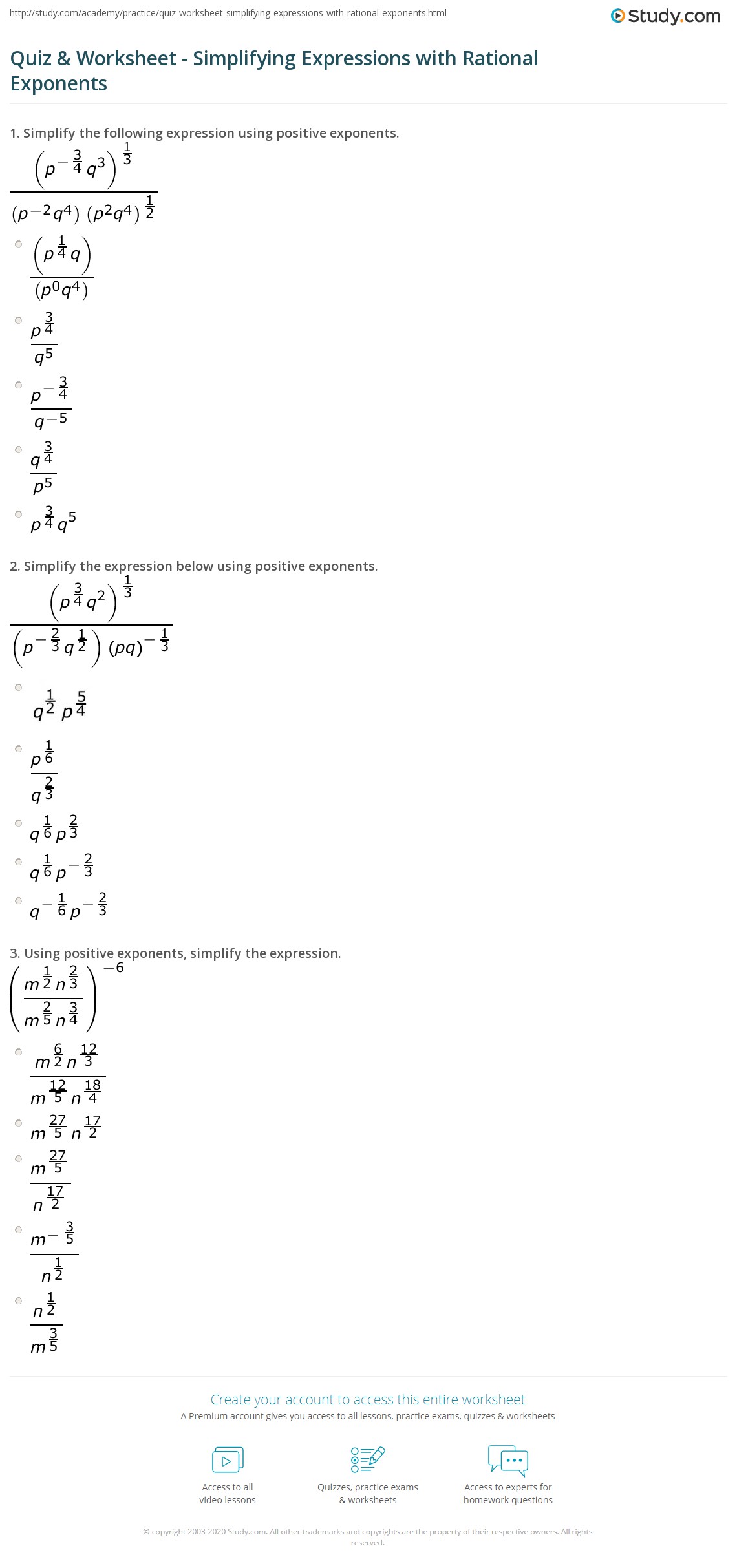
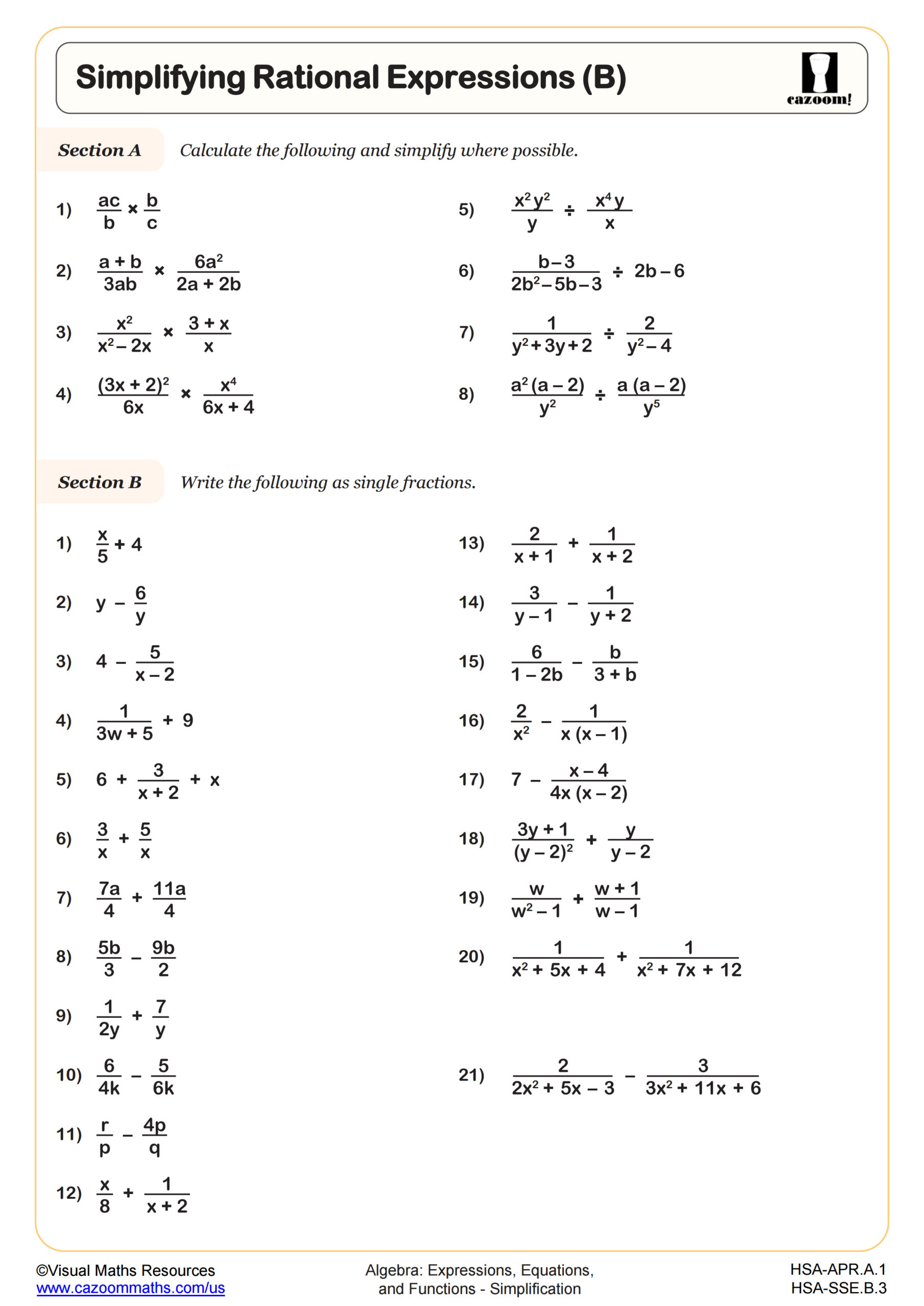
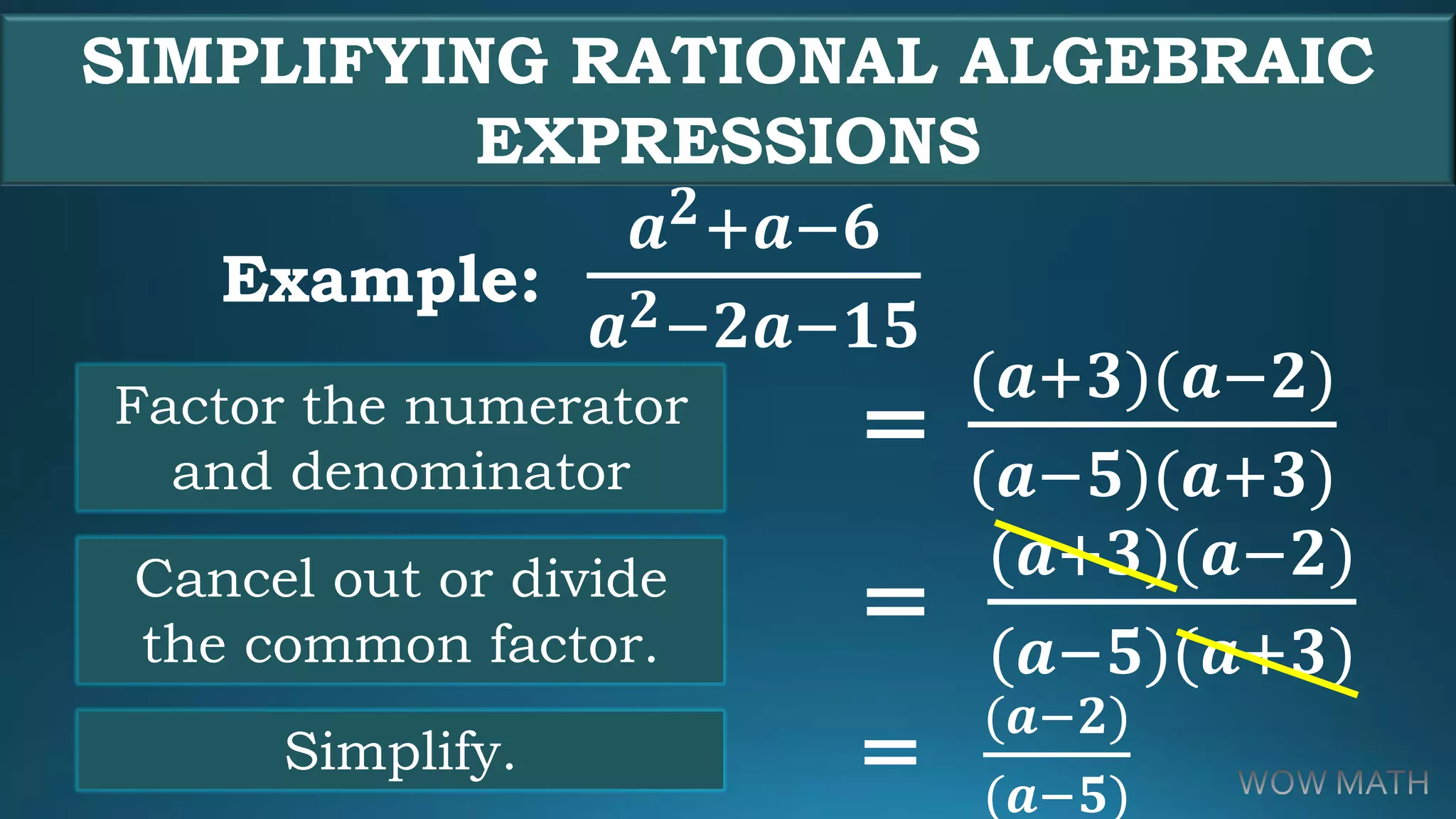
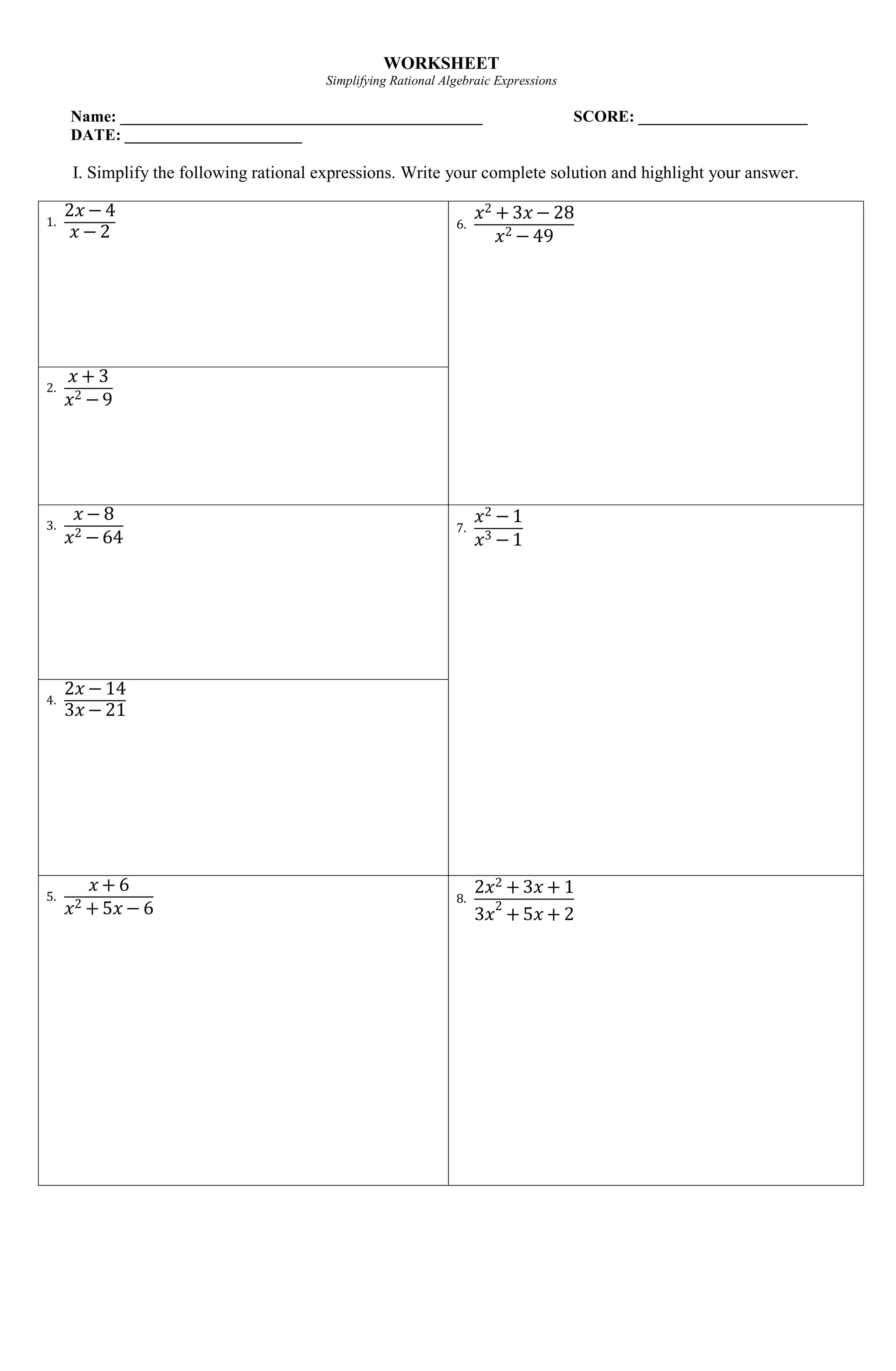
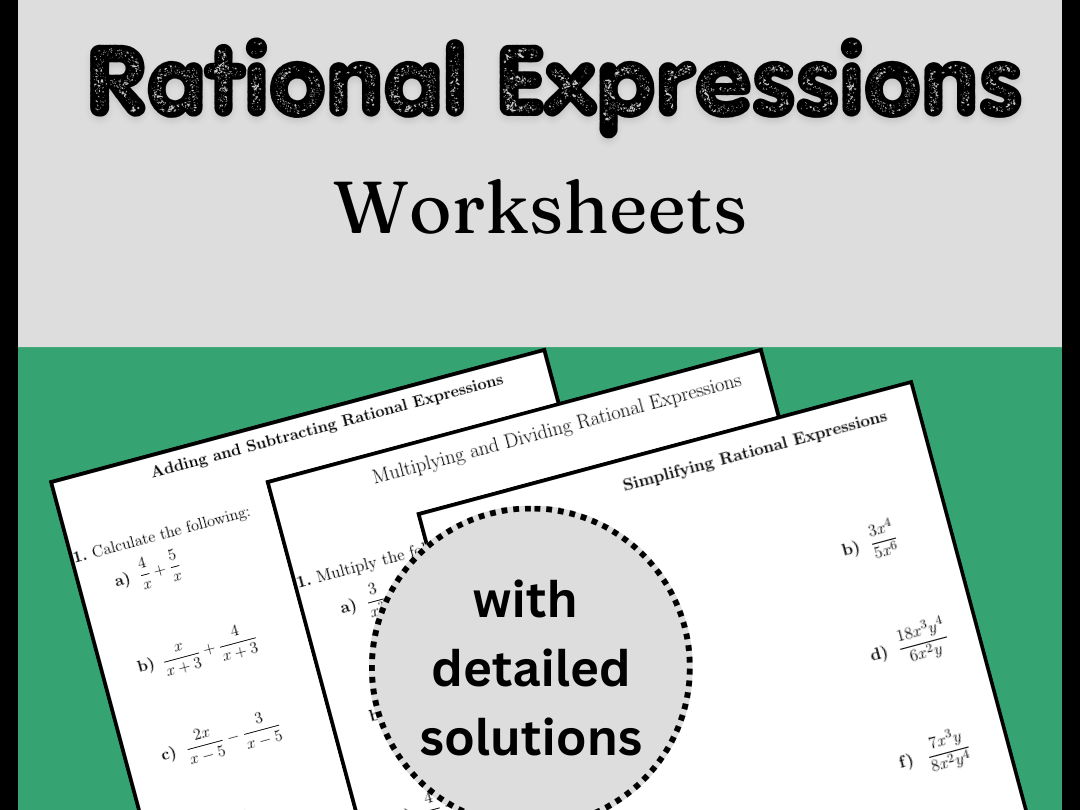
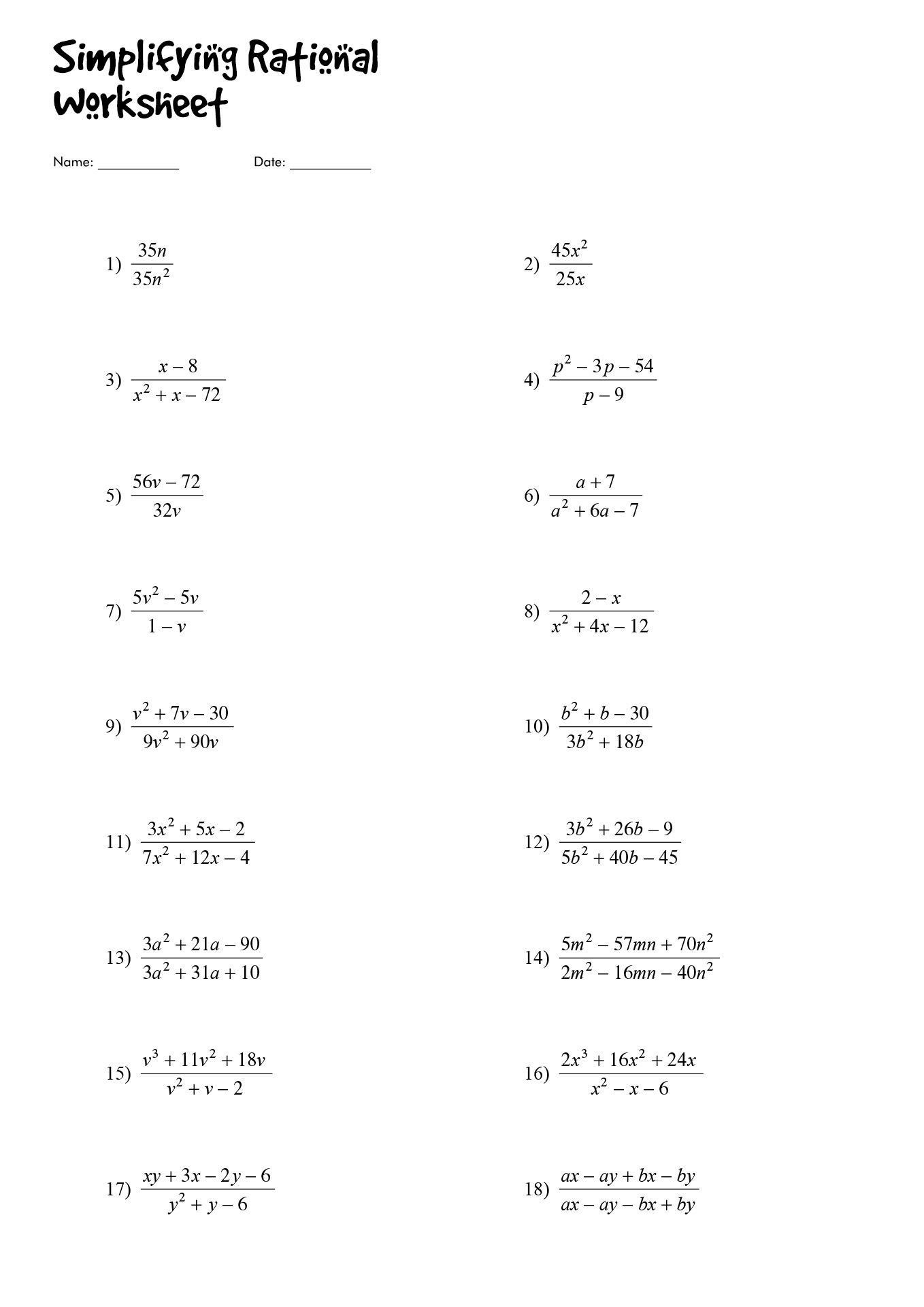
Rational Expression Worksheet Simplifying is a cornerstone skill for students mastering algebra, and it serves as a gateway to higher‑level math concepts such as functions, calculus, and mathematical modeling. By learning how to reduce complex fractions to their simplest form, learners sharpen their analytical thinking, improve problem‑solving speed, and gain confidence when tackling test‑taking scenarios. This comprehensive guide explores the theory behind rational expressions, presents a clear step‑by‑step simplification process, highlights common pitfalls, and offers actionable tips for creating or using worksheets that reinforce mastery.
Understanding Rational Expressions
Definition and Core Components
A rational expression is a fraction whose numerator and denominator are polynomials. For example, (3x^2 – 6x) / (x^2 – 4) qualifies because both the top and bottom contain polynomial terms. The term “rational” originates from the Latin word “ratio,” reflecting the idea that these expressions represent ratios of polynomial quantities.
Key Terminology
- Numerator: The polynomial that appears above the division line.
- Denominator: The polynomial below the division line; it must never be zero.
- Factor: An expression that, when multiplied by another, yields the original polynomial (e.g.,
x^2 – 4 = (x – 2)(x + 2)). - Common Factor: A factor shared by both numerator and denominator, which can be canceled to simplify the expression.
- Domain: All real numbers for which the denominator does not equal zero.
Why Simplification Matters
Simplifying rational expressions reduces computational complexity, reveals hidden cancellations, and clarifies the function’s behavior near critical points. In real‑world contexts—such as engineering calculations, economics models, and physics equations—working with the simplest form minimizes errors and enhances interpretability.
Importance of Simplification in the Classroom

Alignment with Curriculum Standards
Most state and national standards, including the Common Core State Standards for Mathematics (CCSSM), require students to demonstrate proficiency in simplifying rational expressions by the end of secondary algebra. Mastery signals readiness for subsequent topics like rational equations, functions, and asymptotic analysis.
Impact on Assessment Performance
Standardized tests frequently feature multiple‑choice and free‑response items that test a student’s ability to reduce fractions quickly. Students who practice with well‑designed worksheets develop procedural fluency, which translates into higher scores and reduced test anxiety.
Building a Strong Mathematical Foundation
Beyond test performance, simplification nurtures a deeper appreciation for algebraic structure. Learners begin to see patterns, such as the relationship between factoring techniques (difference of squares, perfect square trinomials, sum/difference of cubes) and the ability to cancel terms efficiently.
Step‑by‑Step Guide to Simplifying Rational Expressions

Step 1: Identify the Domain
Before any manipulation, determine the values that make the denominator zero. Set the denominator equal to zero and solve for x. These values are excluded from the domain and must be noted in the final answer.
Step 2: Factor Both Numerator and Denominator Completely
Apply appropriate factoring methods:
- Greatest Common Factor (GCF): Extract the largest monomial that divides every term.
- Difference of Squares: Recognize patterns of the form
a^2 – b^2 = (a – b)(a + b). - Quadratic Trinomials: Use either the AC method or factoring by grouping to split the middle term.
- Sum/Difference of Cubes: Apply
a^3 ± b^3 = (a ± b)(a^2 ∓ ab + b^2).
Step 3: Cancel Common Factors
After factoring, locate any identical binomials or monomials present in both the numerator and denominator. Cancel them, remembering that cancellation is valid only for factors, not for terms added or subtracted.
Step 4: Rewrite the Simplified Expression
Combine any remaining uncanceled factors to construct the simplified rational expression. Ensure that any domain restrictions identified in Step 1 are still applied.
Step 5: Verify by Cross‑Multiplication (Optional)
To confirm correctness, cross‑multiply the original and simplified expressions (excluding the domain restrictions) and simplify both sides. If they are equivalent, the simplification is accurate.
Common Mistakes and How to Avoid Them

Canceling Across Addition or Subtraction
Students often mistakenly cancel terms that are part of a sum or difference, such as attempting to cancel +3x from (x + 3x) / (2x + 6). The correct approach is to factor first, then cancel whole factors, not individual terms.
Ignoring the Domain
Failing to state excluded values leads to incomplete answers. Always list the restricted values after the simplified expression, e.g., “for x ≠ 2, –2.”
Incorrect Factoring of Quadratics
Misidentifying the correct pair of numbers for the AC method or overlooking a GCF results in an unsimplified expression. Double‑check factor pairs and verify that the product equals the constant term multiplied by the leading coefficient.
Over‑Simplifying by Removing Non‑Common Factors
Only factors that appear in both numerator and denominator may be canceled. Removing a factor that appears solely in the numerator changes the value of the expression.
Real‑World Applications of Simplified Rational Expressions

Engineering: Load Distribution
In civil engineering, the load on a beam can be expressed as a rational function of material properties and geometry. Simplifying the expression helps identify critical points where stress may exceed safe limits.
Economics: Cost‑Benefit Analysis
Profit functions often involve ratios of polynomial cost and revenue terms. Simplifying these ratios enables analysts to quickly locate break‑even points and optimal production levels.
Physics: Wave Interference
The amplitude of interfering waves can be modeled by rational expressions involving frequency and medium properties. Reducing these expressions clarifies resonance conditions and predicts constructive or destructive interference.
Tips for Creating Effective Rational Expression Worksheets

Start with Scaffolded Problems
Begin with worksheets that focus on a single skill, such as factoring a GCF, before progressing to multi‑step simplifications that require several factoring techniques in one problem.
Incorporate Real‑Life Scenarios
Embed word problems that require students to translate a situation into a rational expression, then simplify. This reinforces the relevance of the skill.
Use Varied Difficulty Levels
Mix easy, medium, and challenging items within a single worksheet to maintain engagement and differentiate instruction. Include at least one “challenge” problem that integrates multiple concepts.
Provide Answer Keys with Detailed Explanations
Beyond the final simplified form, outline each step—domain identification, factoring, cancellation—to model the thought process for independent learners.
Utilize Visual Aids
Incorporate factor trees or diagrammatic representations of numerator and denominator to help visual learners track cancellations.
Frequently Asked Questions
Can I simplify a rational expression if the denominator is zero for some values?
Yes, you can simplify the expression for all permissible values. However, you must always state the excluded values explicitly, because the simplified form does not automatically convey the original domain restrictions.
Is it ever acceptable to add or subtract factors before canceling?
No. Adding or subtracting terms changes the structure of the expression. The proper method is to factor completely, then cancel identical factors.
How do I know which factoring technique to apply?
Identify patterns in the polynomial: look for common factors, perfect squares, differences of squares, or cubic forms. If none are obvious, the AC method or grouping may be appropriate for quadratics.
What if the numerator and denominator share a factor that is a binomial squared?
Cancel the entire binomial factor, not just one instance. For example, (x – 3)^2 / (x – 3) simplifies to x – 3, provided x ≠ 3 to preserve the domain.
Do I need to simplify rational expressions when solving rational equations?
Simplifying before solving often reduces the number of extraneous solutions and makes the equation easier to handle. It is a recommended best practice.
Conclusion
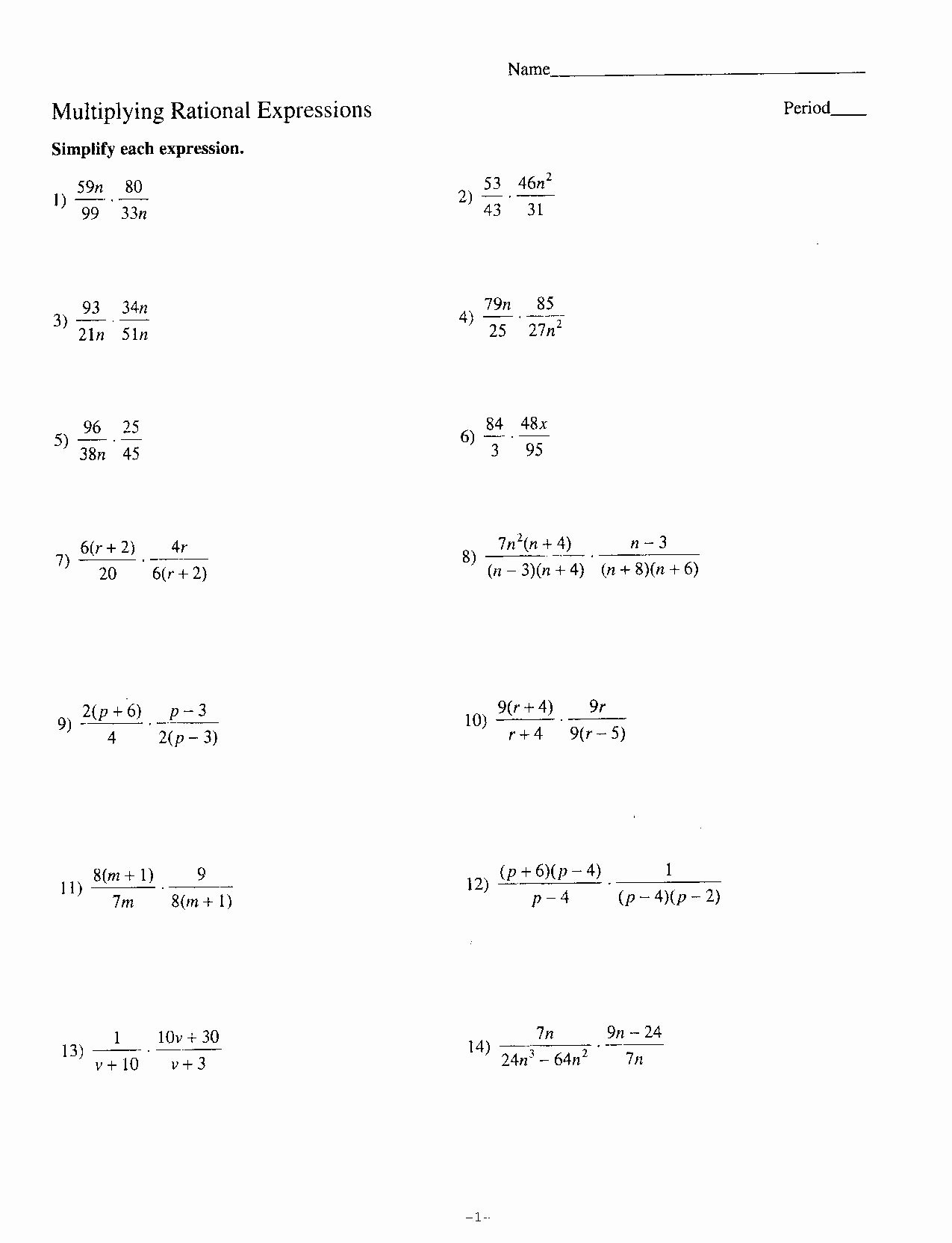
Mastering Rational Expression Worksheet Simplifying equips students with a versatile tool that extends far beyond the classroom, influencing fields ranging from engineering to economics. By understanding the underlying structure of rational expressions, practicing systematic simplification steps, avoiding common errors, and applying the skill to authentic problems, learners develop both procedural fluency and conceptual insight. Thoughtfully designed worksheets that blend scaffolded practice with real‑world relevance further reinforce mastery, preparing students for success on assessments and in future academic pursuits. Embrace these strategies, and watch confidence and competence in algebraic reasoning flourish.