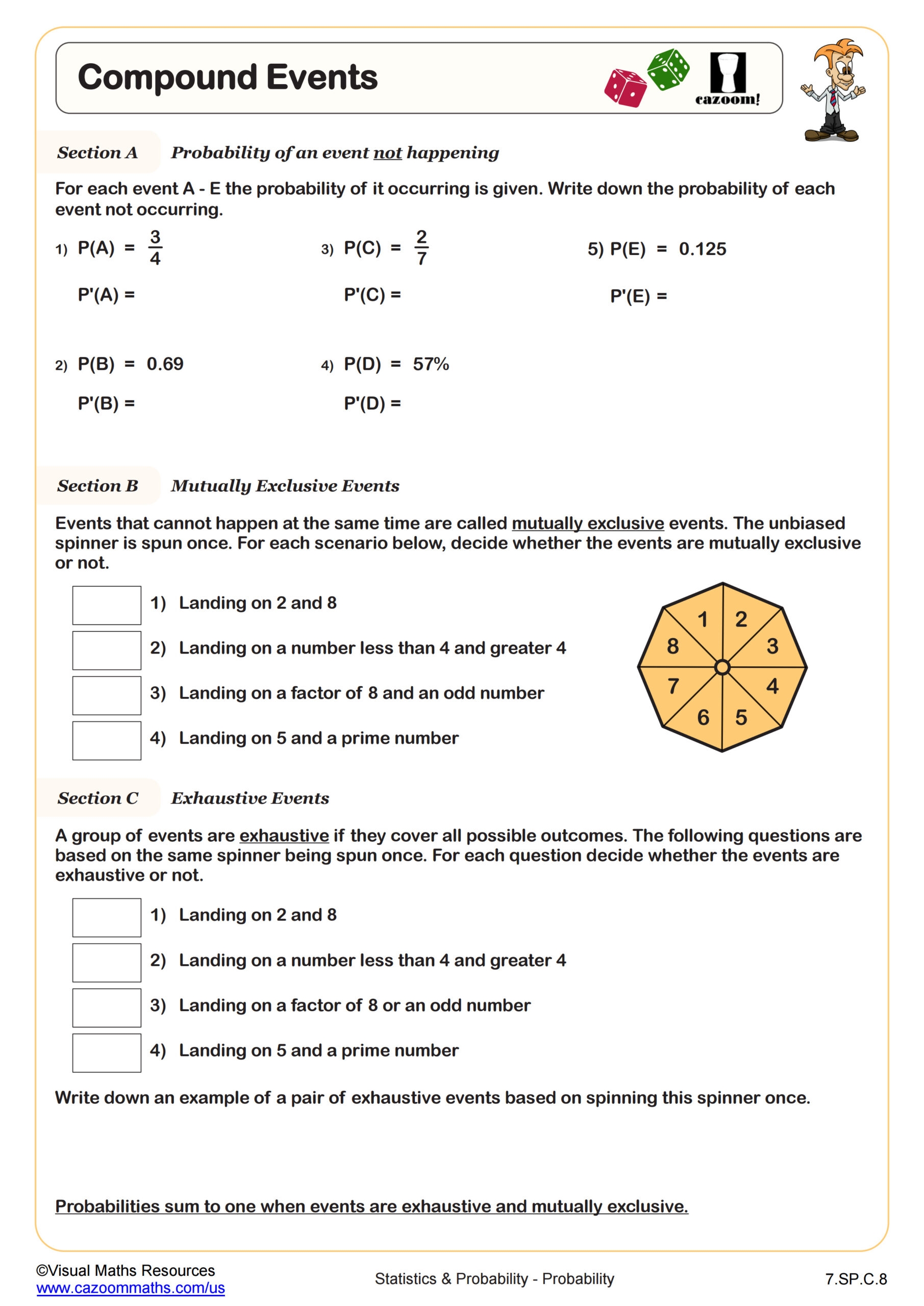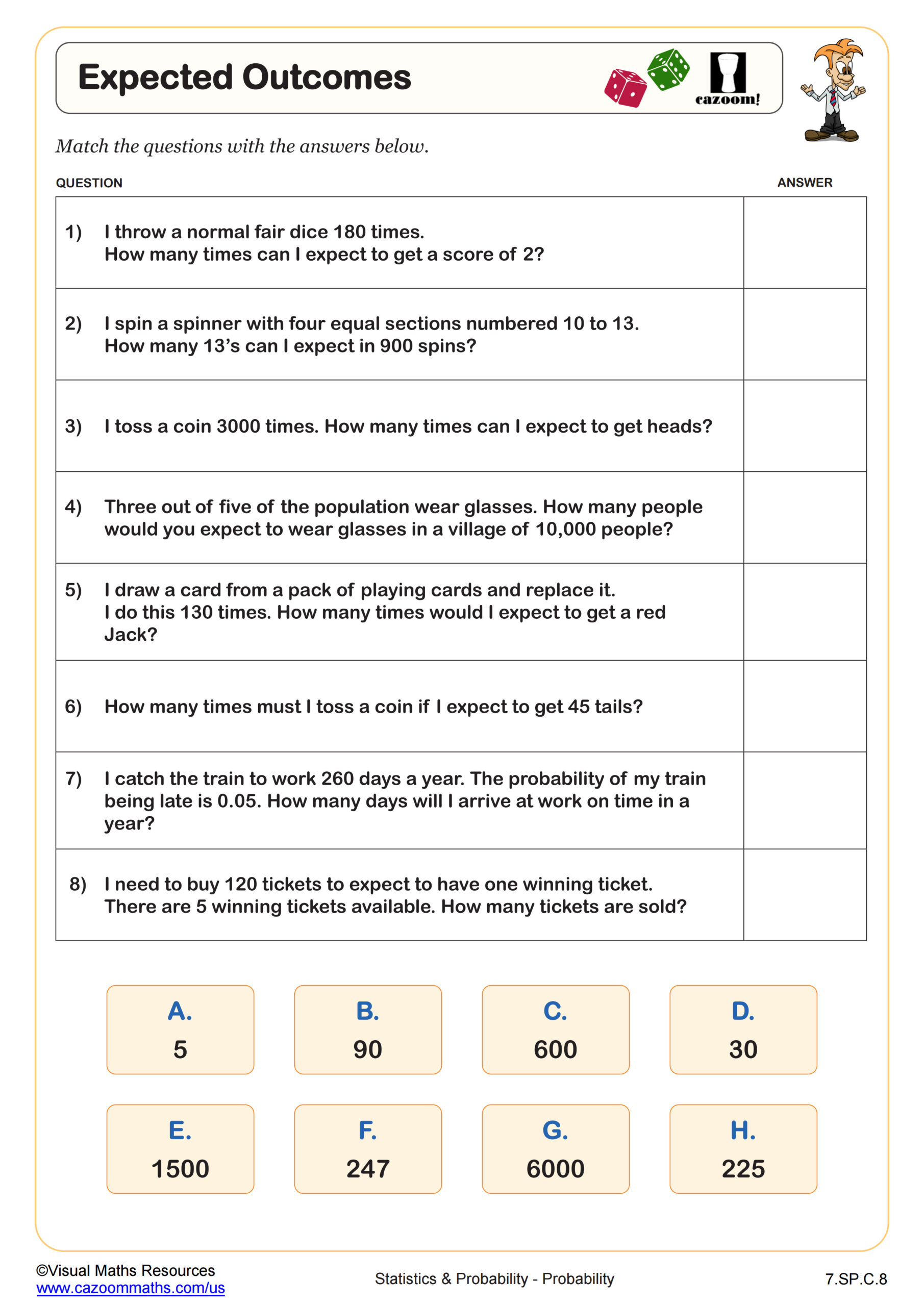
Simple Events Worksheet 7th Grade offers a focused pathway for young learners to master the fundamentals of probability, a skill that bridges everyday decision‑making with the rigor of mathematics. In many Asian classrooms, the emphasis on clear concepts and disciplined practice fuels confidence, and this worksheet embodies that philosophy by presenting concise problems, real‑life contexts, and step‑by‑step guidance. Whether you are a teacher looking to enrich your lesson plan, a parent seeking supplemental practice, or a student eager to boost test scores, the worksheet serves as a versatile tool that blends cultural reverence for education with modern instructional design, ensuring every learner can navigate simple events with precision and enthusiasm.
Understanding Simple Events in Probability

At its core, a simple event represents the most basic outcome of a random experiment—an occurrence that cannot be broken down into smaller components. For 7th‑grade students, grasping this definition is the cornerstone of all future probability work. Consider the classic example of flipping a coin; “heads” and “tails” are each simple events because they are indivisible outcomes of a single trial. By internalizing this concept, students develop the analytical mindset needed to tackle more complex scenarios such as compound events, independent and dependent trials, and probability distributions.
Key Characteristics of Simple Events
- Indivisibility: The event cannot be separated into further outcomes.
- Mutual Exclusivity: No two simple events occur at the same time in the same trial.
- Equal Likelihood (in uniform sample spaces): In many classroom examples, each simple event has the same chance of occurring, simplifying calculations.
Why Emphasize Simple Events Early?
Mastery of simple events lays a logical foundation that mirrors the step‑by‑step problem‑solving approach prized in many Asian educational traditions. When students first learn to identify and count simple events, they simultaneously practice careful observation, enumeration, and clear communication—skills that resonate across subjects from mathematics to language arts.
Why 7th Grade Is a Critical Year for Probability Mastery

Seventh grade serves as a transitional stage where students move from concrete arithmetic to abstract reasoning. In the context of probability, this shift is especially evident: learners begin to translate real‑world phenomena into mathematical models. The Simple Events Worksheet 7th Grade aligns perfectly with curriculum standards, reinforcing concepts that will later appear in middle school standardized tests, high‑school algebra, and even introductory statistics.
Curricular Connections
- Common Core State Standards (CCSS): Aligns with CCSS.MATH.CONTENT.7.SP.C.5, which requires students to understand the concept of simple events and to calculate probabilities of compound events.
- Next Generation Science Standards (NGSS): Supports data interpretation and probability modeling in scientific investigations.
- International Baccalaureate Middle Years Programme (IB MYP): Encourages inquiry‑based learning and real‑world applications, both of which are embedded in the worksheet.
Developmental Benefits
During this age, adolescents develop stronger logical reasoning and begin to appreciate the relevance of mathematics beyond the classroom. The worksheet capitalizes on this developmental window by presenting problems that are both culturally relatable—such as calculating the likelihood of drawing a specific sushi roll from a platter—and mathematically rigorous.
How to Use the Simple Events Worksheet Effectively

To extract maximum benefit from the worksheet, teachers and parents should adopt a structured approach that balances guided instruction with independent practice. Below is a step‑by‑step framework that can be seamlessly integrated into a typical 45‑minute class period or a home study session.
Step 1: Preview the Concepts
Begin with a brief discussion of simple events, using tangible examples from everyday life—like the chance of selecting a red lantern at a festival or picking a specific flavor of bubble tea. Encourage students to verbalize the definition and identify the sample space.
Step 2: Demonstrate a Sample Problem
Work through one worksheet problem on the board, highlighting the process of listing all simple events, counting them, and applying the probability formula P(event) = Number of favorable outcomes ÷ Total number of outcomes. Emphasize the importance of labeling each step clearly.
Step 3: Guided Practice
Assign a set of three to five problems for students to solve in pairs. Circulate the room (or virtual breakout rooms) to provide immediate feedback, correct misconceptions, and model mathematical language. Prompt learners to explain their reasoning aloud, fostering communication skills.
Step 4: Independent Mastery
After guided practice, have students complete the remaining worksheet items individually. This phase consolidates learning and reveals any lingering gaps. Collect the worksheets for quick marking, focusing on both accuracy and the clarity of written explanations.
Step 5: Reflect and Extend
Conclude the session with a reflective discussion. Ask students to compare different problems, identify patterns, and suggest alternative strategies. For advanced learners, introduce a challenge: modify a problem by adding an extra outcome and predict how the probability changes.
Classroom Tips for Smooth Implementation
- Use visual aids such as probability trees or Venn diagrams to illustrate simple events.
- Incorporate culturally resonant items—like traditional lanterns, chopsticks, or festival foods—to make the content more relatable.
- Allocate a short “think‑pair‑share” interval after each major step to encourage collaborative reasoning.
- Maintain a “probability journal” where students record their problem‑solving process and reflections.
Real‑World Applications That Bring Simple Events to Life

Students often wonder why probability matters beyond the textbook. By linking simple events to authentic scenarios, educators can spark curiosity and demonstrate the practical value of mathematical thinking.
Everyday Scenarios
- Snack Selection: Determining the likelihood of grabbing a specific flavor of Pocky from a mixed bag.
- Transportation: Calculating the chance that the next bus arriving at a stop will be the blue line versus the red line.
- Games and Sports: Assessing the probability of rolling a particular number on a dice during a board game night.
Academic and Career Connections
Understanding simple events is a prerequisite for data analysis, risk assessment, and scientific experimentation—fields that are rapidly expanding across Asia and the United States. For instance, future engineers may need to evaluate the probability of component failure, while medical researchers might assess the likelihood of a particular symptom appearing in a patient cohort.
Technology Integration
Leverage digital tools such as interactive probability simulators or spreadsheet calculators to visualize outcomes. Students can input different sample spaces and instantly see how probabilities shift, reinforcing the cause‑and‑effect relationship inherent in simple events.
Common Mistakes and How to Fix Them

Even diligent students can stumble when working with probability. Recognizing and correcting these errors early prevents the formation of persistent misconceptions.
Misidentifying the Sample Space
Students sometimes overlook certain outcomes, leading to inaccurate probability calculations. Encourage them to use a checklist or draw a simple diagram to verify that every possible simple event is accounted for before proceeding.
Confusing Simple and Compound Events
When a problem involves multiple steps—like selecting two cards without replacement—learners may mistakenly treat the combined outcome as a simple event. Clarify the distinction by revisiting the definition and providing side‑by‑side examples that illustrate the difference.
Incorrect Fraction Simplification
After calculating the raw probability, students may neglect to reduce the fraction to its simplest form. Reinforce the importance of proper reduction by integrating a quick “simplify” checkpoint into each worksheet solution.
Overlooking Mutual Exclusivity
Assuming that two simple events can occur simultaneously leads to double‑counting. Use real‑world analogies—such as a single marble being both red and blue—to illustrate why mutual exclusivity is essential.
Tips for Parents and Teachers Supporting Learners

Active involvement from adults significantly enhances a student’s confidence and mastery of probability concepts. Below are practical strategies that can be implemented at home or in the classroom.
Create a Probability Routine
Set aside a regular “probability corner” time each week where students explore a new simple‑event scenario. Consistency reinforces learning and builds habit.
Use Everyday Materials
Gather items like colored beads, playing cards, or fruit pieces to physically model simple events. Hands‑on manipulation aligns with kinesthetic learning styles prevalent in many Asian education systems.
Encourage Mathematical Language
Prompt students to articulate their reasoning using precise terminology—terms such as “sample space,” “favorable outcome,” and “probability fraction.” This practice not only solidifies understanding but also prepares them for higher‑level math discourse.
Integrate Technology Wisely
While digital tools are valuable, ensure they complement rather than replace critical thinking. Use apps to verify calculations after students have worked through the problem manually.
Provide Positive Feedback
Celebrate correct reasoning even when the final answer is incorrect. Highlight the logical steps taken, reinforcing a growth mindset that resonates deeply with cultural values of perseverance and effort.
Frequently Asked Questions About Simple Events Worksheet 7th Grade
What age group is the worksheet designed for?
The worksheet targets 12‑ to 13‑year‑old students, aligning with typical 7th‑grade curricula in both the United States and many Asian education systems.
Can the worksheet be used for remote learning?
Absolutely. Its clear layout and printable format make it ideal for virtual classrooms, and educators can share digital copies through learning management systems.
How many problems are included?
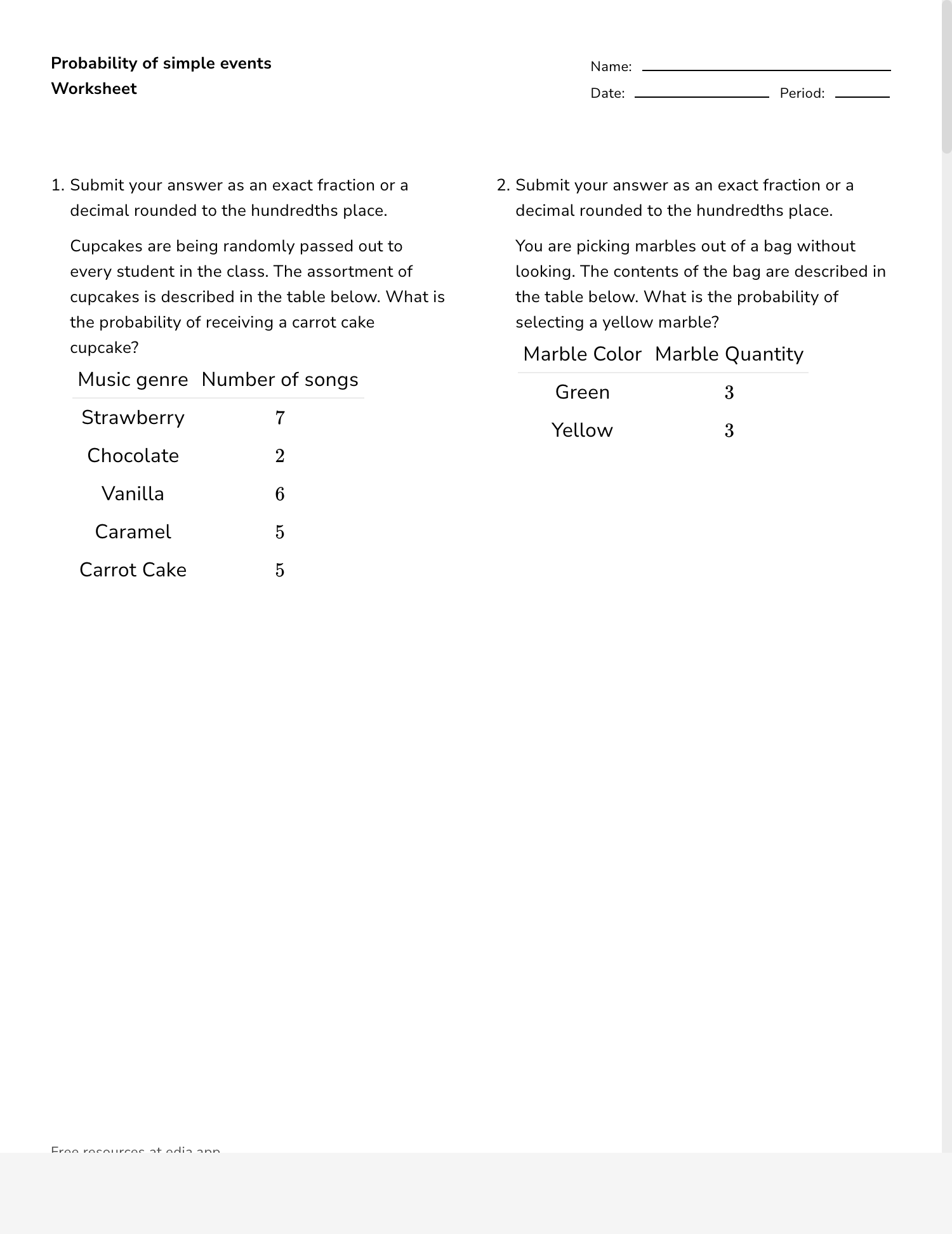
The resource contains a balanced set of 20 problems, ranging from introductory to moderately challenging, ensuring differentiated instruction.
Is there an answer key?
Yes, a comprehensive answer key accompanies the worksheet, providing step‑by‑step solutions that teachers and parents can reference for grading and explanation.
How does this worksheet align with cultural learning styles?
The problems incorporate familiar contexts—such as market stalls, school cafeterias, and traditional games—making the material relatable and fostering deeper engagement among students who value contextual relevance.
Conclusion

By integrating the Simple Events Worksheet 7th Grade into regular instruction, educators and parents can nurture a generation of learners who approach probability with confidence, cultural awareness, and analytical rigor. The worksheet’s clear structure, real‑world examples, and alignment with both U.S. and Asian educational standards make it a powerful catalyst for mastering simple events—an essential building block for future mathematical success. When students internalize the principles of simple events, they not only improve test scores but also gain a lifelong tool for making informed decisions, whether they are choosing a dish at a bustling night market or evaluating risk in a future career. Embrace this resource, apply the strategies outlined above, and watch your students transform uncertainty into measurable understanding.