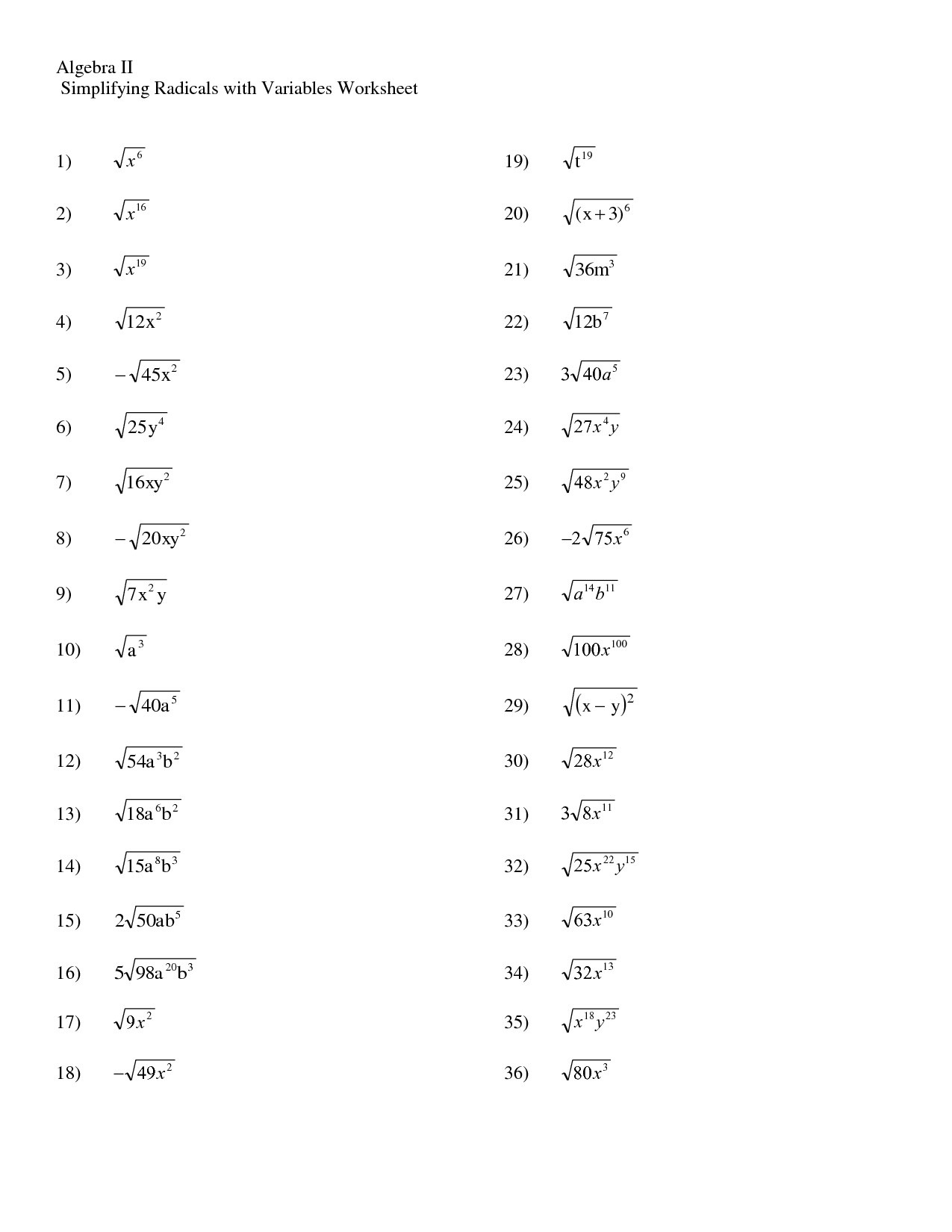
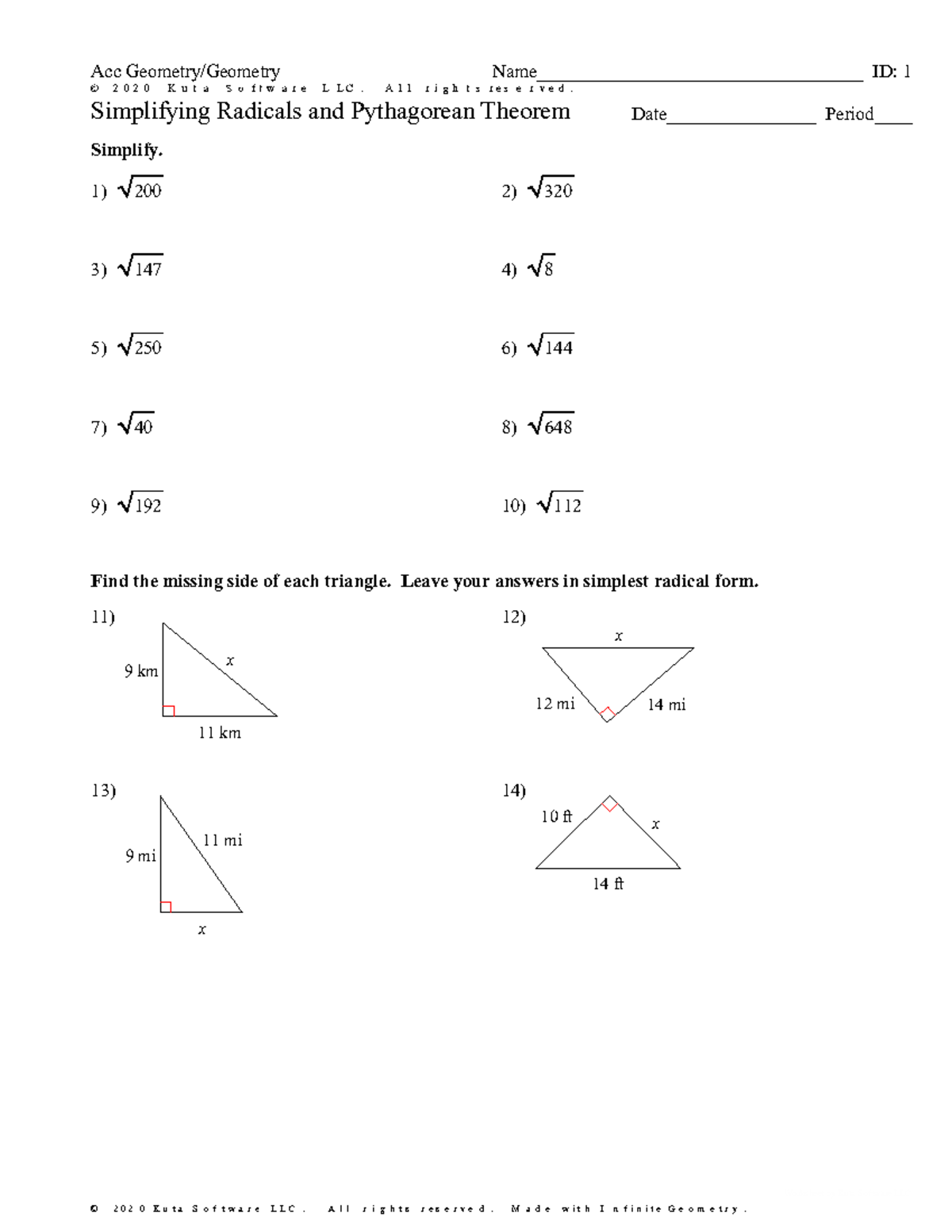
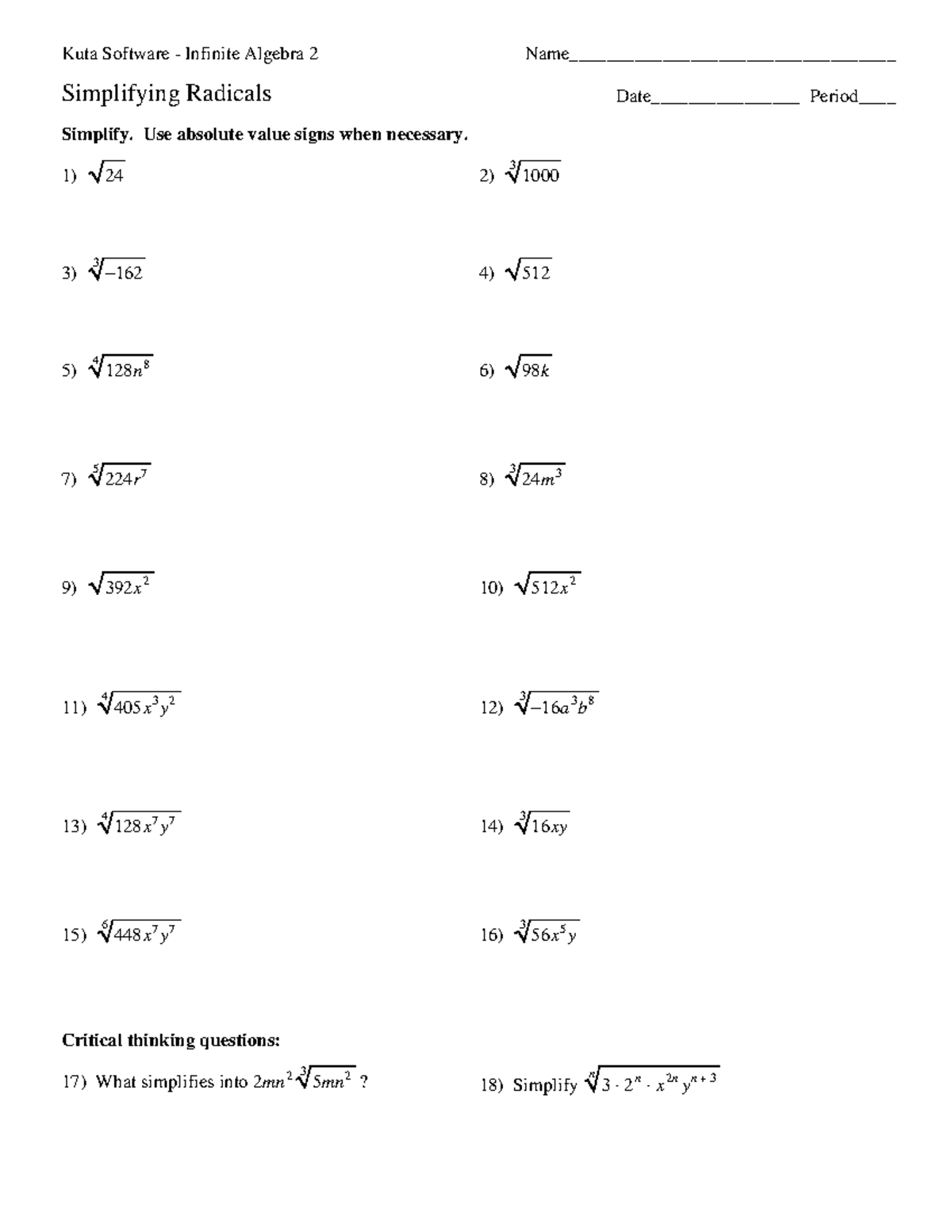
Simplifying Radicals Worksheet Algebra is the secret sauce that turns a confusing jumble of square roots into a tidy, manageable expression that even a high‑school student can conquer, and in this article I’ll walk you through why it matters, how to master it, and how to use worksheets to cement your skills for real‑world success.
Why Simplifying Radicals Matters

When you first encounter radicals in Algebra 2, the symbols can feel like alien script. Yet the ability to simplify them is a foundational skill that unlocks higher‑level topics such as polynomial factoring, solving quadratic equations, and even calculus concepts like integration. A well‑designed worksheet provides structured practice, giving you the repetition needed to internalize the patterns and shortcuts that make radicals feel intuitive rather than intimidating.
Beyond the classroom, simplified radicals appear in fields ranging from engineering (think stress‑strain calculations) to computer graphics (where distances are often expressed as square roots). By mastering the worksheet approach, you develop a mental toolkit that can be deployed instantly whenever a problem calls for a clean, exact answer instead of a messy approximation.
Key Concepts Behind Radical Simplification

Understanding Radicands and Indices
The radicand is the number or expression inside the radical sign, while the index tells you which root you are taking (most commonly a square root, where the index is 2 and is omitted). Recognizing perfect‑power factors inside the radicand is the first step toward simplification.
Prime Factorization as a Roadmap
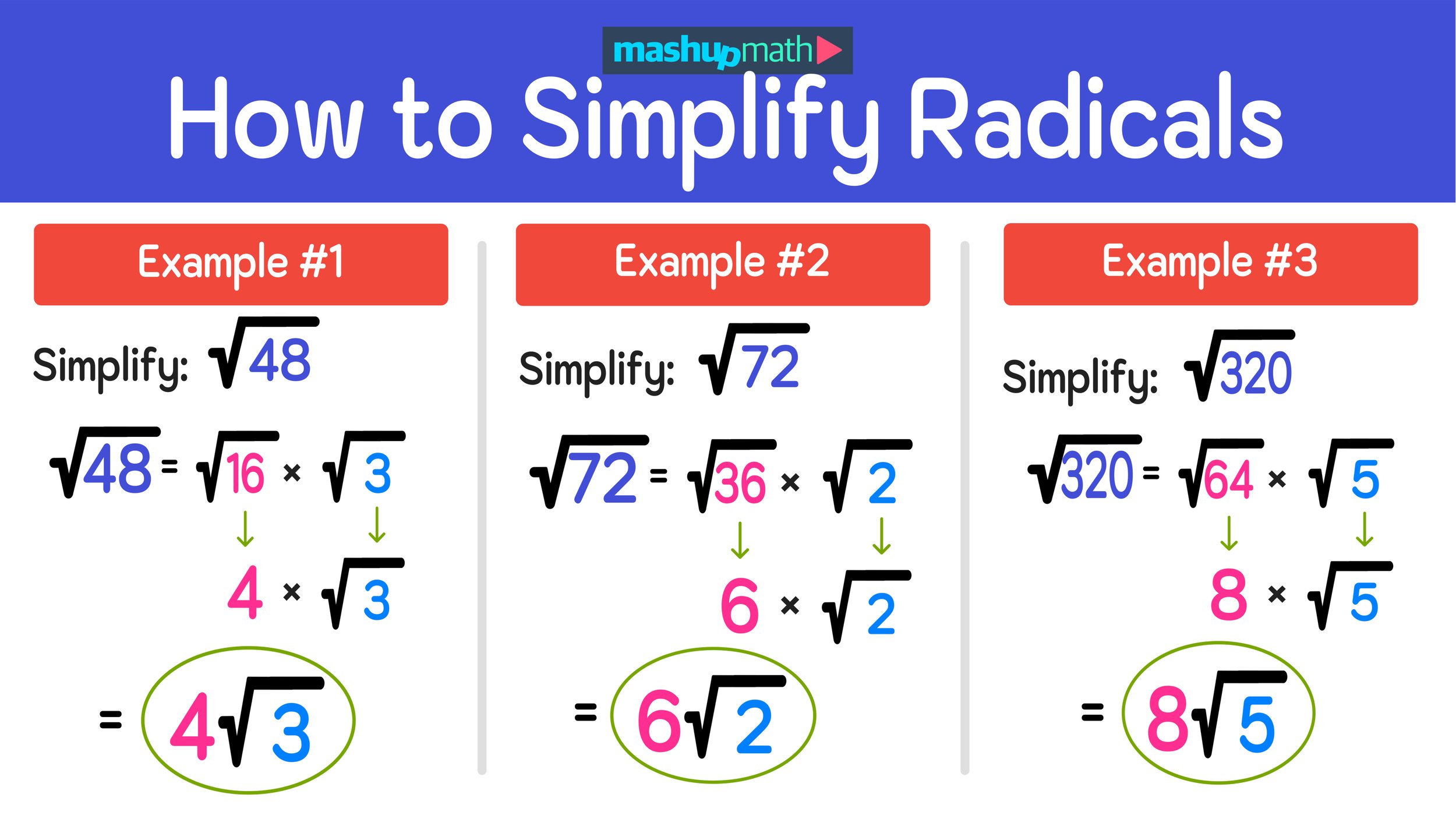
Breaking the radicand into its prime factors lets you pair up identical factors for square roots, or group them in multiples of the index for higher roots. For example, √72 becomes √(2·2·2·3·3), which can be rewritten as 2·3√2 = 6√2. This systematic approach works for any integer radicand and also extends to algebraic expressions.
Variables Inside Radicals
When variables appear under the radical, treat them just like numbers—apply the same factor‑pairing logic, but keep track of exponent rules. For instance, √(x⁴y³) simplifies to x²y√y because x⁴ is a perfect square ((x²)²) and y³ can be split into y²·y, leaving one y inside the root.
Rationalizing Denominators
Many worksheets ask you to eliminate radicals from the denominator. Multiply the numerator and denominator by a conjugate or an appropriate radical to achieve a rational denominator. For example, 1/√5 becomes √5/5 after multiplying top and bottom by √5.
Step‑by‑Step Guide to Solving Worksheets

Step 1: Scan the Problem for Perfect Powers
Before you start any computation, glance at the radicand. Circle any numbers or variable powers that are perfect squares (or cubes, fourth powers, etc.). This quick visual cue saves time and reduces errors.
Step 2: Factor the Radicand Completely
Write the radicand as a product of prime numbers and variable powers. Use exponent rules to break down expressions like (2x)⁴ into 16x⁴ before extracting roots.
Step 3: Pull Out Whole Factors
Group the factors into sets equal to the index. For a square root, pair them; for a cube root, group triples. Each complete group exits the radical as a single factor.
Step 4: Simplify Any Remaining Radicals
If any factors cannot be fully grouped, they stay under the radical sign. Combine them with any existing radical terms, using multiplication rules to keep the expression tidy.
Step 5: Rationalize if Required
Check the denominator. If a radical remains, multiply by the appropriate form of one (or the conjugate for binomials) to eliminate the root. Simplify the resulting fraction fully.
Step 6: Verify Your Answer
Plug a simple numeric value for the variables (if any) to test both the original and simplified expressions. They should evaluate to the same number, confirming that no algebraic slip occurred.
Common Mistakes and How to Avoid Them
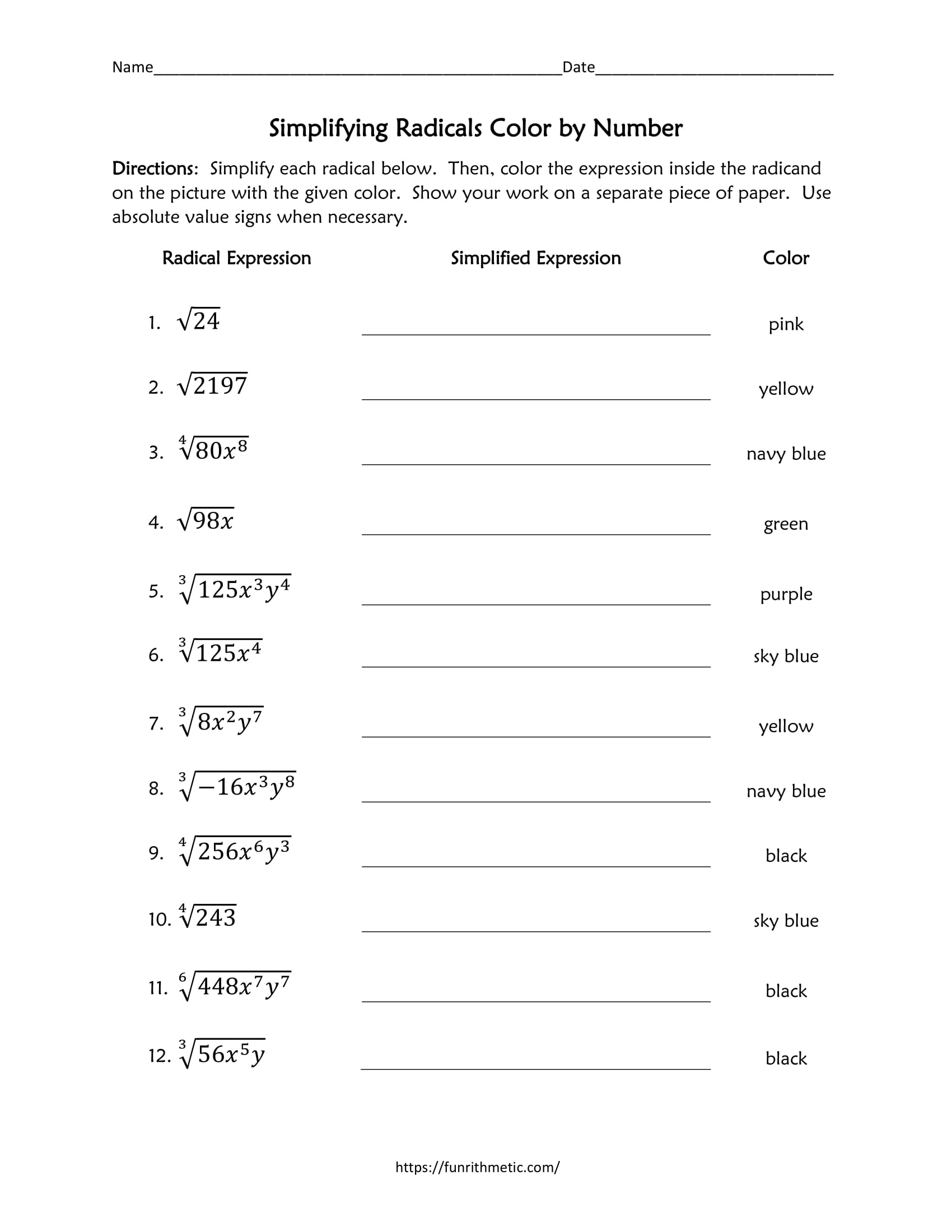
Leaving a Radical in the Denominator
Even seasoned students sometimes forget to rationalize. Remember: a fully simplified answer in an Algebra 2 worksheet never leaves a radical in the denominator unless explicitly instructed otherwise.
Misidentifying Perfect Powers
Assuming 18 is a perfect square will lead you astray. Double‑check by factoring: 18 = 2·3², so only 3² can be pulled out, giving 3√2.
Incorrect Handling of Variable Exponents
When you have √(x⁵), the correct simplification is x²√x, not x³. Remember to divide the exponent by the index and keep the remainder inside the radical.
Forgetting to Simplify Coefficients
After extracting factors, you might end up with a coefficient that can still be simplified, such as 4√2 becoming 2·2√2 = 4√2 (no change) but in other cases like 9√3 you can simplify the coefficient to 3·3√3 = 9√3, which is already simplest. Always look for a common factor that can be taken out.
Real‑World Applications of Simplified Radicals
Engineers frequently calculate diagonal lengths using the Pythagorean theorem, which yields expressions like √(a² + b²). Simplifying that radical can reveal proportional relationships that guide material choices. In physics, the formula for the period of a simple pendulum involves √(L/g), where L is length and g is gravitational acceleration. A worksheet that forces you to simplify such expressions makes the underlying physics clearer and reduces computational errors when plugging in measurements.
Even finance uses radicals when dealing with variance and standard deviation, where the square root of a sum of squared deviations appears. Simplifying those radicals can help analysts present results in a more interpretable form.
Tips for Mastery and Practice

Use a Dedicated Worksheet Routine
Set aside a regular 20‑minute slot each day to complete a few radical‑simplification problems. Consistency beats marathon sessions when building algebraic fluency.
Create Your Own Mini‑Worksheets
Take a textbook problem, alter the numbers or variables, and solve the new version. This active creation reinforces the patterns you’ve learned and prevents rote memorization.
Leverage Technology Wisely
Graphing calculators and algebra apps can check your answers, but avoid using them to do the work for you. Instead, input your simplified result to verify accuracy, then backtrack to see where you might have missed a factor.
Teach the Concept to a Peer
Explaining the simplification steps to a classmate forces you to articulate the reasoning clearly, exposing any lingering gaps in your own understanding.
Conclusion

Mastering Simplifying Radicals Worksheet Algebra is less about memorizing isolated tricks and more about developing a systematic mindset that treats every radical as a puzzle waiting to be broken down into prime factors, paired groups, and clean, rational results. By understanding the core concepts, following a disciplined step‑by‑step process, and practicing regularly with thoughtfully designed worksheets, you will not only ace your Algebra 2 tests but also gain confidence for the more advanced math and real‑world scenarios that await. Keep the routine, stay curious, and let each simplified radical be a small victory that adds up to big mathematical growth.