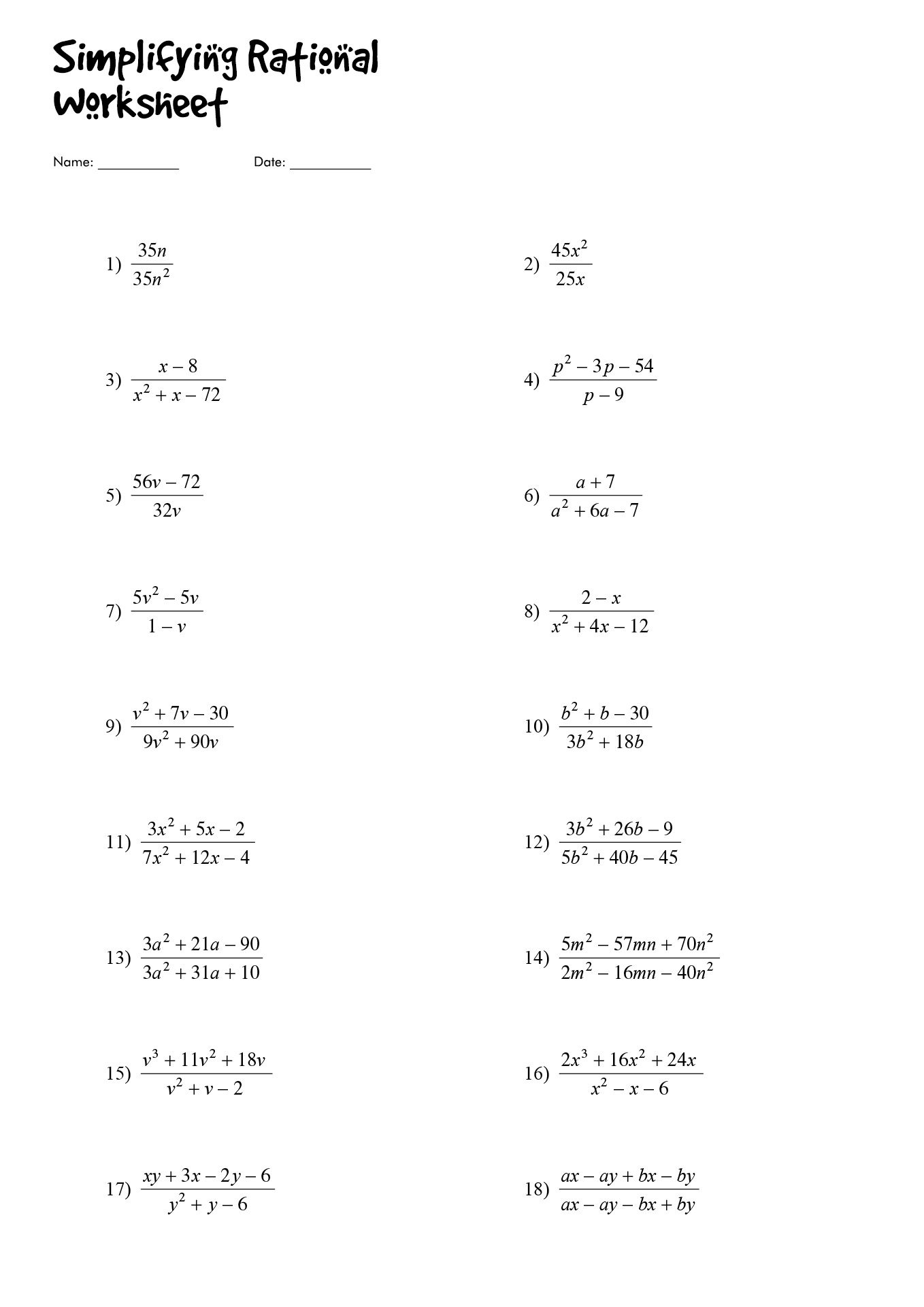
Solving Rational Equations Worksheet offers a structured path for students to master the intricacies of fractions within algebraic equations. Whether you’re a teacher preparing classroom materials, a tutor aiming to sharpen student skills, or a learner seeking deeper understanding, this article unpacks every facet of rational equation problem‑solving. From foundational concepts to advanced techniques, we guide you through each step with real‑world examples and practical tips.
Understanding the Building Blocks

What Is a Rational Equation?
A rational equation is an equation where the unknown variable appears in a fraction. It generally takes the form:
- Numerator: a polynomial expression involving the variable.
- Denominator: another polynomial expression that can never equal zero.
- Equal to a constant or another rational expression.
Example: (2x + 3)/(x − 1) = 5. The goal is to determine all values of x that satisfy this equality while respecting domain restrictions.
Domain Restrictions and Extraneous Solutions
Before solving, identify values that make any denominator zero; these are excluded from the solution set because division by zero is undefined. After solving, verify each candidate by substituting back into the original equation. If it fails, it’s an extraneous solution introduced during algebraic manipulation.
Key Algebraic Operations
Solving rational equations relies on a handful of core operations:
- Common denominators to eliminate fractions.
- Multiplying every term by the least common denominator (LCD) to clear fractions.
- Factoring polynomials for simplification.
- Using cross‑multiplication for equations equated to a fraction.
- Applying the distributive property and combining like terms.
Step‑by‑Step Methodology
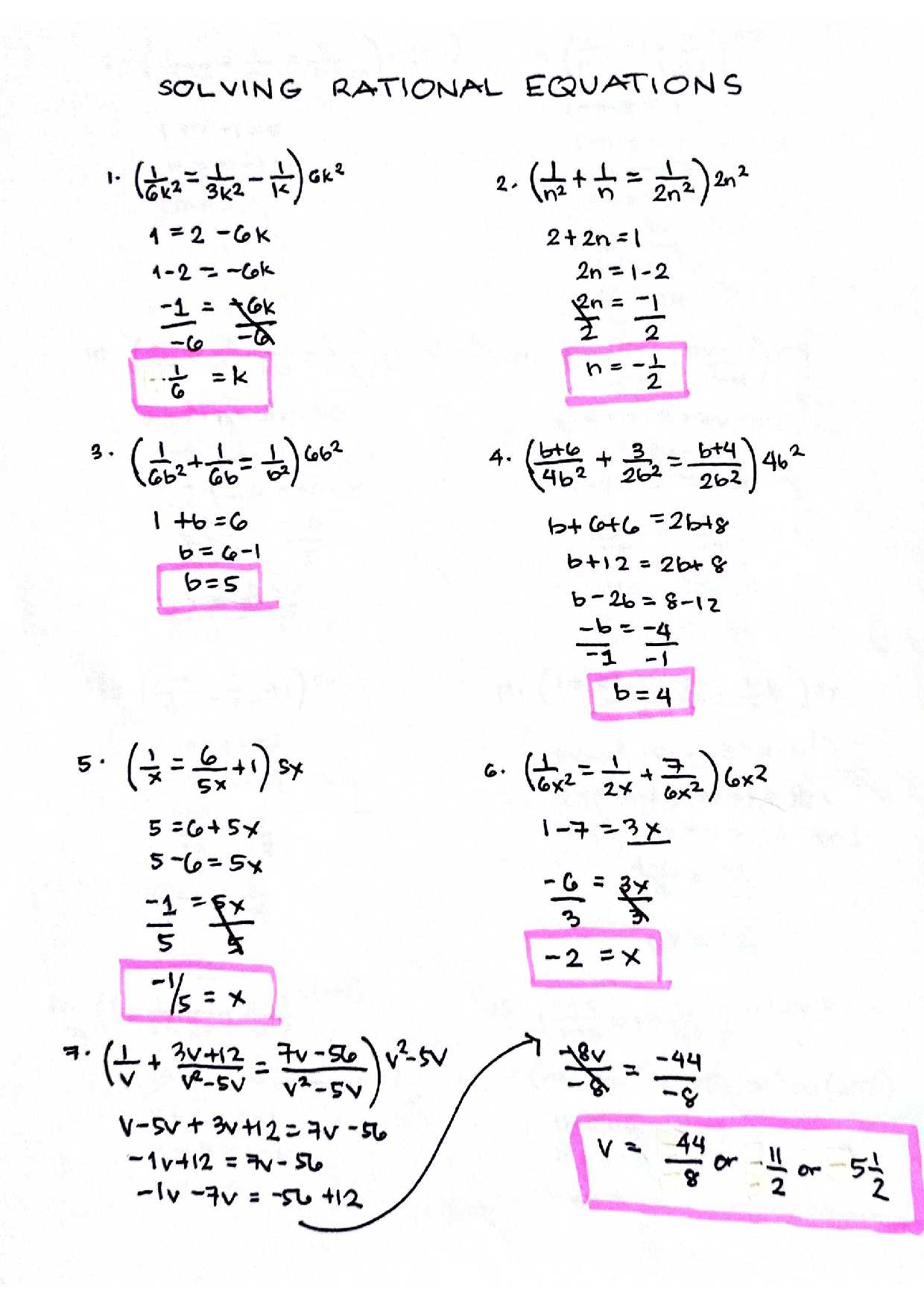
Step 1: Identify and Exclude Denominator Zeroes
For each denominator, set it equal to zero and solve for x. These solutions become the excluded values from your final answer set. Keep a record of these to cross‑check later.
Step 2: Find the Least Common Denominator (LCD)
Factor each denominator fully. The LCD is the product of each distinct factor raised to its highest power appearing in any denominator. This ensures all fractions share a common base after multiplication.
Step 3: Multiply the Entire Equation by the LCD
Doing so clears all fractions. Be careful: if the equation has a constant on one side, multiply it as well. For instance, if you have (3x)/(x + 2) + 5 = 7, multiply each term by (x + 2) to remove the fraction.
Step 4: Simplify and Solve the Resulting Polynomial
After clearing fractions, you typically obtain a linear or quadratic equation. Solve using appropriate methods (factoring, quadratic formula, or completing the square). This yields potential solutions.
Step 5: Verify Candidate Solutions
Substitute each solution back into the original equation. If it satisfies the equation and is not an excluded value, it is valid. Otherwise, discard it.
Common Pitfalls and How to Avoid Them

Misidentifying the LCD
Omitting a factor or using an incorrect power can lead to incorrect clearing and extraneous solutions. Always double‑check the factorization and exponents of each denominator.
Forgetting Domain Restrictions
Students often overlook values that make the denominator zero. This can result in presenting invalid solutions or overlooking real ones. Make a habit of listing excluded values before solving.
Algebraic Errors in Multiplication
When multiplying by the LCD, small sign errors or misapplied distributive properties can propagate through the entire solution. Verify intermediate steps with scratch paper or a calculator.
Accepting Extraneous Roots
When the equation involves squaring or other operations that introduce roots, check each solution. A classic example: solving (x‑1)/(x²‑1) = 3 leads to a root that makes the denominator zero; this must be excluded.
Enhancing Learning with Interactive Worksheets

Types of Rational Equation Worksheets
- Basic Clearing: single fractions on each side.
- Multiple Fractions: several fractions requiring complex LCDs.
- Word Problems: real‑world scenarios modeled with rational equations.
- Challenging variants with radicals or absolute value terms.
Designing Effective Practice Sets
To maximize student engagement, balance difficulty levels and incorporate varied contexts:
- Begin with simple linear rational equations.
- Progress to quadratic or higher‑degree rational equations.
- Integrate real‑life problems (e.g., rates, mixtures, economics) to contextualize the math.
Using Technology to Visualize Solutions
Graphing calculators or online graphing tools can plot rational functions, helping students see asymptotes, intercepts, and behavior around excluded points. Visual insight often reinforces algebraic reasoning.
Real‑World Applications

Economics and Finance
Profit per unit can be modeled as a rational function. Solving for break‑even points often requires setting a rational equation equal to zero, highlighting domain restrictions such as non‑negative quantities.
Engineering and Physics
Transfer functions in control systems are rational expressions. Engineers solve equations like (s + 2)/(s² + 5s + 6) = 0 to determine system poles, which impact stability.
Health and Medicine
Pharmacokinetics uses rational models to predict drug concentration over time. Calculating dosage schedules sometimes involves solving rational equations representing rate constants.
Strategies for Teaching and Mastery

Conceptual Teaching Sequence
- Review fractions and common denominators.
- Introduce rational equations with clear domain constraints.
- Practice clearing fractions using the LCD method.
- Gradually incorporate more complex denominators.
- Use real‑world examples to anchor abstract concepts.
Assessment Techniques
Formative assessments include short quizzes after each worksheet set. Summative assessments may involve multi‑step problems combining rational equations with other algebraic concepts.
Addressing Misconceptions
- Students might think they can multiply by zero; emphasize that multiplying both sides by a variable expression that could be zero is dangerous unless proven non‑zero.
- Misunderstanding that all solutions of a cleared equation are valid; remind them to always verify.
Advanced Topics and Extensions

Rational Equations with Absolute Values
Consider (|x|)/(x − 2) = 3. The absolute value introduces two cases; each must be handled separately before solving.
Rational Equations Involving Radicals
When the numerator or denominator contains a square root, rationalize first or multiply by a conjugate to eliminate the radical.
Partial Fractions and Integration
In calculus, rational equations often decompose into partial fractions. Understanding this process is valuable for students aiming for higher education.
Practical Tips for Efficient Problem Solving

Maintain a Clean Workspace
Write each step on separate lines. Use a table if multiple fractions are involved to keep LCDs and multiplications clear.
Check Your Work Early
After each multiplication step, verify that all fractions have indeed disappeared before proceeding.
Leverage Software When Necessary
Tools like WolframAlpha or symbolic calculators can double‑check your solution sets, especially for complex polynomials.
Conclusion

Mastering Solving Rational Equations Worksheet requires a solid grasp of fractions, careful attention to domain restrictions, and disciplined algebraic manipulation. By following a systematic approach—identifying excluded values, finding the LCD, clearing fractions, simplifying, and verifying solutions—students can tackle problems ranging from elementary worksheets to sophisticated real‑world applications. Continual practice, coupled with strategic use of visual tools and real‑life contexts, transforms abstract rational equations into approachable, engaging mathematics that empowers confidence and analytical skill in every learner.