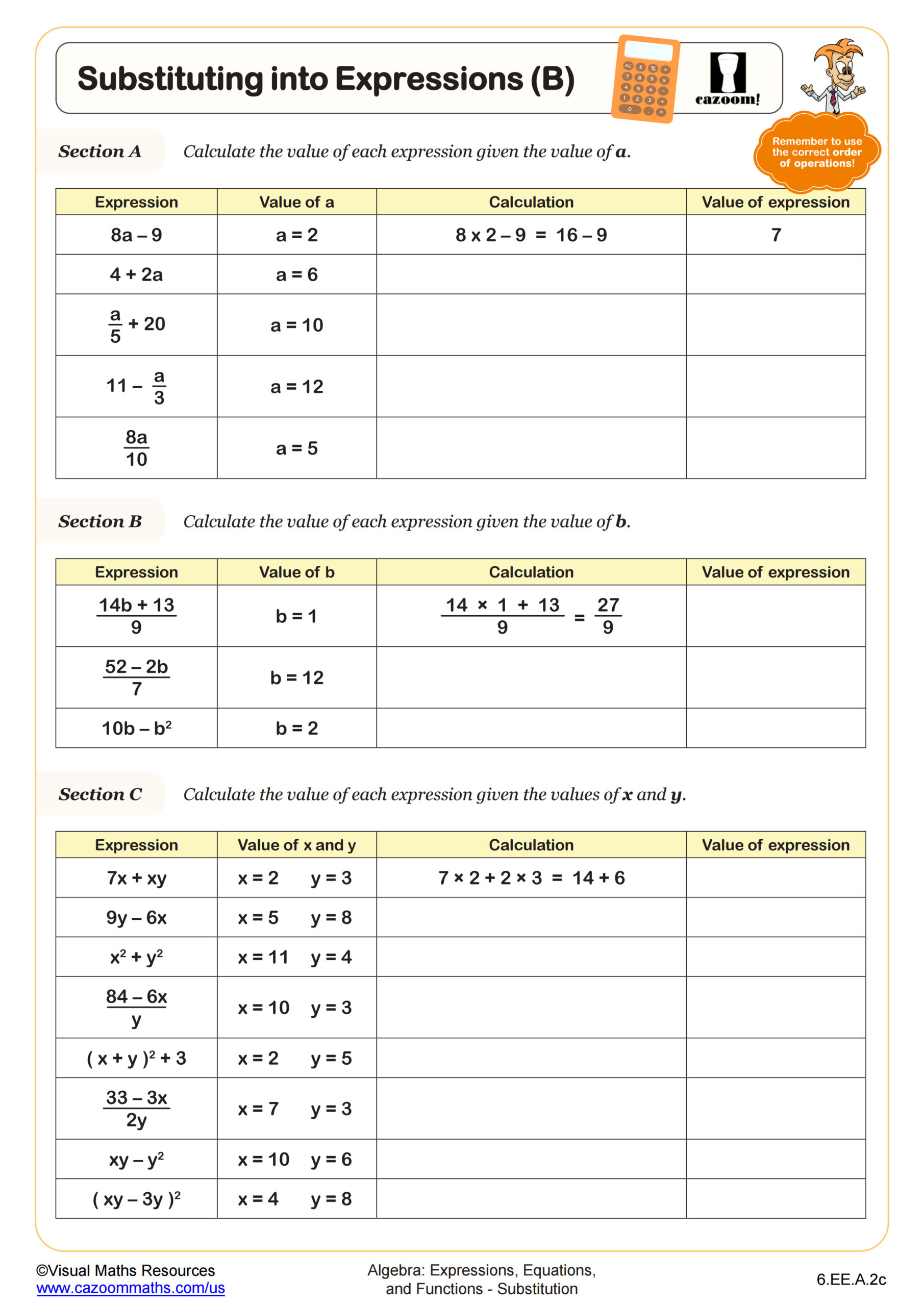
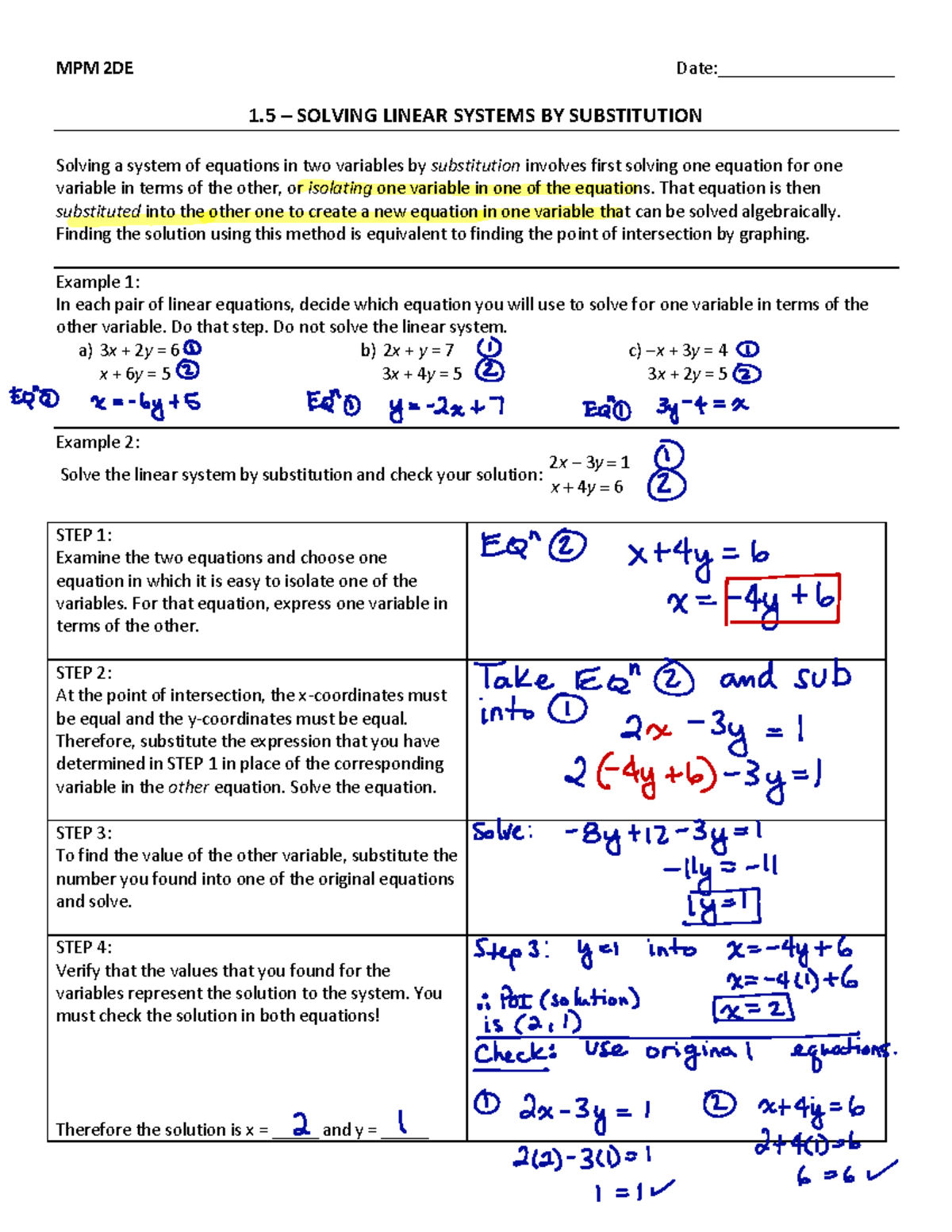
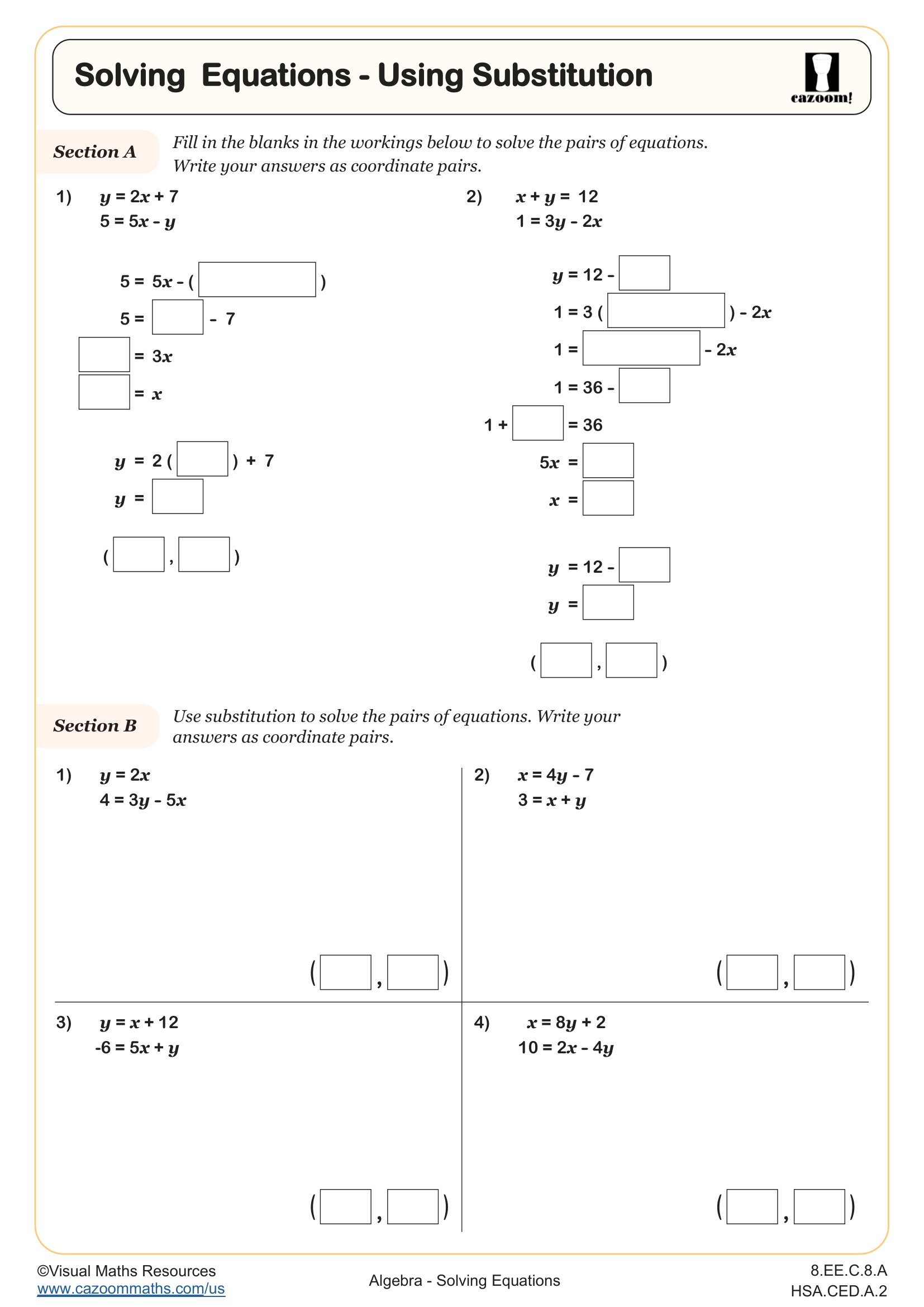
Solving Systems By Substitution Worksheet offers a structured path for students to master linear equations, turning abstract concepts into concrete skills that resonate with everyday problem solving. By walking through clear steps and real‑world examples, this approach cultivates confidence and precision in tackling algebraic challenges.
Why Substitution Matters

When learning algebra, the substitution method stands out for its simplicity and versatility. Unlike elimination, which requires careful alignment of coefficients, substitution invites the solver to isolate one variable first and then substitute that expression into the other equation. This process not only simplifies calculations but also builds a deeper understanding of how equations interrelate.
Key Benefits for Students
- Clarity of Concept: By focusing on one variable at a time, students see directly how changes affect the system.
- Reduced Computational Errors: Fewer arithmetic steps lower the chance of mistakes.
- Versatility with Different Forms: Works well with linear, quadratic, and even some non‑linear systems when one equation can be solved explicitly.
Why It Fits Asian Educational Styles
Many Asian curricula emphasize step‑by‑step reasoning, detailed derivations, and thorough verification. Substitution aligns perfectly with this pedagogy, encouraging meticulous work and systematic verification at each stage. It also dovetails with the region’s strong emphasis on problem‑solving in mathematics competitions.
Understanding the Worksheet Format

Before diving into the method, it’s essential to recognize the structure typical of a Solving Systems By Substitution Worksheet. Each worksheet usually contains:
- Two or more algebraic equations presented side by side.
- Clear labeling of variables (often x and y).
- Spaces for intermediate steps and final solutions.
- Optional “check your answer” sections encouraging verification.
By familiarizing oneself with this layout, students can approach the worksheet with confidence, knowing exactly where to write each step.
Step‑by‑Step Guide
Follow this systematic approach to solve any linear system presented on the worksheet.
Step 1: Isolate a Variable in One Equation
Choose the equation that makes it easiest to solve for one variable. Often, this is the one with the smallest coefficients or already presented in a form like y = …. If neither equation is neatly positioned, perform algebraic manipulation—adding, subtracting, or factoring—to achieve isolation.
Example: For the system
3x + 4y = 12
5y - 2x = 1
We can isolate y in the first equation:
y = (12 – 3x)/4
Step 2: Substitute into the Second Equation
Replace the isolated variable in the other equation with the expression obtained in Step 1. This reduces the system to a single‑variable equation.
Continuing the example:
5( (12 – 3x)/4 ) – 2x = 1
Multiplying out:
(60 – 15x)/4 – 2x = 1
Step 3: Solve the Resulting Equation
Clear any fractions and combine like terms to find the value of the remaining variable.
Multiply both sides by 4 to eliminate the denominator:
60 – 15x – 8x = 4
Combine:
60 – 23x = 4
Isolate x:
-23x = 4 – 60 → -23x = -56 → x = 56/23 ≈ 2.435
Step 4: Back‑Substitute to Find the Other Variable
Insert the value of the solved variable back into the expression from Step 1.
y = (12 – 3(56/23))/4 = (12 – 168/23)/4 = (276/23 – 168/23)/4 = (108/23)/4 = 108/(23×4) = 108/92 ≈ 1.174
Step 5: Verify the Solution
Plug both values back into the original equations to confirm they satisfy both. This practice reinforces accuracy and builds trust in the substitution method.
Common Pitfalls and How to Avoid Them

Even with a clear method, students sometimes encounter errors. Recognizing these pitfalls helps maintain accuracy.
Misidentifying the Variable to Isolate
Choosing a complex expression to isolate can lead to messy algebra. Prefer the equation with the simplest form or the smallest coefficients.
Sign Errors During Substitution
When moving terms across the equals sign, the sign flips. A slip here propagates through the entire solution.
Forgetting to Simplify Fractions
After solving for one variable, reduce fractions early. Working with simplified numbers reduces the chance of arithmetic mistakes.
Skipping the Verification Step
Some students feel confident after solving, but neglecting to check both equations can mask hidden errors. Always verify.
Real‑World Applications

Beyond classroom practice, substitution appears in many everyday scenarios, making the worksheet content directly relevant to life.
Business: Cost and Revenue Analysis
When determining profit from two products, one can set up a system where total revenue and total cost depend on quantities sold. Solving the system reveals the optimal production mix.
Engineering: Load Distribution
Structural engineers use systems of equations to calculate forces in trusses. Substitution helps isolate forces in one direction, simplifying complex load analyses.
Finance: Investment Allocation
Balancing a portfolio with two assets under budget constraints yields a system of equations. Substitution helps investors find the allocation that meets return targets without exceeding limits.
Tips for Mastering Substitution

Beyond the procedural steps, certain strategies accelerate learning and improve long‑term skill.
Practice with a Variety of Coefficients
Work on worksheets that feature fractions, negative numbers, and large integers to become comfortable with diverse arithmetic.
Visualize the System
Sketching the lines represented by each equation on graph paper can provide intuition. When the lines intersect, the point of intersection is the solution.
Use a Check‑List
Before submitting, run through: isolate → substitute → solve → back‑substitute → verify. A mental checklist reduces oversight.
Teach the Method to a Peer
Explaining the process to someone else solidifies your own understanding. Teaching forces you to anticipate questions and clarify steps.
Practice Makes Perfect

Consistent practice on Solving Systems By Substitution Worksheet enhances fluency. Try varying problem types:
- Systems with one linear and one quadratic equation.
- Systems where one variable appears in both equations but with different operations.
- Systems involving parameters, encouraging symbolic substitution.
Challenge yourself by timing each solution; gradually reduce the allotted time as confidence grows.
Final Thoughts

Mastering the substitution method transforms a seemingly daunting algebraic exercise into a manageable, logical sequence. By approaching each worksheet with clear steps, attentive verification, and an awareness of real‑world relevance, students not only score higher academically but also build a foundation for analytical thinking in countless future endeavors. Embrace the Solving Systems By Substitution Worksheet as both a learning tool and a gateway to problem‑solving excellence.