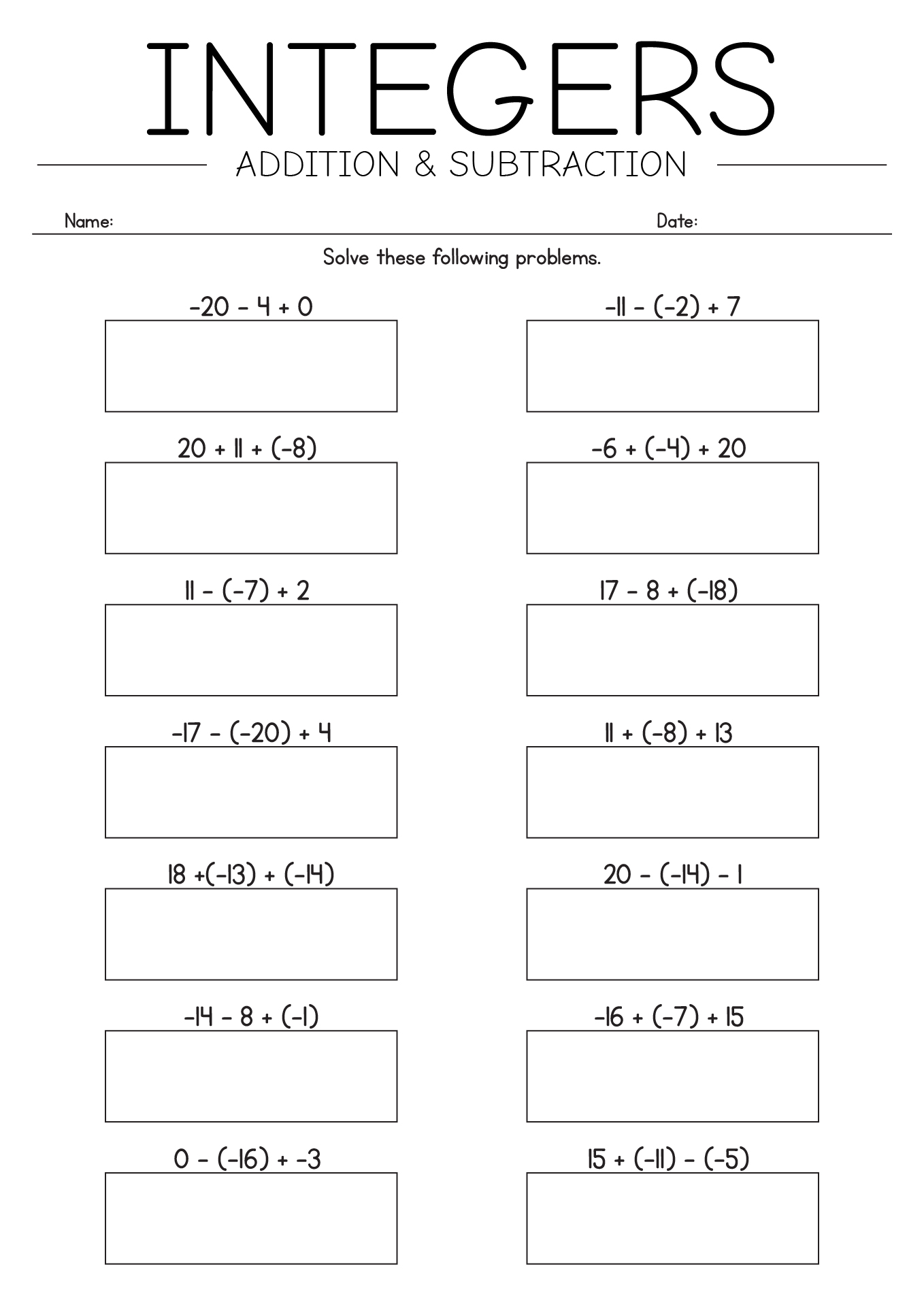
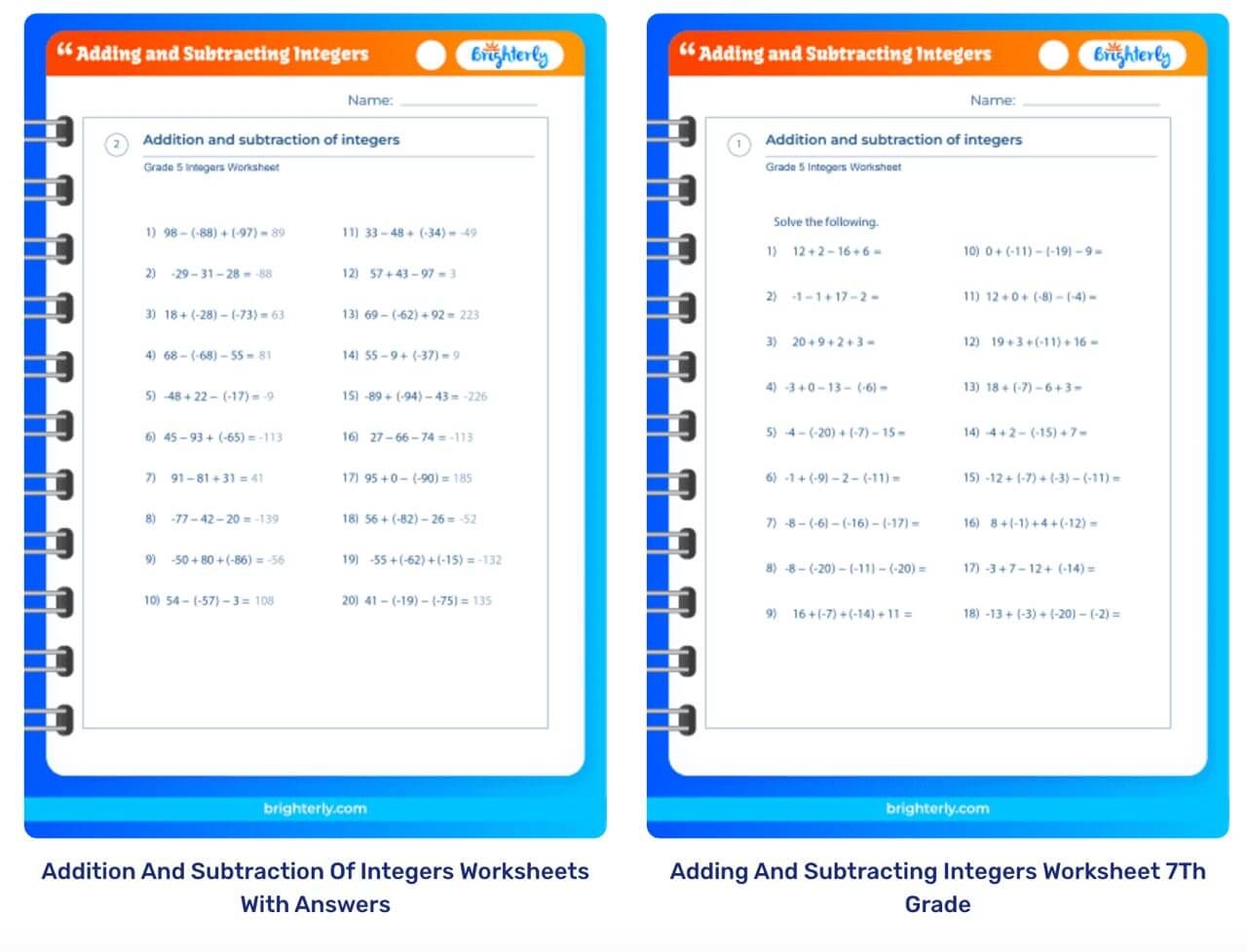
Subtracting And Adding Integers Worksheet resources have become essential tools for building confidence in middle‑school mathematics, especially when students transition from natural number operations to the more nuanced world of integers. A well‑designed worksheet not only reinforces procedural fluency but also encourages critical thinking, problem‑solving, and the ability to translate real‑life scenarios into mathematical language. In this article we explore the pedagogical foundations of integer addition and subtraction, highlight best practices for creating effective worksheets, and provide actionable strategies for teachers, tutors, and parents who want to maximize learning outcomes while keeping students engaged.
Why Mastering Integer Operations Matters

Understanding how to add and subtract integers is more than a classroom requirement; it is a life skill that underpins everyday decisions such as budgeting, temperature tracking, and interpreting sports statistics. When learners grasp the concept of moving forward and backward on a number line, they develop a mental model that supports higher‑order topics like algebraic expressions, coordinate geometry, and even computer programming. Moreover, research shows that students who practice integer operations through varied contexts demonstrate stronger analytical abilities and retain concepts longer than those who rely solely on rote memorization.
Core Concepts Behind Adding and Subtracting Integers
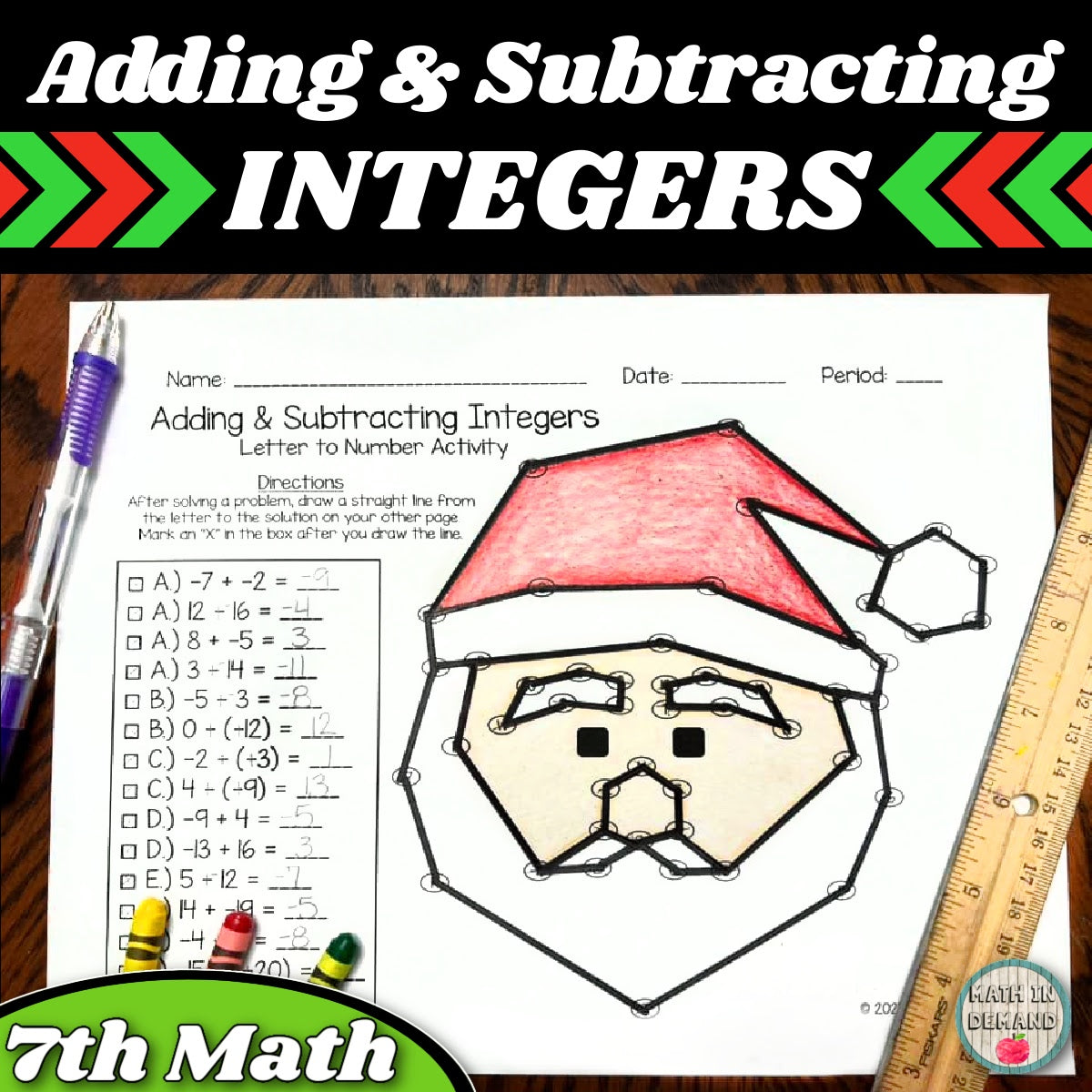
Positive and Negative Values
At the heart of integer operations lies the distinction between positive and negative numbers. Positive integers represent quantities greater than zero, while negative integers denote values less than zero. Clarifying this binary relationship early on prevents common misconceptions, such as assuming that subtraction always yields a smaller magnitude. Visual aids like number lines or colored counters help learners internalize the idea that moving left (negative direction) or right (positive direction) changes the sign and magnitude of a value.
Rules of Integer Addition
The addition of integers follows two simple yet powerful rules:
- If the signs are the same, add the absolute values and keep the common sign. For example, +7 + +5 = +12 and –3 + –4 = –7.
- If the signs differ, subtract the smaller absolute value from the larger absolute value and adopt the sign of the larger absolute value. For instance, +9 + –4 = +5 because 9 is larger than 4.
Worksheets that isolate each rule in separate sections enable students to practice and internalize these patterns before combining them in mixed‑sign problems.
Rules of Integer Subtraction
Subtracting an integer is equivalent to adding its opposite. This concept can be expressed as:
a – b = a + (–b)
By converting subtraction into addition, learners can apply the same addition rules they already know, reducing cognitive load. Effective worksheets illustrate this transformation with step‑by‑step examples, allowing students to see the underlying logic rather than treating subtraction as a mysterious new operation.
Designing an Effective Subtracting And Adding Integers Worksheet

Clear Learning Objectives
Every worksheet should begin with concise learning objectives that state what students will be able to do after completion. Objectives such as “Add and subtract integers with like and unlike signs” or “Apply integer operations to solve real‑world word problems” give both teachers and students a roadmap for success and facilitate targeted assessment.
Progressive Difficulty Levels
Start with simple, single‑operation problems that reinforce the basic rules, then gradually introduce mixed‑sign calculations, multi‑step word problems, and contextual scenarios. A typical progression might look like:
- Level 1: Same‑sign addition and subtraction (e.g., +6 + +3, –8 – –2).
- Level 2: Mixed‑sign addition (e.g., –5 + +9).
- Level 3: Mixed‑sign subtraction using the opposite rule (e.g., +7 – –4).
- Level 4: Two‑step word problems that require interpretation of temperature changes, financial gains/losses, or elevation differences.
This scaffolded approach builds confidence while ensuring that mastery is measured at each stage.
Incorporating Visual Aids
Number lines, colored arrows, and graphic organizers make abstract concepts concrete. For example, a worksheet might feature a horizontal number line where students place the result of each operation, reinforcing the spatial nature of integer arithmetic. Visual cues also help visual‑learners and keep the worksheet engaging, reducing the monotony of repetitive calculations.
Real‑World Contextual Problems
Embedding realistic scenarios transforms practice into meaningful learning. Sample contexts include:
- Tracking temperature fluctuations over a week.
- Calculating profit and loss for a small business.
- Measuring changes in altitude during a hike.
Each problem should explicitly ask students to identify the relevant integers, choose the correct operation, and explain their reasoning. This not only assesses procedural skill but also evaluates comprehension and communication.
Answer Keys and Self‑Assessment Sections
Providing a detailed answer key enables independent review and teacher grading. Include step‑by‑step solutions that highlight the rule applied, the intermediate calculation, and the final answer. Adding a self‑assessment checklist encourages learners to verify their work, fostering metacognitive habits that are valuable across subjects.
Implementing the Worksheet in Classroom and Remote Settings

Whole‑Class Instruction
Begin with a brief teacher‑led demonstration of the core rules, using a large visual number line projected on a screen. Follow with a short guided practice where the entire class solves the first few worksheet items together, discussing common errors as they arise. This collaborative approach creates a supportive environment and clarifies misconceptions before independent work begins.
Partner and Small‑Group Activities
After the initial demonstration, organize students into pairs or triads to tackle a set of mixed‑sign problems. Encourage learners to explain their reasoning to each other, which reinforces understanding through peer teaching. Provide a “challenge card” with a word problem that requires multi‑step reasoning; groups can compete to solve it first, adding a gamified element to the lesson.
Online and Hybrid Learning
For virtual classrooms, convert the worksheet into an interactive Google Form or a learning‑management‑system (LMS) quiz. Use built‑in automatic feedback to highlight correct versus incorrect answers instantly. Incorporate screen‑sharing to walk through complex examples, and record the session for students who need to review the material later.
Formative Assessment Strategies
Use the worksheet as a diagnostic tool at the start of a unit to gauge prior knowledge. Collect student responses and analyze patterns of error—such as confusing the sign rule for subtraction—to inform targeted reteaching. Periodic “exit tickets” that ask for one correctly solved integer problem can serve as quick checks for mastery.
Differentiation Techniques for Diverse Learners

Support for Struggling Students
Offer simplified worksheets that focus exclusively on either addition or subtraction, with only positive or only negative numbers. Provide manipulatives like colored chips that represent positive (blue) and negative (red) values, allowing tactile learners to physically combine and separate quantities. Additionally, short video tutorials that explain each rule in 2‑3 minute segments can reinforce concepts outside of class time.
Extension for Advanced Learners
Challenge high‑achieving students with problems that integrate integer operations with other mathematical ideas, such as solving linear equations, working with absolute values, or exploring modular arithmetic. For example, ask them to determine the integer solution set for 2x – 5 = 9 after completing a worksheet on adding and subtracting integers, thereby linking concepts across the curriculum.
Accommodations for English Language Learners (ELLs)
Use clear, concise language and include visual symbols (plus/minus signs, arrows) beside each problem. Provide a glossary of key terms—“integer,” “opposite,” “absolute value”—and allow extra time for reading and processing word problems. Pair ELLs with bilingual peers who can model problem‑solving steps in their native language before transitioning to English.
Assessing Mastery and Providing Feedback
Rubric Development
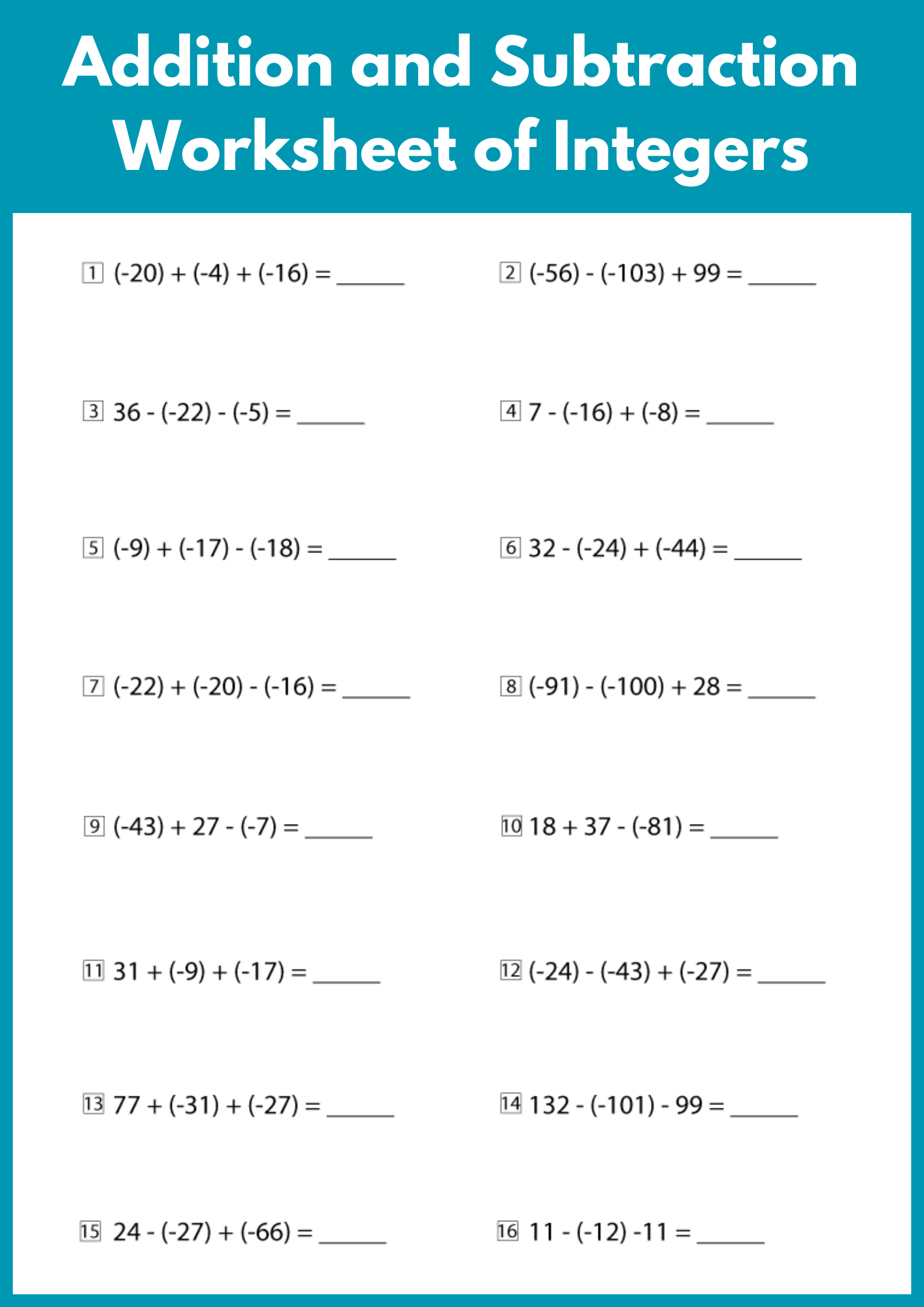
Create a rubric that evaluates three dimensions: procedural accuracy, conceptual reasoning, and communication of solution steps. Assign points for correctly applying the sign rule, accurately calculating the result, and clearly articulating the process. This balanced approach ensures that students are not merely guessing answers but truly understanding the underlying mathematics.
Effective Feedback Practices
When returning graded worksheets, highlight the specific rule used (e.g., “You correctly applied the “different signs, subtract smaller from larger” rule here”). Offer a brief written suggestion for improvement, such as “Double‑check the sign of your final answer when subtracting a negative number.” Positive reinforcement for correctly completed sections boosts confidence, while targeted suggestions guide further practice.
Digital Resources and Printable Options

Online Generators
There are numerous free platforms that generate customizable integer worksheets. Teachers can select the range of numbers, the proportion of same‑sign versus mixed‑sign problems, and the inclusion of word problems. By tailoring each worksheet to current lesson objectives, educators save preparation time while maintaining alignment with curriculum standards.
Printable PDFs for Offline Use
For schools with limited internet access or for after‑school tutoring sessions, printable PDF worksheets remain indispensable. Ensure that the PDF includes ample space for students to show work, as well as a separate answer key page. High‑resolution printouts preserve the clarity of number lines and any graphic elements, making the material accessible to all learners.
Conclusion
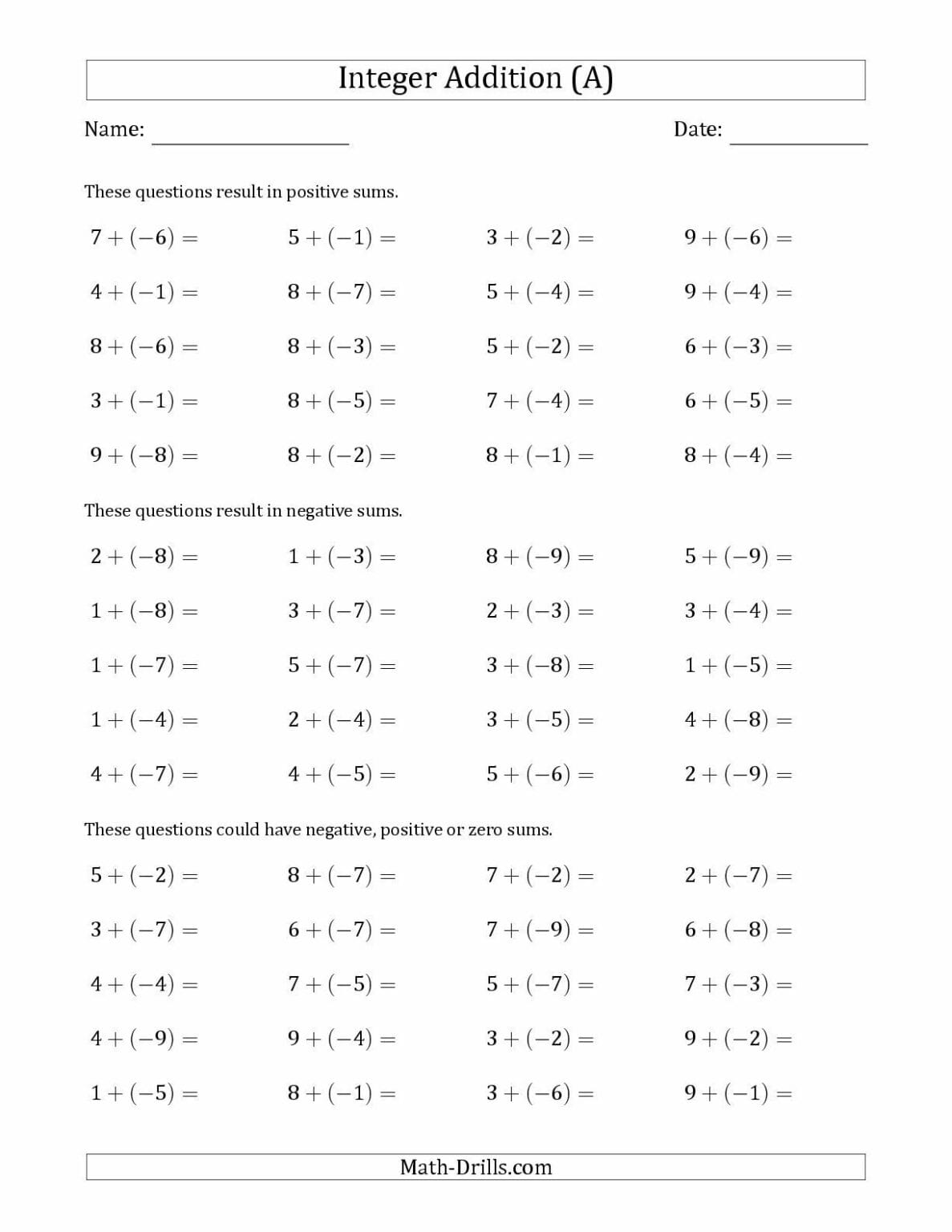
Effective Subtracting And Adding Integers Worksheet design blends clear instructional objectives, progressive difficulty, visual reinforcement, and real‑world relevance to develop both procedural fluency and deep conceptual understanding. By implementing differentiated strategies, leveraging both printed and digital formats, and employing thoughtful assessment practices, educators can create a rich learning environment that empowers students to master integer operations confidently. As learners apply these skills to everyday situations—from budgeting to interpreting temperature changes—they build a mathematical foundation that supports success in higher‑level courses and real‑life problem solving. Continued practice, timely feedback, and purposeful integration of integer concepts will ensure that students not only remember how to add and subtract integers but also understand why these operations matter.