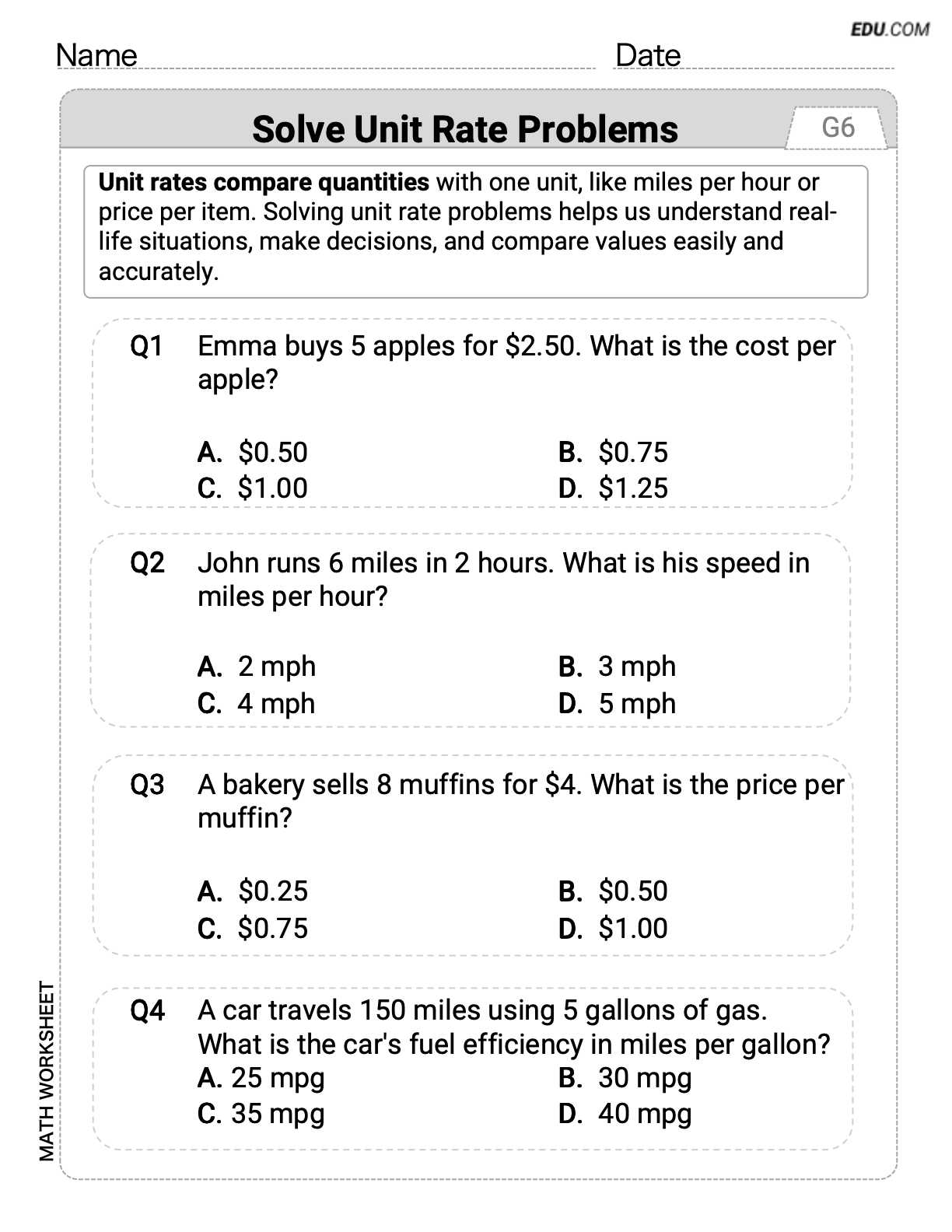
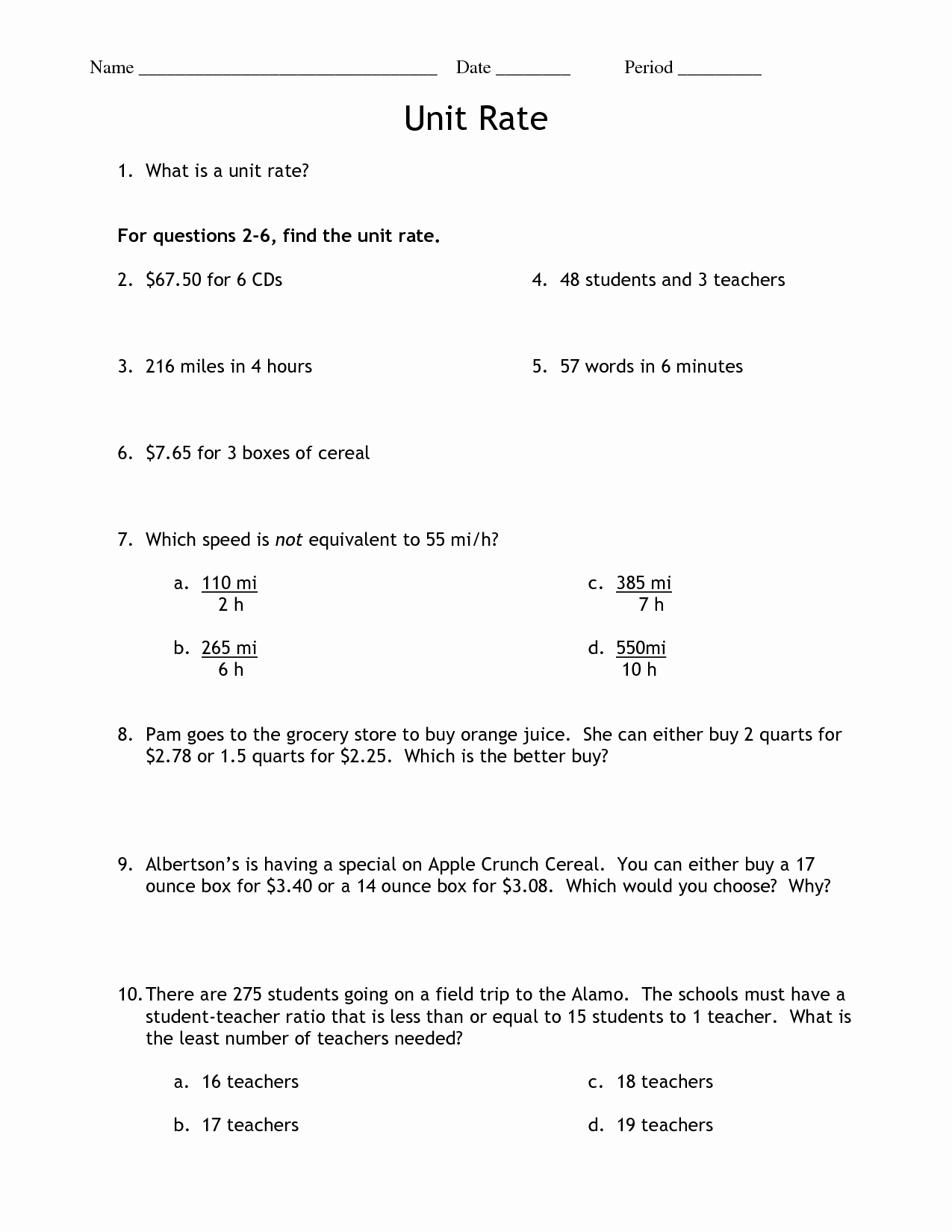
Unit Rate Math Worksheets are the cornerstone of mastering unit rates for students across all grades, especially those tackling the transition into middle school math. By guiding learners through real‑world contexts—like calculating cost per item or speed per distance—these worksheets sharpen critical thinking, reinforce multiplication and division skills, and lay a solid foundation for future topics such as fractions, ratios, and proportions.
What Is a Unit Rate and Why It Matters

Definition and Everyday Examples
A unit rate is a comparison that expresses a quantity of one item relative to another, standardized to a single unit. The classic example is “$5 per pound,” meaning five dollars are needed for every pound of apples. Unit rates help students translate complex relationships into simple, comparable values, which is essential for budgeting, cooking, engineering, and many other real‑world scenarios.
Connection to Core Math Skills
Unit rates build directly on multiplication, division, and fraction concepts. When students determine how many units of one quantity fit into another, they practice dividing by whole numbers and simplifying fractions—a critical step before advancing to ratios, percentages, and algebraic expressions.
Relevance in the 6th‑Grade Curriculum
In many state standards, 6th‑grade math emphasizes problem‑solving with fractions and ratios. Unit rate worksheets bridge the gap between basic arithmetic and more advanced topics like proportional reasoning. Teachers often use unit rates to create engaging, real‑life problems that keep students motivated.
Creating Effective Unit Rate Worksheets

Choose Real-World Contexts That Spark Interest
When designing worksheets, anchor problems in scenarios students encounter daily—grocery shopping, travel planning, or sports statistics. For example:
- Calculating the cost per ounce of a flavored yogurt.
- Determining the number of miles a car travels per gallon of gas.
- Finding the number of points earned per game in a sports season.
These contexts provide a narrative that helps students see the value of unit rates beyond abstract numbers.
Incorporate Progressive Difficulty
Begin with simple, whole‑number unit rates, then gradually introduce decimals, fractions, and mixed numbers. A typical progression might look like:
- 8 apples cost $4 → $0.50 per apple.
- 5 gallons of paint cover 250 square feet → 50 sq ft per gallon.
- 12 miles are traveled in 1.5 hours → 8 mph.
By scaffolding complexity, students build confidence and avoid feeling overwhelmed.
Use Visual Representations
Pair numbers with diagrams, bar models, or pictographs. Visual aids help students grasp the relationship between the two quantities before performing calculations. For instance, a bar model that splits a total distance into equal segments can illustrate how many segments fit into the whole.
Teaching Strategies for Unit Rate Worksheets

Step‑by‑Step Approach
Guide students through a consistent four‑step process:
- Read the problem and identify the two quantities.
- Express the relationship as a fraction or division statement.
- Simplify or calculate the unit rate.
- Interpret the result in the context of the problem.
Repetition of this routine across worksheets solidifies muscle memory.
Encourage Estimation and Check Answers
Before computing the exact unit rate, ask students to estimate. If a problem states “50 bananas cost $25,” a quick mental calculation suggests $0.50 per banana. This estimation check promotes accuracy and helps students spot unrealistic answers.
Integrate Peer Teaching
After solving a worksheet, have pairs or small groups explain their reasoning. Peer teaching reinforces concepts and allows students to articulate strategies they might have missed otherwise.
Common Mistakes and How to Avoid Them

Mixing Units Incorrectly
A frequent error is comparing apples to liters or dollars to miles. Remind students to match the same types of units—both should represent the same quantity (e.g., units of items, distance, time).
Forgetting to Simplify
Some students stop after performing the division but leave the answer in fraction form (e.g., 6/12). Encourage them to reduce fractions or convert to decimals when appropriate, as a simplified answer often matches the expected format.
Ignoring the Context for Interpretation
Students might compute the correct unit rate but fail to contextualize it. For instance, after calculating “$0.50 per apple,” the student must answer “The apples cost fifty cents each.” Always ask a follow‑up question that requires interpretation.
Enhancing Learning with Technology

Interactive Apps and Games
Apps that allow students to drag items onto a graph or match items to unit rates can transform worksheets into engaging activities. A memory‑style matching game where students pair a price with its unit rate can reinforce concepts through repetition.
Dynamic Worksheet Builders
Many online platforms let teachers generate worksheets on the fly, adjusting difficulty levels or topic focus. This flexibility is ideal for differentiated instruction—providing advanced students with more complex unit‑rate challenges while supporting learners who need more practice.
Real‑Time Feedback and Analytics
Digital worksheets often include instant grading, so students can see errors immediately and learn from them. Analytics dashboards help teachers identify class‑wide misconceptions and tailor subsequent lessons accordingly.
Sample Unit Rate Worksheet Problems
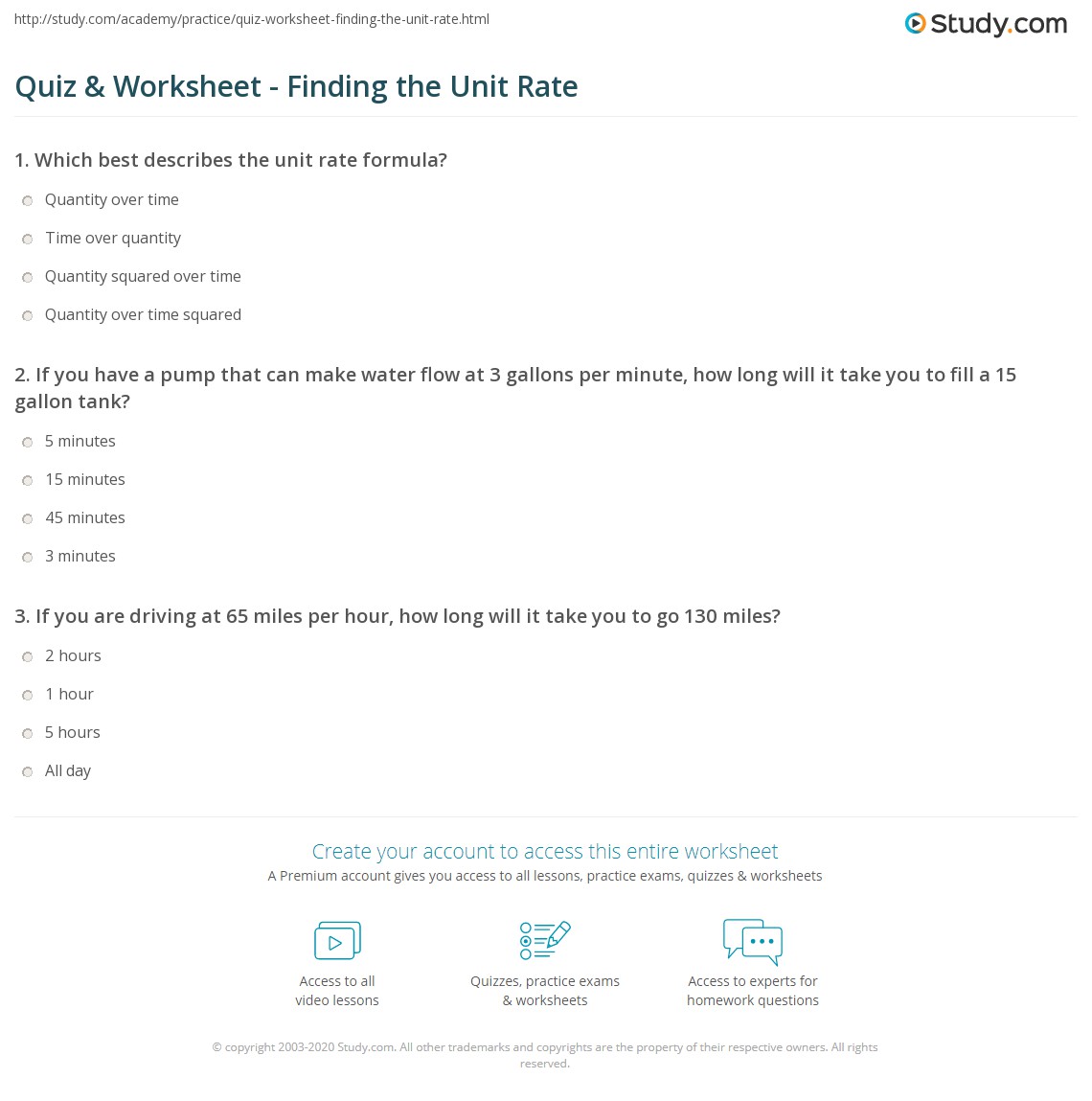
Example 1: Grocery Shopping
A bag of 12 carrots costs $4.50. Find the cost per carrot.
Solution: $4.50 ÷ 12 = $0.375 per carrot.
Example 2: Travel Planning
A rental car travels 400 miles on 8 gallons of gas. What is the fuel efficiency?
Solution: 400 miles ÷ 8 gallons = 50 miles per gallon.
Example 3: Sports Statistics
During a season, a basketball team scored 1,200 points over 30 games. Determine the average points per game.
Solution: 1,200 ÷ 30 = 40 points per game.
Example 4: Cooking Conversion
A recipe calls for 3 cups of flour to make 12 cookies. How many cups of flour are needed per cookie?
Solution: 3 cups ÷ 12 cookies = 0.25 cups per cookie.
Example 5: Time Management
A student reads 90 pages in 3 hours. Calculate the reading rate in pages per hour.
Solution: 90 ÷ 3 = 30 pages per hour.
Example 6: Currency Conversion
5 euros equal 6.25 dollars. What is the exchange rate in dollars per euro?
Solution: 6.25 ÷ 5 = $1.25 per euro.
Example 7: Manufacturing Efficiency
Factory A produces 2,400 widgets in 40 hours. Find the widgets produced per hour.
Solution: 2,400 ÷ 40 = 60 widgets per hour.
Conclusion

Unit Rate Math Worksheets are more than just practice drills—they are gateways to real‑world problem solving, critical thinking, and foundational math skills. By embedding everyday contexts, providing clear scaffolding, and incorporating technology, teachers can transform the learning experience into an engaging, practical journey. Whether you’re guiding 6th‑grade students through basic unit rates or preparing high‑schoolers for complex ratios, the principles outlined here will help ensure clarity, confidence, and continued success in mathematical exploration.