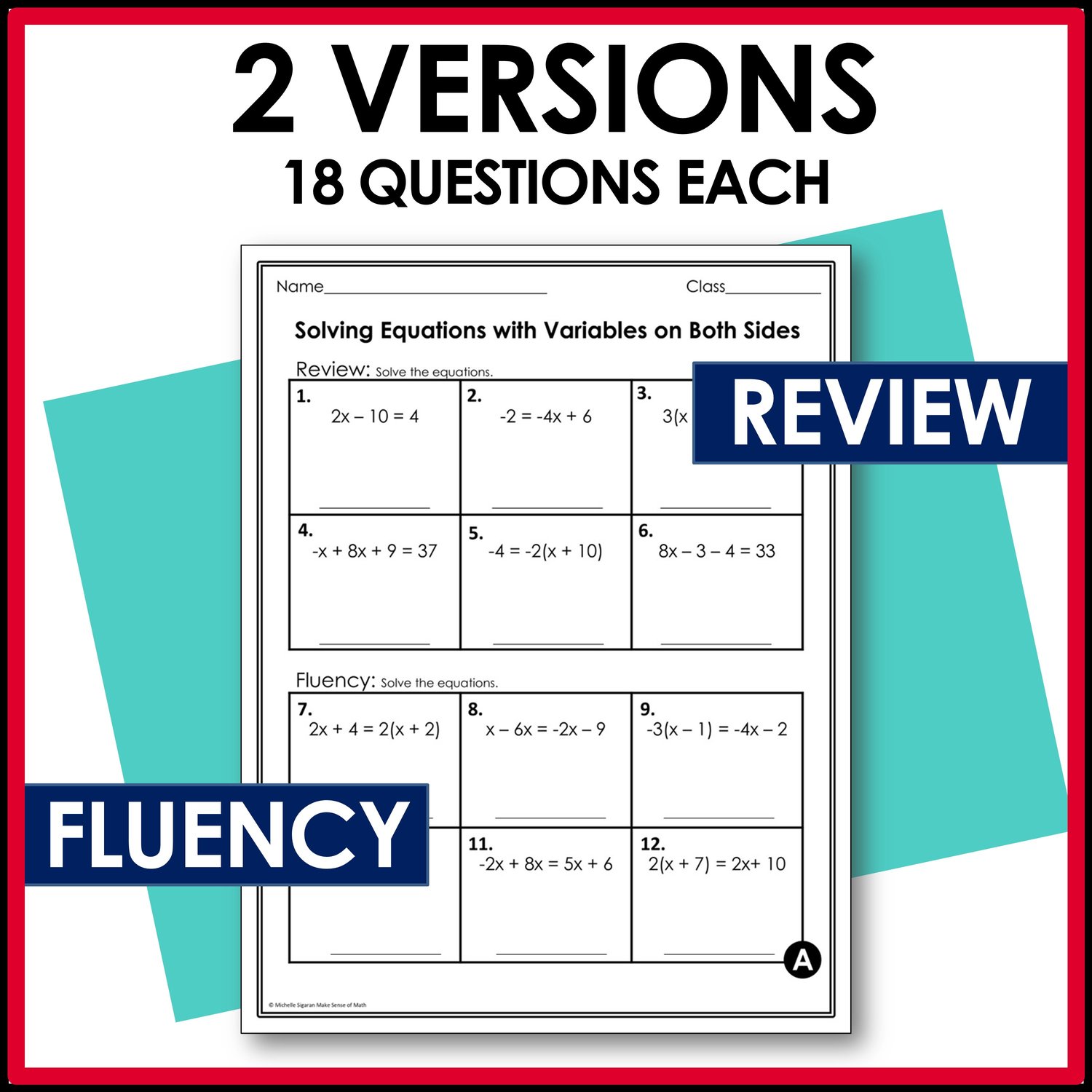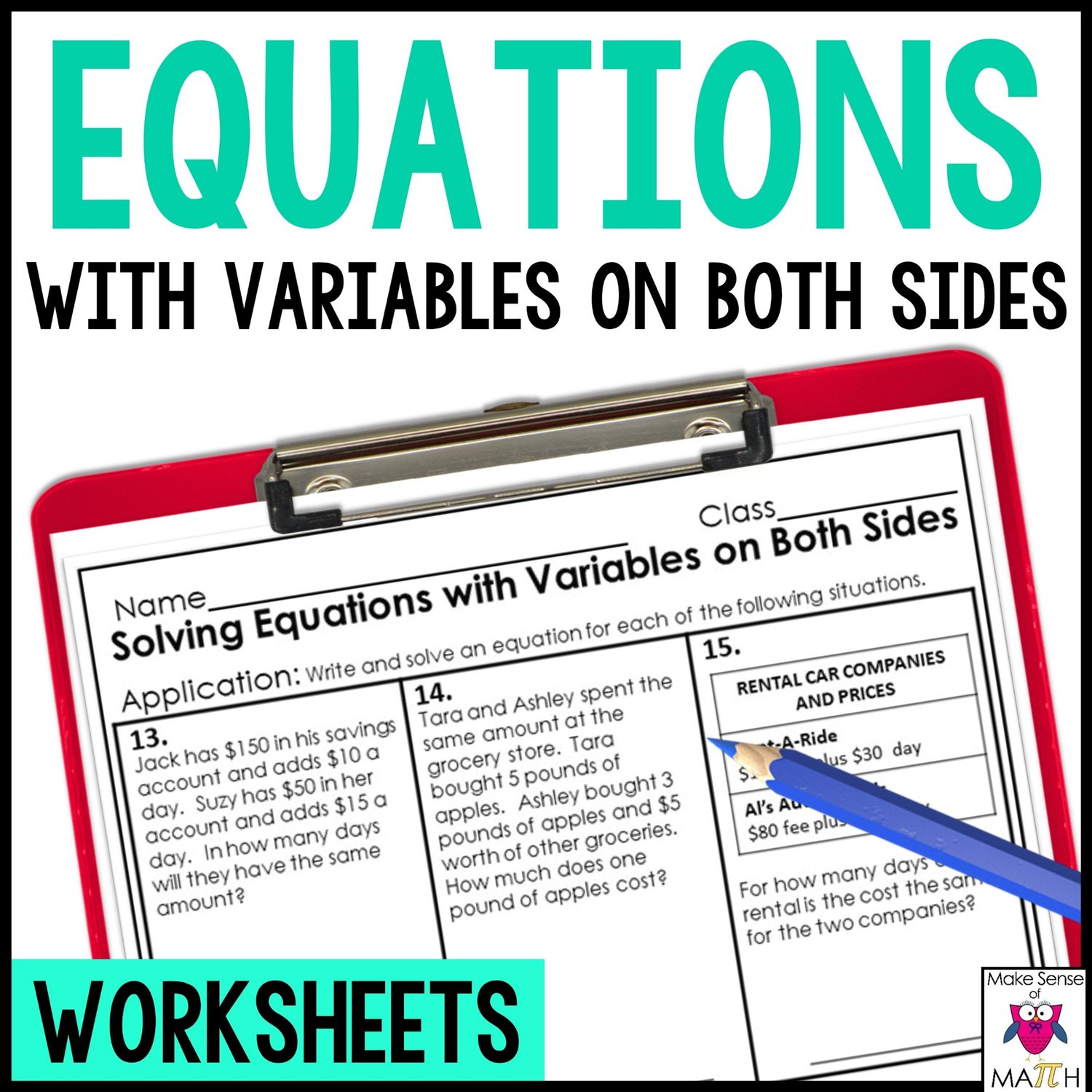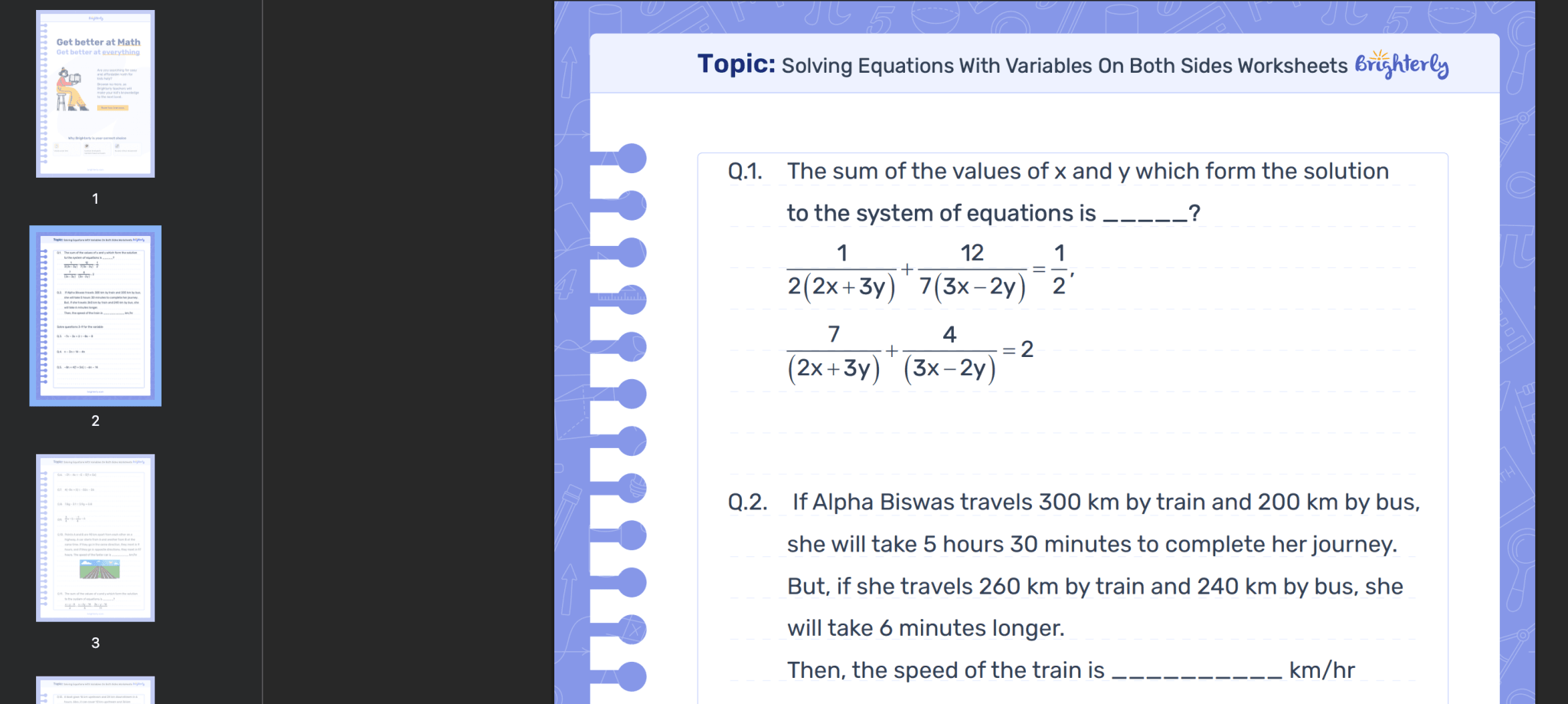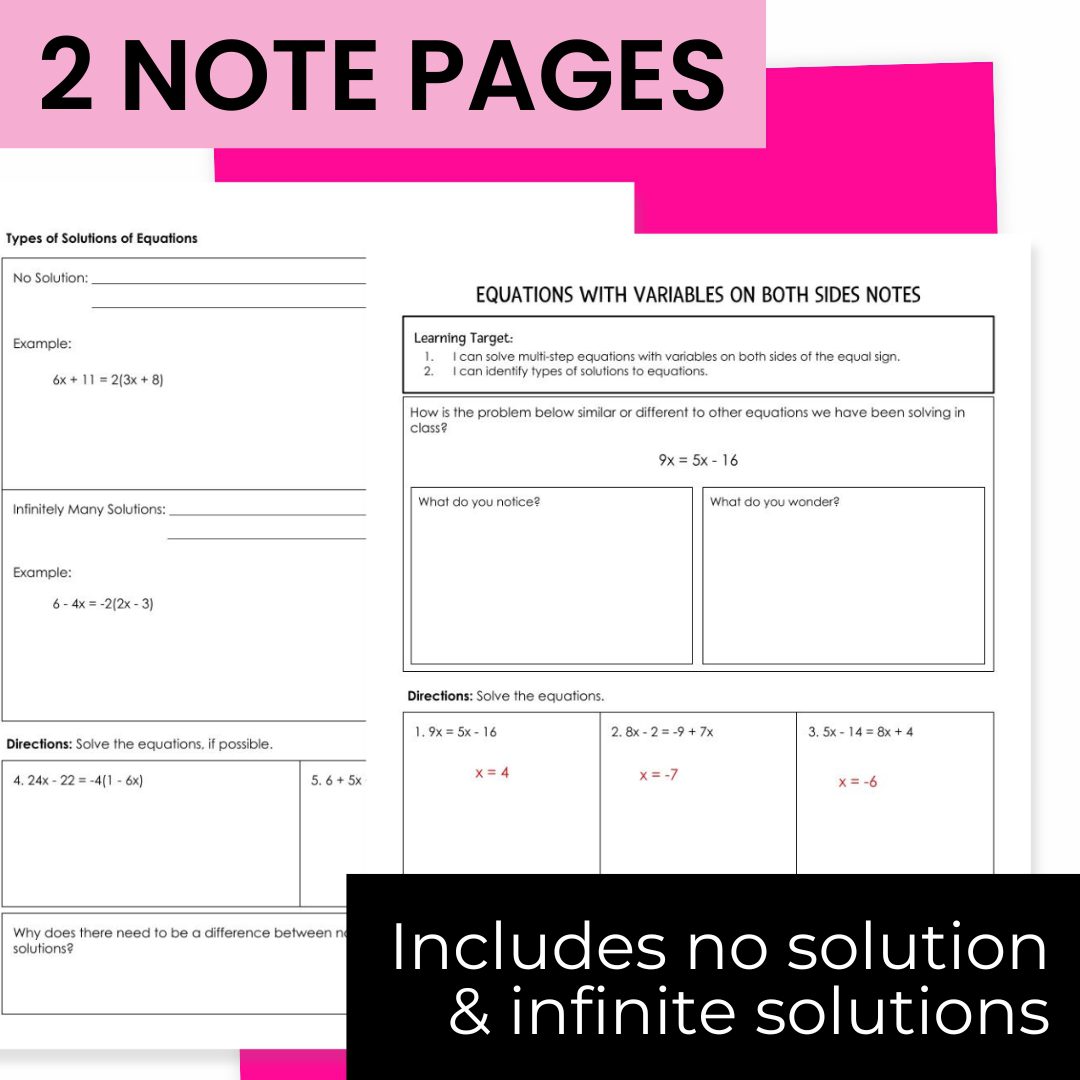
Variables On Both Sides Worksheet is the silent battleground where algebraic confidence is forged, and the moment a student learns to tame the chaos of unknowns on each side of the equal sign, the whole math world shifts from bewildering to weaponizable. In this gritty, no‑nonsense guide we’ll tear down the myth that “both‑sides” problems are a peripheral curiosity and reveal why they belong at the core of any robust math curriculum, how to deploy them effectively, and what real‑world scenarios make the skill indispensable.
Why Mastering Variables on Both Sides Matters
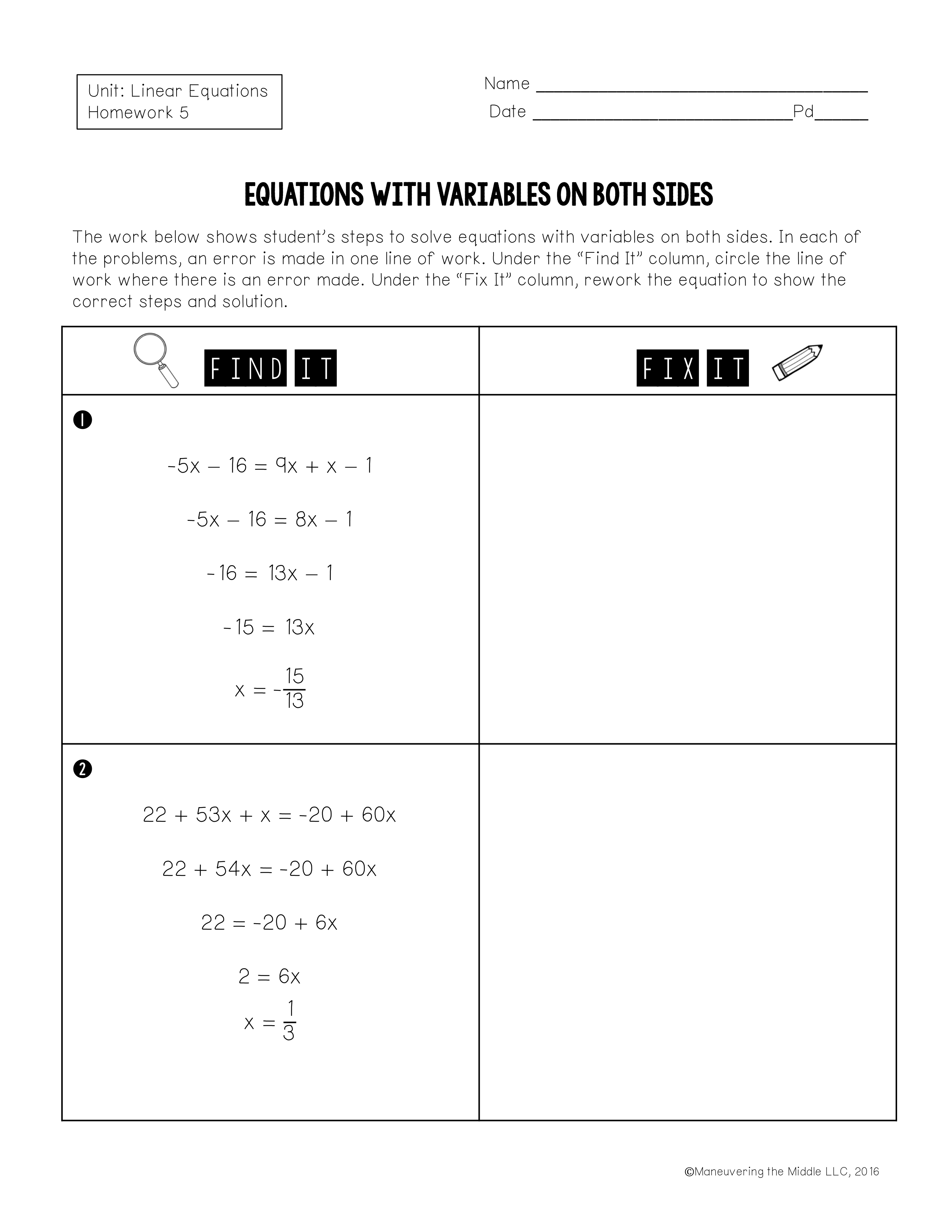
Most students encounter a solitary variable on one side of an equation before they ever see a true “dual‑front” conflict. That early exposure builds a false sense of mastery; they learn to isolate, divide, and solve in a vacuum. Yet life rarely offers such tidy equations. From balancing chemical reactions to budgeting multi‑source revenue streams, the ability to negotiate variables on both sides translates directly to problem‑solving muscle. In a black‑tone educational environment—one that respects the harsh reality of failure before triumph—the Variables On Both Sides Worksheet becomes a crucible that tests perseverance, logical rigor, and the willingness to confront ambiguity head‑on.
Core Concepts Behind Dual‑Side Equations

Understanding Equality as a Balance
At its heart, an equation is a scale. Each side must weigh exactly the same. When variables appear on both pans, the student’s task is to shift the weight until one side is free of unknowns. This mental image is crucial: every operation performed on one side must be mirrored on the other, preserving equilibrium. The worksheet reinforces this principle repeatedly, forcing learners to internalize the “what you do to one, you do to the other” mantra.
Identifying Hidden Constants and Coefficients
Often, the variables are camouflaged by coefficients—numbers that multiply the unknown. Recognizing when to factor, distribute, or combine like terms is a decisive step. The worksheet typically includes problems like 3x + 5 = 2x + 12, demanding that the student first isolate the variable terms by subtracting 2x from both sides, then simplify the constant side. The dark lesson here is that careless handling of coefficients leads to subtle errors that compound quickly, a reality that mirrors high‑stakes scenarios in engineering and finance.
Dealing with Negative Variables and Fractions
When negativity or fractions enter the mix, the stakes rise. A problem such as -4y + 7 = (1/2)y - 3 forces the learner to confront sign changes and common denominators. The worksheet provides scaffolded steps: multiply through by the least common denominator, then proceed as if the equation were integer‑based. This approach not only simplifies the algebra but also trains the brain to anticipate and neutralize hidden traps.
Step‑by‑Step Blueprint for Solving Dual‑Side Worksheets

Step 1: Write the Equation in Standard Form
Before any manipulation, rewrite the problem so that all variable terms sit on one side and all constant terms on the opposite. This may involve moving terms across the equal sign, remembering to flip their signs. For instance, transform 5a - 3 = 2a + 8 into 5a - 2a = 8 + 3, which simplifies to 3a = 11. The worksheet often includes “messy” versions with terms scattered across the equation to train this skill.
Step 2: Combine Like Terms
Once the variables are together, collapse them into a single term. Similarly, add or subtract constant numbers. This step reduces the equation to a single‑variable linear form, such as 7x = 42. The worksheet may purposely include multiple like terms on each side to test precision.
Step 3: Isolate the Variable
Divide or multiply both sides by the coefficient attached to the variable. Using the previous example, 7x = 42 becomes x = 6 after dividing both sides by 7. The worksheet may present a coefficient that is a fraction, requiring the student to multiply by its reciprocal—an exercise in flipping perspectives.
Step 4: Verify the Solution
Plug the answer back into the original equation. This step, often neglected, catches sign errors or misapplied operations. For a black‑tone learning atmosphere, verification is a non‑negotiable checkpoint: “If you cannot verify, you have not truly solved.” The worksheet typically includes a “check your work” section that prompts this reflective practice.
Common Pitfalls and How to Avoid Them

Forgetting to Apply Operations Symmetrically
The most frequent mistake is performing an operation on only one side. The worksheet’s “dual‑error” columns highlight this by presenting a wrong solution alongside the correct one, forcing the student to spot the asymmetry. The key is to develop a habit of verbally stating each step: “I am adding 5 to both sides.”
Mismanaging Negative Signs
Negatives are the silent assassins of algebraic accuracy. When moving a term like -2x across the equal sign, it becomes +2x. The worksheet often includes problems that deliberately place negative coefficients on both sides to train this reflex.
Overlooking Fractional Coefficients
Fractions demand a clear visual strategy—either multiply through by the denominator or convert to decimals with caution. The worksheet includes a “multiply‑through” section where students must decide the optimal route, reinforcing the importance of preserving exact values.
Integrating the Worksheet into Classroom and Homeschool Environments

Progressive Difficulty Scaling
Begin with simple integer‑only equations, then incrementally introduce negatives, fractions, and multiple variables. A well‑designed Variables On Both Sides Worksheet set typically offers three tiers: basic, intermediate, and advanced. Teachers can assign a tier as a warm‑up, a main activity, or a mastery check.
Collaborative Problem‑Solving Sessions
Pair students and give each a copy of the worksheet. One student narrates each step while the other writes it down. This “talk‑through” method surfaces hidden misconceptions and encourages peer accountability. The dark, gritty tone encourages students to confront their errors rather than hide behind silence.
Digital Adaptations and Immediate Feedback
While the physical worksheet remains a tactile anchor, converting problems into a learning management system allows instant validation. The worksheet’s answer key can be programmed into an online quiz that flags mismatched steps, prompting the learner to revisit the specific operation that went awry.
Real‑World Applications That Mirror Dual‑Side Equations

Financial Modeling: Balancing Income and Expenses
Consider a small business where revenue streams (sales, services) and expenses (rent, payroll) must balance. An equation like 2R + 300 = 5E - 150 mirrors a dual‑side variable problem, where R represents revenue per unit and E expense per unit. Solving for one variable informs pricing strategy and cost control.
Chemical Stoichiometry: Reactants and Products
In a reaction, the number of atoms on each side of the equation must be equal. Balancing equations such as 2Al + 3Cl₂ → 2AlCl₃ translates to an algebraic representation where coefficients are variables to be solved. Mastery of dual‑side worksheets equips students to tackle these balancing acts with confidence.
Engineering Load Distribution
When designing a bridge, engineers calculate load distribution across multiple support beams. The equation 4L₁ + 2L₂ = 3L₁ + 5L₂ (where L₁ and L₂ are load capacities) is a literal variables‑on‑both‑sides problem. Solving it determines how much weight each beam can safely bear.
Designing Your Own Variables On Both Sides Worksheet

Selecting Problem Types
- Linear equations with integer coefficients
- Equations involving negative numbers
- Fractional coefficient equations
- Word problems that translate into dual‑side equations
Balancing Difficulty and Skill Development
Each worksheet should contain a mix of problem types to prevent monotony and to reinforce different strategies. For example, a 10‑question worksheet might include 4 basic, 3 intermediate, and 3 advanced items. This distribution ensures that students experience incremental challenge while still achieving a sense of progress.
Incorporating Reflection Prompts
After each problem, add a short prompt: “What was the most confusing step?” or “How did you verify your answer?” These reflective questions turn a mechanical exercise into a metacognitive experience, aligning with the black‑tone emphasis on confronting one’s shortcomings.
Assessing Mastery and Providing Constructive Feedback

Rubric Components
- Correctness of each step (10 points)
- Use of proper algebraic notation (5 points)
- Verification of final answer (5 points)
- Clarity of written explanation (5 points)
Feedback Strategies
Focus on the process, not just the final answer. Highlight where the student correctly mirrored an operation, then point out where symmetry broke down. Encourage revision: “Rewrite step three, ensuring the same operation appears on both sides.” This approach fosters a growth mindset even within a stark, no‑excuses learning environment.
Conclusion
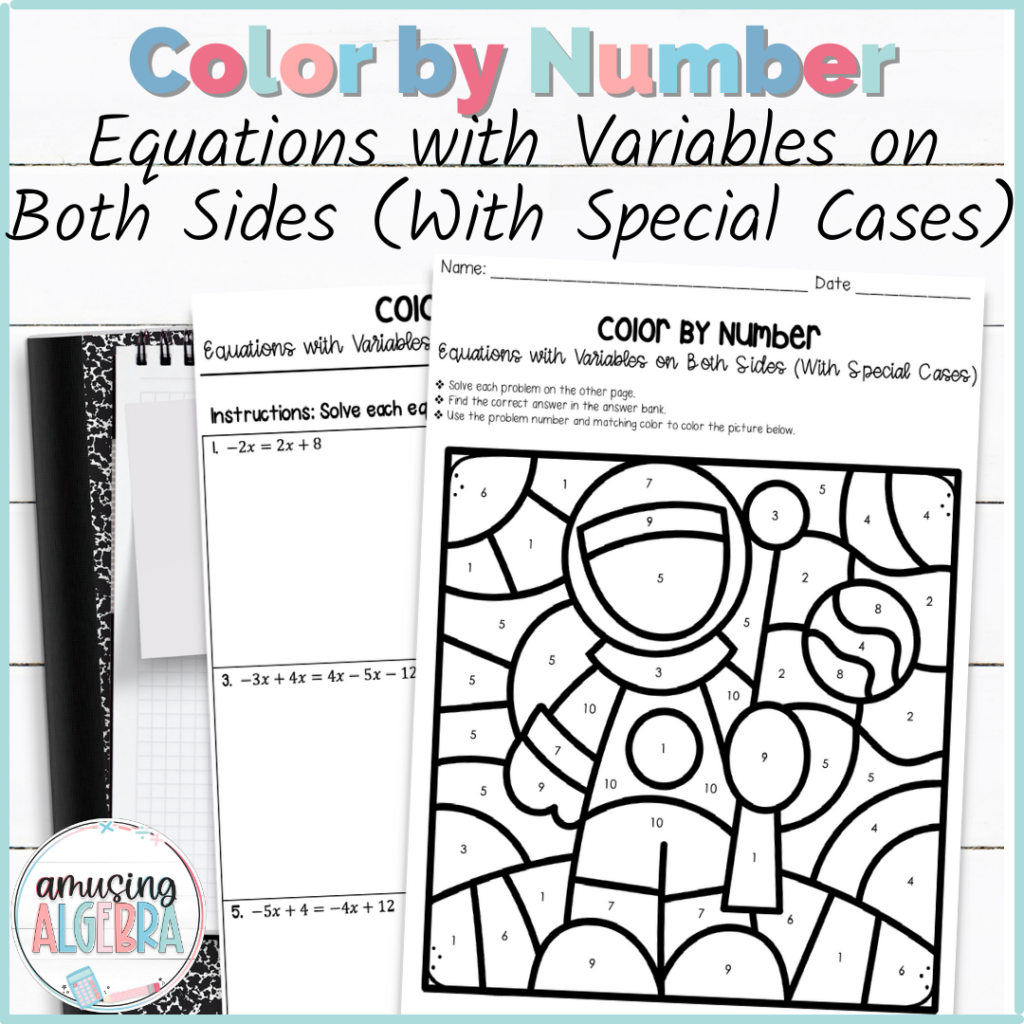
The Variables On Both Sides Worksheet is more than a collection of algebraic drills; it is a rigorous training ground that shapes resilient problem solvers capable of navigating the chaotic equations of real life. By understanding the underlying balance, mastering step‑by‑step strategies, anticipating common errors, and applying the skill to tangible scenarios, educators can turn a seemingly dry topic into a powerful engine for critical thinking. Whether in a traditional classroom, a homeschool setting, or an online platform, the disciplined use of this worksheet ensures that students emerge not just with the ability to solve equations, but with the confidence to confront any imbalance—mathematical or otherwise.