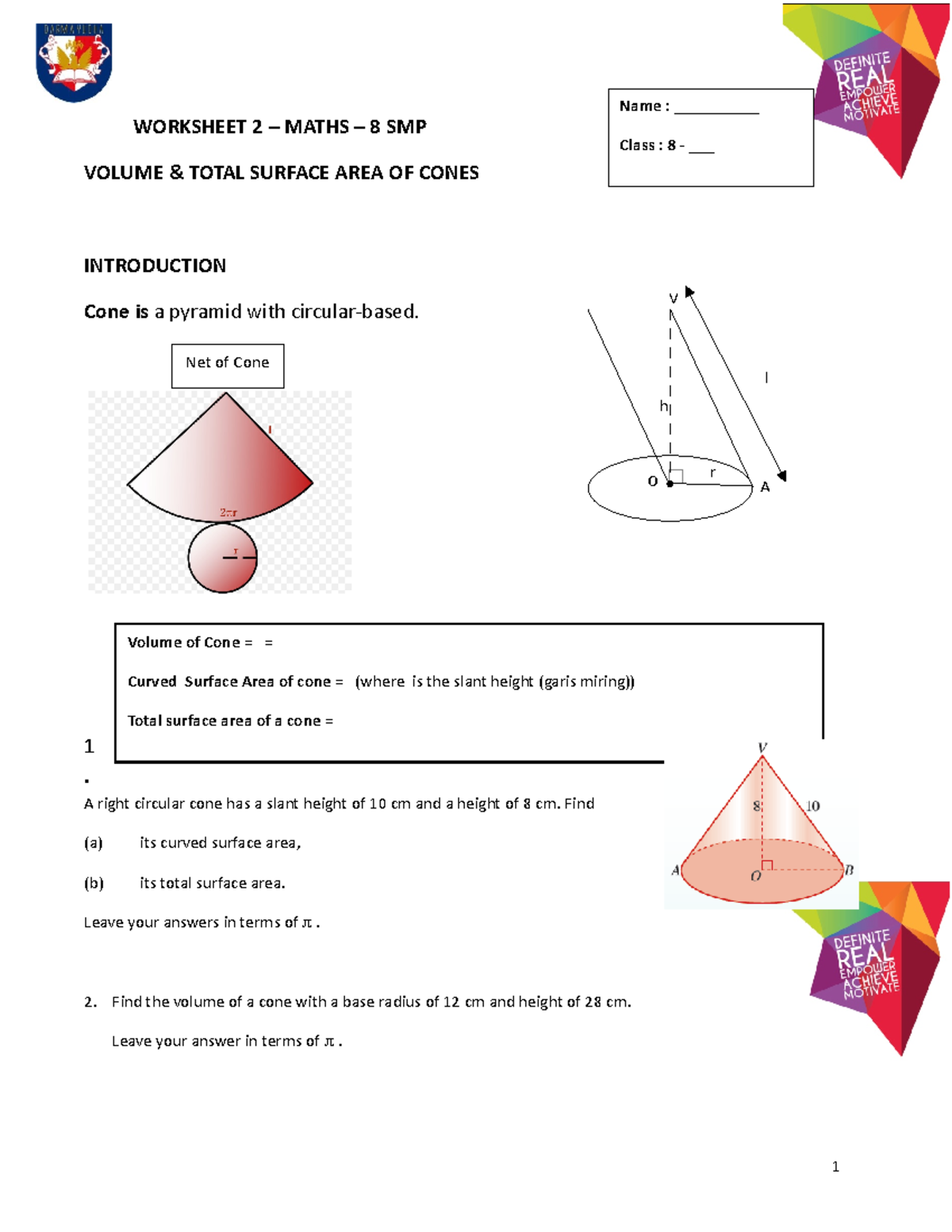
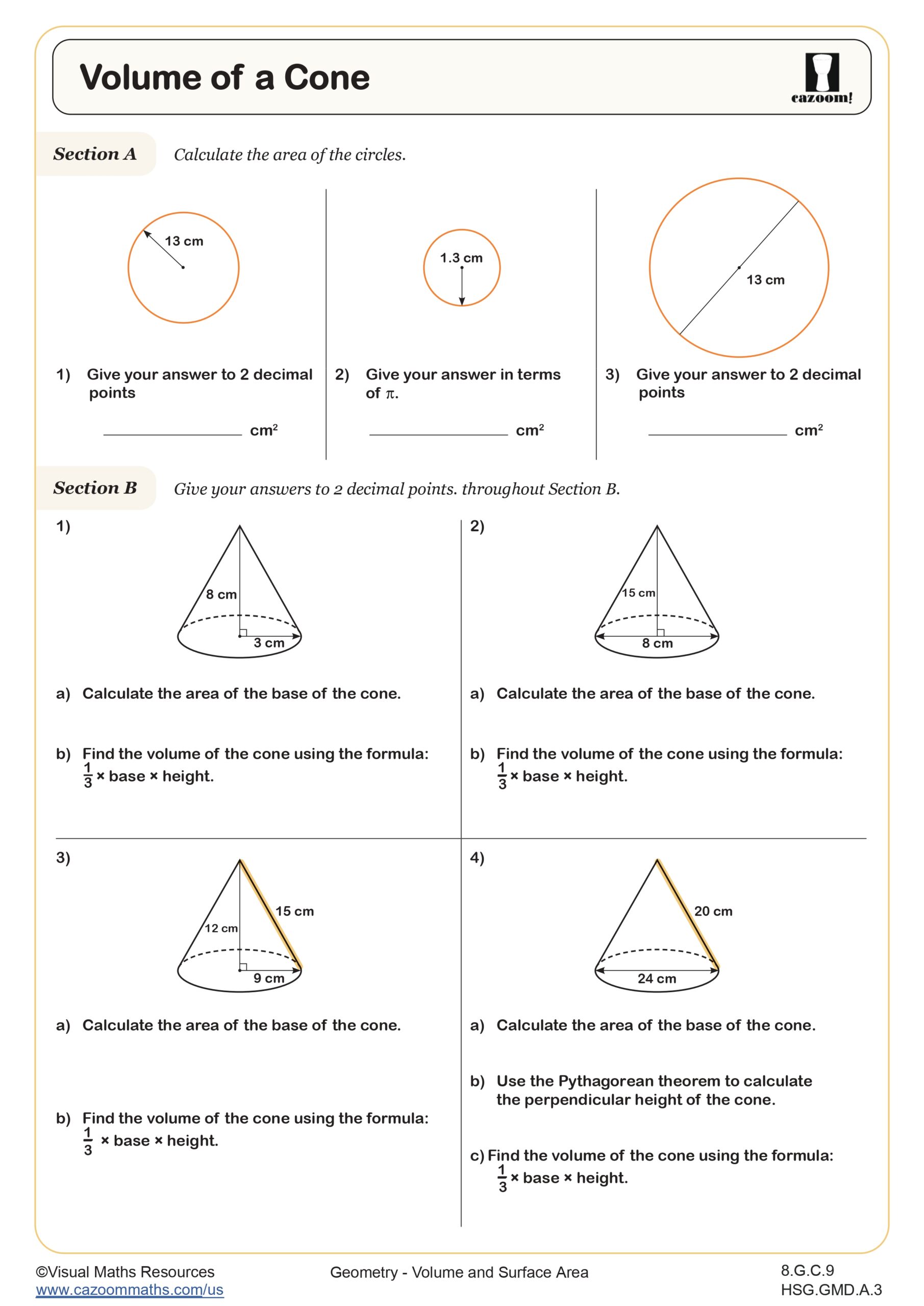
Volume Of A Cone Worksheet resources are essential tools for teachers and students who want to master the geometric principles behind three‑dimensional shapes while developing strong problem‑solving skills. A well‑designed worksheet not only reinforces the formula V = (1/3)πr²h but also challenges learners to apply the concept in varied contexts, from simple calculations to real‑world engineering scenarios. This article explores how to create, implement, and maximize the educational impact of a comprehensive cone‑volume worksheet, providing actionable strategies, sample problems, and tips for assessing student understanding.
Why Cone Volume Matters in the Curriculum

Understanding the volume of a cone bridges the gap between two‑dimensional geometry and three‑dimensional spatial reasoning. It introduces students to the notion of scaling, proportional reasoning, and the use of constants such as π in practical calculations. Moreover, mastering cone volume prepares learners for later topics in calculus, physics, and engineering, where the concept appears in topics like fluid dynamics, material science, and architectural design.
Core Components of an Effective Volume Of A Cone Worksheet

Clear Objectives and Learning Outcomes
A successful worksheet begins with explicit learning goals. Typical objectives include:
- Recall and correctly write the cone volume formula.
- Identify radius and height from diagrams and word problems.
- Perform accurate calculations using π approximations (22/7, 3.14) and exact values.
- Apply the formula to solve multi‑step problems involving unit conversions, composite shapes, and real‑world contexts.
- Explain the reasoning behind each step, reinforcing mathematical communication skills.
Progressive Difficulty Levels
Organize the worksheet so that questions increase in complexity. Begin with direct computational tasks, then move to word problems, followed by multi‑step challenges that integrate other math concepts such as surface area, density, or cost estimation. This scaffolding approach supports confidence building while stretching higher‑order thinking.
Visual Aids and Realistic Diagrams
Students benefit from clear, labeled diagrams that illustrate the radius, height, and slant height where applicable. Including images of everyday objects—traffic cones, ice‑cream scoops, or funnel‑shaped containers—helps learners connect abstract formulas to tangible items. Ensure each diagram has a consistent scale to avoid confusion.
Varied Question Types
Mix multiple‑choice, short‑answer, and open‑ended questions. Incorporate fill‑in‑the‑blank statements for formula recall, and provide space for students to show work. Include at least one challenge problem that encourages creative reasoning, such as determining the volume of a cone formed by rotating a triangular region about an axis.
Designing Sample Problems

Basic Computational Example
Calculate the volume of a right circular cone with a radius of 4 cm and a height of 9 cm. Use π ≈ 3.14.
Solution: V = (1/3)πr²h = (1/3)(3.14)(4²)(9) = (1/3)(3.14)(16)(9) ≈ 150.72 cm³.
Unit Conversion Challenge
A cylindrical water tank is being replaced by a conical tank of the same capacity. The cone’s height is 12 ft, and its radius is 6 ft. Determine the volume in gallons, given that 1 ft³ ≈ 7.48 gal.
Solution: V = (1/3)π(6²)(12) = (1/3)π(36)(12) = 144π ≈ 452.39 ft³. Converting to gallons: 452.39 × 7.48 ≈ 3,383.9 gal.
Multi‑Step Real‑World Problem
A bakery uses a conical pastry bag to pipe frosting. The bag’s radius at the opening is 2 inches, and its depth (height) is 5 inches. The baker wants to know how much frosting can be stored if the frosting has a density of 0.05 lb/in³. Determine the weight of frosting the bag can hold.
Solution: Volume = (1/3)π(2²)(5) = (1/3)π(4)(5) = 20π/3 ≈ 20.94 in³. Weight = 20.94 in³ × 0.05 lb/in³ ≈ 1.05 lb.
Composite Shape Investigation
Design a problem where a cone is attached to a rectangular prism, forming a storage container. Ask students to calculate the total volume, given dimensions for each component, and then compare it to a standard cylindrical container of equal height.
Integrating Technology and Interactive Elements

Modern classrooms benefit from digital tools that reinforce worksheet concepts. Consider these approaches:
- Use geometry software (e.g., GeoGebra) to let students manipulate cone dimensions and observe volume changes in real time.
- Create an online quiz with instant feedback, highlighting common errors such as forgetting to square the radius.
- Incorporate virtual manipulatives that allow learners to “build” cones from nets, reinforcing the relationship between surface area and volume.
These interactive components increase engagement, provide immediate diagnostic data, and accommodate diverse learning styles.
Assessment Strategies for Worksheet Completion

Rubric Development
Develop a clear rubric that evaluates both procedural accuracy and conceptual explanation. Sample criteria include:
- Correct formula usage (10 points).
- Accurate identification of radius and height (10 points).
- Precise arithmetic and correct use of π (15 points).
- Logical organization of work and clear labeling (10 points).
- Explanation of reasoning, especially for multi‑step problems (15 points).
Providing the rubric before students begin the worksheet sets transparent expectations and encourages self‑assessment.
Formative Checks
During worksheet activity, circulate the room and ask probing questions such as:
- “How does changing the radius affect the volume compared to changing the height?”
- “Why do we multiply by one‑third in the volume formula?”
- “Can you estimate the volume before calculating? How close is your estimate to the exact answer?”
These checks reveal misconceptions early, allowing for targeted reteaching.
Adapting the Worksheet for Diverse Learners

Support for Struggling Students
Offer scaffolded worksheets with highlighted formulas, step‑by‑step guided examples, and additional visual cues. Provide a “formula cheat sheet” and allow the use of calculators for arithmetic while emphasizing conceptual reasoning.
Extension for Advanced Learners
Challenge gifted students with problems involving calculus concepts such as deriving the cone volume formula using integration, or exploring the relationship between a cone’s volume and that of a cylinder that encloses it (the cone occupies one‑third of the cylinder’s volume). Encourage research projects on historical applications of cone geometry in architecture.
Practical Classroom Implementation Tips

Warm‑Up Activities
Begin the lesson with a quick mental math exercise: ask students to estimate the volume of a cone with given dimensions without performing full calculations. Discuss estimation strategies and how they guide checking work later.
Collaborative Problem Solving
Pair students and assign each pair a different real‑world scenario (e.g., designing a traffic cone, calculating ice‑cream scoop volume). Have them present their solutions, fostering peer teaching and reinforcing communication skills.
Reflection and Metacognition
Conclude the worksheet session with a reflective prompt: “Describe one insight you gained about how radius and height interact in the cone volume formula, and how you might apply this understanding in a future math problem.” Collect responses to gauge depth of learning.
Common Mistakes and How to Address Them

Forgetting to Square the Radius
Students often write V = (1/3)πrh instead of V = (1/3)πr²h. Emphasize the geometric reasoning: the base area of a circle is πr², and volume is one‑third of the product of base area and height. Visual aids that compare the area of the base to the resulting volume can reinforce this point.
Incorrect Use of π Approximations
Mixed use of 22/7, 3.14, or the π button on calculators leads to inconsistent answers. Advise learners to choose a single approximation for a given problem set, and to note which value they used in their work. For higher‑level tasks, encourage exact answers expressed as multiples of π.
Unit Mismatch
When problems involve converting between centimeters, meters, or feet, students sometimes forget to convert all measurements to the same unit before applying the formula. Include explicit conversion reminders in the worksheet instructions and model the process in a sample problem.
Extending Beyond the Worksheet

To deepen understanding, integrate cross‑curricular projects. For example, a science class can investigate how the volume of a conical container affects the rate of liquid flow, while an art class can explore the aesthetic properties of cones in sculpture. Such interdisciplinary connections highlight the relevance of the volume formula in multiple fields.
Conclusion

A thoughtfully crafted Volume Of A Cone Worksheet serves as a powerful conduit for developing geometric fluency, analytical reasoning, and real‑world problem‑solving abilities. By aligning the worksheet with clear objectives, progressive difficulty, vivid visuals, and diverse question types, educators can create an engaging learning experience that meets the needs of all students. Incorporating technology, robust assessment rubrics, and reflective activities further enhances mastery and retention. When teachers consistently address common misconceptions and provide differentiated support, learners not only master the cone volume formula but also gain confidence in applying it across mathematics, science, and everyday contexts. Ultimately, such a comprehensive worksheet equips students with the foundational skills necessary for advanced mathematical study and practical innovation.