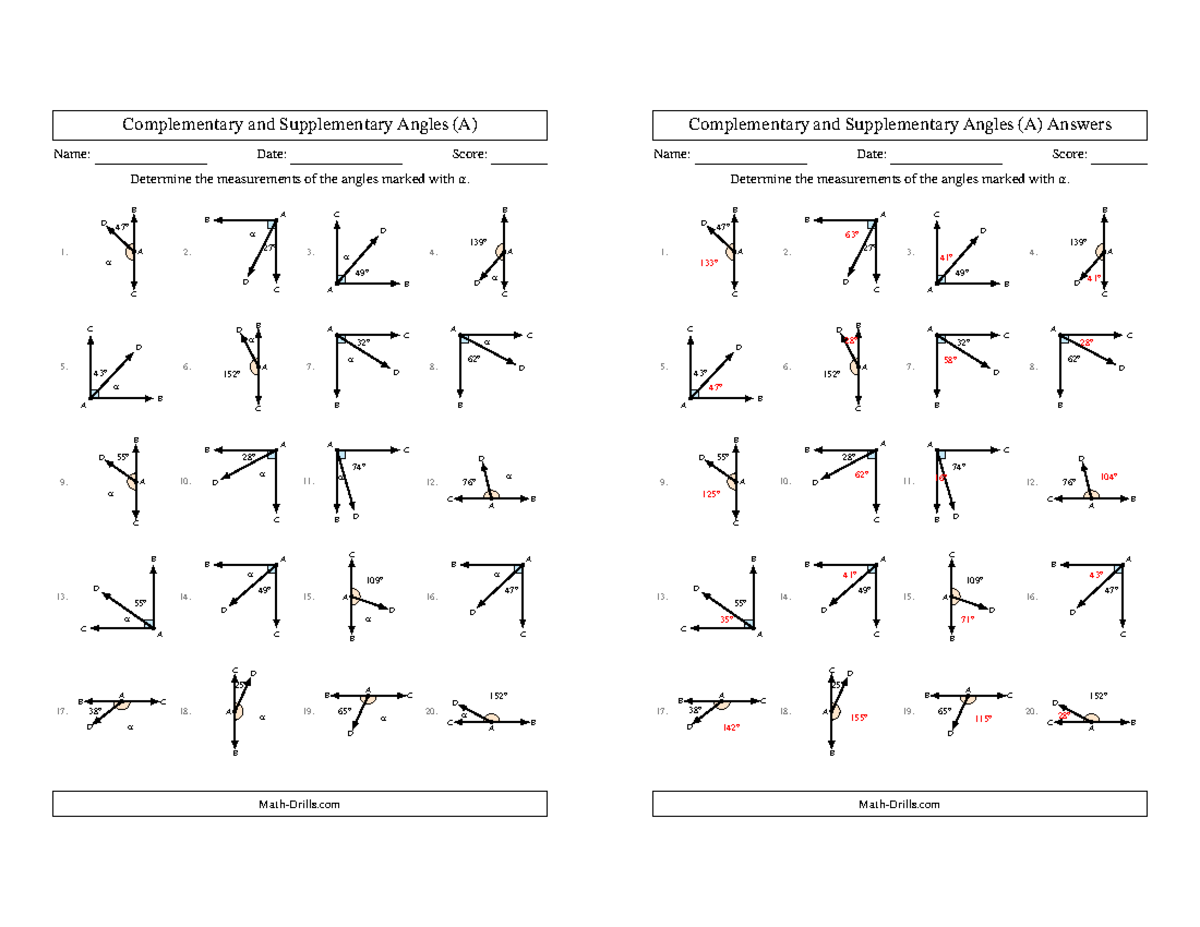
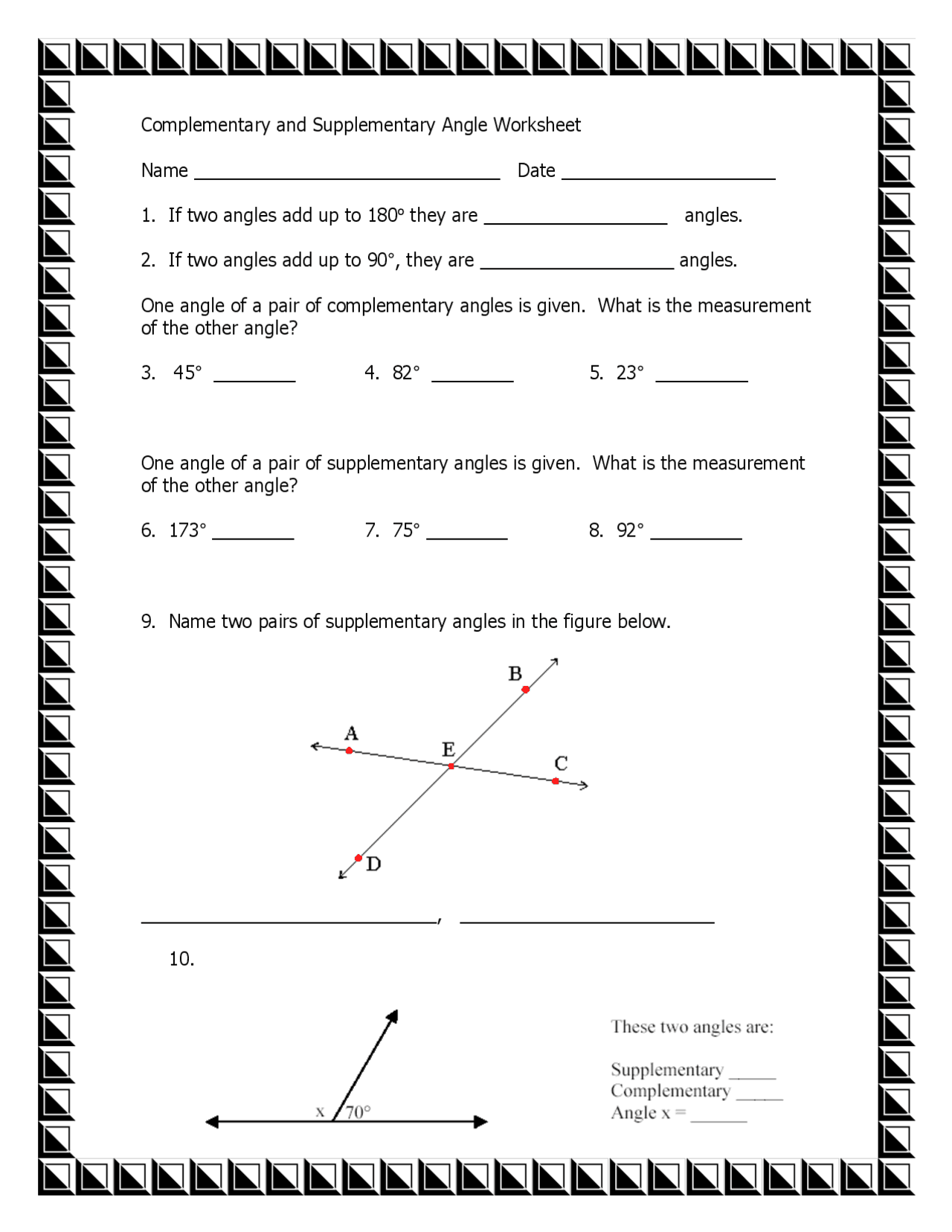
Worksheet Complementary And Supplementary Angles is the perfect gateway for students who want to master the art of angle relationships while enjoying a learning experience that feels as harmonious as a tea ceremony and as precise as a calligrapher’s brushstroke. In this guide we will explore why these worksheets matter, how they are crafted, and the step‑by‑step strategies that turn a simple problem set into a confident, problem‑solving habit. Whether you are a teacher seeking fresh classroom resources, a parent guiding homework, or a learner eager to ace the next math test, this article offers a comprehensive roadmap that blends cultural nuance with practical pedagogy.
Why Complementary and Supplementary Angles Matter

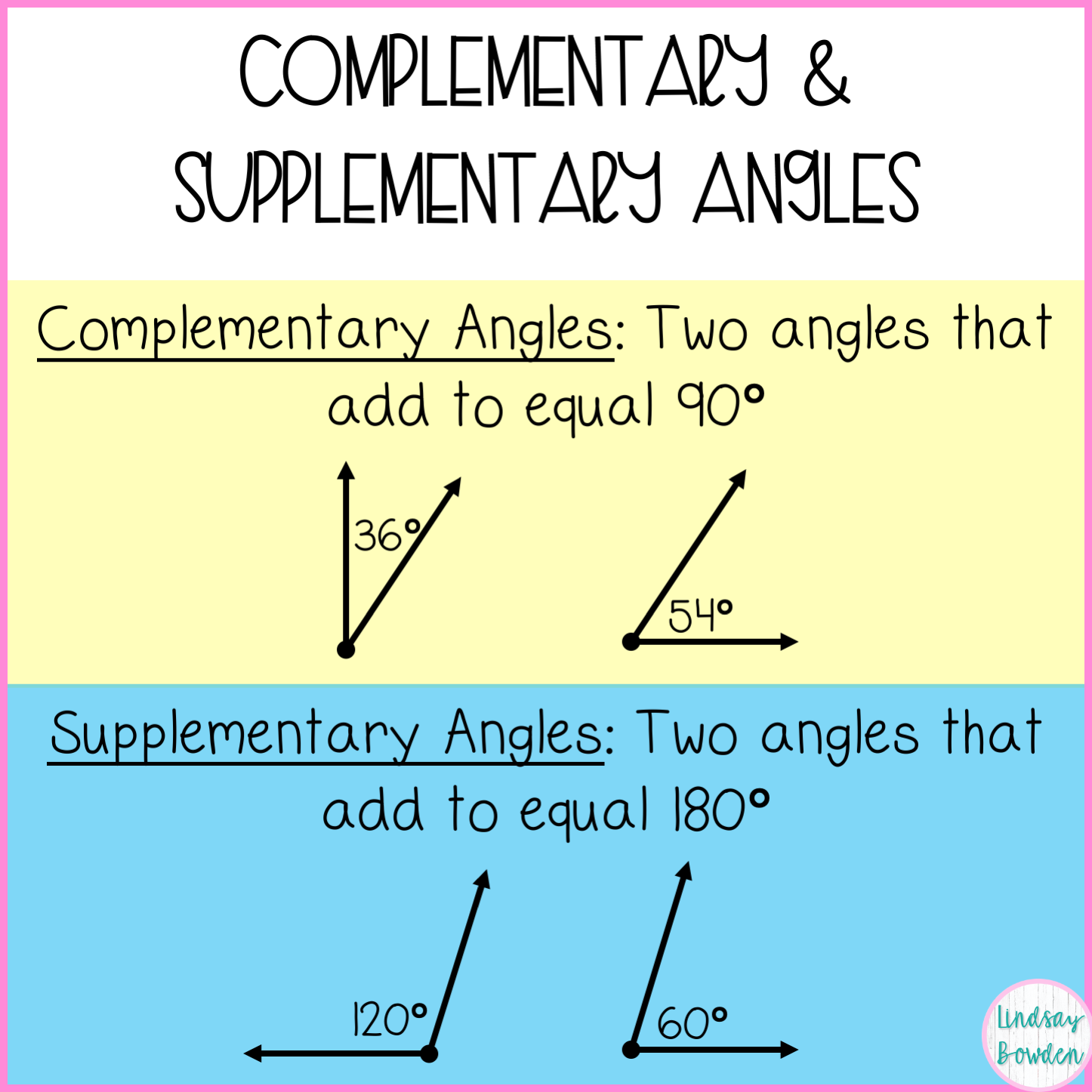
In many Asian educational philosophies, mastery begins with a strong foundation. Complementary (two angles that add up to 90°) and supplementary (two angles that sum to 180°) concepts are the building blocks for geometry, trigonometry, and even real‑world design. Understanding these relationships enhances spatial reasoning, improves measurement accuracy, and cultivates a mindset that looks for hidden connections—much like discovering the subtle flavors in a well‑balanced bowl of ramen.
Link to Real‑World Applications
From the precise angles of a pagoda roof to the geometry of a sushi roll, angle concepts appear everywhere. Architects calculate complementary angles to ensure structural balance, engineers use supplementary angles when designing bridges, and artists rely on these principles to achieve symmetry in traditional mandala patterns. By practicing with targeted worksheets, students internalize the logic that underpins these everyday marvels.
Key Features of an Effective Worksheet

A high‑quality worksheet does more than list problems; it guides the learner through a thoughtful progression. Below are the essential elements that make a worksheet both engaging and educational.
Clear Visuals and Layout
- Bold headings that separate sections, mirroring the clean lines of Japanese calligraphy.
- Illustrations of angles drawn with contrasting colors to highlight the complementary or supplementary relationship.
- Ample white space that mimics the calm of a Zen garden, allowing the mind to focus on each problem without feeling crowded.
Gradual Difficulty Curve
Start with simple identification tasks, then move to calculations, and finally introduce word problems that require contextual thinking. This mirrors the Asian teaching tradition of “step‑by‑step” mastery, where each layer builds confidence before the next challenge appears.
Embedded Reasoning Prompts
Questions such as “Why does this pair of angles add up to 90°?” encourage students to articulate the “why” behind the answer, reinforcing conceptual understanding rather than rote memorization.
How to Use the Worksheet Effectively

Using a worksheet isn’t just about filling in blanks; it’s a disciplined practice that benefits from structure. The following routine, inspired by the disciplined study habits of Confucian scholars, can transform a routine worksheet into a powerful learning session.
Preparation Phase
- Gather Materials: A ruler, protractor, pencil, and an eraser. A calm workspace free from distractions helps maintain focus.
- Set Intentions: Write a brief goal at the top of the page, such as “I will correctly identify all complementary angle pairs.” This mirrors the mindfulness practiced in tea ceremonies.
Execution Phase
- Read each problem carefully. Visualize the angles before drawing them.
- Identify whether the problem calls for a complementary or supplementary relationship.
- Apply the appropriate equation (e.g., m∠A + m∠B = 90° for complementary).
- Check your work using a protractor, reinforcing the tactile feedback that many Asian learners appreciate.
Reflection Phase
After completing the worksheet, review each answer. Highlight any mistakes, and rewrite the problem on a fresh sheet, solving it again without looking at the original solution. This reflective step echoes the practice of revisiting a handwritten poem to improve phrasing.
Sample Problems and Detailed Solutions

Below are representative worksheet items with step‑by‑step explanations. These examples illustrate how to think analytically while maintaining a calm, focused mindset.
Problem 1: Identify Complementary Angles
Given: ∠X = 35°. Find the measure of its complementary partner.
Solution: Since complementary angles sum to 90°, subtract 35° from 90°.
m∠Y = 90° – 35° = 55°. Therefore, the complementary angle is 55°.
Problem 2: Solve for an Unknown Supplementary Angle
Given: ∠A + ∠B = 180°, and ∠A = 2∠B – 10°.
Solution: Substitute the expression for ∠A into the supplementary equation.
2∠B – 10° + ∠B = 180° → 3∠B = 190° → ∠B = 63.33° (rounded to two decimal places).
Then ∠A = 2(63.33°) – 10° = 126.66° – 10° = 116.66°.
Check: 116.66° + 63.33° ≈ 179.99°, which rounds to 180°, confirming the solution.
Problem 3: Real‑World Context
Scenario: A carpenter is installing a shelf that requires a 30° angle between two supports. The remaining angle between the shelf and the wall must be supplementary to the 30° angle. What is that angle?
Solution: Since supplementary angles sum to 180°, the required angle is 180° – 30° = 150°.
This demonstrates how complementary and supplementary concepts translate directly to practical tasks.
Adapting Worksheets for Different Learner Levels

Just as Asian cuisines adapt flavors for varying palates, worksheets can be customized to match the proficiency of each student.
Beginner Adaptations
- Use whole‑number angles only (e.g., 20°, 30°, 40°) to avoid decimal complications.
- Include visual cues such as colored arcs that clearly label the angles.
- Provide a “formula cheat‑sheet” on the side of the page.
Intermediate Adaptations
- Introduce mixed problems that combine complementary and supplementary scenarios.
- Add word problems that require translation of a real‑life situation into an equation.
- Encourage the use of algebraic expressions for unknown angles.
Advanced Adaptations
- Incorporate trigonometric reasoning, such as using sine and cosine to verify angle measures.
- Present multi‑step problems involving polygons, where interior angles are related to supplementary pairs.
- Challenge students with proof‑style questions: “Prove that the exterior angle of a triangle is supplementary to its interior opposite angle.”
Integrating Technology Without Losing the Human Touch

Digital tools like interactive geometry apps can animate the rotation of complementary angles, offering immediate visual feedback. However, the tactile experience of drawing angles with a protractor remains invaluable. A balanced approach—using technology for exploration and paper worksheets for practice—mirrors the Asian principle of “yin and yang,” where complementary forces work together to create harmony.
Recommended Digital Resources
- Dynamic geometry software that lets students manipulate angles and see the sum update in real time.
- Online quiz platforms that provide instant scoring and detailed explanations.
- Virtual “whiteboard” sessions where teachers can demonstrate step‑by‑step solutions while students follow along on their own sheets.
Preserving the Traditional Feel
Print the worksheet on high‑quality paper, use a mechanical pencil, and encourage students to write neatly—practices that honor the discipline of classic Asian calligraphy. This tactile ritual reinforces concentration and respect for the learning material.
Assessing Mastery and Providing Feedback
Effective assessment goes beyond a simple correct/incorrect tally. It should illuminate the learner’s thought process, much like a master chef tasting a dish at each stage of preparation.
Rubric Elements
- Accuracy: Correct calculation of angle measures.
- Methodology: Clear demonstration of the equation used.
- Reasoning: Explanation of why the angles are complementary or supplementary.
- Presentation: Neatness, proper labeling, and use of correct symbols.
Constructive Feedback Strategies
When a student errs, point out the specific step where the logic broke down and provide a hint rather than the full answer. For example, “Check whether you subtracted from 90° or 180° based on the problem type.” This mirrors the Asian educational value of guided discovery.
Creating Your Own Custom Worksheet
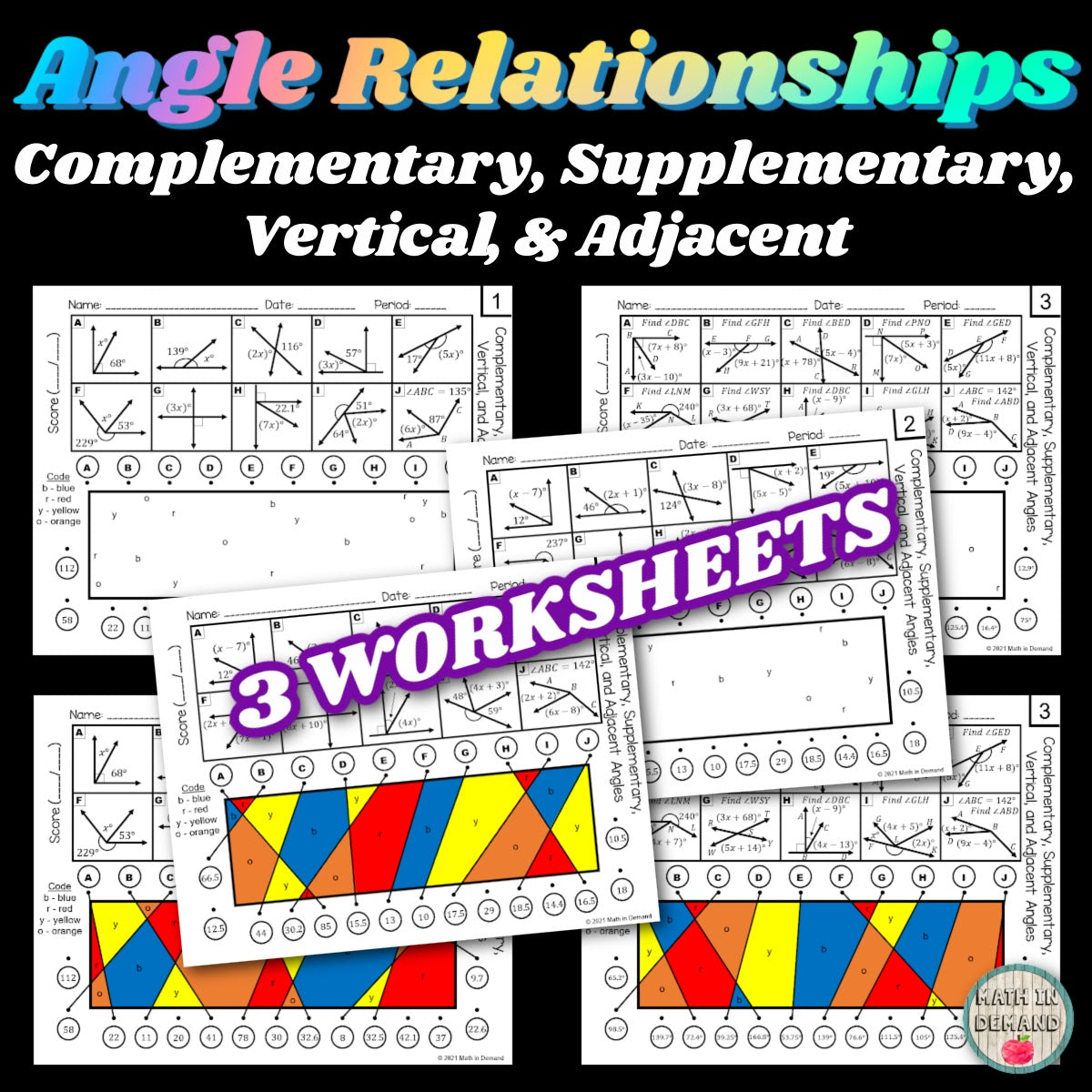
Educators can design personalized worksheets that align with classroom themes or cultural celebrations. Here’s a quick template to get started.
Step‑by‑Step Template
- Title: Give the worksheet a themed name, such as “Lantern Light Angles.”
- Section 1 – Identification: Provide a set of diagrams where students label complementary or supplementary pairs.
- Section 2 – Calculation: Include problems that require solving for an unknown angle.
- Section 3 – Application: Pose word problems tied to cultural contexts, like arranging chopsticks at a proper angle.
- Section 4 – Reflection: End with a short prompt asking students to describe a real‑life situation where they used angle knowledge.
Design Tips
- Use culturally resonant graphics (e.g., origami folds, bamboo motifs) to create visual interest.
- Incorporate bilingual terminology for English‑language learners, reinforcing both language and math skills.
- Leave margin space for students to doodle or sketch, encouraging creativity alongside calculation.
Conclusion: Building Confidence One Angle at a Time

Mastering Worksheet Complementary And Supplementary Angles is more than an academic requirement; it is a disciplined practice that cultivates precision, cultural appreciation, and problem‑solving confidence. By selecting well‑designed worksheets, following a structured study routine, and reflecting on each solution, learners can transform abstract numbers into tangible, real‑world insights. Whether you are teaching a classroom, tutoring at home, or studying independently, the strategies outlined here provide a harmonious blend of tradition and modern pedagogy—ensuring that every angle you encounter fits perfectly into the larger picture of mathematical mastery.