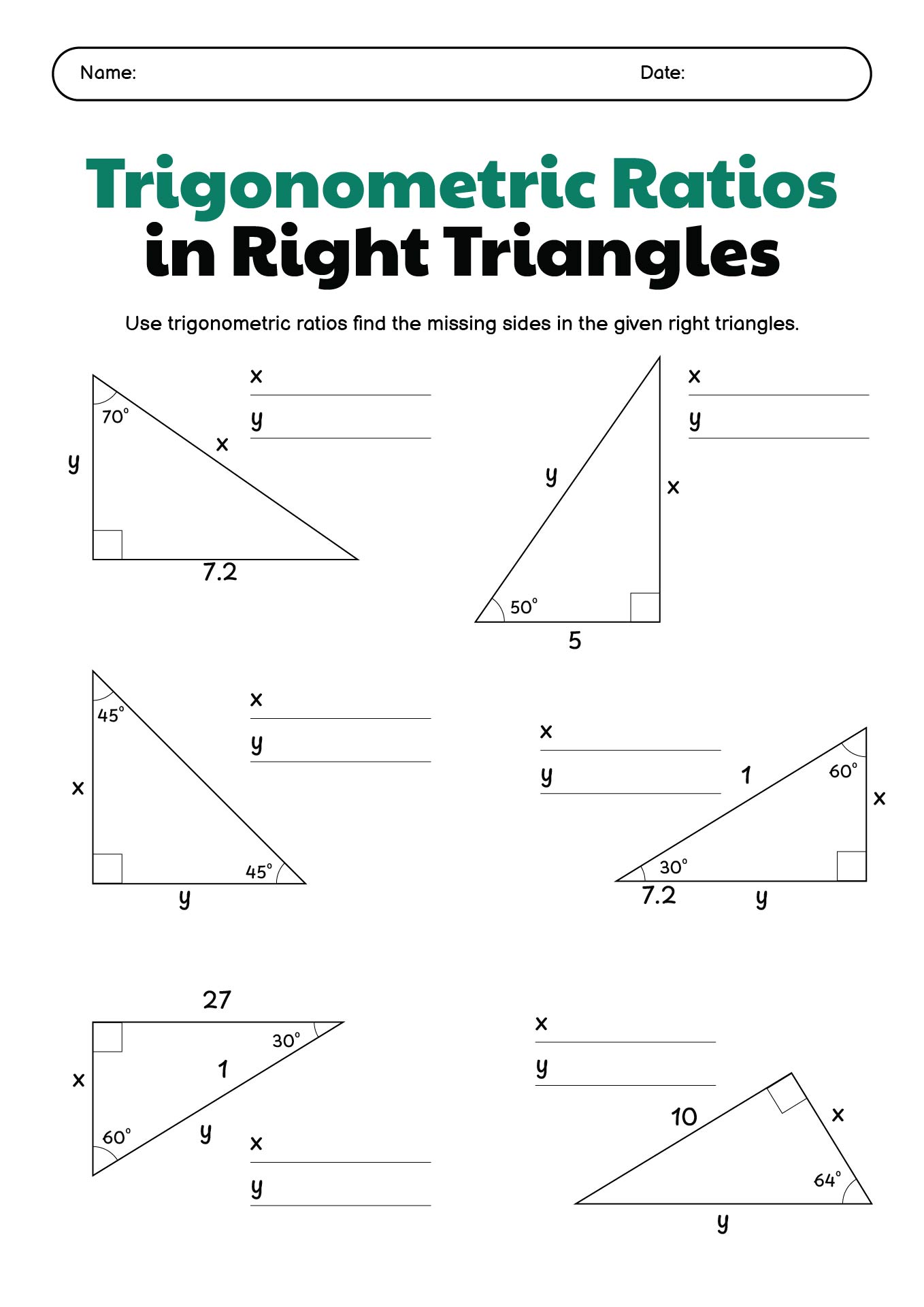
Worksheet On Trig Ratios serves as a powerful catalyst for unlocking the mysteries of trigonometry, turning abstract formulas into tangible, hands‑on learning experiences. By providing structured practice that mirrors real‑world applications, these worksheets help students internalize sine, cosine, and tangent concepts, master right‑triangle geometry, and develop the problem‑solving skills needed for advanced studies in engineering, physics, and design.
Understanding the Core Concepts Behind Trigonometric Ratios
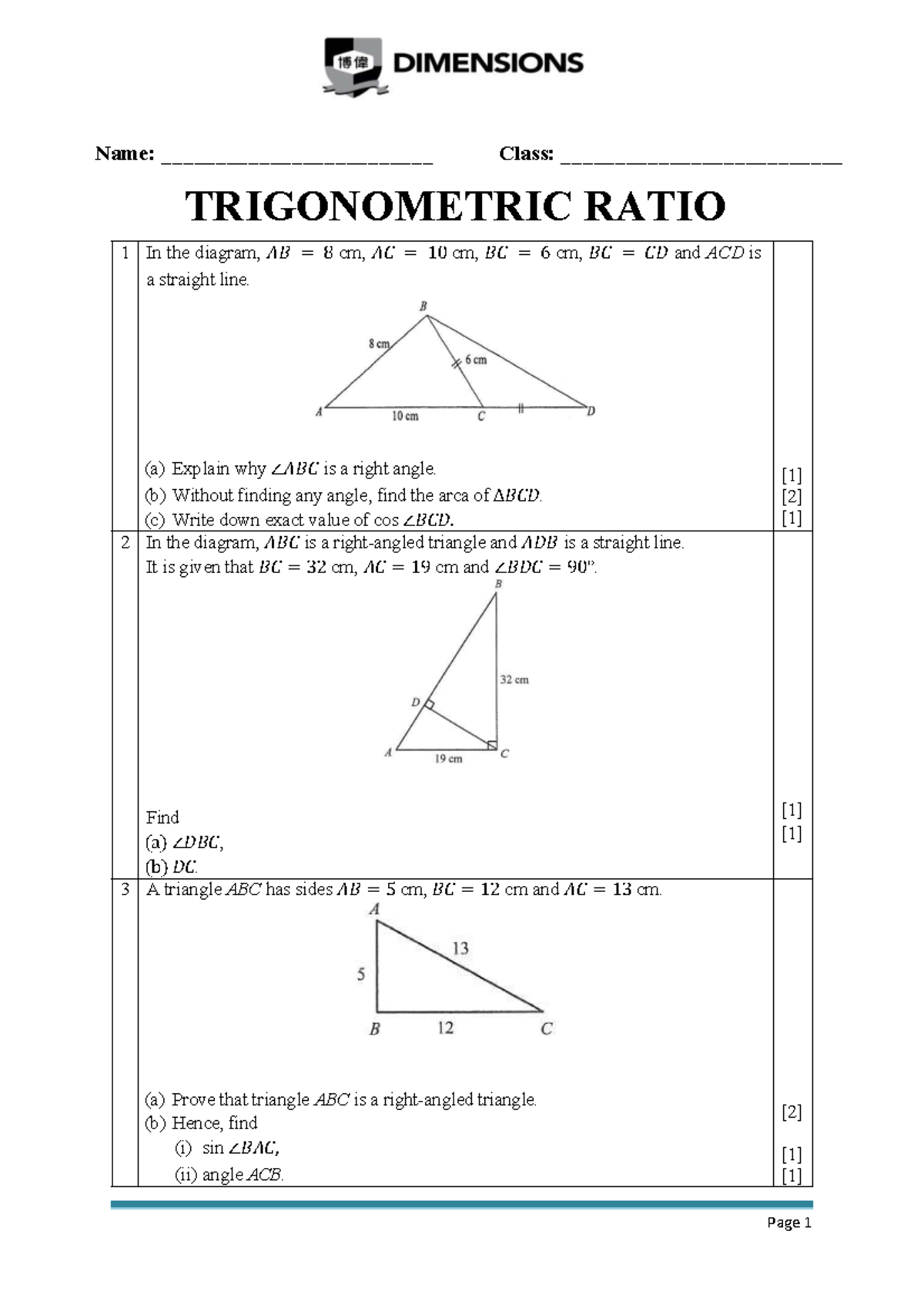
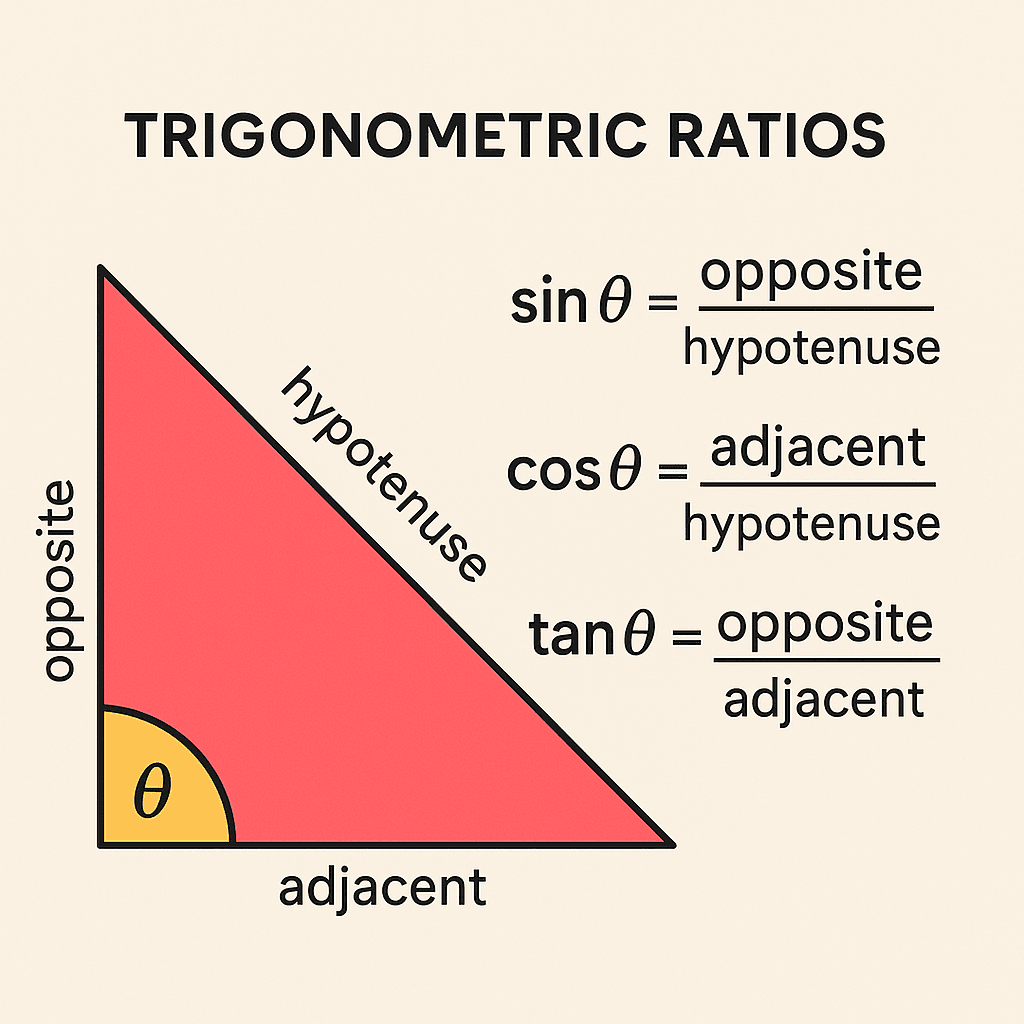
Before diving into worksheet exercises, it’s essential to ground students in the foundational principles that make trigonometric ratios both useful and intuitive. The three primary ratios—sine (sin), cosine (cos), and tangent (tan)—are defined in the context of a right‑angled triangle:
- Sin(θ) = Opposite / Hypotenuse
- Cos(θ) = Adjacent / Hypotenuse
- Tan(θ) = Opposite / Adjacent
These relationships create a direct link between a triangle’s angles and the lengths of its sides, allowing students to calculate missing dimensions with confidence.
From Angles to Ratios: Why It Matters
By mastering these ratios, learners can:
- Predict how changes in one side affect the entire triangle.
- Translate angular measurements into measurable distances in real‑life contexts.
- Build a mental toolbox that facilitates quick mental calculations, especially when estimating heights or distances.
Common Pitfalls and How Worksheets Address Them
Students often struggle with:
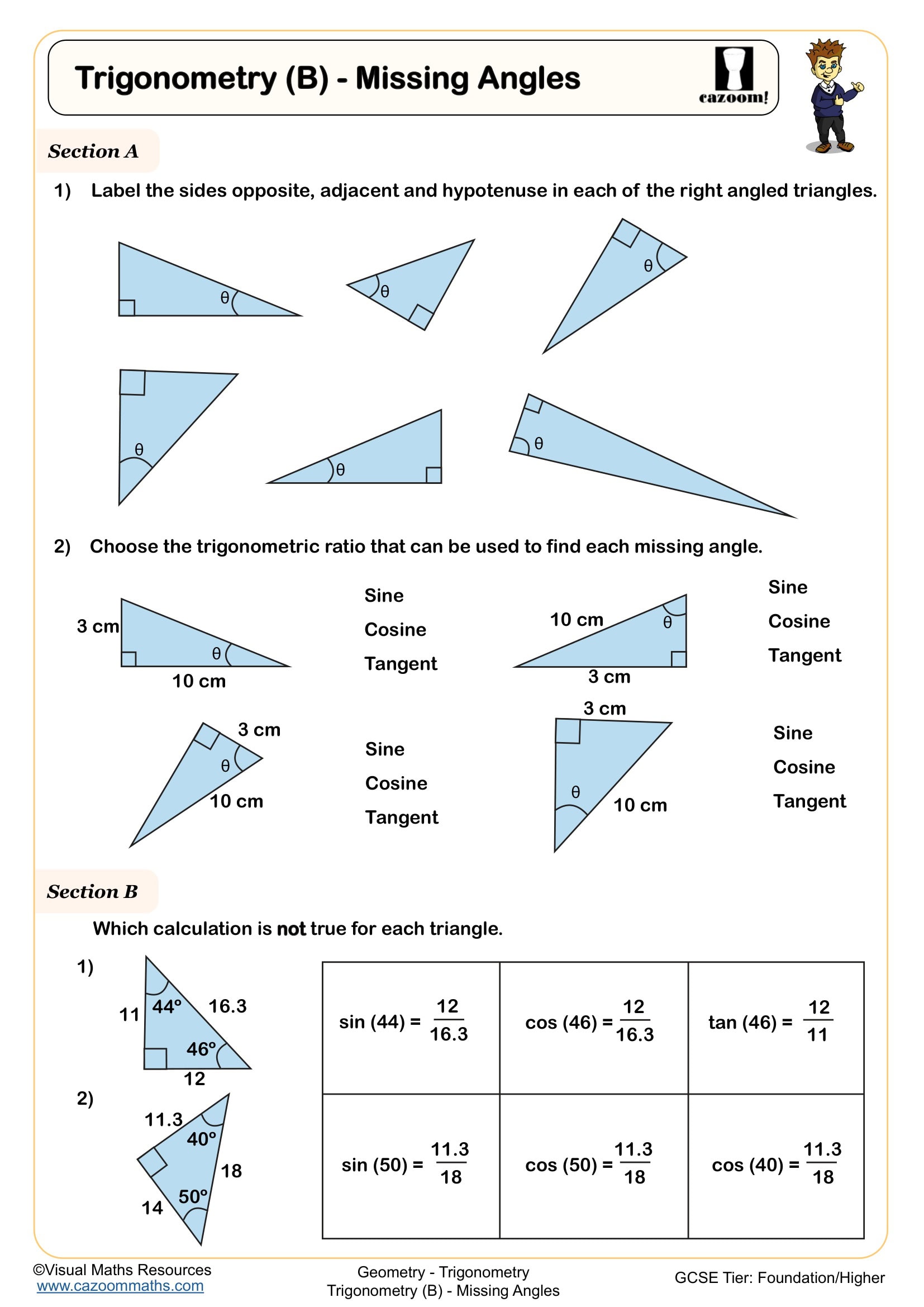
- Confusing which side corresponds to the opposite or adjacent designation.
- Forgetting that the hypotenuse is always the longest side in a right triangle.
- Applying the wrong ratio when solving for a specific side or angle.
Well‑designed worksheets guide learners through step‑by‑step problem sets, reinforcing each concept with immediate feedback and visual cues.
Designing Effective Worksheet On Trig Ratios

Crafting worksheets that both challenge and support students requires a balanced approach. Below is a framework that teachers and curriculum developers can use to build engaging, pedagogically sound content.
1. Start with Real‑World Contexts
Anchor problems in scenarios students can visualize:
- A hiker calculates the height of a mountain using a known distance and angle of elevation.
- An architect determines roof pitch by applying tangent ratios to design slopes.
- A photographer sets up a tripod to capture a horizon line, using sine to adjust angles.
Contextualized questions help students see the relevance of trigonometry beyond the classroom.
2. Gradually Increase Complexity
Begin with straightforward ratio identification, then progress to multi‑step problems that integrate algebraic manipulation.
- Level 1: Identify the hypotenuse given two side lengths.
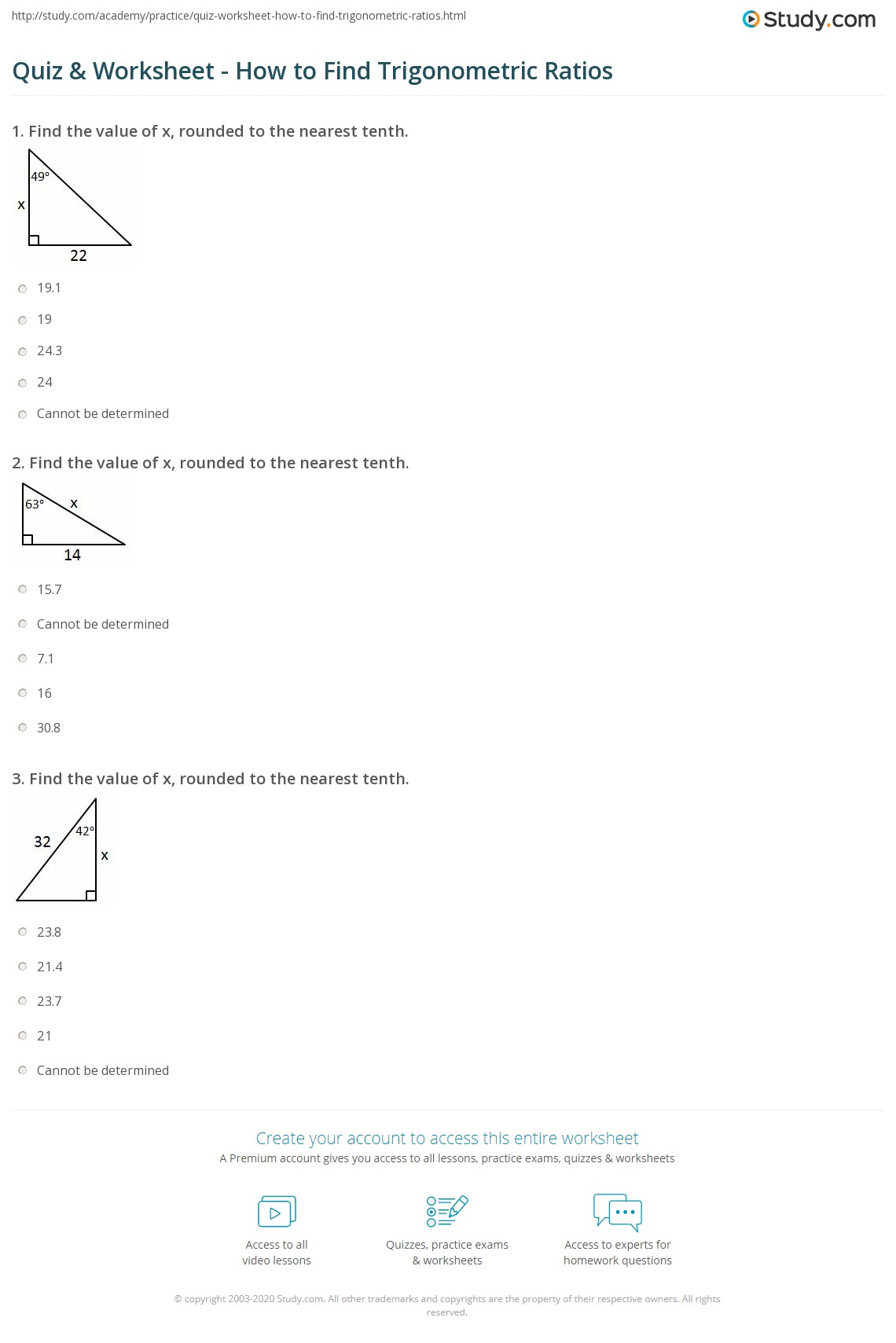
- Level 2: Solve for an unknown side when the angle and another side are known.
- Level 3: Combine ratios with trigonometric identities (e.g., Pythagorean theorem, co‑function identities) to solve for missing angles.
Layering difficulty maintains engagement while ensuring mastery of foundational skills.
3. Incorporate Visual Aids and Diagrams
Students benefit from visual representation of problems:
- Labelled triangles indicating which side is opposite, adjacent, or hypotenuse.
- Graphs or unit circles illustrating angle measurement in degrees versus radians.
- Color‑coded sides to reduce confusion during calculation.
These elements make abstract numbers tangible and reduce cognitive overload.
4. Provide Immediate, Constructive Feedback
Each worksheet should include answer keys or auto‑graded options that explain the reasoning behind each solution, not just the final numeric result.
- Show intermediate steps: solving for a side, then verifying with the Pythagorean theorem.
- Highlight common mistakes and how to correct them.
- Offer alternative solution paths, especially for algebraic manipulations.
Feedback reinforces learning and builds confidence.
5. Encourage Reflection and Metacognition
After solving a set of problems, prompt students to reflect on their approach:
- Which steps were most challenging?
- Did they choose the correct ratio?
- What strategies might improve speed or accuracy next time?
Reflection turns practice into deep learning.
Integrating Worksheets Into Diverse Teaching Environments
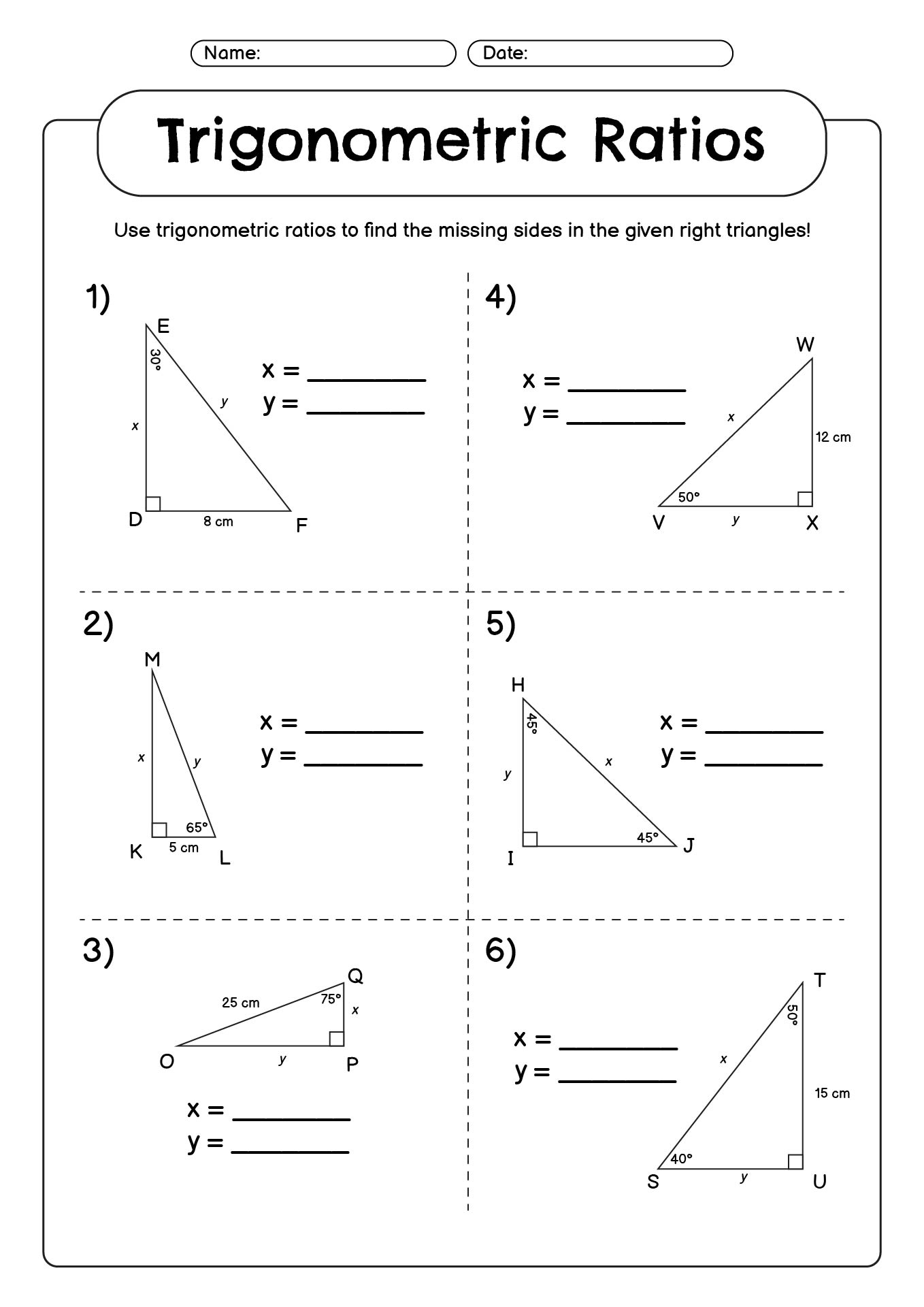
Whether in a traditional classroom, an online course, or a self‑paced study session, worksheets can be adapted to fit diverse learning styles.
Online Platforms and Digital Worksheets
Digital worksheets allow for interactive elements such as:
- Drag‑and‑drop triangle labeling.
- Instant calculators that validate answers in real time.
- Embedded videos explaining key concepts before the exercise begins.
These tools accommodate visual, auditory, and kinesthetic learners alike.
Printed Worksheets for Hands‑On Practice
Print‑ready worksheets can be distributed in exam preparation kits or homework assignments. Incorporate:
- Clear, large diagrams with ample space for calculations.
- Answer sections that are self‑contained, enabling students to check work independently.
- Optional extensions that challenge advanced learners to apply ratios in new contexts.
Small Group and Peer‑Teaching Sessions
Using worksheets in collaborative settings fosters peer instruction:
- Students can pair up, solve a problem, then explain their reasoning to the group.
- Teachers can rotate groups to expose students to various problem‑solving styles.
- Discussion of common errors promotes collective problem‑solving strategies.
Real‑World Applications of Trigonometric Ratios
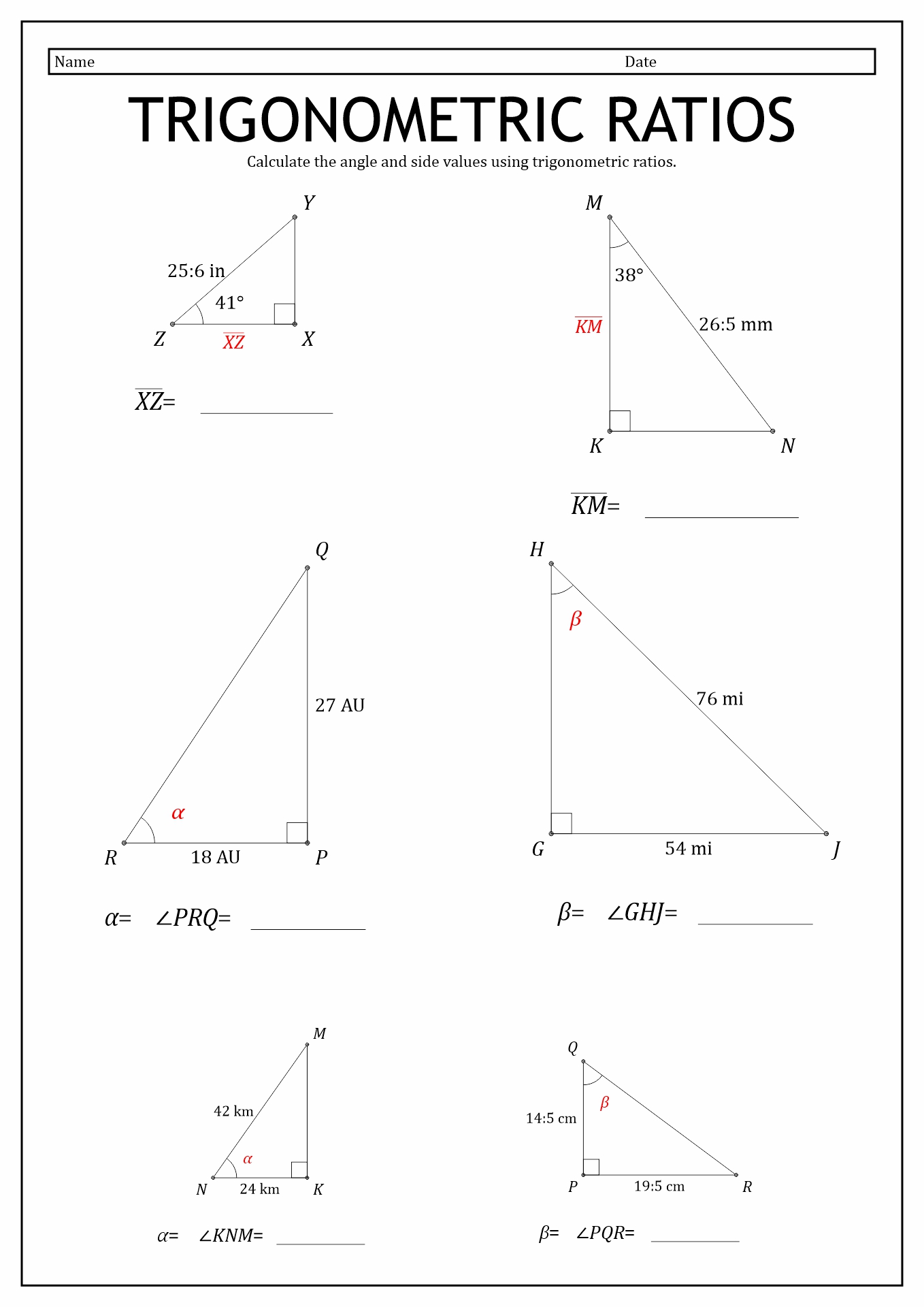
Understanding the practical utility of trig ratios not only boosts student motivation but also demonstrates the versatility of mathematics. Below are several fields where these concepts are indispensable.
1. Architecture and Construction
Engineers use tangent ratios to calculate roof pitches, ensuring proper drainage and structural stability. By measuring roof angles and applying tan(θ) = opposite / adjacent, they can determine necessary beam lengths and support placements.
2. Navigation and Surveying
Surveyors employ sine and cosine to map terrain, calculate distances between points, and establish coordinates. GPS technology relies on trigonometric calculations to triangulate positions with high precision.
3. Aerospace and Aviation
Flight paths and altitudes are determined using trigonometric ratios. Pilots compute glide slopes, wind corrections, and approach angles to maintain safe, efficient routes.
4. Computer Graphics and Game Design
Rendering 3D environments hinges on trigonometry. Calculating perspective, light angles, and object positioning requires repeated use of sine, cosine, and tangent to create realistic visuals.
Advanced Topics and Extension Opportunities
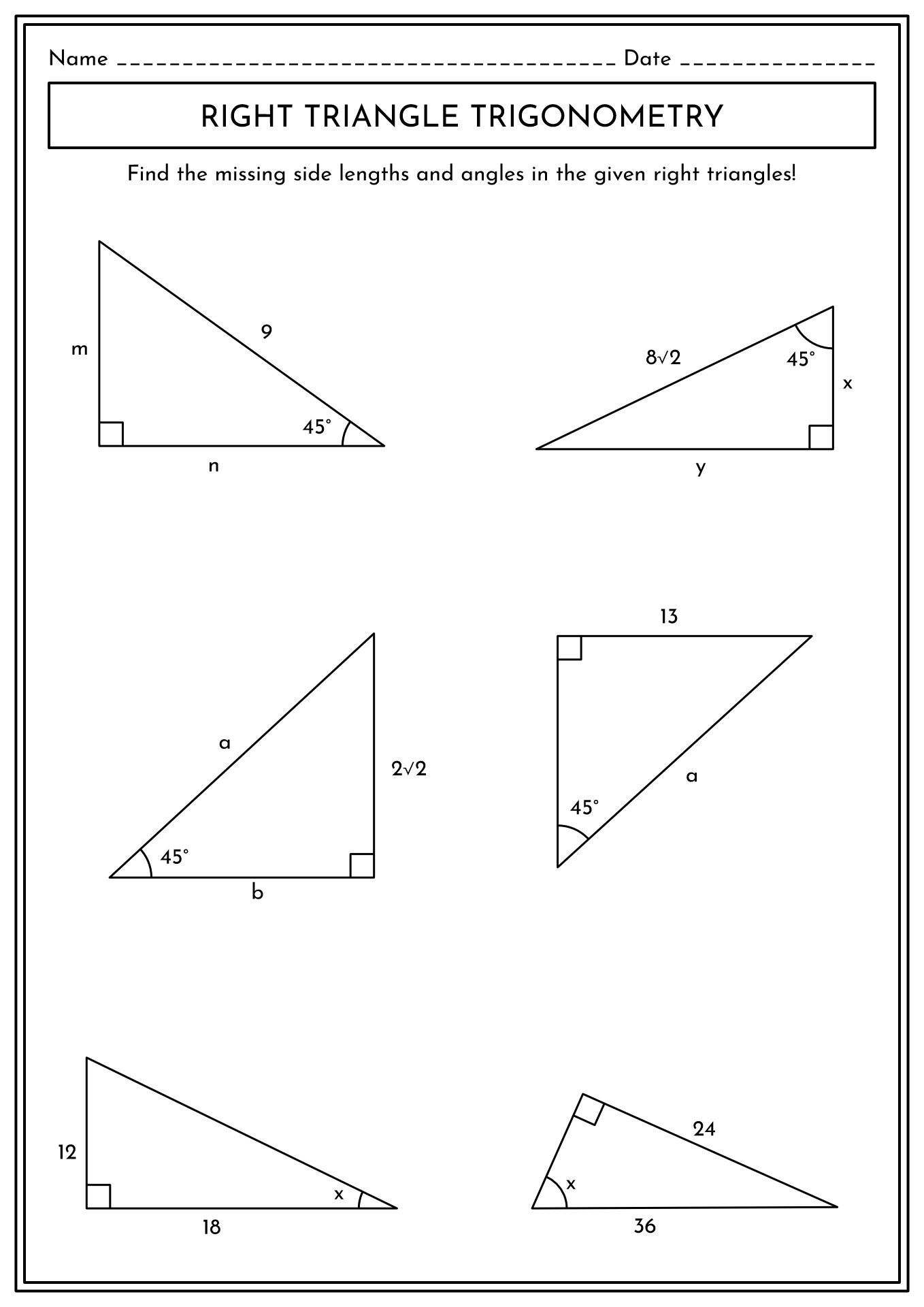
For students ready to push beyond basic right‑triangle ratios, worksheets can explore more complex trigonometric concepts.
1. Unit Circle and Radian Measure
Introduce the unit circle to connect angle measure with coordinate geometry. Worksheets might ask students to locate points on the circle given an angle in radians and then compute sine, cosine, and tangent values.
2. Trigonometric Identities
Key identities such as sin²θ + cos²θ = 1 and tanθ = sinθ / cosθ can be woven into problem sets that require simplification or proof.
3. Inverse Trigonometric Functions
Use arcsin, arccos, and arctan to solve for unknown angles when side lengths are provided. Worksheets can challenge students to reverse-engineer triangles from given data.
4. Complex Numbers and Euler’s Formula
For high‑level learners, exploring the relationship between trigonometric functions and complex exponentials can open doors to advanced mathematics and physics.
Assessment and Mastery Tracking

Effective use of worksheets not only supports learning but also enables teachers to assess progress accurately.
Progressive Assessment Design
Structure assessments to align with the three levels of difficulty. Start with formative quizzes that test recognition of ratios, move to summative tests that require multi‑step problem solving, and finish with a capstone project that integrates trigonometry into a real‑world design challenge.
Data‑Driven Feedback Loops
Collect metrics such as:
- Time taken per problem.
- Accuracy rates across different types of questions.
- Common misconceptions revealed by error patterns.
Use this data to tailor instruction, provide targeted interventions, and celebrate growth.
Conclusion: Empowering Students Through Trig Worksheet Mastery

When thoughtfully crafted, Worksheet On Trig Ratios becomes more than a set of practice problems—it transforms into an engaging learning journey that bridges theory with application. By grounding concepts in real‑world scenarios, layering difficulty, incorporating visual aids, and ensuring instant, constructive feedback, educators can foster a deeper, lasting understanding of trigonometry. These worksheets equip learners with the analytical tools needed for success in STEM fields, enabling them to measure angles, predict outcomes, and solve complex problems with precision. As students master the art of trigonometric ratios, they gain confidence not only in mathematics but in their ability to tackle any challenge that involves measurement, design, or analysis.